
Midweek Review
Daunting challenges ahead

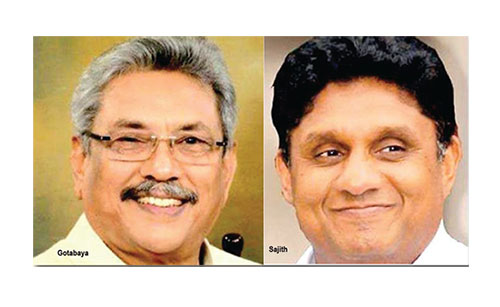
2020 general election:
By Shamindra Ferdinando
The Sri Lanka Podujana Peramuna (SLPP), expected to comfortably win today’s parliamentary polls, has never been represented in parliament.
The SLPP is confident of a comfortable, simple majority, though, publicly, its leadership vows to secure a two-thirds majority. A two-thirds majority that hadn’t been achieved by any political party since the introduction of the Proportional Representation (PR) system, at the 1989 parliamentary polls, seems unrealistic.
The Samagi Jana Balavegaya (SJB), certain to win the second highest number of seats, has also never been in parliament. The SLPP and SJB are led by prime ministerial aspirants, Mahinda Rajapaksa (74) and Sajith Premadasa (53), respectively.
There are similarities in the SLPP and the SJB. Political strategist Basil Rajapaksa got the Lanka Jathika Peramuna (LJP) re-named as the Ape Sri Lanka Nidahas Peramuna, a few weeks before the 2015 August parliamentary polls, and then again registered the party as Sri Lanka Podujana Peramuna, on Nov 1, 2016. Former external affairs minister Prof. G.L. Peiris and Attorney-at-Law Sagara Kariyawasam received appointment as the Chairman, and Secretary, of the SLPP, respectively.
If not for the last minute agreement, between the Mahinda Rajapaksa’s group and the SLFP, the former was to contest the 2015 August parliamentary election, under the Ape Sri Lanka Nidahas Peramuna ticket.
In early 2020, Ape Jathika Peramuna (AJP) was re-named Samagi Jana Balavegaya (SJB). Sajith Premadasa and Ranjith Madduma Bandara received appointments as the Leader, and the Secretary of the SJB respectively. Both the LJP and the AJP had been totally ineffective, as political parties, though, today, they enjoyed political clout.
Of the seven previous general elections, since 1989, simple majority had been secured by the winning party twice, in 1989 (UNP) and 2010 (UPFA) during the second JVP-inspired insurgency, and the first countrywide poll, after the annihilation of the LTTE, in May 2009.
For the first time, the parliament will recognize two parties hitherto not represented in the House. Both the SLPP and the SJB emerged as major parties, at the expense of the SLFP and the UNP respectively, during the previous administration. The newcomers changed the political landscape completely. The SLFP ended up, at the 2020 general election, contesting all districts, except Jaffna and Kalutara, under the SLPP ticket, whereas the badly depleted UNP is likely to take a distant third place, in terms of the numbers of seats. The SLFP, too, is expected to be reduced to less than 10 seats.
The SJB is most likely to secure more than double, perhaps treble the number of seats won by the UNP at today’s poll, the third since the successful conclusion of the war, 11 years ago.
Before discussing the delayed 2020 poll further, it would be pertinent to mention the composition of the last parliament (August 2015-March 2020). As the writer pointed out earlier, the SLPP and the SJB hadn’t been represented in any of the previous parliaments. The last parliament consisted of UNP (106), UPFA (95), TNA (16), JVP (6), SLMC (1) and EPDP (1). Having fielded its candidates, under the UNP ticket, in most districts, at the last election, the SLMC won just one seat.
The JHU, ACMC and Tamil Progressive Front, too contested under the UNP ticket at the last election, but have now switched their allegiance to Sajith Premadasa like the SLMC, at the expense of beleaguered Ranil Wickremesinghe.
Of the 106 elected, and appointed, on the UNP ticket, at the last election, over 80 are in the fray, on the SJB ticket, whereas Wickremesinghe managed to retain about a dozen. Speaker Karu Jayasuriya is among those who opted not to contest again. Jayasuriya, who had received significant backing from some members of the party, as well as a section of the civil society, to come forward as their presidential candidate, in 2019, quit the parliamentary contest, after having failed to thwart the break-up of the party.
Former National List member, Malik Samarawickrema, a close associate of Wickremesinghe, too, quit parliamentary politics. So did Mangala Samaraweera after having entered the fray from the Matara District on the SJB ticket.
Deputy Speaker Ananda Kumarasiri, who headed the high profile parliamentary probe into the 2019 Easter Sunday carnage, ended up in the SJB’s Moneragala District nominations list.
Having handsomely won the 2018 February Local Government election and the 2019 November presidential poll, the SLPP faces the parliamentary poll confidently. The SJB knows of its inevitable defeat at today’s poll, though it seems happy breaking away from Wickremesinghe for once and for all.
President Gotabaya Rajapaksa, who never bothered to take the membership of the SLPP, in spite being its presidential candidate, spearheaded the parliamentary polls campaign. There had never been a president, previously, who shunned political party membership. In other words, the cabinet is headed by a person, who is apolitical, a situation never experienced before.
Politicians, former Member of Parliament and various other interested parties, speculated about the number of seats that could be obtained by contesting parties. A former lawmaker, a respected professional, asserted that the SLPP might secure about 118, SJB 64, UNP 15, Tamil political parties 19 and the JVP 9. The former MP is of the view that frustrated UNPers and Muslims may vote for the JVP led Jathika Jana Balavegaya, hence the opportunity to improve its position in parliament. But its image has been somewhat tarnished after having been seen as a passive partner of the UNP during the last regime. The UNP being a right wing party throughout its history is anathema to any true Marxist and its leader was clearly involved in the brutal crushing of the JVP’s second uprising in the late 80s and killing of its then entire leadership, barring late Somawansa Amarasinghe, who survived by fleeing abroad.
The JVP fielded its candidates, through a coalition, in a bid to attract wider support at the expense of contesting under its own symbol. The JVP will find it difficult to at least retain the number of seats it received at the last parliamentary election. The six-member JVP parliamentary group included two National List members (defeated candidates Sunil Handunnetti and Bimal Ratnayake).
SJB survives unexpected onslaught
Sajith Premadasa’s SJB experienced unexpected onslaught in the run-up to the Aug 5 poll. UNP
Colombo district candidate, Oshala Herath, caused quite a stir by challenging the EC over the re-naming of the Ape Jathika Peramuna (AJP) as the SJB under controversial circumstances. The deal earned AJP Secretary Diana Gamage a slot in the SJB National List.
Having unsuccessfully moved the Supreme Court against the EC, in this regard, Herath, who had twice served President Maithripla Sirisena’s staff, received UNP membership and an opportunity to contest.
Before Herath received UNP membership, as well as nomination, Sirikotha declared that the party had nothing to do with the court action. Subsequently, Herath lodged a complaint with the Commission to Investigate Allegations of Bribery or Corruption (CIABOC) as he pushed hard to disqualify the SJB.
In spite of his own party disowning him, the social media activist took on EC Chairman Mahinda Deshapriya. Herath released recorded conversations with Deshapriya as well as recordings at a church in Rajagiriya where he met Deshapriya in the company of UNP Assistant Leader Ravi Karunanayake in a bid to settle the matter. However, the SJB had the last laugh when all other contesting political parties accepted the EC’s version of events.
The UNP refrained from exploiting Herath’s shocking revelations that may have caused quite serious problems for the SJB. In a way, the SJB should be grateful to the UNP for not jeopardizing its campaign.
The SLPP and the JVP, too, conveniently refrained from taking up the issue, while election monitors, too, played it safe, much to the disappointment of Herath whose emergence as a UNP candidate, especially from Colombo, was made possible by the unprecedented UNP split.
Of the 11 elected from the Colombo district, at the last general election, eight (Patali Champika Ranawaka, Hirunika Premachandra, Dr. Harsha de Silva, Mujibur Rahman, S.M. Marikkar, Mano Ganesan, Eran Wickramaratne and Sujeewa Senasinghe), switched allegiance to Sajith Premadasa, who moved from Hambantota to Colombo. Except Eran Wickremaratne who opted to join the SJB National List, others are in the fray. Only Ravi Karunanayake remained with Wickremesinghe while the remaining ex-lawmaker Dr. Wijeyadasa Rajapakse, PC, joined the SLPP.
A humiliated UNP struggled to field a team in Colombo. Its list is undoubtedly the weakest ever fielded in Colombo. The UNP in its desperation even accommodated tainted businessman A.S.P. Liyanage, who had received diplomatic postings both from Presidents, Mahinda Rajapaksa and Maithripala Sirisena for being publicly servile to them. Of the 22 UNP candidates fielded in Colombo, there were only four former members of parliament (Ranil Wickremesinghe, Ravi Karunanayake, Daya Gamage and Sunethra Ranasinghe). Daya Gamage contested the last parliamentary polls from Digamadulla, while Sunethra Ranasinghe hadn’t been in parliament in its last term.
Oshala Herath is among those lucky to receive UNP nomination due to damaging split caused by dissidents. However, he proved his mettle as a fighter by pursuing an unprecedented strategy that exposed the utterly corrupt political set up.
UNP leader Wickremesinghe, SJB leader Premadasa and JVP leader Anura Kumara Dissanayake are in the fray in Colombo. Premadasa, who lost the last presidential election by a staggering 1.3 mn votes to Gotabaya Rajapaksa, is expected to win his contest with his former leader. Will Premadasa be able to poll the highest number of preferences in Colombo by a candidate representing any party? Or will retired Rear Admiral Sarath Weerasekera, or National Freedom Front leader Wimal Weerawansa, both contesting on the SLPP ticket take the honours.
Weerasekera is among nine candidates fielded by President Gotabaya Rajapaksa, through his ‘Viyathmaga’ organization. Other ‘Viyathmaga’ contestants are Dr. Nalaka Godahewa (Gampaha), Anura Fernando (Colombo), Engineer Nalaka Kottegoda (Matale), Dr. Tilak Rajapaksha (Digamadulla), Dr. Upul Galapatti (Hambantota), Prof. Channa Jayasumana (Anuradhapura), Prof. Gunapala Ratnasekera (Kurunegala) and Attorney-at-Law Udayana Kirindigoda (Mahanuwara). The SLPP has also accommodated two ‘Viyathmaga’ members, Ajith Nivard Cabraal and Dr. Seetha Arambepola, on its National List.
Ratnapura HC ruling, other issues rattle SLPP
If not for the unprecedented crisis caused by the corona epidemic, the SLPP could have easily secured victory at the parliamentary polls, originally scheduled to take place on April 25. Unfortunately, for the SLPP, corona derailed its plans. However, even if election was held in a corona-free environment, as previously scheduled, the ruling party couldn’t have obtained a two-thirds majority. Seeking two-thirds, in terms of the PR system, is not possible at all.
Had the election been held on April 25 as previously scheduled, the SLPP could have avoided the fallout of the demolition of a part of an historical building in Kurunegala and death sentence given to an SLPP candidate. The delay, on the part of the government, resulted in some protests. A section of the assembly hall of King Bhuvanaikabahu II had been demolished on the orders of the Kurunegala Mayor. A divided SLPP struggled to cope up with the issue as Kurunegala heavyweight Johnston Fernando; one-time UNPer threw his weight behind the Kurunegala Mayor. The SLPP could have also avoided Ratnapura HC sentencing Ratnapura District candidate Premalal Jayasekera to death over his involvement in the 2015 January political murder, in the Kahawatte area on the eve of the January 2015 presidential election.
The protests by Colombo port workers, over Sri Lanka’s deal with India against the transfer of control of the ECT (East Container Terminal), too, disturbed the government as it sought Indian financial backing to overcome the crises caused by the corona pandemic. President Gotabaya Rajapaksa and Premier Mahinda
Rajapaksa seeking Indian Premier Modi’s intervention, in the last week of May, led to July negotiations on re-scheduling of Lanka’s debt repayments.
President Gotabaya Rajapaksa faces an unprecedented challenge. In fact, the economic challenge is even bigger than the conventional LTTE threat, previous presidents faced. Under the former Defence Secretary’s leadership, the new administration will have to work with the Opposition, whether it likes it or not, if it is genuinely interested in the wellbeing of the country. However, the SJB is unlikely to provide the required support, in parliament, to do away with the 19th Amendment, though the two parties can explore ways and means of reaching consensus on some matters.
With the country is in such a bad shape, economically, pivotal importance of consensus, among those political parties represented in parliament, at least between the government and the main Opposition, cannot be ignored.
The SLPP cannot pursue strategies, disregarding ground realities. With nearly one fifth of President Gotabaya Rajapaksa’s five-year term over, the SLPP has no option but to move fast, without getting embroiled in useless political dogfights.
Let us hope political parties wouldn’t seek to do away with the provision in the 19th Amendment to appoint no more than 30 ministers. The UNP conveniently reached an agreement with a section of the SLFP to form a national government in the wake of the 2015 general election. The UNP-SLFP arrangement paved the way for them to appoint more than 30 ministers, at the expense of the much-touted good governance promise.
Challenges in 2020 and beyond
The parliament comprises 196 elected and 29 appointed members. The SLPP and the SJB will face daunting challenge in picking their National List members. In the last parliament, the UNP had 13 National List slots, the UPFA 12, the TNA 2 and the JVP 2. The lion’s share of 29 National List slots is expected to be shared by the SLPP and the SJB, with the UNP most likely to obtain a couple of slots, though very much lower than the last time. The SLPP faces the daunting task in forming a 30-member cabinet with the inclusion of some new members. Will any successful ‘Viyathmaga’ candidates receive cabinet portfolios?
With the new parliament, scheduled to meet on August 20, the SLPP will have an opportunity to explore the possibility in reaching a consensus, with the Opposition, to secure the required two-thirds. If not there is bound to be plenty of horse trading to secure that illusive majority.
The case of misappropriation of billions of rupees that was lying at the Central Cultural Fund is certain to be a big stink with the active support of the UNP as was seen in the document leaked to the Sunday Times last weekend. Since Sajith Premadasa has much to answer it would be quite interesting how he deals with the victorious SLPP.
The government will have to address several issues. Among the contentious issues are (1) the proposed agreements with the US (MCC and SOFA) as President Sirisena finalized ACSA in August 2017, the controversial Singapore–Sri Lanka Free Trade Agreement, entered into in January 2018, co-sponsorship of the Geneva Resolution, in Oct 2015, bringing investigations into Central Bank bond scams to a successful end, tangible action on forensic reports that dealt with Treasury bond scams, and other major financial irregularities, both during UPFA and UNP-SLFP administrations, and the toxic UK garbage dumped, in the port of Colombo, et al. With the national economy in tatters, the parliament, as an institution, will have to play its classic role.
Ensuring financial discipline, and the introduction of new laws, must be the parliament’s primary objective, neglected by successive governments, over the years. It would be pertinent to remind what no less a person than the former Central Bank Governor Dr. Indrajith Coomaraswamy said before the Presidential Commission, probing public sector corruption. Coomaraswamy urged the electorate to elect lawmakers capable of understanding public finance.
Dr Coomaraswamy said that the country was facing a non-virtuous cycle of debt and it was a very fragile situation which could even lead to a debt crisis. Arjuna Mahendran’s successor said that people should elect MPs who were prudent enough to handle fiscal and monetary matters of the country. “I’m not referring to any government, but it’s been the case ever since independence.




The failure on the part of the Janatha Vimukthi Peramuna (JVP)-led National People’s Power (NPP) government to fulfil a plethora of promises given in the run up to the last presidential election, in September, 2024, and a series of incidents, including cases of corruption, and embarrassing failure to act on a specific weather alert, ahead of Cyclone Ditwah, had undermined the administration beyond measure.
Ditwah dealt a knockout blow to the arrogant and cocky NPP. If the ruling party consented to the Opposition proposal for a Parliamentary Select Committee (PSC) to probe the events leading to the November 27 cyclone, the disclosure would be catastrophic, even for the all-powerful Executive President Anura Kumara Dissanayake, as responsible government bodies, like the Disaster Management Centre that horribly failed in its duty, and the Met Department that alerted about the developing storm, but the government did not heed its timely warnings, directly come under his purview.
The NPP is on the back foot and struggling to cope up with the rapidly developing situation. In spite of having both executive presidency and an overwhelming 2/3 majority in Parliament, the government seems to be weak and in total disarray.
The regular appearance of President Dissanayake in Parliament, who usually respond deftly to criticism, thereby defending his parliamentary group, obviously failed to make an impression. Overall, the top NPP leadership appeared to have caused irreparable damage to the NPP and taken the shine out of two glorious electoral victories at the last presidential and parliamentary polls held in September and November 2024 respectively.
The NPP has deteriorated, both in and out of Parliament. The performance of the 159-member NPP parliamentary group, led by Prime Minister Dr. Harini Amarasuriya, doesn’t reflect the actual situation on the ground or the developing political environment.
Having repeatedly boasted of its commitment to bring about good governance and accountability, the current dispensation proved in style that it is definitely not different from the previous lots or even worse. (The recent arrest of a policeman who claimed of being assaulted by a gang, led by an NPP MP, emphasised that so-called system change is nothing but a farce) In the run-up to the November, 2024, parliamentary polls, President Dissanayake, who is the leader of both the JVP and NPP, declared that the House should be filled with only NPPers as other political parties were corrupt. Dissanayake cited the Parliament defeating the no-confidence motions filed against Ravi Karunanayake (2016/over Treasury Bond scams) and Keheliya Rambukwella (2023/against health sector corruption) to promote his argument. However, recently the ongoing controversy over patient deaths, allegedly blamed on the administration of Ondansetron injections, exposed the government.
Mounting concerns over drug safety and regulatory oversight triggered strong calls from medical professionals, and trade unions, for the resignation of senior officials at the National Medicines Regulatory Authority (NMRA) and the State Pharmaceutical Corporation (SPC).
Medical and civil rights groups declared that the incident exposed deep systemic failures in Sri Lanka’s drug regulatory framework, with critics warning that the collapse of quality assurance mechanisms is placing patients’ lives at grave risk.
The Medical and Civil Rights Professional Association of Doctors (MCRPA), and allied trade unions, accused health authorities of gross negligence and demanded the immediate resignation of senior NMRA and SPC officials.
MCRPA President Dr. Chamal Sanjeewa is on record as having said that the Health Ministry, NMRA and SPC had collectively failed to ensure patient safety, citing, what he described as, a failed drug regulatory system.
The controversy has taken an unexpected turn with some alleging that the NPP government, on behalf of Sri Lanka and India, in April this year, entered into an agreement whereby the former agreed to lower quality/standards of medicine imports.
Trouble begins with Ranwala’s resignation
The NPP suffered a humiliating setback when its National List MP Asoka Ranwala had to resign from the post of Speaker on 13 December, 2024, following intense controversy over his educational qualification. The petroleum sector trade union leader served as the Speaker for a period of three weeks and his resignation shook the party. Ranwala, first time entrant to Parliament was one of the 18 NPP National List appointees out of a total of 29. The Parliament consists of 196 elected and 29 appointed members. Since the introduction of the National List, in 1989, there had never been an occasion where one party secured 18 slots.
The JVP/NPP made an initial bid to defend Ranwala but quickly gave it up and got him to resign amidst media furor. Ranwala dominated the social media as political rivals exploited the controversy over his claimed doctorate from the Waseda University of Japan, which he has failed to prove to this day. But, the JVP/NPP had to suffer a second time as a result of Ranwala’s antics when he caused injuries to three persons, including a child, on 11 December, in the Sapugaskanda police area.
The NPP made a pathetic, UNP and SLFP style effort to save the parliamentarian by blaming the Sapugaskanda police for not promptly subjecting him for a drunk driving test. The declaration made by the Government Analyst Department that the parliamentarian hadn’t been drunk at the time of the accident, several days after the accident, does not make any difference. Having experienced the wrongdoing of successive previous governments, the public, regardless of what various interested parties propagated on social media, realise that the government is making a disgraceful bid to cover-up.
No less a person than President Dissanayake is on record as having said that their members do not consume liquor. Let us wait for the outcome of the internal investigation into the lapses on the part of the Sapugaskanda police with regard to the accident that happened near Denimulla Junction, in Sapugaskanda.
JVP/NPP bigwigs obviously hadn’t learnt from the Weligama W 15 hotel attack in December, 2023, that ruined President Ranil Wickremeinghe’s administration. That incident exposed the direct nexus between the government and the police in carrying out Mafia-style operations. Although the two incidents cannot be compared as the circumstances differ, there is a similarity. Initially, police headquarters represented the interests of the wrongdoers, while President Wickremesinghe bent over backwards to retain the man who dispatched the CCD (Colombo Crime Division) team to Weligama, as the IGP. The UNP leader went to the extent of speaking to Chief Justice Jayantha Jayasuriya, PC, and Speaker Mahinda Yapa Abeywardena to push his agenda. There is no dispute the then Public Security Minister Tiran Alles wanted Deshabandu Tennakoon as IGP, regardless of a spate of accusations against him, in addition to him being faulted by the Supreme Court in a high-profile fundamental rights application.
The JVP/NPP must have realised that though the Opposition remained disorganised and ineffective, thanks to the media, particularly social media, a case of transgression, if not addressed swiftly and properly, can develop into a crisis. Action taken by the government to protect Ranwala is a case in point. Government leaders must have heaved a sigh of relief as Ranwala is no longer the Speaker when he drove a jeep recklessly and collided with a motorcycle and a car.
Major cases, key developments
Instead of addressing public concerns, the government sought to suppress the truth by manipulating and exploiting developments
* The release of 323 containers from the Colombo Port, in January 2025, is a case in point. The issue at hand is whether the powers that be took advantage of the port congestion to clear ‘red-flagged’ containers.
Although the Customs repeatedly declared that they did nothing wrong and such releases were resorted even during Ranil Wickremesinghe’s presidency (July 2022 to September 2024), the public won’t buy that. Container issue remains a mystery. That controversy eroded public confidence in the NPP that vowed 100 percent transparency in all its dealings. But the way the current dispensation handled the Port congestion proved that transparency must be the last thing in the minds of the JVPers/NPPers holding office.
* The JVP/NPP’s much touted all-out anti-corruption stand suffered a debilitating blow over their failure to finalise the appointment of a new Auditor General. In spite of the Opposition, the civil society, and the media, vigorously taking up this issue, the government continued to hold up the appointment by irresponsibly pushing for an appointment acceptable to President Dissanayake. The JVP/NPP is certainly pursuing a strategy contrary to what it preached while in the Opposition and found fault with successive governments for trying to manipulate the AG. It would be pertinent to mention that President Dissanayake should accept the responsibility for the inordinate delay in proposing a suitable person to that position. The government failed to get the approval of the Constitutional Council more than once to install a favourite of theirs in it, thanks to the forthright position taken by its civil society representatives.
The government should be ashamed of its disgraceful effort to bring the Office of the Auditor General under its thumb:
* The JVP/NPP government’s hotly disputed decision to procure 1,775 brand-new double cab pickup trucks, at a staggering cost exceeding Rs. 12,500 mn, under controversial circumstances, exposed the duplicity of that party that painted all other political parties black. Would the government rethink the double cab deal, especially in the wake of economic ruination caused by Cyclone Ditwah? The top leadership seems to be determined to proceed with their original plans, regardless of immeasurable losses caused by Cyclone Ditwah. Post-cyclone efforts still remain at a nascent stage with the government putting on a brave face. The top leadership has turned a blind eye to the overwhelming challenge in getting the country back on track especially against the backdrop of its agreement with the IMF.
Post-Cyclone Ditwah recovery process is going to be slow and extremely painful. Unfortunately, both the government and the Opposition are hell-bent on exploiting the miserable conditions experienced by its hapless victims. The government is yet to acknowledge that it could have faced the crisis much better if it acted on the warning issued by Met Department Chief Athula Karunanayake on 12 November, two weeks before the cyclone struck.
Foreign policy dilemma
Sri Lanka moved further closer to India and the US this year as President Dissanayake entered into several new agreements with them. In spite of criticism, seven Memorandums of Understanding (MoUs), including one on defence, remains confidential. What are they hiding?
Within weeks after signing of the seven MoUs, India bought the controlling interests in the Colombo Dockyard Limited for USD 52 mn.
Although some Opposition members, representing the SJB, raised the issue, their leader Sajith Premadasa, during a subsequent visit to New Delhi, indicated he wouldn’t, under any circumstances, raise such a contentious issue.
Premadasa went a step further. The SJB leader assured his unwavering commitment to the full implementation of the 13th Amendment to the Constitution that was forced on Sri Lanka during President JRJ’s administration, under the highly questionable Indo-Lanka Accord of July, 1987, after the infamous parippu drop by Indian military aircraft over Jaffna, their version of the old gunboat diplomacy practiced by the West.
Both India and the US consolidated their position here further in the post-Aragalaya period. Those who felt that the JVP would be in a collision course with them must have been quite surprised by the turn of events and the way post-Aragalaya Sri Lanka leaned towards the US-India combine with not a hum from our carboard revolutionaries now installed in power. They certainly know which side of the bread is buttered. Sri Lanka’s economic deterioration, and the 2023 agreement with the IMF, had tied up the country with the US-led bloc.
In spite of India still procuring large quantities of Russian crude oil and its refusal to condemn Russia over the conflict in Ukraine, New Delhi has obviously reached consensus with the US on a long-term partnership to meet the formidable Chinese challenge. Both countries feel each other’s support is incalculably vital and indispensable.
Sri Lanka, India, and Japan, in May 2019, signed a Memorandum of Cooperation (MoC) to jointly develop the East Container Terminal (ECT) at the Colombo Port. That was during the tail end of the Yahapalana administration. The Gotabaya Rajapaksa administration wanted to take that project forward. But trade unions, spearheaded by the JVP/NPP combine, thwarted a tripartite agreement on the basis that they opposed privatisation of the Colombo Port at any level.
But, the Colombo West International Terminal (CWIT) project, that was launched in November, 2022, during Ranil Wickremesinghe’s presidency, became fully operational in April this year. The JVP revolutionary tiger has completely changed its stripes regarding foreign investments and privatisation. If the JVP remained committed to its previous strategies, India taking over CDL or CWIT would have been unrealistic.
The failure on the part of the government to reveal its stand on visits by foreign research vessels to ports here underscored the intensity of US and Indian pressure. Hope our readers remember how US and India compelled the then President Wickremesinghe to announce a one-year moratorium on such visits. In line with that decision Sri Lanka declared research vessels wouldn’t be allowed here during 2024. The NPP that succeeded Wickremesinghe’s administration in September, 2024, is yet to take a decision on foreign research vessels. What a pity?
The NPP ends the year on the back foot, struggling to cope up with daunting challenges, both domestic and external. The recent revelation of direct Indian intervention in the 2022 regime change project here along with the US underscored the gravity of the situation and developing challenges. Post-cyclone period will facilitate further Indian and US interventions for obvious reasons.
****

Perhaps one of the most debated events in 2025 was the opening of ‘City of Dreams Sri Lanka’ that included, what the investors called, a world-class casino. In spite of mega Bollywood star Shah Rukh Khan’s unexpected decision to pull out of the grand opening on 02 August, the investors went ahead with the restricted event. The Chief Guest was President Anura Kumara Dissanayake, who is also the Finance Minister, in addition to being the Defence Minister. Among the other notable invitees were Dissanayake’s predecessor Ranil Wickremesinghe, whose administration gave critical support to the high-profile project, worth over USD 1.2 bn. John Keells Holdings PLC (JKH) and Melco Resorts & Entertainment (Melco) invested in the project that also consist of the luxurious Nüwa hotel and a premium shopping mall. Who would have thought President Dissanayake’s participation, even remotely, possible, against the backdrop of his strong past public opposition to gambling of any kind?
Don’t forget ‘City of Dreams’ received a license to operate for a period of 20 years. Definitely an unprecedented situation. Although that license had been issued by the Wickremesinghe administration, the NPP, or any other political party represented in Parliament, didn’t speak publicly about that matter. Interesting, isn’t it, coming from people, still referred by influential sections of the Western media, as avowed Marxists?
By Shamindra Ferdinando

Through the Eyes of the Patua:
 Organised by the Colombo Institute for Human Sciences in collaboration with Millennium Art Contemporary, an interesting and unique exhibition got underway in the latter’s gallery in Millennium City, Oruwala on 21 December 2025. The exhibition is titled, ‘Through the Eyes of the Patua: Ramayana Paintings of an Artisanal Community’ and was organized in parallel with the conference that was held on 20 December 2025 under the theme, ‘Move Your Shadow: Rediscovering Ravana, Forms of Resistance and Alternative Universes in the Tellings of the Ramayana.’ The scrolls on display at the gallery are part of the over 100 scrolls in the collection of Colombo Institute’s ‘Roma Chatterji Patua Scroll Collection.’ Prof Chatterji, who taught Sociology at University of Delhi and at present teaches at Shiv Nadar University donated the scrolls to the Colombo Institute in 2024.
The paintings on display are what might be called narrative scrolls that are often over ten feet long. Each scroll narrates a story, with separate panels pictorially depicting one component of a story. The Patuas or the Chitrakars, as they are also known, are traditionally bards. A bard will sing the story that is depicted by each scroll which is simultaneously unfurled. For Sri Lankan viewers for whom the paintings and their contexts of production and use would be unusual and unfamiliar, the best way to understand them is to consider them as a comic strip. In the case of the ongoing exhibition, since the bards or the live songs are not a part of it, the word and voice elements are missing. However, the curators have endeavoured to address this gap by displaying a series of video presentations of the songs, how they are performed and the history of the Patuas as part of the exhibition itself.
The unfamiliarity of the art on display and their histories, necessitates broader explanation. The Patua hail from Medinipur District of West Bengal in India. Essentially, this community of artisans are traditional painters and singers who compose stories based on sacred texts such as the Ramayana or Mahabharata as well as secular events that can vary from the bombing of the Twin Towers in New York in 2001 to the Indian Ocean Tsunami of 2004. Even though painted storytelling is done by a number of traditional artisan groups in India, the Patua is the only community where performers and artists belong to the same group. Hence, Professor Chatterji, in her curatorial note for the exhibition calls them “the original multi-media performers in Bengal.”
‘The story of the Patuas’ also is an account of what happens to such artisanal communities in contemporary times in South Asia more broadly even though this specific story is from India. There was a time before the 21st century when such communities were living and working across a large part of eastern India – each group with a claim to their recognizably unique style of painting. However, at the present time, this community and their vocation is limited to areas such as Medinipur, Birbhum, Purulia in West Bengal and Dumka in Jharkhand.
A pertinent question is how the scroll painters from Medinipur have survived the vagaries of time when others have not. Professor Chatterji provides an important clue when she notes that these painters, “unlike their counterparts elsewhere, are also extremely responsive to political events.” As such, “apart from a rich repertoire of stories based on myth and folklore, including the Ramayana and other epics, they have, over many years, also composed on themes that range from events of local or national significance such as boat accidents and communal violence to global events such as the tsunami and the attack on the World Trade Centre.”
There is another interesting aspect that becomes evident when one looks into the socio-cultural background of this community. As Professor Chatterji writes, “one significant feature that gives a distinct flavour to their stories is the fact that a majority of Chitrakars consider themselves to be Muslims but perform stories based largely on Hindu myths.” In this sense, their story complicates the tension-ridden dichotomies between ethno-cultural and religious groups typical of relations between groups in India as well as more broadly in South Asia, including in Sri Lanka. Prof Chatterji suggests this positionality allows the Patua to have “a truly secular voice so vital in the world that we live in today.”
As a result, she notes, contemporary Patuas “have propagated the message of communal harmony in their compositions in the context of the recent riots in India and the Gulf War. Their commentaries couched in the language of myth are profoundly symbolic and draw on a rich oral tradition of storytelling.” What is even more important is their “engagement with contemporary issues also inflects their aesthetics” because many of these painters also “experiment with novel painterly values inspired by recent interaction with new media such as comic books and with folk art forms from other parts of the country.”
From this varied repertoire of the Patuas’ painterly tradition, this exhibition focusses on scrolls portraying different aspects of the Ramayana. In North Indian and the more dominant renditions of the Ramayana, the focus is on Rama while in many alternate renditions this shifts to Ravana as typified by versions popular among the Sinhalas and Tamils in Sri Lanka as well as in some areas in several Indian states. Compared to this, the Patua renditions in the exhibition mostly illustrate the abduction of Sita with a pronounced focus on Sita and not on Ravana, the conventional antagonist or on Rama, the conventional protagonist. As a result, these two traditional male colossuses are distant. Moreover, with the focus on Sita, these folk renditions also bring to the fore other figures directly associated with her such as her sons Luv and Kush in the act of capturing Rama’s victory horse as well as Lakshmana.
Interestingly, almost as a counter narrative, which also serves as a comparison to these Ramayana scrolls, the exhibition also presents three scrolls known as ‘bin-Laden Patas’ depicting different renditions on the attack on New York’s Twin Towers.
While the painted scrolls in this collection have been exhibited thrice in India, this is the first time they are being exhibited in Sri Lanka, and it is quite likely such paintings from any community beyond Sri Lanka’s shores were not available for viewing in the country before this. Organised with no diplomatic or political affiliation and purely as a Sri Lankan cultural effort with broader South Asian interest, it is definitely worth a visit. The exhibition will run until 10 January 2026.

Power comes like a demonic spell,
To restless humans constantly in chains,
And unless kept under a tight leash,
It drives them from one ill deed to another,
And among the legacies they thus deride,
Are those timeless truths lucidly proclaimed,
By prophets, sages and scribes down the ages,
Hailing from Bethlehem, Athens, Isipathana,
And other such places of hallowed renown,
Thus plunging themselves into darker despair.
By Lynn Ockersz

Myanmar votes as military holds first election since 2021 coup

Interment of singer Latha Walpola at Borella on Wednesday [31st]

Western Naval Command conducts beach cleanup to mark Navy’s 75th anniversary

Ex-Malaysia PM Najib Razak given 15-year jail term over state funds scandal

Two dead in 50-vehicle pile up on Japan highway

New York blanketed in snow, sparking travel chaos

‘Dates have the highest sugar content to fight Coronavirus’

Sunday Island 27 December – Headlines

#SundayIsland 17th December – Headlines

Sunday Island – 28th March

Sunday Island Headlines – 21 March

Sunday Island – 21st February – Headlines
-

 News5 days ago
Members of Lankan Community in Washington D.C. donates to ‘Rebuilding Sri Lanka’ Flood Relief Fund
-

 News3 days ago
British MP calls on Foreign Secretary to expand sanction package against ‘Sri Lankan war criminals’
-

 News6 days ago
Air quality deteriorating in Sri Lanka
-

 News6 days ago
Cardinal urges govt. not to weaken key socio-cultural institutions
-

 Features5 days ago
General education reforms: What about language and ethnicity?
-
 News5 days ago
Suspension of Indian drug part of cover-up by NMRA: Academy of Health Professionals
-

 Opinion6 days ago
Ranwala crash: Govt. lays bare its true face
-

 News6 days ago
CID probes unauthorised access to PNB’s vessel monitoring system