
News
Customs, CEA delaying legal action against importers of foreign waste

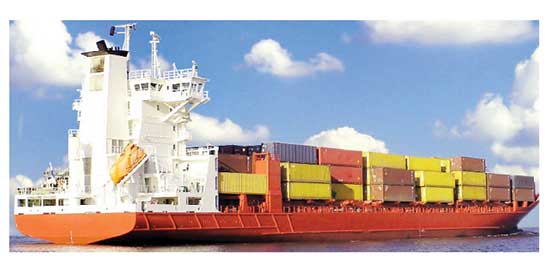
Twenty-one hazadous waste containers sent back to United Kingdom recently
Another 242 UK waste containers still lying here
By Ifham Nizam
The Sri Lanka Customs and the Central Environmental Authority (CEA) have failed to take legal action against the companies responsible for importing 263 containers full of hazardous waste from the United Kingdom.
With more foreign garbage entering the country, this time from Ukraine, environmentalists and authorities are up in arms.
A senior lawyer told The Island that the Attorney General’s Department would soon submit a report to Parliament, spelling out the fact that the CEA and Customs Department had failed to file legal action against the importers of waste.
Environment Minister Mahinda Amaraweera, contacted for comment, told The Island that he would take immediate action.
He also said that such activities should be completely stopped and he would do his utmost to rid the country of foreign waste..
Customs Director Sunil Jayarathna told The Island that a new probe team would be appointed and the CID called in.
He said that the delay was due to a Court order and a Customs inquiry. He said the Customs had not been able to do much for months due to the pandemic and most of the officials were quarantined.
On September 21, some containers of hazardous waste were finally sent back to the United Kingdom after more than a year.
Jayaratne said that the Customs had decided on the penalties. Environmentalists said Rs. 1.6 billion had to be charged from the local agent and a separate penalty imposed on the British company concerned.
Jayaratne said that hazardous waste transfers were against the Basel Convention.
The Customs said that they wanted to send the containers last year back to the UK and awaited the verdict of the Court of Appeal.
Colombo Metal Industries and ITL Colombo Limited imported the hazardous waste.
The containers contained used mattresses, carpets and hospital waste, officials said.
Another 242 containers from Britain, which the government said were holding illegal waste in violation of international law, are lying at the Colombo Port and at a free trade zone outside. They arrived here between 2017 and 2018.






Latest News
Sun directly overhead Nagawilluwa, Galgamuwa, Sigiriya, Palugasdamana and Mankerni about 12:11 noon today (10)


On the apparent northward relative motion of the sun, it is going to be directly over the latitudes of Sri Lanka from the 05th to 15th of April in this year.
The nearest areas of Sri Lanka over which the sun is overhead today (10th) are Nagawilluwa, Galgamuwa, Sigiriya, Palugasdamana and Mankerni about 12:11 noon.

No-faith motion to be taken up today
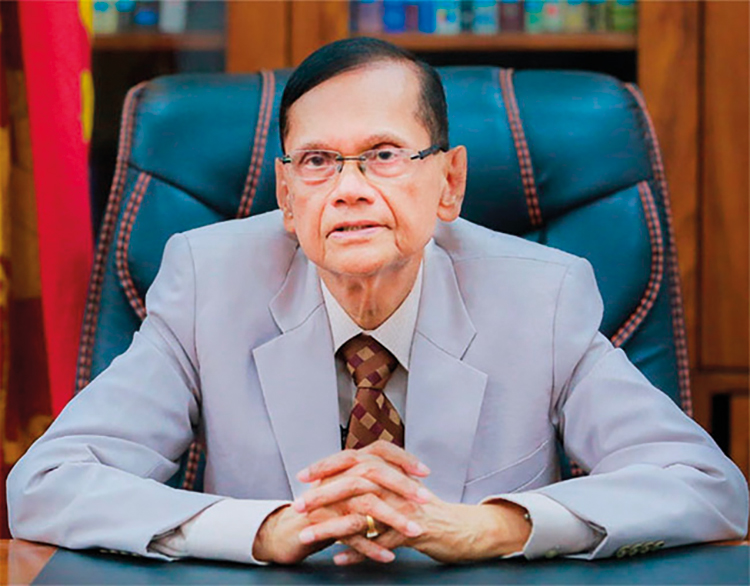
Former Foreign Minister Prof. G. L. Peiris yesterday (9) said that President Anura Kumara Dissanayake should remove Energy Minister Kumara Jayakody unless the minister stepped down on his own.Prof. Peiris, addressing a press conference called by the Opposition, said that Jayakody couldn’t under any circumstance continue to serve as a minister after the Commission to Investigate Allegations of Bribery or Corruption (CIABOC) moved the Colombo High Court against the government member over a previous financial scandal.
Pointing out that Minister Jayakody had been indicted of a corrupt deal struck during the yahapalana regime, Prof. Peiris said it was wrong for the NPP to retain him as a minister, claiming that the offence was not committed during his tenure as a Cabinet minister in the current government.
Prof. Peiris and several other Opposition members dealt with the No-Confidence Motion (NCM) against Jayakody that would be taken up today (10) with the academic calling the vote an acid test for the NPP. Having campaigned on an anti-corruption platform at presidential and parliamentary polls, the NPP couldn’t protect Jayakody though he was widely believed to be close to President Dissanayake.
As the Manager of the Procurement and Import Division of the Ceylon Fertilizer Company, Jayakody is alleged to have committed the offence of corruption, according to CIABOC.
Jayakody has been accused of causing a loss of Rs. 8,859,708 to the State by influencing and exploiting the procurement process.
Following the serving of indictments on 27 March, the judge ordered Jayakody’s release on two personal bail bonds of Rs. 1 million each. The court directed that the defendant’s fingerprints be obtained and a formal report be submitted. The case has been scheduled for a pre-trial conference on 6 May.
Prof. Peiris stressed that the CIABOC action against Jayakody is central to the NCM primarily moved over the irregularities ridden coal procurement process launched in 2025 that caused severe disruption to the power generation. Responding to The Island query after the media briefing, Prof Peiris expressed surprise that the JVP/NPP accommodated a person under investigation by the CIABOC. Having taken an utterly irresponsible decision, the JVP/NPP were now playing down the developing issue, prof. Peiris said.
The entire government parliamentary group faced the prospect of having its image tarnished by defending Jayakody, the former lawmaker said.
Prof. Peiris said that they intended to build a campaign around the issues involving the energy minister to expose the government. With yet another electricity tariff hike in the offing due to the growing demand for thermal generation as a result of coal-fired Lakvijaya power plant’s failure to meet the requirement[RA1] , the energy minister and ministry’s performances have to be examined, Prof. Peiris said.The timely release of the Auditor General’s report on controversial coal procurement should compel the government to decide on the energy minister’s fate or be prepared to face the fallout.
By Shamindra Ferdinando
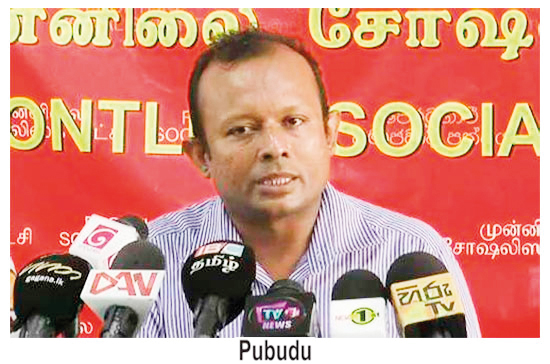
The Frontline Socialist Party (FSP) has alleged that two recent coal tenders awarded for 2026 are illegal, citing irregularities in both the long-term and emergency local agreements.
Speaking at a press conference at the party headquarters in Nugegoda yesterday, Pubudu Jagoda, Educational Secretary of the FSP, said the long-term tender for 25 coal shipments awarded to Trident Chemphar Company, as well as the emergency local tender for five shipments awarded to Tarangot Resources Company in case Trident Chemphar failed to deliver, were both unlawful.
Jayagoda said that a report released by the National Audit Office, on April 2, 2026, had confirmed the irregularities in the Trident Chemphar award.
Jayagoda said that according to the country’s law, tender documents should be sent only to registered companies. While Trident Chemphar failed to deliver, applied for registration on August 19, 2025, it had received the tender documents via email earlier on August 18, making the process illegal. He also noted that the tender agreement had been signed on November 19, 2025, before the Attorney General’s approval was granted the following day, and therefore that agreement was legally invalid.
Regarding Tarangot Resources, Jagoda said the company did not meet the minimum qualifications for the emergency tender, which required prior experience in trading at least one million tonnes of high-calorific coal within 36 months. The company had not sold any coal to meet those standards, Jayagoda said.
The FSP also raised questions about the involvement of Dhammika Perera and his company in the transactions. It said announced that it intended to take both tenders to court, seeking a legal declaration of their invalidity and an order to prevent the costs from being passed on to electricity consumers.

Sun directly overhead Nagawilluwa, Galgamuwa, Sigiriya, Palugasdamana and Mankerni about 12:11 noon today (10)

Showers expected in the Western, Sabaragamuwa, Southern and Uva provinces and in Kandy and Nuwara-Eliya districts after 2.00 p.m

Opposition tells Minister Kumara Jayakody to resign

Coal tender scandal: FSP to move court against illegal deals

Govt. determined to bring GMOA to heel

IMF deal clears path for $700M boost to Lanka’s recovery

‘Dates have the highest sugar content to fight Coronavirus’

Sunday Island 27 December – Headlines

#SundayIsland 17th December – Headlines

Sunday Island – 28th March

Sunday Island Headlines – 21 March

Sunday Island – 21st February – Headlines
-

 Features5 days ago
Ranjith Siyambalapitiya turns custodian of a rare living collection
-

 News5 days ago
Global ‘Walk for Peace’ to be held in Lanka
-

 News3 days ago
Lankan-origin actress Subashini found dead in India
-

 Features5 days ago
Beyond the Blue Skies: A Tribute to Captain Elmo Jayawardena
-

 Features5 days ago
Aspects of Ceylon/Sri Lanka Foreign Relations – 1948 to 1976
-

 Business1 day ago
Hayleys Mobility introduces Premium OMODA C9 PHEV
-

 News1 day ago
AG: Coal procurement full of irregularities
-
 News2 days ago
AKD admits import of substandard coal, blames technicalities and supplier