
News
CPC Losses Rs 3.5 bn: Culprits allowed to go overseas

Fuel Commission Scam
By Shamindra Ferdinando
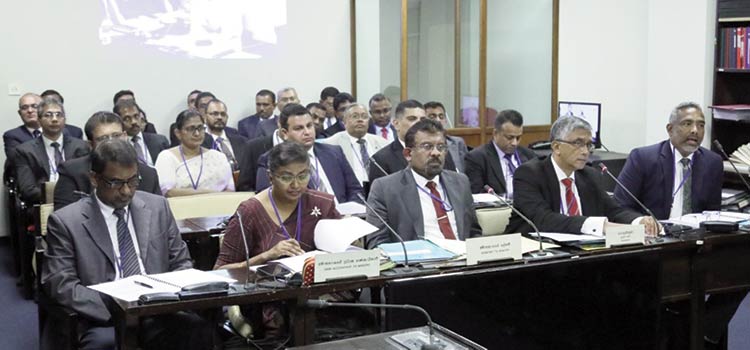
A group of Ceylon Petroleum Corporation (CPC) officials, responsible for causing loss of nearly 3.5 billion rupees, had left the country over the past several years and successive Ministers had failed to take action against any one of them, the Committee of Public Enterprises (COPE) was told recently.
The parliamentary watchdog delved into the corrupt deal that enabled filling station owners to make a killing at the expense of both the corporation and consumers alike, according to a statement issued by the Parliament.
Declaring that the marketing department of the then loss-making enterprise had been directly responsible for the massive fraud, the parliamentary watchdog committee emphasized that the top management deliberately delayed the issuance of a particular circular for nearly nine years to facilitate payment of excessive commissions to distributors.
COPE alleged that the public had to bear the burden as the CPC conveniently passed the unwarranted additional expenditure to the consumers.the statement issued by Jayalath Perera, Director (Legislative Services) on behalf of the Director Communication, the CPC and the distributors had perpetrated the robbery exactly over a period of eight years and eight months. On the basis of Auditor General W.P.C. Wickremaratne’s report for 2022 and examination of the current status of the CPC, the COPE estimated the losses caused at Rs. 3,416 mn for the period of 2014 to 2022.
The examination of the CPC was undertaken by COPE, under the leadership of Rohitha Abeygunawardena, whose appointment as its Chairman, in early March this year, caused a major uproar in Parliament. Questioning the integrity of the lawmaker concerned, the Opposition announced a boycott of the proceedings. The status quo remains the same. AG Wickremaratne had been present at the proceedings where COPE questioned the current top management of the CPC on June 19th.
State Ministers Indika Anuruddha and Shantha Bandara, Members of Parliament Mahindananda Aluthgamage, Dayasiri Jayasekara, U. K. Sumith Udukumbura, (Major) Sudarshana Denipitiya, Upul Mahendra Rajapaksha, M. Rameshwaran and Madhura Withanage were present at the proceedings.
COPE declared that the marketing department should be held accountable for the mega fraud. At the time the marketing department initiated the manipulation of the process in 2014, Pavitradevi Wanniarachchi had been the Minister in charge of the Power and Energy portfolio. According to the AG’s findings, the manipulation had continued during the tenure of Patali Champika Ranawaka, Ranjith Siyambalapitiya, Ravi Karunanayake, Mahinda Amaraweera, Dullas Alahapperuma, Gamini Lokuge and again Pavitradevi Wanniarachchi. Except Ravi Karunanayake, who is a qualified top accountant, all others are in the current Parliament, with Amaraweera serving the Cabinet of Ministers, while Siyambalapitiya is State Finance Minister.
The corrupt deal between the CPC and the distributors had continued unabated during the Covid-19 epidemic, and the economic crisis, leading to the declaration of bankruptcy in April 2022.
The top management hadn’t been able to explain the action taken against those responsible at any level. COPE asked the CPC, on June 19, to submit a list of those responsible for the sordid operation, within seven working days. COPE also asked for a comprehensive report on fraudulent activities, within two weeks, and requested the lodging of a complaint with the Criminal Investigation Department (CID), regarding the case.
According to COPE, due to payment of unjustifiable commissions to the distributors, consumers had to pay Rs. 5.85 for a litre of 92 petrol, Rs. 7.50 for a litre of 95 petrol, Rs. 5.88 for LED and Rs. 6.96 for LSD in excess as of the calculations to date.
It was also disclosed that massive commissions that had been paid in 2022, the year the country declared bankruptcy, was conveniently categorised as sales expenditure. The examination revealed that absolutely no action had been taken against those responsible.
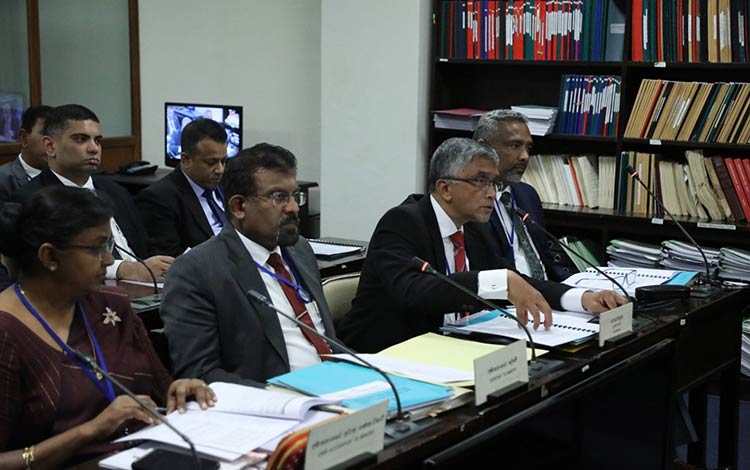
CPC officials before COPE




Bus fares have been increased by 12.19% with effect from midnight today [23rd March 2026].
The minimum fare will be increased from Rs 27 to Rs 30 while the maximum fare of Rs2159/- will be increased to 2422/-
Latest News
Public will not be served as Computer system failure at Department of Registration of Persons

The Acting Commissioner General of Registration of Persons has announced that due to an unexpected failure of the computer system of the Department of Registration of Persons, all services, including the one day service will not be held on Tuesday (24th March) at the Head Office and all Provincial offices.

Latest News
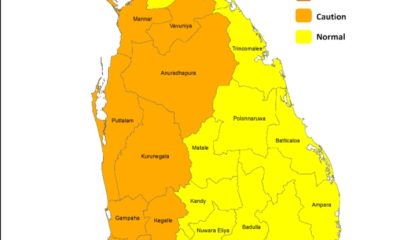
Heat Index at Caution Level in the Western, Sabaragamuwa, Southern and North-western provinces and in Anuradhapura, Mannar and Vavuniya districts
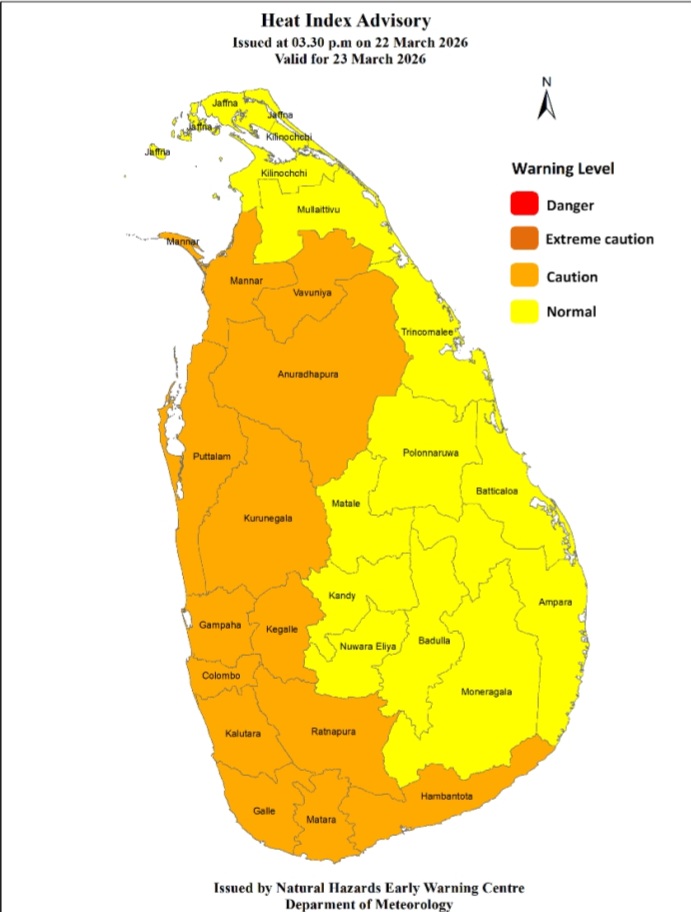
Warm Weather Advisory
Issued by the Natural Hazards Early Warning Centre of the Department of Meteorology
at 3.30 p.m. on 22 March 2026, valid for 23 March 2026.
The Heat index, the temperature felt on human body is likely to increase up to ‘Caution level’ at some places in the Western, Sabaragamuwa, Southern and North-western provinces and in
Anuradhapura, Mannar and Vavuniya districts.
The Heat Index Forecast is calculated by using relative humidity and maximum temperature and this is the condition that is felt on your body. This is not the forecast of maximum temperature. It is generated by the Department of Meteorology for the next day period and prepared by using global numerical weather prediction model data.

Effect of the heat index on human body is mentioned in the above table and it is prepared on the advice of the Ministry of Health and Indigenous Medical Services.
ACTION REQUIRED
Job sites: Stay hydrated and takes breaks in the shade as often as possible.
Indoors: Check up on the elderly and the sick.
Vehicles: Never leave children unattended.
Outdoors: Limit strenuous outdoor activities, find shade and stay hydrated.
Dress: Wear lightweight and white or light-colored clothing.
Note:
In addition, please refer to advisories issued by the Disaster Preparedness & Response Division, Ministry of Health in this regard as well. For further clarifications please contact 011-7446491.

Two killed when Air Canada jet hits fire truck at NYC’s LaGuardia Airport

Bus fares increased by 12.19% from midnight today [23]
Public will not be served as Computer system failure at Department of Registration of Persons

Trump says he is postponing strikes on Iran power plants after ‘productive’ talks on ending war

Asia stocks slide as US and Iran threaten to escalate war

Heat Index at Caution Level in the Western, Sabaragamuwa, Southern and North-western provinces and in Anuradhapura, Mannar and Vavuniya districts

‘Dates have the highest sugar content to fight Coronavirus’

Sunday Island 27 December – Headlines

#SundayIsland 17th December – Headlines

Sunday Island – 28th March

Sunday Island Headlines – 21 March

Sunday Island – 21st February – Headlines
-

 News6 days ago
CIABOC questions Ex-President GR on house for CJ’s maid
-

 News7 days ago
Sri Lankan marine scientist Asha de Vos honoured at UNGA opening
-

 News7 days ago
Australian HC debunks misleading travel risk claims for Sri Lanka
-

 News5 days ago
Bailey Bridge inaugurated at Chilaw
-
 Latest News7 days ago
Wednesdays declared a government holiday with effect from 18th March
-

 News5 days ago
Pay hike demand: CEB workers climb down from 40 % to 15–20%
-

 News4 days ago
CIABOC tells court Kapila gave Rs 60 mn to MR and Rs. 20 mn to Priyankara
-

 Editorial6 days ago
Couple QR-based quota with odd-even rationing