
News
Courtroom shooting: Police admit serious security lapses


By Hemanta Randunu and Norman Palihawadana
Those who planned the assassination of underworld leader Ganemulle Sanjeewa, inside Court No. 5 of the Hulftsdorp court complex, had taken advantage of the fact that the police did not conduct checks on lawyers, and the first response of the police was to secure the judges, police spokesman, Senior Superintendent of Police (SSP), Buddhika Manatunga told the media on Wednesday.
When journalists pointed out that the attack had been carried out inside the court complex, swarming with police and STF personnel, and there had been a serious lapse on the part of the police, Manatunga admitted that there had been weaknesses in the security arrangements and steps would be taken to correct them.
Journalists also pointed out that intelligence officials conducted threat assessments before suspects with serious threats are brought before courts. Thus intelligence services had also failed in their duty, they pointed out.
A Special Forces deserter, disguised as a lawyer, has been identified as the gunman responsible for the assassination of underworld leader Ganemulle Sanjeewa inside Court No. 5 of the Hulftsdorp court complex in Colombo. The police have also identified a woman, similarly disguised as a lawyer, who assisted in smuggling the firearm used in the attack.
Investigations have revealed that the gunman was a contract killer with a history of underworld assassinations. Police sources indicate that he was heavily addicted to crystal meth (ICE) and had carried out contract killings for as little as Rs. 200,000.
It has been established that the firearm used in the attack had been smuggled into the courtroom by the female accomplice, who posed as a lawyer. She had concealed the firearm inside a modified criminal procedure code handbook, in which a section had been hollowed out to hide the weapon. The book was carried inside her handbag and taken into the courtroom undetected.
After the shooting, the assassin abandoned the firearm inside the courtroom before making his escape. Police suspect that the attack had been orchestrated by a rival underworld gang operating from Dubai.
Sanjeewa Kumara Samararatne, known as Ganemulle Sanjeewa, was brought to the Aluthkade court complex from Boossa Prison at approximately 9:50 AM yesterday (19) under heavy security provided by prison officers and the Special Task Force (STF). However, as armed STF officers were not permitted inside the courtroom, they remained outside near the entrance.
Once inside, Sanjeewa was seated under prison and police supervision.
Investigations have revealed that the assassin entered the courtroom before Sanjeewa’s arrival. His female accomplice, already inside, discreetly handed over the concealed firearm.
The assassin sat among the lawyers and even asked one of them, “Would it be alright if I sit here?” before taking his seat. As court proceedings were about to begin, Sanjeewa was escorted to the dock. At that moment, the assassin stood up abruptly, approached him, retrieved the pistol, and fired five shots at point-blank range.
Lawyers and civilians inside the courtroom panicked and fled, allowing both the gunman and his female accomplice to escape in the process.
Sanjeewa was immediately rushed to the Colombo National Hospital, where he succumbed to his injuries a short while later.
Police believe the assassins chose to carry out the killing inside the courtroom because Sanjeewa was under tight security during transport, making an ambush on the way impossible. Investigations indicate that the killers had visited the Aluthkade court complex multiple times in the weeks leading up to the assassination to plan the attack. Reports suggest that additional accomplices were stationed outside the court to facilitate their escape.
The Colombo Crime Division (CCD) has launched a comprehensive investigation into the assassination, with additional support from the Peliyagoda and Nugegoda Criminal Investigation Divisions.
Police stated that they had no authority to search lawyers entering the courtroom, which enabled the disguised assassins to bring in the weapon without detection.
Ganemulle Sanjeewa was accused of committing nearly 60 murders, according to police records. In addition to his involvement in underworld activities, he faced multiple charges related to drug trafficking, extortion, and illegal arms dealing.
He was also implicated in several large-scale robberies, including the theft of Rs. 70 million, which was intended for deposit into private bank ATMs.
Police records indicate that Sanjeewa was responsible for contract killings across Ganemulla, Minuwangoda, Gampaha, Veyangoda, and Divulapitiya, with nearly 60 homicides linked to his name.
In 2023, he was arrested at Bandaranaike International Airport (BIA) while attempting to re-enter Sri Lanka using a forged passport. He had been deported from India and was taken into custody upon arrival at Katunayake.
Following his arrest, he was detained for nine months at the Gampaha and Weeragula police stations before being produced in court and remanded in custody in April 2024.
Sanjeewa had reportedly made five failed attempts to assassinate a businessman named Osman, who had opposed his drug trafficking operations in the Gampaha region. On multiple occasions, members of Sanjeewa’s gang had been arrested with weapons while attempting to attack Osman.
The investigation is being conducted under the supervision of Western Province Senior Deputy Inspector General (SDIG) Sanjeewa Dharmaratne.
Main suspect arrested
The gunman responsible for the assassination of Ganemulle Sanjeewa was arrested during a special operation conducted by the Police Special Task Force (STF) in Pallaviya, Puttalam.
The suspect was attempting to flee in a van at the time of his arrest. The individual taken into custody has been identified as Mohammed Asman, a former commando of the Sri Lanka Army.



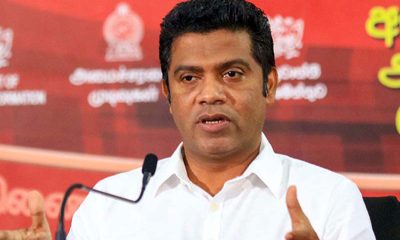


The government, under heavy Opposition fire over inclusion of a sex website in the Grade 6 English module, as well as overall education reforms, has decided to put on hold reforms in respect of Grade 6.
Cabinet Spokesman and Media and Health Minister Dr. Nalinda Jayatissa announced the government decision yesterday (13) at the post-Cabinet media briefing at the Information Department.
According to him, the decision had been taken at the previous day’s Cabinet meeting, chaired by President Anura Kumara Dissanayake. Dr. Jayatissa said that education reforms pertaining to Garde 6 had been put on hold until 2027.
The Minister said that other proposed education reforms would be implemented as planned. The Minister said that action would be taken against those responsible for the inclusion of a link to a sex website following investigations conducted by the Criminal Investigation Department and the National Education Institute.
The SJB and several other political parties, as well as civil society groups, have accused the government of promoting an LGBTQ agenda, through the proposed education reforms.
The Opposition grouping Mahajana Handa, on Monday, made representations to the Mahanayake Thera of the Malwatta Chapter regarding the controversial reforms, while urging their intervention to halt the project.
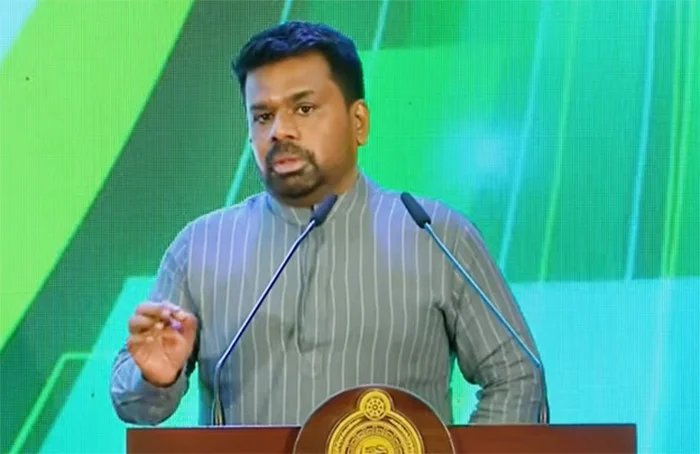
President Anura Kumara Dissanayake yesterday (13) vowed to go ahead with his government’s agenda, regardless of the destruction caused by Cyclone Ditwah.
Emphasising the responsibility on the part of all to contribute to the post-Ditwah recovery efforts, President Dissanayake said that he would have complete faith in the public service.
The President said so at the launch of the re-building Sri Lanka project at the BMICH yesterday.
The JVP and NPP leader said that he wouldn’t take advantage of the death and destruction caused by the cyclone or use the situation as an excuse to reverse their agenda or weaken it.
President Dissanayake said that in spite of many calling for amending the then Budget, in view of the cyclone, the government presented the proposals that were agreed before the disaster struck.

The United States has announced that it will provide the Sri Lanka Air Force with 10 US Navy TH-57 helicopters free of charge.
The announcement was made by outgoing US Ambassador Julie Chung, who stated, on social media, that the helicopters would be transferred under the United States’ Excess Defence Articles programme. The aircraft are Bell 206 Sea Ranger helicopters previously operated by the US Navy.
US sources said that the transfer was intended to strengthen Sri Lanka’s disaster response capabilities, following the devastating cyclone that struck the island at the end of 2025 and killed more than 600 people. US officials have framed the move as a humanitarian measure aimed at improving aerial rescue and relief operations.

At least 28 dead as crane collapses onto train in Thailand

Fair weather will prevail except for a few showers in the Uva, Eastern, Western and Central provinces and in Galle, Matara and Rathnapura districts

Trump cancels US-Iran meetings, urges protesters to take over institutions

Govt. bows to pressure, shelves Grade 6 reforms

AKD: Govt. agenda on track despite Ditwah disaster

SL to receive 10 helicopters from US

‘Dates have the highest sugar content to fight Coronavirus’

Sunday Island 27 December – Headlines

#SundayIsland 17th December – Headlines

Sunday Island – 28th March

Sunday Island Headlines – 21 March

Sunday Island – 21st February – Headlines
-

 Business3 days ago
Dialog and UnionPay International Join Forces to Elevate Sri Lanka’s Digital Payment Landscape
-

 News3 days ago
Sajith: Ashoka Chakra replaces Dharmachakra in Buddhism textbook
-

 Features3 days ago
The Paradox of Trump Power: Contested Authoritarian at Home, Uncontested Bully Abroad
-

 Features3 days ago
Subject:Whatever happened to (my) three million dollars?
-

 News3 days ago
Level I landslide early warnings issued to the Districts of Badulla, Kandy, Matale and Nuwara-Eliya extended
-

 News3 days ago
65 withdrawn cases re-filed by Govt, PM tells Parliament
-

 News3 days ago
National Communication Programme for Child Health Promotion (SBCC) has been launched. – PM
-

 Opinion5 days ago
The minstrel monk and Rafiki, the old mandrill in The Lion King – II