
News
Combination of ill-timed decisions prevented Lanka recover from pandemic shock

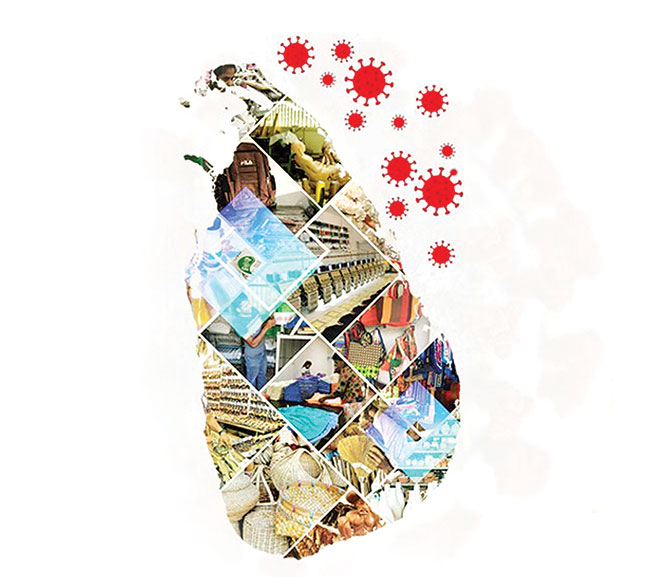
The country has lost several hundred thousand jobs to Covid-19. The impact of the agrochemical ban on agriculture, the mismanagement of the exchange rate, a highly accommodative monetary policy, and the use of foreign exchange reserves for debt repayment thwarted the country’s ability to recover from the initial shock of COVID-19, an ILO study titled, ‘The labour market implications of Sri Lanka’s multiple crises,‘ has revealed.
“These policy decisions generated multiple crises which impacted on businesses, workers, and their families, manifesting in shortages of essential consumer goods including food, fuel, power, raw materials, and capital equipment on the one hand, and the disruption of key public services, such as education and health, on the other. The fiscal bind and looming debt crisis have also left Sri Lanka very little room to manoeuvre. The economic crises have, in turn, generated political instability and further constrained timely decision-making about how to deal with the crisis,” the ILO report said.
The multiple crises have intensified long-standing worrisome features of the labour market: they have expanded unemployment, widened gender gaps in labour force participation, and given rise to job insecurity, uncertainty, and hardship, it said.
“Sri Lanka lost more than 200,000 jobs to the pandemic between the fourth quarter 2019 and the second quarter 2021. The employment share of the informal sector increased because formal sector employment contracted more sharply. Although there was some recovery, during the second half of 2021, extensive job losse, among employers, augured ill for the vigorous regeneration of jobs,” the study reveals.
The report added that the pandemic also impacted the skills development sector. Efforts to provide education and training online were constrained, mainly due to problems of infrastructure access, particularly outside of the Western Province. Enrolment and completion of TVET courses in 2020, relative to 2019, declined by 50 and 57 percent respectively. However, the imposition of power cuts, in 2022, are likely to have disrupted even these limited measures.
“The pandemic also saw the emergence of the new poor — those who fell into poverty because of the pandemic – among the more educated and employed in industry and service sectors, particularly in urban areas and Western Province, the latter which accounted for the largest share of the new poor. These negative developments would have worsened in 2022 as the economic crises intensified,” it said.
Sri Lanka is currently in a full-blown debt and balance-of-payments crisis, leading to massive shortages of essentials and severe disruption to economic activity. As the crisis continues to deteriorate and is likely to lead to a deep impact on the labour market, which will require careful monitoring and analysis over the months to come, the ILO said. The severity of the crisis means that policy-makers need to grasp the nettle of structural reforms needed for recovery and job-rich growth, which will require carefully balancing macroeconomic stabilization with longer-term goals of creating decent, sustainable, and productive employment. The report suggests eight areas of policy intervention for the short, medium and long term.
They are; addressing current macroeconomic crisis through fiscal consolidation and debt restructuring, plus improved fiscal space, restoring investor confidence, reformulating investment, industry, and trade policies to support export-led growth, technological transformation, productive efficiency and job creation, especially for SMEs, increasing R&D and infrastructure investments with a clear focus on 3IR and 4IR technologies, promoting demand-driven skills development and adjustment to a post-COVID-19 economy, including remedial education/training, creating a social dialogue and legislative reform to support flexible arrangements while protecting workers, promoting policies that foster women’s entry into the labour market and support other hard-hit groups, and expanding access to adequate social protection to workers and families (including institutional reforms).
The report also said that Sri Lanka needs to work on improving learning outcomes. Even the TVET sector performs no better than the general education system, the ILO said. According to a 2018 ADB study, a sizable proportion of TVET graduates leave training programmes, without the skills that employers require. Tracer studies on the employability of TVET graduates reveal a high rate of unemployment among TVET graduates who had been trained for employment in even the fast-growing ICT, construction, tourism, and light engineering subsectors.







Latest News
Sun directly overhead Dodanduwa, Rathgama, Yakkalamulla, Akuressa, Mulgirigala, Ranna, Kalamatiya and Ussangoda at about 12:13 noon today (05th April)


On the apparent northward relative motion of the sun, it is going to be directly over the latitudes of Sri Lanka during 05th to 15th of April in this year.
The nearest areas of Sri Lanka over which the sun is overhead today (05th) are Dodanduwa, Rathgama, Yakkalamulla, Akuressa, Mulgirigala, Ranna, Kalamatiya and Ussangoda at about 12:13 noon
Latest News
Heat Index at Caution Level in the Western, Sabaragamuwa, Southern, Eastern, North-western, Northern and North-central provinces and in Monaragala district

Warm Weather Advisory
Issued by the Natural Hazards Early Warning Centre
Issued at 3.30 p.m. on 04 April 2026, valid for 05 April 2026
The Heat index, the temperature felt on human body is likely to increase up to ‘Caution level’ at some places in the Western, Sabaragamuwa, Southern, Eastern, North-western, Northern and North-central provinces and in Monaragala district.
The Heat Index Forecast is calculated by using relative humidity and maximum temperature and this is the condition that is felt on your body. This is not the forecast of maximum temperature. It is generated by the Department of Meteorology for the next day period and prepared by using global numerical weather prediction model data.

Effect of the heat index on human body is mentioned in the above table and it is prepared on the advice of the Ministry of Health and Indigenous Medical Services.
ACTION REQUIRED
Job sites: Stay hydrated and takes breaks in the shade as often as possible.
Indoors: Check up on the elderly and the sick.
Vehicles: Never leave children unattended.
Outdoors: Limit strenuous outdoor activities, find shade and stay hydrated.
Dress: Wear lightweight and white or light-colored clothing.
Note:
In addition, please refer to advisories issued by the Disaster Preparedness & Response Division, Ministry of Health in this regard as well. For further clarifications please contact 011-7446491.

The internationally recognized “Walk for Peace,” originating from the United States, is set to take place in Sri Lanka starting April 21, 2026, led by the Most Venerable Paññakara Thero and a delegation of twelve monks from the Maha Sangha, President’s Media Division said.
Spanning seven days across the island, this pilgrimage’s purpose and concept are guided by the Buddha’s teaching, “Caratha bhikkhave carikam bahujana hitaya bahujana sukhaya lokanukampaya” (Wander forth, O Monks, for the welfare and happiness of the many, out of compassion for the world).
This program aims to promote peace and lovingkindness within society. It serves as a practical demonstration that peace cannot be attained by force, but must be cultivated step-by-step through mindfulness.
The inaugural event of this program is scheduled to be held in Anuradhapura on April 21, 2026. A ceremony to receive the sacred sapling of the Jaya Sri Maha Bodhi will take place at 4:00 PM, followed by special religious observances at the sacred Ruwanweliseya premises at 5:00 PM.
Thereafter, the walk will commence from the ancient Dambulla Royal Cave Temple and proceed towards Kandy. Upon reaching Kandy, the Maha Sangha will pay their respects to the Chief Prelates (Maha Nayaka Theros) of the Malwatta and Asgiriya Chapters, before visiting the Sri Dalada Maligawa (Temple of the Sacred Tooth Relic) to receive blessings.
Throughout the journey, the procession will carry the sacred sapling of the Jaya Sri Maha Bodhi, along with venerated relics from the historic Nilagiri Cetiya, Madanwala Raja Maha Viharaya in Hanguranketa, Mahiyangana Raja Maha Viharaya, and the Hunupitiya Gangaramaya.
The walk will conclude at Independence Square in Colombo on April 28, 2026. Subsequently, the venerated relics and the sacred sapling of the Jaya Sri Maha Bodhi are to be carried from Independence Square to Gangaramaya Temple, Hunupitiya, Colombo by a procession.
The Sri Lankan coordination of the event is spearheaded by Venerable Melpitiye Wimalakirti Thera. The Government of Sri Lanka’s flagship national program, “Clean Sri Lanka,” serves as the principal state partner.
Additionally, the event receives extensive support from various state institutions, including the National Design Centre, the Tri-Forces, and the Department of Information.
At the conclusion of the seven-day walk, a special State Ceremony will be held at Independence Square in Colombo on April 28, 2026. Concurrently, a special exhibition showcasing Sri Lanka’s Buddhist heritage and traditional handicrafts will be organized by the National Design Centre at the Gangaramaya premises on April 28 and 29, 2026.
This exhibition will feature brass items (ceremonial fans, flags, statues, bowls, and pinnacles), lacquerwork (caskets and boxes), clay crafts (bowls and statues), palm leaf crafts (fans and sesath), natural dyeing of robes, Dumbara wall hangings, traditional drums, and traditional paintings.
The primary objective of this cultural program is to contribute Sri Lanka’s Buddhist and cultural heritage to a project in Texas, USA, where the Tripitaka is being inscribed in 10 languages and enshrined within 840 stupas to create a centre for Buddhist education.

Sun directly overhead Dodanduwa, Rathgama, Yakkalamulla, Akuressa, Mulgirigala, Ranna, Kalamatiya and Ussangoda at about 12:13 noon today (05th April)

Showers expected in the Western, Sabaragamuwa, Central, Southern, Uva, Eastern and Northcentral provinces after 2.00 p.m.

Heat Index at Caution Level in the Western, Sabaragamuwa, Southern, Eastern, North-western, Northern and North-central provinces and in Monaragala district

Global ‘Walk for Peace’ to be held in Lanka

World Bank launches new 5-year partnership framework with Lanka

NASA’s Epic Flight, Trump’s Epic Fumble and Asian Dilemmas

‘Dates have the highest sugar content to fight Coronavirus’

Sunday Island 27 December – Headlines

#SundayIsland 17th December – Headlines

Sunday Island – 28th March

Sunday Island Headlines – 21 March

Sunday Island – 21st February – Headlines
-
 News3 days ago
2025 GCE AL: 62% qualify for Uni entrance; results of 111 suspended
-
 News5 days ago
Tariff shock from 01 April as power costs climb across the board
-
 News6 days ago
Inquiry into female employee’s complaint: Retired HC Judge’s recommendations ignored
-
 Features6 days ago
New arithmetic of conflict: How the drone revolution is inverting economics of war
-

 Editorial3 days ago
Search for Easter Sunday terror mastermind
-
 Business4 days ago
Hour of reckoning comes for SL’s power sector
-

 Sports6 days ago
Sri Lanka’s 1996 World Cup heroes to play exhibition match in Kuala Lumpur
-

 Features5 days ago
Seychelles … here we come