
Foreign News
Claudia Sheinbaum sworn in as Mexico’s first female president

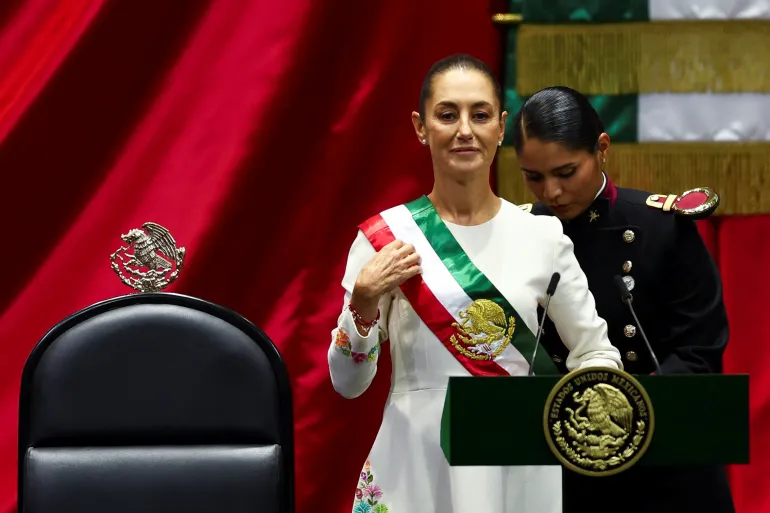
Claudia Sheinbaum has been sworn in as Mexico’s first female president.
Sheinbaum took over from outgoing president – and close Morena party ally – Andres Manuel Lopez Obrador at an inauguration ceremony in the country’s Congress on Tuesday.
The 62-year-old climate scientist and former mayor of Mexico City is set to serve a six-year term, ending in 2030.
Sheinbaum took the oath of office in front of parliamentarians, as her supporters chanted “President! President!” and “Long live Mexico!”
“Now is the time of transformation, now is the time of women,” Sheinbaum said.
She enters office with her party holding super-majority control in the legislature’s lower house, and nearly the same in the Senate, and immediately sought to reassure investors, saying that investments will be safe in Mexico.
Sheinbaum will need to contend with some last-minute moves by Lopez Obrador, namely a controversial judicial overhaul that will see federal judges – including those on the Supreme Court – elected by popular vote. The constitutional change has roiled both advocates of judicial independence and investors.
The incoming president will also be navigating a US election on November 5 that could shift relations with Mexico’s top trading partner.
Later in November, she will deliver her government’s first budget, which will likely give clues as to whether Sheinbaum can make good on commitments to reduce the country’s widening fiscal deficit while maintaining popular welfare spending and costly crime-fighting initiatives.
That task comes at a time when Mexico’s economy, the second-largest in Latin America, is forecasted to have only modest growth.

Sheinbaum’s inauguration is the culmination of a four-decade rise in Mexican politics, punctuated by her history-making election as the first woman to lead Mexico City.
Sheinbaum, the daughter of academic activists, has also leaned into the history-making nature of her presidency.
In a social media post on Monday, she unveiled a logo showing a young woman in profile hoisting a Mexican flag, her hair pulled back into a ponytail. The hairstyle has become a sort of signature for Sheinbaum.
“A young Mexican woman will be the emblem of Mexico’s government,” Sheinbaum wrote.
Mexico remains one of the most conservative countries in Latin America, with its 65 presidents since independence from Spain all men.
As Mexico City mayor, Sheinbaum built a reputation for a data-driven approach to leadership, winning praise for reducing the city’s murder rate by half.
Her policies sought to boost security spending on an expanded police force with higher salaries. She has pledged to replicate the approach across Mexico, which continues to be plagued by high rates of crime and the outsized influence of powerful drug cartels. Critics have questioned how realistic those pledges will prove to be.
At the same time, Sheinbaum has promised to continue policies of generous social spending pensions and youth scholarships championed by her populist predecessor Lopez Obrador.
Having studied energy engineering, and later being tapped for the UN’s Intergovernmental Panel on Climate Change, Sheinbaum has sought to strike a more careful balance on environmental initiatives.
She has said she will protect the industrial dominance of Mexico’s state-owned oil and power companies, while expressing interest in shifting towards renewable energy projects.
Sheinbaum shared a Nobel Peace Prize with former US Vice President Al Gore in 2007 for her climate work.
Prior to that, she had been Lopez Obrador’s environmental chief when he served as the mayor of Mexico City. She had previously served as the chief spokesperson for Lopez Orador’s failed 2006 campaign.
[Aljazeera]

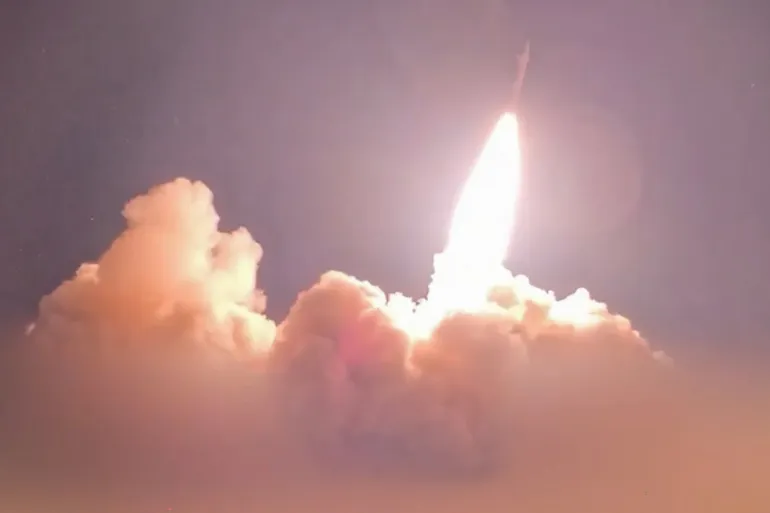
The United States military says that two service members have been killed and four medically evacuated following an Iranian missile and drone attack in Jordan.
In a statement shared on Saturday, US Central Command (CENTCOM), which oversees US military operations in the Middle East, said that one service member remains missing following an Iranian strike on Friday.
“On July 17, two US service members in Jordan were killed in action as US Central Command (CENTCOM) and partner forces defended against Iranian ballistic missile and drone attacks. Additionally, one service member is currently missing in action,” the statement reads.
“Four American service members were medically evacuated to Jordanian hospitals. They have since been discharged. Other personnel who were evaluated for minor injuries have returned to duty.
“Out of respect for the families, CENTCOM will withhold additional information, including the identities of the fallen warriors, until 24 hours after the next of kin have been notified.”
The statement appears to be the first US confirmation of fatalities resulting from renewed Iranian strikes on US forces, following the breakdown of a memorandum of understanding (MoU) that temporarily paused fighting between the US and Israel, and Iran.
Responding to the deaths of the two service members, US Defence Secretary Pete Hegseth said that “their sacrifice only stiffens our resolve”.
CENTCOM later announced that it was launching retaliatory airstrikes against Iran at President Trump’s direction.
[Aljazeera]
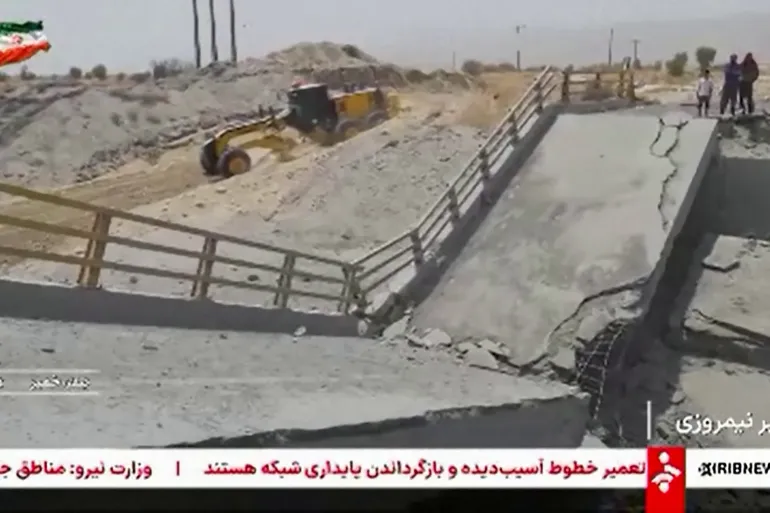
A seventh consecutive night of attacks by United States forces on targets across Iran has left 10,000 people without water after a desalination plant was hit, with Iran retaliating by launching another wave of drones and missiles at US-allied Gulf states.
Hamzeh Pour, chief executive of the Hormozgan Water and Wastewater Company, was quoted by the Tasnim news agency on Saturday as saying that a seawater pumping station and a power transformer at the Bunji desalination plant in Jask in southern Iran were “completely destroyed”, depriving 20 villages of water.
Iran’s retaliation also targeted civilian infrastructure, a war crime under international humanitarian law.
In the early hours of Saturday, Kuwait announced the closure of its airspace and said two power and water desalination plants were hit by Iranian attacks. Several Kuwaiti firefighters were wounded while responding to a fire sparked by the strikes, the country’s firefighting force said.
Air raid sirens also sounded repeatedly in Bahrain, where authorities urged residents to seek shelter.
In Jordan, authorities said they intercepted 10 Iranian ballistic missiles.
Iran’s Islamic Revolutionary Guard Corps (IRGC) said its naval forces had targeted a US military fuel pier at Kuwait’s al-Ahmadi port and a US warplane assembly site at Bahrain’s Sheikh Isa Air Base. The IRGC also said it attacked a US base in Azraq in Jordan, claiming to have destroyed two American fighter jets.
The Iranian attacks came after the US military’s Central Command, or CENTCOM, announced it had carried another wave of overnight strikes targeting “surveillance sites, military logistics infrastructure, underground weapons storage, and maritime capabilities” in Iran.
[Aljazeera]
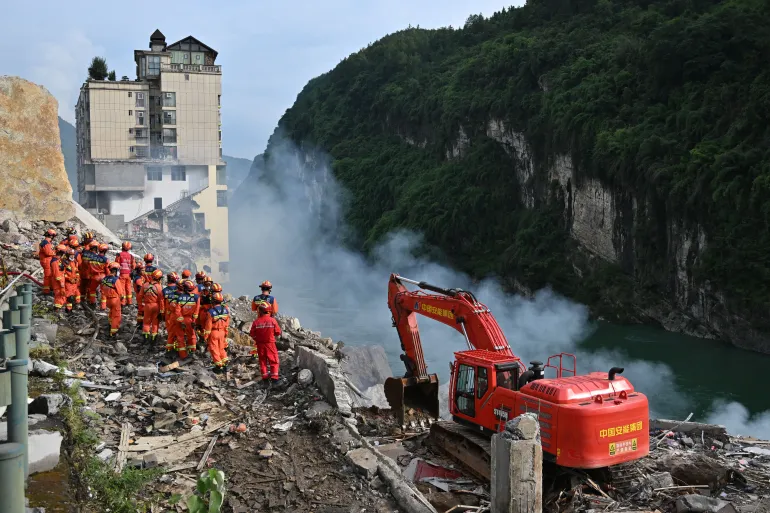
Rescuers are rushing to locate dozens of people missing in the southwestern Chinese city of Chongqing, after a deadly landslide buried homes in the area, according to Chinese authorities.
The landslide took place around 9:10am (01:10 GMT) on Friday in Chongqing’s Pengshui county, killing eight people, leaving 34 unaccounted for and displacing more than 1,100, reported state media.
Footage shared by China’s CCTV broadcaster showed a huge buildup of rocks and dirt covering part of a residential and commercial street at the bottom of a mountain in the region.
Ten people have been rescued from the debris, including two who are seriously injured, reported China’s state-run Xinhua news agency.
Water, electricity and gas supplies were cut off within a one-kilometre (0.6-mile) radius of the landslide to prevent further disruptions. More than 800 rescuers have gone to the site, reported CCTV.

Authorities said they sent more than 8,000 disaster relief items to Chongqing, including tents, folding beds and family emergency kits.
Pengshui county is located in the southeast part of Chongqing, bordering the provinces of Hubei and Guizhou.
The area where the landslide happened is known for “unpredictable” steep terrain, a local official told a news conference, adding that dangerous rocks remain along the sides of the cliff.
The government has allocated 50 million yuan ($7.36m) in natural disaster relief funds to support the rescue and relief operations and to provide assistance to affected residents, the Ministry of Finance and the Ministry of Emergency Management said.
[Aljazeera]

Rare identical quadruplets born in Australia

Showers will occur in the Western, Sabaragamuwa and North-western provinces and in Kandy, Nuwara-Eliya, Galle and Matara districts

Merchant Shipping Secretariat probes bribery scandal

Theft of USD 2.5 mn: Dinana Dakuna claims COPF trying to protect mastermind

COPF chief slams security sticker scam

CAA urged to protect soap users

‘Dates have the highest sugar content to fight Coronavirus’

Sunday Island 27 December – Headlines

#SundayIsland 17th December – Headlines

Sunday Island – 28th March

Sunday Island Headlines – 21 March

Sunday Island – 21st February – Headlines
-
 Business2 days ago
‘Giving up was never an option’: The fisherman who fought back after losing millions in SL
-

 Features2 days ago
Two memorable excerpts from a former SLAF commander’s memoir
-

 Latest News2 days ago
Davis cup Asia/Oceania Group IV 2026 to be held in Colombo from 20th to 25th July
-

 Features2 days ago
Erdoğan’s New Republic
-

 Life style2 days ago
Taste of the Swiss Alps comes to Colombo
-

 Features6 days ago
Dirty Money
-
 News3 days ago
Dengue outbreak gallops ahead: Infections surpasses 73,455, leaving 50 dead
-

 News3 days ago
Evidence recorded in money laundering case against Yoshitha Rajapaksa