
Foreign News
China’s Xi steals the limelight in a defiant push against US-led world order


As the cannon fire echoed through Tiananmen Square, even before the first set of troops goose-stepped their way through Beijing’s central avenue, the day’s most enduring image unfolded.
China’s President Xi Jinping welcomed North Korea’s Kim Jong Un with a long handshake, then moved on to greet Russia’s Vladimir Putin, and then walked to his seat, flanked by two of the world’s most sanctioned leaders.
It was sheer political theatre. And it was this meeting – rather than the weaponry – that appears to have irked US President Donald Trump.
As the parade began, Trump sent a sharply-worded message on Truth Social, accusing the three leaders of conspiring against America.
This may well have been the reaction President Xi had hoped for as he kept Putin to his right and Kim to his left throughout the parade. The moment may have even been designed to infuriate a US president who would perhaps prefer to be the centre of the world’s attention.
The Chinese leader has stolen the limelight, and he’s using it to show his power and influence over an eastern-led alliance – a defiant group determined to push back against a US-led world order.
It is a strong message from Xi as the world reels from the unpredictability of Trump’s presidency. Besides Kim and Putin, there were more than 20 other foreign heads of state. Just earlier this week, Xi also appeared to be resetting his troubled relationship with Indian Prime Minister Narendra Modi. Trump’s 50% levy on Indian imports has prompted a thaw between the long-time rivals.
Wednesday’s spectacle was supposed to be about commemorating an 80-year-old victory over Japan. But it was actually about where China is headed – right to the top, with Xi playing the role of a global leader.
And at his feet was a military that is being built to rival the West.
This was the first time Xi, Putin and Kim had been seen together – and together, they climbed to the top of the Gate of Heavenly Peace that overlooks the historic square to watch the parade.
The symbolism was hard to miss. Communist China’s founder Mao Zedong had declared the founding of the republic there in 1949 – and 10 years later, it was where he hosted Kim’s grandfather and the then Soviet leader Nikita Khrushchev, to watch a military parade.
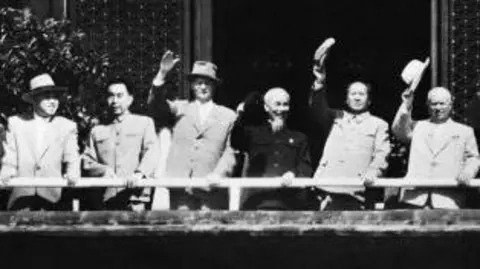
That was the last time the leaders of the three countries were together. It was the height of the Cold War, China was isolated from much of the world, as was North Korea, and the Soviet Union was the most powerful and richest among them.
Now, it’s China that holds the reins in this relationship. Nuclear-armed but still poor, North Korea needs Beijing’s aid. And Putin needs the legitimacy that Xi just provided him.
In the past, Xi appeared to keep his distance from Putin and Kim, and publicly maintain a neutral stance on the war in Ukraine. He did not condemn it, but denied China was helping Russia.
It even seemed like he was on the sidelines as Russia and North Korea grew closer more recently. Kim has been sending troops to support Putin’s invasion of Ukraine in exchange for money and technology.
But now he seems to be standing by his two neighbours, even as they continue to attack Kyiv.
“Today humanity is again faced with the choice of peace or war, dialogue or confrontation, win-win or zero sum,” Mr Xi told the watching crowds, along with millions glued to the parade coverage on state TV across the country.
China is a “great nation that is never intimidated by any bullies”, he declared.
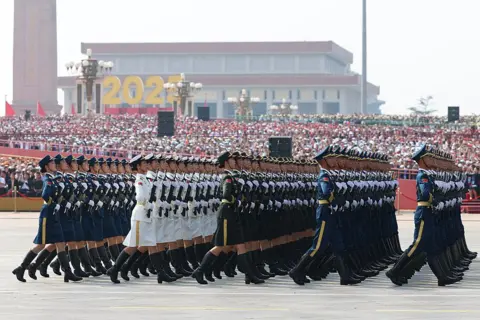
The US may still have an edge, honed over years and through its involvement in conflicts across the world, but there is no doubt that China is building a military to rival that.
And Wednesday’s show of strength was a statement aimed at Washington and its allies, as well as the rest of the world – and even at Putin and Kim, who knew the significance of what they were looking at.
“The great rejuvenation of the Chinese nation is unstoppable,” Xi had said in his speech in an effort to bolster pride in the nation.
And the military parade that followed was about showing that – it was a display of power, precision and patriotism.
It started with a gun salute – 80 times to mark 80 years since China’s victory over Japan in World War Two, ending a brutal occupation. The sound bounced off every corner of the square as 50,000 spectators, some of them war veterans, sat in silence.
The choir followed, every single member appearing exactly spaced out as the cameras panned above them. They sang in perfect harmony: “Without the Communist Party, there is no modern China.” Each verse was punctuated by raised fists.
President Xi drove the length of the parade route to inspect his troops before each battle unit took turns to goose-step past their leader. Every joint strike on the tarmac reverberated through the stands.
The rumbling tanks came first in the display of China’s new weapons. But they looked old compared to what followed. A new nuclear-capable missile that can be launched from sea, land and air, hypersonic anti-ship missiles and laser weapons to defend against drone attacks. There were new underwater and airborne drones that can spy on targets.
It appears to be working on some people.
On a bridge overlooking the Tonghui River, crowds had gathered away from the main parade route to try to see the military flypast. Thirty-year-old Mr Rong said he found the parade moving.
“Cherishing this moment is the most fundamental thing we can do. We believe we will retake Taiwan by 2035,” he declared.
This is the rhetoric feared by many on the self-governing island of Taiwan, which China believes is a breakaway province that will one day be united with the motherland. Xi has not ruled out the use of force to achieve that goal. And the weaponry that he showed off on Wednesday, much of which emphasised China’s naval capabilities, is bound to worry Taiwanese leaders.
It also worries many Western nations, especially in Europe, which are still grappling with how to end the war in Ukraine. Many were absent from the parade.
Han Yongguang, 75, shrugged off any suggestion that Western leaders had shunned the parade.
“It’s up to them to come or not,” he said. “They are envious of China’s fast development. To be honest, they are aggressive at heart. We are completely committed to the common prosperity of mankind. We are different.”
This parade has been fuelling a wave of nationalism at a time when China is battling serious domestic challenges: a sluggish economy, a real estate crisis, an ageing population, high youth unemployment and local governments deep in debt.
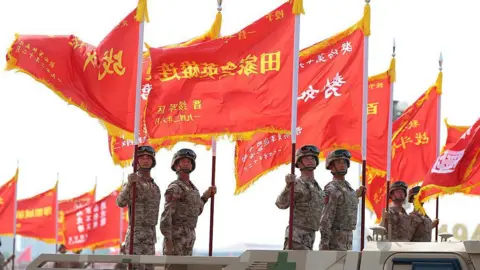
As confident as China appears on the world stage, President Xi must find a way to keep a burgeoning middle class from worrying about their future. China’s economic rise was once thought unstoppable, but that is no longer the case.
So this parade – with all the rhetoric about an old enemy, Japan – may be a welcome distraction.
After a long display of cutting-edge weaponry, including nuclear missiles, the parade concluded with thousands of doves and balloons released into the skies over Beijing.
The commemoration – the songs, the marches, the missiles, the drones, even the “robot wolves” – was not so much about China’s struggle.
Rather, it was about how far China has come – and how it is catching up with the US and challenging it for supremacy.
[BBC]

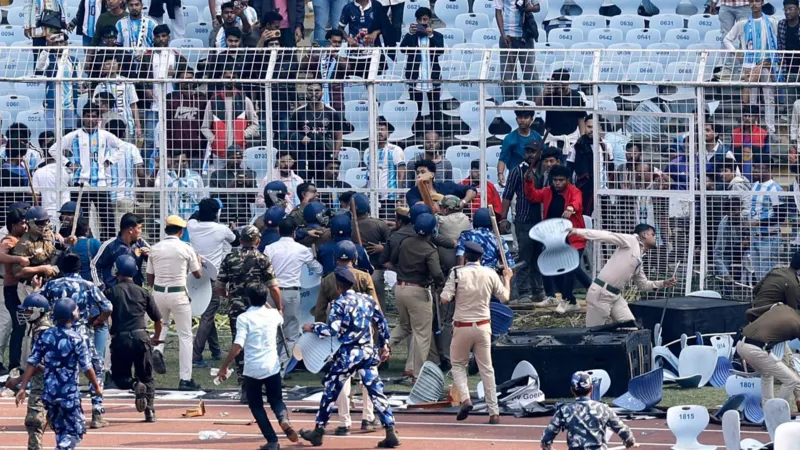
Angry fans attending Lionel Messi’s tour of India ripped up seats and threw items towards the pitch after his appearance at Kolkata’s Salt Lake Stadium.
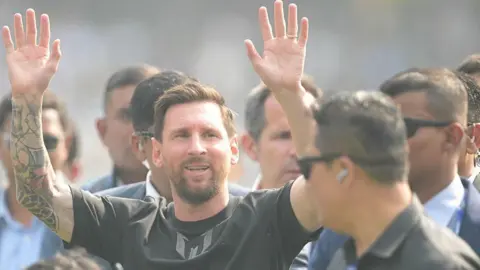
Thousands of adoring supporters had paid up to 12,000 rupees (£100; $133) to catch a glimpse of the football star, but were left disappointed when he emerged to walk around the pitch and was obscured by a large group of officials and celebrities.
When the Argentina and Inter Miami forward was whisked away early by security after around 20 minutes, elements of the crowd turned hostile.
West Bengal’s chief minister, Mamata Banerjee, said she was “deeply disturbed and shocked” by the events.
Announcing an enquiry, Banerjee apologised to Messi and “sports lovers” for the incident at the stadium.
“The enquiry committee will conduct a detailed enquiry into the incident, fix responsibility, and recommend measures to prevent such occurrences in the future,” the chief minister said on X.
A spokesperson for Messi said that he fulfilled the time commitment that had been agreed in advance. In terms of the organisation of the event itself, he referred the BBC to the apology issued by Banerjee on social media.
A police official told reporters that the event’s “chief organiser” had been arrested, without giving any further details, AFP reports.
Authorities will look into how organisers could refund money to those who bought tickets, the official added.
The All India Football Federation (AIFF) said it was not involved in the “private event”.
Messi is in India for his ‘GOAT [greatest of all time] tour’, a series of promotional events in Kolkata, Hyderabad, Mumbai and Delhi.
His tour began with the unveiling of a 70ft [21m] statue of himself in Kolkata, which had been assembled over the course of 27 days by a 45-strong crew. Messi appeared virtually due to security concerns.
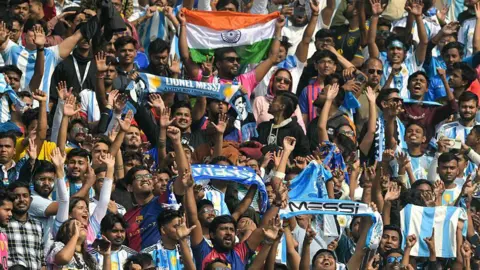
Thousands of fans travelled to the city’s stadium for a chance to see the footballer in person.
They were chanting, buying jerseys and wearing “I love Messi” headbands.
Messi initially walked out at the stadium waving to fans, but after his appearance was abruptly ended on Saturday, some frustrated fans stormed the pitch and vandalised banners and tents, as others hurled plastic chairs and water bottles.
The 2022 World Cup winner – consdered one of football’s greatest ever players – had been expected to play a short exhibition game at the stadium, the AFP news agency reports.
“Only leaders and actors were surrounding Messi… Why did they call us then? We have got a ticket for 12,000 rupees, but we were not even able to see his face,” a fan at the stadium told Indian news agency ANI.
One angry fan told the Press Trust of India news agency people had paid the equivalent of a month’s salary to see the eight-time Ballon d’Or winner.
“I paid Rs 5,000 for the ticket and came with my son to watch Messi, not politicians,” they said.
“The police and military personnel were taking selfies, and the management is to blame.”
Messi was accompanied on his brief visit by his Inter Miami teammate and Uruguay star Luis Suarez, and Argentina’s Rodrigo de Paul.
Bollywood actor Shah Rukh Khan also met Messi earlier in the day, according to the Reuters news agency.
Kolkata is the capital of the Indian state of West Bengal and has a large football fanbase in an otherwise cricket-crazed country.
In the city, it is common to see hundreds of thousands of fans gather at stadiums at a derby of local clubs.
In the early hours of Saturday, thousands lined the roads and congregated outside the hotel where Messi was staying to try and catch a glimpse of him.
Hitesh, a 24-year-old corporate lawyer, flew nearly 1,900 kilometres from the south Indian city of Bengaluru.
“For me it’s personal. You can see I am quite short, and I love to play football with my friends,” Hitesh told the BBC, standing in front of the statue.
“Messi is the player I related with the most, no one can match his talent. He gives me hope that with talent you can do anything.”
[BBC]
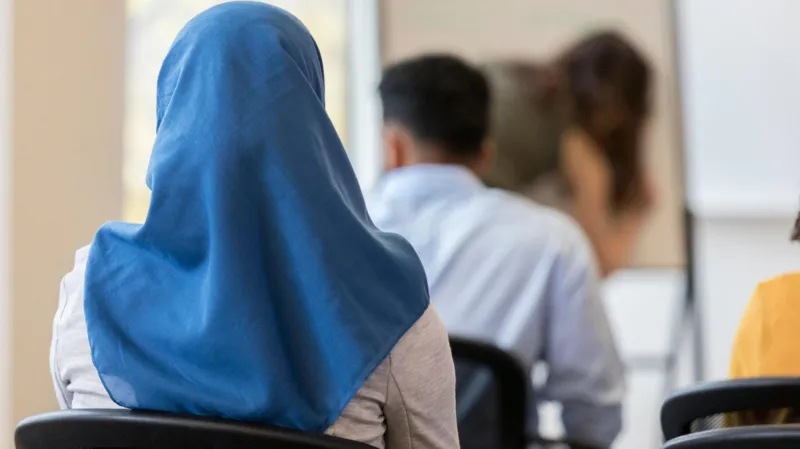
Austria has passed a law banning headscarves in schools for girls under the age of 14.
The conservative-led coalition of three centrist parties, the ÖVP, the SPÖ and the Neos, says the law is a “clear commitment to gender equality”, but critics say it will fuel anti-Muslim feeling in the country and could be unconstitutional.
The measure will apply to girls in both public and private schools.
In 2020, a similar headscarf ban for girls under 10 was struck down by the Constitutional Court, because it specifically targeted Muslims.
The terms of the new law mean girls under 14 will be forbidden from wearing “traditional Muslim” head coverings such as hijabs or burkas.
If a student violates the ban, they must have a series of discussions with school authorities and their legal guardians. If there are repeated violations, the child and youth welfare agency must be notified.
As a last resort, families or guardians could be fined up to €800 (£700).
Members of the government say this is about empowering young girls, arguing it is to protect them “from oppression”.
Speaking ahead of the vote, the parliamentary leader of the liberal Neos party, Yannick Shetty said it was “not a measure against a religion. It is a measure to protect the freedom of girls in this country,” and added that the ban would affect about 12,000 children.
The opposition far-right Freedom Party of Austria, the FPÖ, which voted in favour of the ban, said it did not go far enough.
It described the ban as “a first step”, which should be widened to include all pupils and school staff.
“There needs to be a general ban on headscarves in schools; political Islam has no place here”, the FPÖ’s spokesperson on families Ricarda Berger said.
Sigrid Maurer from the opposition Greens called the new law “clearly unconstitutional”.
The official Islamic Community in Austria, the IGGÖ, said the ban violated fundamental rights and would split society.
In a statement on its website, it said “instead of empowering children, they will be stigmatised and marginalised.”
The IGGÖ said it would review “the constitutionality of the law and take all necessary steps.”
“The Constitutional Court already ruled unequivocally in 2020 that such a ban is unconstitutional, as it specifically targets a religious minority and violates the principle of equality,” the IGGÖ said.
The government says it has tried to avoid that.
“Will it pass muster with the Constitutional Court? I don’t know. We have done our best,” Shetty said.
An awareness-raising trial period will start in February 2026, with the ban fully going into force next September – the beginning of the new school year.
[BBC]
At least 34 people have died and dozens more are injured after air strikes from Myanmar’s military hit a hospital in the country’s west on Wednesday night, according to ground sources.
The hospital is located in Mrauk-U town in Rakhine state, an area controlled by the Arakan Army – one of the strongest ethnic armies fighting the country’s military regime.
Thousands have died and millions have been displaced since the military seized power in a coup in 2021 and triggered a civil war.
In recent months, the military has intensified air strikes to take back territory from ethnic armies. It has also developed paragliders to drop bombs on its enemies.
The Myanmar military has not commented on the strikes, which come as the country prepares to vote later this month in its first election since the coup.
However, pro-military accounts on Telegram claim the strikes this week were not aimed at civilians.
Khaing Thukha, a spokesperson for the Arakan Army, told the BBC that most of the casualties were patients at the hospital.
“This is the latest vicious attack by the terrorist military targeting civilian places,” he said, adding that the military “must take responsibility” for bombing civilians.
The Arakan Army health department said the strike, which occurred at around 21:00 (14:30 GMT), killed 10 patients on the spot and injured many others.
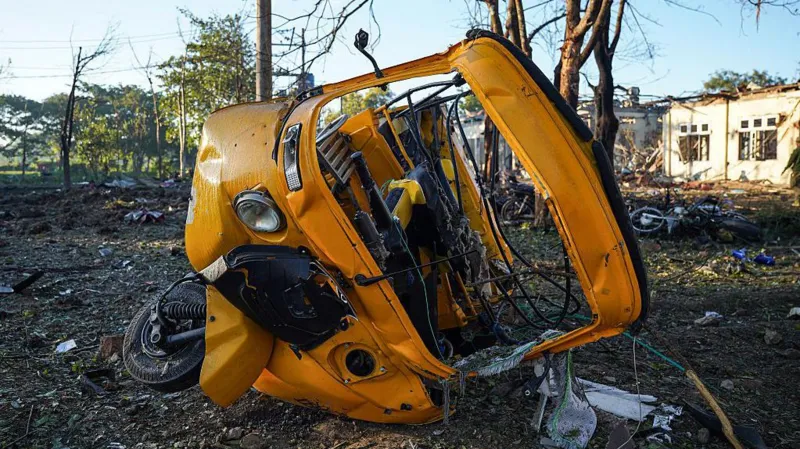
Photos believed to be from the scene have been circulating on social media showing missing roofs across parts of the building complex, broken hospital beds and debris strewn across the ground.
The junta has been locked in a years-long bloody conflict with ethnic militias, at one point losing control of more than half the country.
But recent influx of technology and equipment from China and Russia seems to have helped it turn the tide. The junta has made significant gains through a campaign of airstrikes and heavy bombardment.
Earlier this year, more than 20 people were killed after an army motorised paraglider dropped two bombs on a crowd protesting at a religious festival.
Civil liberties have also shrunk dramatically under the junta. Tens of thousands of political dissidents have been arrested, rights groups estimate.
Myanmar’s junta has called for a general election on 28 December, touting it as a pathway to political stability.
But critics say the election will be neither free nor fair, but will instead offer the junta a guise of legitimacy. Tom Andrews, the United Nations’ human rights expert on Myanmar, has called it a “sham election”.
In recent weeks the junta has arrested civilians accused of disrupting the vote, including one man who authorities said had sent out anti-election messages on Facebook.
The junta also said on Monday that it was looking for 10 activists involved in an anti-election protest.
Ethnic armies and other opposition groups have pledged to boycott the polls.
At least one election candidate in in central Myanmar’s Magway Region was detained by an anti-junta group, the Associated Press reported.
[BBC]

Akbar Brothers crowned MBSA A-Division champions

Several spells of showers will occur in the Northern, North-Central, Eastern, Uva and Central provinces

Bondi Beach gunmen who killed 15 after targeting Jewish celebration were father and son, police say

Govt. urged to take action against deputy minister

India sends stock of life-saving medicines

George Keyt Foundation contributes to national disaster relief efforts

‘Dates have the highest sugar content to fight Coronavirus’

Sunday Island 27 December – Headlines

#SundayIsland 17th December – Headlines

Sunday Island – 28th March

Sunday Island Headlines – 21 March

Sunday Island – 21st February – Headlines
-
 Features6 days ago
Finally, Mahinda Yapa sets the record straight
-
 News7 days ago
Cyclone Ditwah leaves Sri Lanka’s biodiversity in ruins: Top scientist warns of unseen ecological disaster
-
 Features6 days ago
Handunnetti and Colonial Shackles of English in Sri Lanka
-
 Business4 days ago
Cabinet approves establishment of two 50 MW wind power stations in Mullikulum, Mannar region
-
 News5 days ago
Gota ordered to give court evidence of life threats
-

 Features7 days ago
An awakening: Revisiting education policy after Cyclone Ditwah
-

 Features5 days ago
Cliff and Hank recreate golden era of ‘The Young Ones’
-
 Opinion6 days ago
A national post-cyclone reflection period?