
News
China signals readiness to work with India to help Sri Lanka and other developing countries

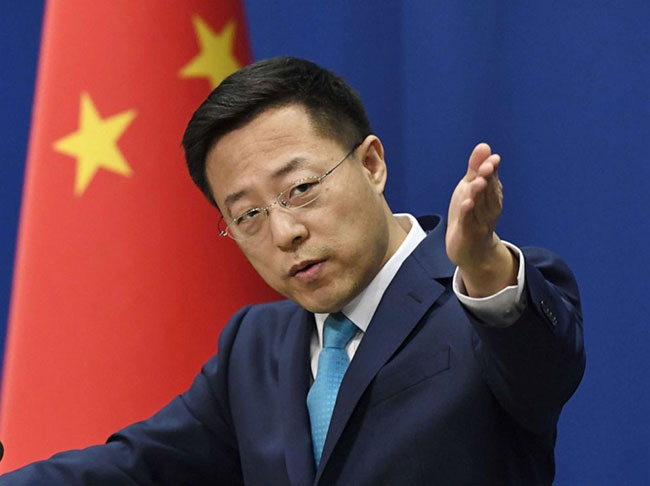
Chinese foreign ministry spokesman Zhao Lijian told a media briefing in Beijing on Wednesday that the Indian government has done a lot to help Sri Lanka and China is ready to work with India and the rest of the international community to help Sri Lanka and other developing countries.
A representative from China’s CCTV asked Zhao Lijian about President Gotabaya Rajapaksa’s recent claim that China seems to have shifted its strategic focus to Southeast Asia and Africa, and has less interest in South Asia.
The foreign ministry spokesman said that as a traditional friendly neighbor, China pays close attention to and feels for the difficulties and challenges facing Sri Lanka.
“We have all along provided support to Sri Lanka’s socioeconomic development as long as our ability permits. China has announced that it would provide emergency humanitarian assistance worth 500 million RMB for Sri Lanka. The first delivery of medicine has arrived in Sri Lanka, and the first shipment of rice has left China for Sri Lanka. Through government-to-government and subnational channels and through friendly organizations, China has provided multiple batches of assistance in diverse forms to people across the sectors of Sri Lanka to improve their livelihood”, he said.
Zhao added that shortly after the Sri Lankan government announced to suspend international debt payments, Chinese financial institutions reached out to the Sri Lankan side and expressed their readiness to find a proper way to handle the matured debts related to China and help Sri Lanka to overcome the current difficulties.
“We hope Sri Lanka will work actively with China in a similar spirit and work out a feasible solution expeditiously. China is ready to work with relevant countries and international financial institutions to continue to play a positive role in supporting Sri Lanka’s response to current difficulties and efforts to ease debt burden and realize sustainable development. In the meantime, we believe Sri Lanka will boost its own effort, protect the stability and credibility of the investment and financing partners and ensure the stability and credibility of Sri Lanka’s investment and financing environment”, he said.
He said that South Asian countries, along with the other countries in our neighboring areas, are China’s priority in its diplomacy. China attaches great importance to forging closer good neighborly relations with its neighbors and has worked hard to this end. China and South Asian countries are each other’s friendly neighbors and development partners.
“Together we belong to one community with a shared future. From natural disasters like earthquakes and tsunamis, to global challenges like financial crises and COVID-19, history has shown that China has always stood in solidarity with South Asian countries through difficult times. Under the current circumstances, China will work with relevant countries to respond to risks and challenges and pursue high-quality Belt and Road cooperation to jointly sustain the sound momentum of security, stability, cooperation and development in our region and bring great benefits for all peoples in this region”, he said.
A representative from India’s PTI followed up by asking about a statement made by the Chinese ambassador to Colombo earlier this year that China was considering a line of credit to Colombo. The PTI journalist said that this credit line has not materialised so far, though China went about with some relief and medical supplies.
“My question is, is China concerned about the kind of economic crisis being faced by several South Asian countries? Not Sri Lanka alone, that includes Pakistan as well, are seeking bailout packages, especially from the IMF. Is China, a major investor in these countries, hesitating to provide huge assistance?” the journalist asked.
Zhao said that China notes and follows closely the financial, fiscal and international balance of payment difficulties facing the South Asian countries and other developing countries as you mentioned. The difficulties faced by these countries partly stem from the challenges brought by the COVID-19 pandemic.
They also have a lot to do with the Russia-Ukraine conflict and the unilateral sanctions slapped by the US and other Western countries on Russia in the wake of the conflict, he said, adding that the sanctions aggravated the food crisis and financial difficulties in developing countries and inflicted even more hardships on the people.
“Just now I outlined some of China’s efforts to help Sri Lanka. We have taken note that the Indian government has also done a lot in this regard. We commend those efforts. China is ready to work with India and the rest of the international community to help Sri Lanka and other developing countries experiencing difficulty to pull through the hardship as early as possible. I assume you have also noticed that the shipment and arrival of medicine, rice and other supplies donated by Chinese provinces and cities to Sri Lanka. The Chinese government will do its utmost and make full use of the channels available to deliver help to the Sri Lankan society”, he said.



The Sri Lanka Press Institute (SLPI) and several leading media organisations have expressed strong opposition to the proposed Chartered Institute of Media Professionals of Sri Lanka (CIMP) Bill, urging the Government to withdraw the legislation and engage in consultations with stakeholders.
In a joint statement, the SLPI, together with its constituent organisations—the Newspaper Society of Sri Lanka (NSSL), the Editors’ Guild of Sri Lanka (TEGOSL), the Free Media Movement (FMM) and the Sri Lanka Working Journalists Association (SLWJA)—as well as affiliated bodies including the Muslim Media Forum (MMF), the Tamil Media Alliance (TMA), the Federation of Media Employees Trade Union (FMETU) and the South Asia Free Media Association (SAFMA) – Sri Lanka Chapter, said their primary objection was the government-led nature of the proposed institute.
Full text of the statement: The Sri Lanka Press Institute (SLPI), and its constituent partners, the Newspaper Society of Sri Lanka (NSSL), The Editors’ Guild of Sri Lanka (TEGOSL), the Free Media Movement (FMM), the Sri Lanka Working Journalists Association (SLWJA) together with its affiliated organizations, the Muslim Media Forum (MMF), the Tamil Media Alliance (TMA), The Federation of Media Employees Trade Union (FMETU), the South Asia Free Media Association’s SL Chapter (SAFMA) object the proposed Chartered Institute of Media Professionals of Sri Lanka (CIMP) Bill.
Our primary objection stems from the government-led nature of this initiative. History shows that robust professional bodies, such as the Institute of Engineers and the Sri Lanka Institute of Architects, were founded and drafted by the professionals themselves before being incorporated by Parliament. In contrast, the CIMP is a state-driven project ordered to be published by the Minister of Health and Mass Media despite objections raised by media’s professional bodies. We view this as an attempt to impose a state-managed regulatory framework upon a profession that must remain independent of government interference to function effectively.
The SLPI, its constituents and affiliated organizations maintain that professional media standards must be self-regulated in principle and led by the media community, not mandated by law under ministerial oversight. The SLPI has presented an alternative mechanism, viz., the Sri Lanka Media Commission (SLMC), based on co-regulatory and self-regulatory principles, which improves professionalism. In addition, the Sri Lanka College of Journalism, which is recognised by the media industry for training journalists for more than two decades, could also be an alternative way of building relevant journalism standards with government financial support if it intends to genuinely promote media professionalism. We call upon the government to withdraw this Bill and engage in a genuine dialogue with stakeholders that respects the autonomy and freedom of the media in a democracy.

The Fort Magistrate’s Court yesterday issued a warrant for the arrest of Jaffna District MP Ramanathan Archchuna after he failed to appear before court in connection with a pending case.
Court officials said the MP and his bail sureties were absent when the matter was taken up, prompting the Magistrate to issue the warrant.
The case relates to an alleged incident in which Archchuna is accused of obstructing the duties of Fort Police officers while they were performing their duties.
The matter was listed before the Colombo Magistrate’s Court yesterday as well, when the MP failed to appear before court and his bail guarantor was also absent. Following this, the Magistrate ordered that a warrant be issued against him.
The case is to proceed with further legal action against the MP.

Sri Lanka’s dengue outbreak has continued to worsen, with the number of infections reported this year surpassing 80,000, according to official surveillance data.
The country recorded 80,114 dengue cases as of midnight on July 23, while health authorities reported 59 dengue-related deaths, resulting in a case fatality rate of 0.07%.
The National Dengue Control Unit said that by Week 29, a total of 175 Medical Officer of Health (MOH) areas had been identified as high-risk zones, with an average of 2,391 new cases being reported daily.
July has emerged as the worst month of the year so far, with 24,739 cases recorded, while June also saw a significant surge with 21,534 infections.
The Western Province continues to account for more than half of the country’s dengue burden, with Gampaha recording 16,950 cases and Colombo 16,091 cases. Together, the two districts account for more than 40% of total infections reported nationwide.
Other districts recording high numbers include Matara with 5,534 cases, Kandy with 4,827, Kalutara with 4,545, and Ratnapura with 4,428 cases. The Colombo Municipal Council area alone has reported over 3,200 dengue infections.
At provincial level, the Southern Province has recorded 12,143 cases, followed by the Central Province with 6,686 and Sabaragamuwa with 6,607. Meanwhile, the North Western, Eastern, Uva, North Central and Northern provinces have reported 3,844, 3,148, 2,154, 1,264 and 1,173 cases respectively.
Health authorities have urged residents, particularly those living in high-risk areas, to intensify mosquito-control measures and seek immediate medical attention when dengue symptoms appear, warning that the situation could deteriorate further without sustained preventive action.

ICC prosecutor Karim Khan removed over ‘political’ sex abuse claims

A few showers will occur in the Western, Sabaragamuwa and North-western provinces and in Galle and Matara districts

Govt. urged to withdraw Media Professionals Bill

Fort Magistrate orders arrest of MP Archchuna

Dengue rages with average of 2,391 new cases detected daily

Lanka produces only 43% of daily milk requirement, says Deputy Minister

‘Dates have the highest sugar content to fight Coronavirus’

Sunday Island 27 December – Headlines

#SundayIsland 17th December – Headlines

Sunday Island – 28th March

Sunday Island Headlines – 21 March

Sunday Island – 21st February – Headlines
-

 Features6 days ago
Two memorable excerpts from a former SLAF commander’s memoir
-
 Business6 days ago
‘Giving up was never an option’: The fisherman who fought back after losing millions in SL
-

 Life style6 days ago
Taste of the Swiss Alps comes to Colombo
-
 Features6 days ago
Erdoğan’s New Republic
-
 Midweek Review3 days ago
Three high-profile alleged suicides shaping key investigations
-

 News3 days ago
Customs asked to resume probe or face legal action
-

 Editorial4 days ago
Welcome bid to tackle rolling death traps
-
 Foreign News7 days ago
Iran accuses US of striking critical infrastructure as war intensifies