
Opinion
China is leading the world in a new type of energy production!


China is finally leading the world out of the wilderness and into the light and warmth that Thorium energy provides. They are leading the way in developing this new technology to create almost unlimited cheap clean power from Thorium that China needs so much.
Oil, gas and coal seriously pollute the planet, but influential businessmen and governments resist any change. But China has a real problem – serious pollution in its major cities caused by the burning of fossil fuels in transport, homes and to power its major industries. It has to find a reliable, safe, clean source of fuel. Chinese people are dying in their own pollution! But also, scientists and professionals around the world, are speaking to people in large meetings and warning that renewables; wind and solar and even hydro, are not reliable enough to satisfy present day commercial and industrial needs and business conditions. Clearly, the Chinese Government agrees with this assessment and have taken action.
The Chinese have taken action and invested heavily in modern, up- to-date designs for using Molten Salt Thorium to produce heat and generate electricity.
The Americans ran a Thorium experiment at Oakridge National Laboratory, Tennessee, and successfully ran a heat producing, plant non-stop for five years, in the 1960’s providing proof of principle. It was a game changer. However, the researchers had met with some serious problems such as corrosion of the reactor vessel walls by the fluoride salts used, and corrosion of the materials of which the reactor control valves were made. Also they had the problem of being unable to measure the high operating temperatures of around 500oC. But now, with advancements in metallurgy and instrumentation, these are no longer serious obstacles. This method of generating heat can be made to work successfully and it promises to become dirt cheap – by using widely available dirt! Energy from Thorium is a game changer. Importantly, the waste products are only dangerous for 300 years unlike the uranium waste from the old pressurised water power plants, and so, safe storage is much less expensive.
In a molten salt nuclear reactor, the fissile material is dissolved in heated fluoride salt (=liquid) in the reactor core. This liquid salt acts as a coolant in place of water but works at atmospheric pressure. Fission occurs in the reactor core, generating heat. The hot coolant is passed through a heat exchanger with water, so producing steam. This steam drives a turbine which generates electricity. Engineers like fluoride, lithium or beryllium salt mixture as a coolant, hence ‘FLIBE energy.’
With thorium there are no high-pressure chambers of steam to explode and runaways are impossible because thorium reactors have walk-away safety features and if there is overheating, fusible drain plugs melt and drain the hot fluid to emergency dump tanks, below.
The Shanghai Institute of Applied Sciences, supervised by the Chinese Academy of Science, have been active. In 2011 they employed around 700 PhD researchers to investigate and design new Thorium reactors based on the Oakridge reactor design, and in 2017 they built their first experimental 2 MW prototype in the Gobi Desert, in Wuwai, Gansu province, for operational and material testing. Because of the success they have had with these prototypes, now they plan a 10MW power plant to go into service in 2025 and a 100 megawatt to start work by 2035. China hopes to go carbon neutral in 2060.
Because these plants are scalable, they can be built large or small to suit their application. They plan to build Thorium power plants and sell them to their favoured customers. These can be managed and run by Chinese or locally trained operators. All nations need to recruit and train graduate scientists in preparation for this new technology and not be dependent on the Chinese! Jobs for graduates!
At present, 1 % of world energy comes from wind and solar and 75% comes from fossil fuels, but those percentages are not improving much each year. The whole world must move away rapidly from fossil fuels, and also, we need large amounts of energy to develop and grow our economies. Thorium is the ‘Holy Grail’ of energy production. We have to bring this technology to Sri Lanka, too.


by Eng. Parakrama Jayasinghe
El Niño is here! It is now official. With the fear of it being even a super El Niño, the authorities have been summoned by President Anura Kumara Dissanayake for an urgent discussion and instructions have been given on measures to initiate possible mitigation measures. These have spanned a wide spectrum of sectors which are in danger of being gravely affected. While food production and energy have received much attention, even the drinking water supply is expected to be adversely affected.
However, by and large the feeling that an ordinary citizen gets, on listening to the reportage on public media, is that at least on this critical issue there are no cohesive, detailed pragmatic plans and strategies being discussed and promoted.
It may not be impossible to mitigate the possible effects of El Niño fully, but what we can hope for is a degree of mitigation. El Niño is nearly upon us and there is no time for longdrawn discussions or time-consuming plans.
Specific comments on electricity sector
I would like to focus on the electricity sector in particular and its unavoidable links to irrigation and domestic water supply.
We have already discussed in earlier articles, how power cuts are being avoided by using diesel for power generation, with grave impacts on balance of payments as well as the economy. In response to a query, in public media, the Chairman of the National System Operator (NSO) has said he expects a fuel subsidy to continue until September and therefore there will be an increase in cost of diesel and consequently a hike in electricity tariff.
The Proposals for safeguarding the Electricity Supply
An analytical review of our past electricity generation mix records would reveal this eminently feasible and attractive way forward.
At the above public energy committee meeting, it was further noted that while the electricity utility consumed over 900,000 litres of diesel per day for power generation, in April 2026, the amount came down to some 350,000 litres per day in May. It is important to consider and recognise the circumstances which led to this turnaround, even if not adequate to solve the problem.
The Island newspaper reported on 8 June 2026 that to overcome the deficit of some 27 GWh of coal power, caused by substandard coal imports, the gap had to be filled with diesel power once more. Lack of courage to face the problem and declare limited power cuts to overcome it ,is the reason for this state of affairs. The resultant extra cost is said to be Rs 4.5 Billion.
Accordingly, the startling fact is that the unit cost of diesel power generation was Rs 166/kWh, but the utility charges only Rs 100/kWh for consumers with a monthly consumption over 180/kWh since 11 May . Those with lower consumption are charged much less. These figures highlight the unsustainable reliance on diesel.
It is very likely that there would be a call for increasing the consumer tariff once more in September when the next tariff review is due. This is in spite of the lowered world crude oil prices on 17 June 2026, due to a framework for peace signed between the USA and Iran. As per the IMF edicts, the Utility has to recover all its costs from consumers, irrespective of their mode of operation and efficiency or the lack thereof.
Change from April 2026 to May 2026 is illustrated above. (See image 1)
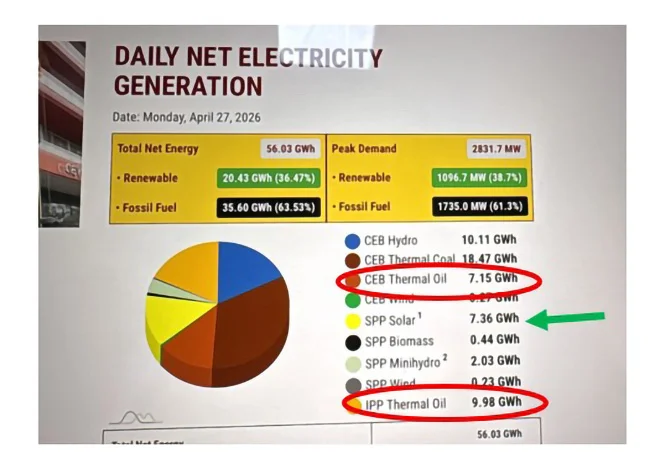
Further the dramatic decline in use of diesel highlights the past scenarios we illustrated earlier with possible increase in the availability of major hydro power in May with the onset of the monsoon. With added increase in ground mounted solar. It is to be noted that the large input from rooftop solar PVs is not recognized here.
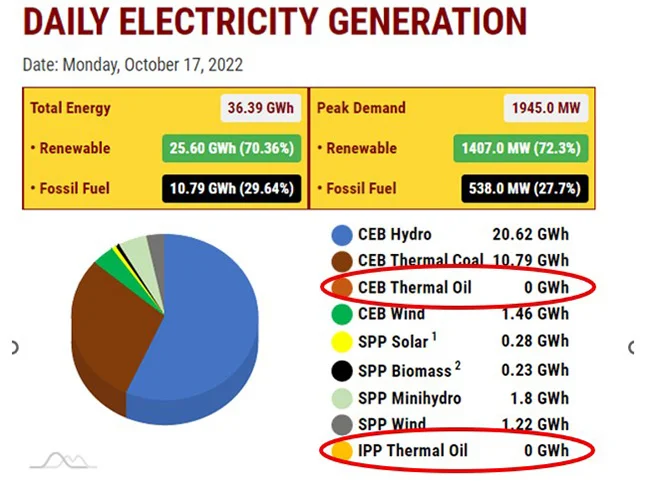
Sri Lanka has experienced the most encouraging instances of generating all its electricity without the use of any oil including diesel, furnace oil or Naptha on isolated days, all too infrequent, but it is noteworthy. (See image 2)
The days of zero or near zero use of oil for power generation listed below, unfortunately did not receive the attention of either the Utility or the Ministries of Power or Finance. Such attention could have resulted in a much more progressive electricity sector and a much lower consumer prices and saving of billions of dollars over the past decade. (See Table 1)
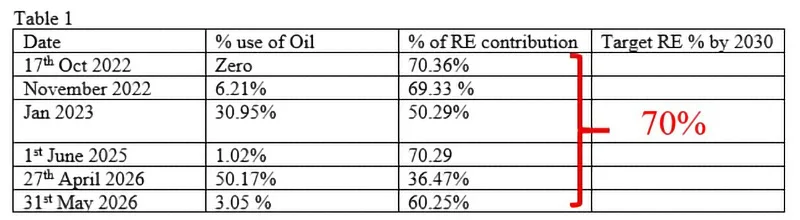
The bottom line is that when there is good May–Dec hydro generation, there is a scant need for oil-based generation. Past records show that in such good hydro years, the CEB was making profits and not in need of Treasury handouts. However, the dry season of January to April results in low hydro generation and generation costs rise. No one bothered to consider the means of filling the gap of lower hydro during the dry months with other available economical and indigenous renewable resources. Instead, the easy solution and perhaps the more profitable solution for some, and obviously not for the country, or the consumer, was the use of oil and even the so-called emergency power at enormous cost to the consumers.
The authorities professed that there was no solution. Slow adoption of mini-hydro, wind, and biomass was making only a small impact. There was a singular lack of support for accelerating development of such projects in spite of the setting up of the Sri Lanka Sustainable Energy Authority in 2007, expressly to facilitate and promote the development of the sector.
That was the case until the acceleration of solar power development. (See graph 1)
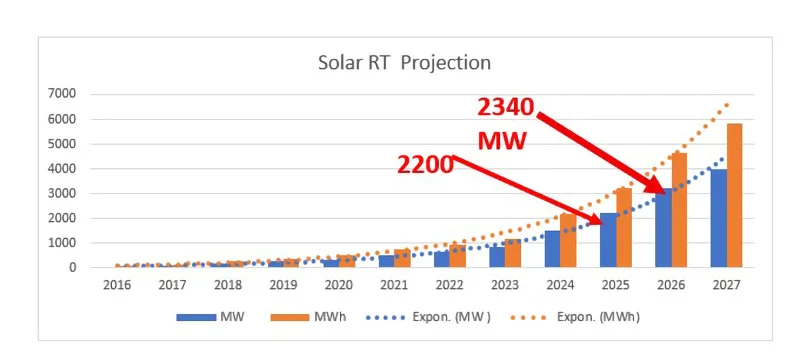
The ignored impact of Surya Bala Sangraamaya
Matters changed in 2010 with the declaration of the Surya Bala Sangramaya, opening the door for smallscale rooftop solar PV development. Further impetus was given by Net Plus and Net Accounting schemes. From 2016, exponential growth in the solar PV sector was recorded, reaching over 2300 MW through 150,000 mostly with sub MW scale domestic rooftop solar PV installations.
The power generation industry was no longer the sole purview of large wealthy corporations. The consumers themselves became generators thus becoming “Prosumers”
However, in 2025, the Surya Bala Sangraamaya suffered a setback, because of the machinations of the utility and others in authority; they did not recognize its true value.
It is necessary to recognise the growing contribution of rooftop solar PV, recognised world over along with its variable nature and not unique to Sri Lanka. An attempt was made to include such strategies in the successive Long-Term Generation Plans, but without much success.
How do we face the El Nino , already with us ?
It is under these circumstances that we have to face El Niño or even a Super El Niño. At least in the electricity sector, the past records point to a way forward.
It does not require much intelligence to discern the fact that
* When there is good hydro we manage without oil and CEB can make good profits
* But when there is low hydro, we have the advantage of much higher Solar energy
* Only intervention that is needed is to provide storage batteries so that solar energy can be stored and used at night as well and thus avoid the need for thermal generation.
* There is now some 2500 MW of rooftop solar and 400 MW of ground mounted solar and 170 MW of wind already installed, just waiting for the batteries to be added.
* The Utility is dragging its feet on adding the large batteries at grid substations and ignoring the fact that much more urgent need for early benefits is by adding batteries at the distribution substations and even individual distribution transformers.
* The Prosumers with 2500 MW of rooftop solar are ready and waiting to add the behind-the-meter batteries, provided that the Utility is willing to accept that option.
Will this happen? Or, will anyone in the government realise this possibility and get cracking.
Electricity and Irrigation
It is argued that as for water allocation in case of drought conditions, priority should be given for drinking water and agriculture. While this is logical, I have never seen any figures related to the actual water needs and water discharge.
Naturally, drinking water is the first priority. But what percentage is needed for this? Have we got logical strategies to maintain a balance between drinking needs and the power generation or Irrigation? Can’t we have the cake and eat it by making sure that the water released for irrigation also generates electricity?
Short-term approach with long lasting advantages
Therefore, it is my contention that the maximum attention should be paid to adding behind-the -meter batteries to get ready in case El Nino results in draughts, even during the conventional high rainfall periods, say June to December. If not, it would give us an opportunity to get ready with the infrastructure needed to make the best use of the basic facilities already built by the Prosumers and also to attract new Prosumers to install solar with batteries. These could then be ready to face the likely dry months from January to May 2027, however severe they are.
My appeal is to the current Prosumers with rooftop solar and the many others, whose requests for grid connections have been rejected out of hand to install rooftop solar and batteries to operate in the off-grid mode and thus reduce their dependence on the grid significantly. This would automatically reduce the peak load demand and the need for diesel based generation and enable the reduced hydro resource to be used to meet the peak load at much lower cost. This is an interim measure and they should be permitted to participate by exporting any excess during peak hours, once the FIT scheme presently being developed is active.
This is not the time and place to quote detailed numbers, but suffice it to say that if 100,000 Prosumers with 5 kWh batteries go off the grid during peak hours, it will help reduce the peak demand by 500 MW. The current peak load is only about 2900MW. This positive contribution could in fact be much greater if there is even the slightest signal of support from the state.
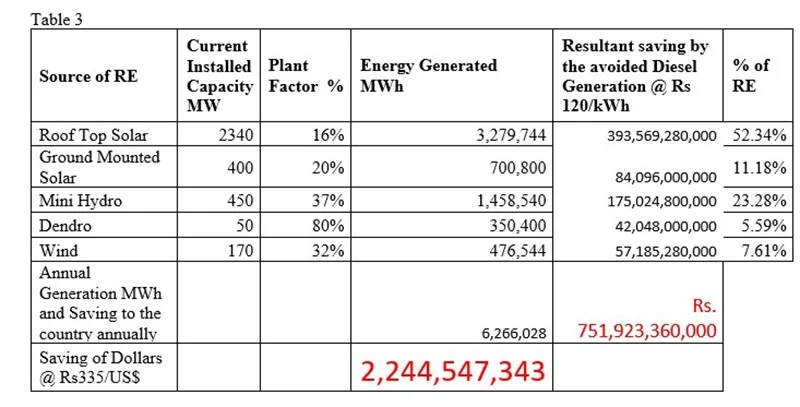
If further evidence is needed the following table illustrates the contribution made by the Renewable Energy Sector to the Country on an annual basis. (See Table 2)
The potential is unlimited. Therefore, the current El Nino scare should be treated as a warning as well as an opportunity to get control of the electricity sector and ensure future energy security.
(The writer can be contacted at
parajayasinghe@gmail.com)

Terminally Ill:
 Anyone with a minimal rational understanding of international relations and the functioning of multilateral organisations would know that South Asian Association for Regional Cooperation (SAARC) has gone the same way the Non-Aligned Movement had gone before. That is, to total oblivion and inconsequence. Maintaining these organisations today is a waste of taxpayers’ money from countries which can hardly afford extra cash for inconsequential diplomatic performances.
In June 2026, amidst an official visit to Colombo, SAARC’s outgoing Secretary General, Md. Golam Sarwar made several public statements about the future of the organisation during engagements at the Regional Centre for Strategic Studies and the SAARC Cultural Centre. It is instructive to see what he said. He did recognise the organisation was in trouble when he noted the need for member nations to engage more proactively with each other to overcome the present difficulties the organisation faces and “re-ignite” it. He also noted at Colombo’s RCSS that “an inspiring momentum is emerging as visionary leadership across the region works to keep broader cooperation at the heart of the conversation.” He further said, “when member nations champion this collective vision together, they can successfully elevate the dialogue around shared progress, ensuring that deep, meaningful regional integration remains a vibrant and lasting priority for all.”
But where exactly is this wonderful world of cooperation and visionary leadership emerging in the messiness that typifies domestic and international relations in South Asia? Where exactly can one see this inspiring momentum? Not on the ground for sure. In more realistic terms, what he has articulated is not fact or what is possible, but hope, against hope. What he outlined also does not constitute ongoing action on the ground. The reality beyond diplomatic sound bites is something very different. That reality merely mirrors the fractured history and dysfunctionality of SAARC over the last four decades.
In an essay titled ‘As SAARC Faces Unprecedented Setback, Time to Rethink the Rigid Boundaries of Its Nation States’ published in 2016, my former colleague Ravi Kumar and I noted the need to rethink how actually SAARC works. We wrote at a time when India, Bangladesh, Afghanistan and Bhutan refused to attend the 2016 SAARC summit scheduled to be held in Islamabad affectively scuttling the important meeting. Despite its forty-year history, the last summit took place twelve years ago in 2014 in Katmandu indicating the utter dysfunctionality of the organisation. What organisation can function when it cannot even successfully hold regular mandatory summits? This inability comes fundamentally from the India-Pakistan rivalry that flows into decision-making and more crucially, due to the unpractical expectation of 100 percent consent across all nations to proceed with all significant programmes.
In this background, when Mr Sarwar claims SAARC is the “irreplaceable beacon of hope” for the 2 billion people in South Asia, it means nothing more than utter naivety. It is precisely this ostrich attitude of its leaders and officials which have at one level ensured SAARC’s established dysfunctionality and track record in relatively unimaginative programing. That is, they have not moved beyond the practices and hurdles so typified by nation states and mere sound good rhetoric as in this case.
Beyond this, SAARC should never have been merely focused on a geographic grouping led by nation states with their often-irreconcilable idiosyncrasies and rivalries. This is what Ashish Nandy had referred to as “garrison states.” Where are the region’s people, their collective organisations, their cultural productions and their hopes and histories beyond the overused rhetoric of people-to-people relations? This is what Kumar and I raised in 2016. That is, whether it was possible, “from the continued existence and overall usefulness of the regional grouping, to the foundational concern of how to work out issues of regional cooperation.”
In this situation, mere “politics and economics of nation states” have “become the most significant dimension of the hegemonic discourses of regional cooperation.” Unfortunately, “in this process, it loses track of the actual sites inhabited by people, which are the messy cultural and emotional spaces beyond these territorial boundaries.” Moreover, “this has become evident in the way states have to work through their own formal bureaucratic mechanisms, while the initiatives of the people, and the imagination of scholars and creative people of the region, have often been very different and more inclusive than that of the state.”
Beyond the matter of leadership, the other area where SAARC has failed is in its lack of creative imagination in the way it should work. If it could put in place a process beyond the usual bureaucratic performances where there is more grounded involvement of people, there can be some hope. However, as Kumar and I had noted in 2016, “these non-hegemonic approaches have not been recognised at the level of formal statecraft. The obvious disconnect between the people and the nation is reflected in the constitutive character of the SAARC.” This is why even when visual artists, singers, dancers and sometimes scientists take part in purportedly SAARC-led initiatives, they are drawn from lists of supporters maintained by individual national governments and constituent political parties rather than from repositories of people who have actually worked tirelessly and excelled in their respective fields. The result is consistent mediocrity.
Mr Sarwar reportedly noted at RCSS that the “SAARC Cultural Centre in Sri Lanka” is “a vital node of technical expertise driving a practical, bottom-up approach to regional problem-solving.” Since when does this organisation do this kind of thing? While this is certainly possible when it comes to discourses on issues such as heritage management and preservation, the Centre’s mandate is to “promote regional unity through cultural integration and intercultural dialogue” and to “contribute towards preservation, conservation and protection of South Asia’s cultural heritage within the framework of the SAARC Agenda for Culture.” In any case, this organisation as well as SAARC more generally have never been about working through a bottom-up approach to address regional problems. Given their bureaucratic personalities, they are top-down by definition like all such multilateral organisations.
Notwithstanding that the SAARC Cultural Centre has become far more active in very recent times than it ever has been in the recent past due to changes in its leadership affected under the auspices of the Sri Lankan government, it is nevertheless reduced to run programmes mostly online. The inability to undertake more proactive programming despite the Centre’s present enhanced interest comes from both funding restrictions as well as the unnecessary rivalry between member states, particularly between India and Pakistan that percolates into the way the Centre is expected to function. It also does not help when the ability to be creatively independent in its programs is severely curtailed by unpractical norms of consent across member nations.
The Secretary General’s observations on the South Asian University in Delhi were far more disappointing as were they also completely wrong. Referring to the University’s now meaningless slogan, “knowledge without borders,” he described the university as a “visionary investment in our collective intellectual capital” that inculcates a shared regional consciousness by functioning as a “living bridge of mutual trust and academic collaboration” transcending political boundaries. Clearly, despite being the current Secretary General of SAARC, Mr Sarwar is completely unaware of what the university has become in more recent times, and particularly under his own watch.
What he has outlined are the expectations and hope upon which the university was established, which was also put into practice in the first decade or so of its existence. However, this is far from the reality now. Under its present and continuing India-appointed leadership, where no other South Asian nation has been able to appoint a President, the university has not only become completely North Indian (not even simply Indian) for all practical purposes in so far as its discission-making apparatus is concerned, but it has also become an organ of Hindutva and upper caste dominance. This transformation has affectively made it a mere extension of domestic Indian politics.
It no longer admits students from Pakistan and Afghanistan. And students from countries beyond India that include Sri Lanka and the Maldives hardly show any interest in joining the university given its seriously dented reputation and toxic environment as regularly reported in the Indian press. Even the number of students joining from Nepal – compared to early years – has also come down for the same reasons. This is an unfortunate but conscious deviation from its original intentions. What has happened in the process is its mandated South Asian identity and consciousness that the Secretly General himself referred to, has been violently uprooted. All this has happened officially under the auspices of SAARC and unofficially under the guidance of the Indian government while all member states have remained silent. The university’s deterioration into what is at best a mediocre regional ‘coaching centre’ has been well-documented in the Indian press over a long period of time. In this context, the Secretary General seeing the failed South Asian University experiment as a “living bridge of mutual trust and academic collaboration” is truly shocking.
In this overall situation, as opposed to the Secretary General’s over-optimistic and naïve assessment of SAARC’s future not grounded on regional realities, it is creditable that some of the Sri Lankan participants did bring up the South Asian University’s deterioration as well as what actually is meant by rhetoric such as South Asian identity and consciousness.
Ceylon Today of 28 June 2026 quoted the Secretary General as asking rhetorically, “without SAARC, what is the alternative?” This is indeed an important question. The answer to this question has been provided by the Secretary General’s own public pronouncements of naivety. Rather than a dynamic diplomatic institution, SAARC has become a moribund entity that merely reemploys retired diplomats and officials from the region, appoints others on secondment and employs junior officers on an unenviable pay scale, none of which have effectively contributed to serious and long-term institution-building. It is merely a burden on the region’s hapless taxpayers.
All this suggests the necessity for SAARC to radically and completely reinvent itself if it is not to become even more irrelevant than it already is. Its only hope is to rediscover itself within a “sense of embedded subversiveness in the acts of reasonable people” which cannot be done within the shackles of officialdom and dysfunctionality SAARC and the nation states which reluctantly fund it are straddled with. To be functional, the organisation also must be rescued from the India-Pakistan rivalry and its consequences. We know, all this is impossible as things stand today. This is why SAARC should be formally put to rest while its functioning organisations can be reinvented – where necessary and if it makes economic and financial sense – in the national personalities of the countries where they are located as South Asian University has already done.
Let me conclude by answering in plain terms the Secretary General’s question, “without SAARC, what is the alternative?” South Asia’s future is clearly not with SAARC. It lies squarely with individual nation states and their ability to forge bilateral and multilateral relations in areas that matter to them and in ways that benefit their national interests while at the same time self-consciously remaining out of the shadows and devious plans of any single hegemon.
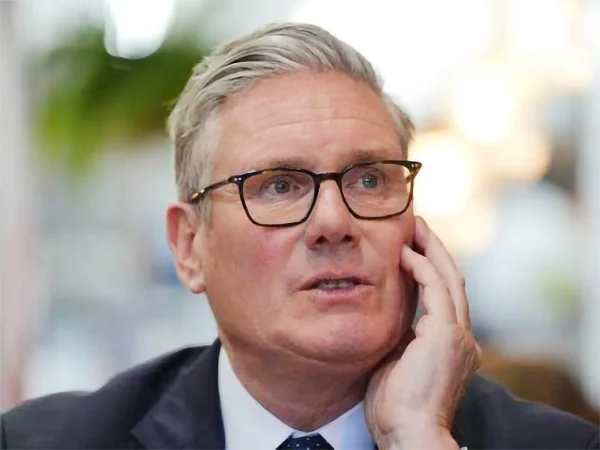
Monday, 22nd June was yet another important day in British politics. As the golden rays of late spring sunshine was bathing Downing Street early in the morning, a lectern was seen placed on the doorstep of No.10, which meant only one thing; that the sixth British Prime Minister in 10 years was about to deliver his swansong, before completing even two years in office.
Queen Elizabeth II had only 15 British Prime Ministers in her record-breaking reign, lasting 70 years, having had a record of 179 serve as Prime Ministers in her realm, the first new appointment, after her ascension to the Throne, being none other than Dudley Senanayake of Ceylon in 1952.
In contrast, King Charles III will have his fourth British Prime Minister even before he completes his fourth year of ascension on 8th September, as Andy Burnham may be PM by 16th July. This rapid turnover of PMs is the sign of a deeper problem underneath; the inability to prevent the rapid decline of a once great nation!
Keir Starmer led the Labour party to a landslide victory in the general election held on 4 July, 2024, when it won 411 seats of the 650 in the House. Interestingly, the party’s vote share was only 33.7%, the lowest of any governing party on record, making the thumping majority of 174 rather paradoxical. It made this the least proportional election in British Parliamentary history and was largely due to Nigel Farage’s Reform Party taking a major slice off the Conservative vote. The gloss of this remarkable victory was quickly tarnished when it transpired that Starmer accepted thousands of pounds, from a Labour Lord, to buy clothes and spectacles! Starmer, devoid of charisma, started becoming unpopular very quickly, more due to a large number of policy U-turns he made.
Starmer’s biggest blunder, however, turned out to be the hasty appointment, without proper security clearance, of the Labour grandee Peter Mandelson as the British Ambassador to the USA. Mandelson, the first ‘spin doctor’ in the UK, was one of the architects of Tony Blair’s massive victory and was a powerful figure in the Labour Party. He was a bitter critic of Trump but changed his views to get appointed to the coveted position!
Further, he hid his close connections to the sex offender Jeffrey Epstein, exposure of which by the media, left no choice for Starmer but to sack him. This raised serious concerns regarding Starmer’s judgement. The extremely poor performance of Labour at the May Local Government, as well as Devolved Assembly elections, sealed the fate of Starmer.
In comes Andy Burnham, who has always harboured ambitions of being PM. He is certainly charismatic and more to the left than Starmer. Having being unsuccessful at the leadership of the Labour party twice, losing out to Ed Miliband and Jeremy Corbyn, Burnham gave up national politics to be Mayor of Manchester, a major city in the Northwest of England with a rich industrial heritage and the birthplace of Marxism, where he had done some good work. Viewing a golden opportunity in Starmer’s failure, Burnham attempted to enter national politics again.
Though Starmer was able to thwart his first attempt, Burnham succeeded in the second attempt, winning the Makerfield by-election, convincingly defeating Reform, which is the emerging threat to Labour. The belief of most Labour MPs, and supporters, that ‘crowning’ him will see off Reform, nationally, may well turn out to be an illusion!
Burnham is a typical politician, who changed his views on many of his convictions during the election campaign, simply to get elected. If he keeps to his leftwing policies, it is very likely that the UK economy would get worse. Anyone thinking that only Sri Lankan politicians are fickle are completely wrong. As much as Sri Lankan politicians have ruined a country with so much potential, British politicians have ruined the country that once had the largest empire.
I have been familiar with the UK since 1969, when I first came for my postgraduate studies and visiting regularly, and intimately, since 1988, when I started working for the NHS. With a sense of horror, and sadness, I have seen the slippery slope taken by once a great country. It is to a great extent due to idiotic decisions taken by politicians based either on ideology or because of self-interest. I can well see the parallel decline in the two countries close to my heart.
When I started work in the NHS, it was the best health service in the world. Then ‘Clarke’s curse’ struck. Kenneth Clarke, during his tenure as the Secretary of State for Health in Margaret Thatcher’s government, introduced a ‘Trust’ system for hospitals and other health institutions on the premise that they should be better managed, like in the USA, disregarding all the evidence that the health services in the USA was not cost-effective and gave poor coverage. Most resources pumped to health services, since, have been absorbed by management, resulting in falling clinical care. Whilst there are plenty of managers in hospitals, there are no beds in wards resulting in corridor patients, the equivalent of floor-patients in Sri Lanka. UK doctors are also on strike frequently, perhaps taking the cue from the GMOA!
John Major, who followed Thatcher, privatised railways and even water services. Most of these are returning to the government due to failures. The first public railway service in the world was the Stockton to Darlington Railway in the North East of England, which started in September 1825 but today UK rail services have nothing to boast of. Beeching cuts of the 1960s decimated the British railway services and, in spite of attempted reforms, expansion does not match anything remotely similar to what countries like China have achieved. The high-speed rail link from London to Manchester is over budget and behind schedule, opening in 2036!
Britain once was a leader in aviation, Sir Frank Whittle being credited with the invention of the jet engine in 1930. London Heathrow was, not so long ago, the busiest international airport in the world but due to squabbling by environmentalists, etc., has been struggling for the past 10 years to build a third runway while many other countries have built hundreds of airports!
When we first came to the UK, honesty was the cornerstone of society. Today, shoplifting is the norm! Police do not care for petty thefts and some illicit immigrants are having a field day earning a living by shoplifting and petty theft! Antipathy towards immigrants is thus developing fast, as everyone is looking for someone or something to blame.
Could another PM from the Labour party make a difference? It is highly unlikely as the Labour Party is so intimately tied to the powerful trade unions. The infighting has led to the demise of the Conservatives as a political force and it is unlikely to have electoral success in the near future. Will Nigel Farge’s right-wing Reform party, which is likely to form the next government, if Burnham too fails, do any better? Perhaps, it will take the wind out of the sails of the extreme right and reduce anti-immigrant rhetoric but whether Farage has the vision, and the team, to reverse the decline of the UK, is the big question!
By Dr Upul Wijayawardhana

Balogun reprieve in vain as Belgium beat USA to set up Spain quarterfinal

Trump confirms he asked Fifa to review Balogun ban

Late Spain goal eliminates Portugal, ends Ronaldo’s international career?

Nyamhuri and Ngarava stun Bangladesh by defending 141

Sri Lanka try to make a play after Greaves 180, Hope 112

Dry weather except for a few showers in the Western and Sabaragamuwa provinces and in Galle, Matara, Kandy and Nuwara-Eliya districts

‘Dates have the highest sugar content to fight Coronavirus’

Sunday Island 27 December – Headlines

#SundayIsland 17th December – Headlines

Sunday Island – 28th March

Sunday Island Headlines – 21 March

Sunday Island – 21st February – Headlines
-

 News2 days ago
Singapore-based Buddhist monk marks nearly four decades of humanitarian service
-
 News3 days ago
Freedom 250: US Embassy celebrates America’s 250th Independence Day through magic of American cinema
-
 News4 days ago
CIABOC to question Harak Kata on Rs. 200 mn bribery allegation
-
 News4 days ago
SLAF conducts successful rescue mission under UN command in Central African Republic
-
 Midweek Review6 days ago
H’tota port’s strategic status remains focal point of geopolitical scrutiny
-

 News1 day ago
AI concerned over proposed SL military deployment in Haiti
-
 News4 days ago
UNEP support pledged to strengthen Sri Lanka’s Environmental Priorities
-

 Features2 days ago
The NPP’s New Challenge: Balancing Easter Lawfare and Economic Welfare