
News
Chief Govt. Whip denies move to replace PM


‘Namal R qualified to hold ministerial portfolio’
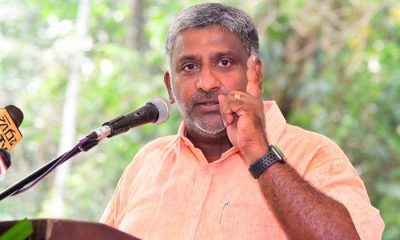
Urban Development and Housing Minister and Chief Government Whip, Prasanna Ranatunga, has denied reports that the SLPP is planning to replace Prime Minister Dinesh Gunawardena.
Calling Gunawardena an experienced politician who had proved his capabilities, Ranatunga said that there was no need to replace him. The assurance was given at a simple ceremony at his ministry when Thenuka Widanagamage assumed duties as the State Minister for Urban Development and Housing.
Recently, SLPP rebel, Prof. Channa Jayasumana, told the Parliament that there was a move to replace Dinesh Gunawardena.
A statement issued by Urban Development and Housing Ministry quoted Minister Ranatunga as having said that they required State Ministers as Ministers found it difficult to handle various institutions assigned to a particular ministry. Minister Ranatunga said that there was no basis for accusations that appointments of State Ministers resulted in additional expenditure. If so, all lawmakers have to stop receiving salary and allowances, Minister Ranatunga said, pointing out that public servants receive salaries, and allowances, much more than them.
Minister Ranatunga said that JVP leader Anura Kumara Dissanayake had received a ministerial post while Sri Lanka was experiencing an economic crisis.
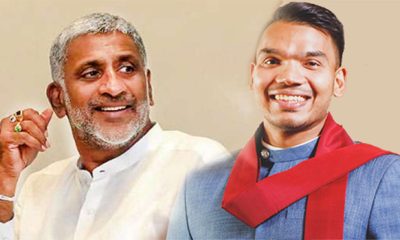
Commenting on the Rajapaksas, Minister Ranatunga said the people had elected Gotabaya Rajapaksa at the November 2019 presidential election, as they wanted a system change. Minister Ranatunga said that Namal Rajapaksa was eligible for a Cabinet appointment as he polled the highest number of preferential votes in the Hambantota district, at the last general election. The Minister said that he didn’t know whether Namal Rajapaksa would accept a ministerial portfolio.
Minister Ranatunga said that former President Gotabaya Rajapaksa should decide whether to return to active politics. The future would decide whether the actions of Gotabaya Rajapaksa, in his capacity as the President, were right, the Minister said (SF)







Latest News
Sun directly overhead Pomparippu, Anuradhapura, Mihinthale, Galenbindunuwewa, Agbopura and Serunuwara about 12:11 noon today (11)


On the apparent northward relative motion of the sun, it is going to be directly over the latitudes of Sri Lanka from 05th to 15th of April in this year.
The nearest areas of Sri Lanka over which the sun is overhead today (11th) are Pomparippu, Anuradhapura, Mihinthale, Galenbindunuwewa, Agbopura and Serunuwara about 12:11 noon.

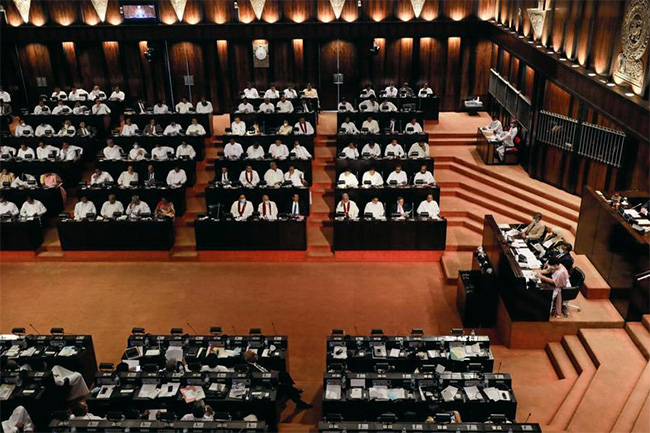
A no-confidence motion brought by the Opposition against Energy Minister Kumara Jayakody was defeated in Parliament yesterday by a majority of 104 votes.At the end of the debate, 49 members voted in favour of the motion, while 153 voted against it.
The motion, submitted to the Speaker on 19 March, was signed by Opposition Leader Sajith Premadasa, SJB MPs, and other Opposition members.
It accused Minister Jayakody of failing to ensure the procurement of adequate and quality coal for the Lakvijaya Coal Power Plant in Norochcholai, alleging that such negligence amounted to a breach of ministerial responsibility over a critical national energy asset.
The motion also cited ongoing legal proceedings against the Minister, noting that he has been indicted by the Commission to Investigate Allegations of Bribery or Corruption and produced before the Colombo High Court under Section 70 of the Bribery Act, in connection with alleged acts of corruption during his tenure as Procurement Manager of the Ceylon Fertiliser Company Limited.
The motion read: Vote of No Confidence against Kumara Jayakody, Minister of Energy,— Whereas the Provision in Section 6 of the Part III of the Code of Conduct for Members of Parliament which states that: “The Members shall on all occasions act in accordance with the public trust entrusted with them and shall always behave with probity and integrity, including the use by them of any public resources.” has been violated; And whereas the following rules of conduct set out in Section 9 of the Part V of the Code of Conduct for Members of Parliament have prima facie been breached, namely:- “(a) to be conscience; (c) to act so as to merit the trust and respect of the people; (e) to hold themselves accountable for the conduct and duties for which they are responsible;” And whereas it is observed that the Minister has failed, in his capacity as a Minister of the Cabinet of Ministers, to discharge the fundamental duties incumbent upon him in accordance with Article 28 of the Constitution;
And whereas it is established that the Minister of Energy has failed to discharge his primary duty of ensuring the procurement of adequate and good quality coal for the Norochcholai Lakvijaya Coal Power Plant;
And whereas such gross negligence in overseeing a critical national energy asset constitutes a fundamental breach of ministerial responsibility;
And whereas the Minister of Energy has failed to carry out the subjects and functions vested in him by the Notification of Gazette Extraordinary No. 2412/08 of 25th November 2024 of the Democratic Socialist Republic of Sri Lanka, including taking necessary steps to reduce the losses at the institutional management level and technical damages that occur to the electricity generation and distribution system and reduction of costs for generating electricity and removal of uncertainties during generation;
And whereas the Commission to Investigate Allegations of Bribery or Corruption has filed formal indictments before the Colombo High Court against the incumbent Minister of Energy under Section 70 of the Bribery Act (Chapter 26) for the offence of “corruption” in connection with acts of corruption allegedly committed while he was serving as the Procurement Manager of the Lanka Fertilizer Company;
And whereas, in light of the foregoing, the Minister of Energy has irretrievably forfeited the confidence of Parliament and the people of Sri Lanka by causing losses to public finances, endangering national energy security, corruptly mishandling the procurement process, being subjected to active judicial proceedings for the offence of “corruption”, and betraying the Government’s own “anti-corruption mandate”, and his continued tenure as the Minister of Energy is contrary to the public interest, the rule of law, and the principles of good governance;
That this Parliament resolves that it has no confidence in the competence of Kumara Jayakody, Minister of Energy to function as a Minister of the Cabinet of Ministers any longer.”
by Saman Indrajith

Chinese Ambassador to Sri Lanka Qi Zhenhong yesterday assured that China would not allow a fuel crisis to arise in Sri Lanka, under any circumstances, reaffirming Beijing’s continued support to the country.
The Ambassador made these remarks addressing the media after attending a dry ration distribution programme for 350 low-income families at Sri Chandananda Buddhist College, at Asgiriya, in Kandy.
Highlighting the longstanding ties between the two countries, Ambassador Qi said China has consistently stood by Sri Lanka and remains ready to extend assistance whenever required.
Amid concerns over global energy disruptions, stemming from the ongoing Middle East conflict, he noted that several countries are already facing difficulties, but stressed that China is prepared to support Sri Lanka at any time.
He said that any potential fuel shortage in Sri Lanka could be managed with the involvement of China’s Sinopec.
Reiterating Beijing’s commitment to Sri Lanka’s economic recovery and development, the Envoy also expressed hope that the current ceasefire in the Middle East would hold, while assuring that China stands ready to respond to any future developments and assist Sri Lanka as needed.
By SK Samaranayake

Sooryavanshi blitz, Jurel 81* help Rajasthan Royals take down Royal Challengers Bengaluru with ease

Sun directly overhead Pomparippu, Anuradhapura, Mihinthale, Galenbindunuwewa, Agbopura and Serunuwara about 12:11 noon today (11)

Showers expected in the Western, Sabaragamuwa, North-western , Southern and Uva provinces and in Anuradhapura, Mannar, Kandy and Nuwara-Eliya districts after 2.00 p.m.

Opposition NCM against Energy Minister defeated

Chinese Ambassador assures Lanka China will not allow a fuel crisis to develop here

Minister Jayatissa blames administrations since 2010 for not following proper procedures when procuring coal

‘Dates have the highest sugar content to fight Coronavirus’

Sunday Island 27 December – Headlines

#SundayIsland 17th December – Headlines

Sunday Island – 28th March

Sunday Island Headlines – 21 March

Sunday Island – 21st February – Headlines
-

 Features6 days ago
Ranjith Siyambalapitiya turns custodian of a rare living collection
-

 News6 days ago
Global ‘Walk for Peace’ to be held in Lanka
-

 News4 days ago
Lankan-origin actress Subashini found dead in India
-

 News2 days ago
AG: Coal procurement full of irregularities
-

 Business1 day ago
Israeli attack on Lebanon triggers local stock market volatility
-

 Features6 days ago
Beyond the Blue Skies: A Tribute to Captain Elmo Jayawardena
-

 Features6 days ago
Aspects of Ceylon/Sri Lanka Foreign Relations – 1948 to 1976
-

 Business2 days ago
Hayleys Mobility introduces Premium OMODA C9 PHEV