
Features
Celebrating 25 Years of Excellence: The Silver Jubilee of SLIIT – II

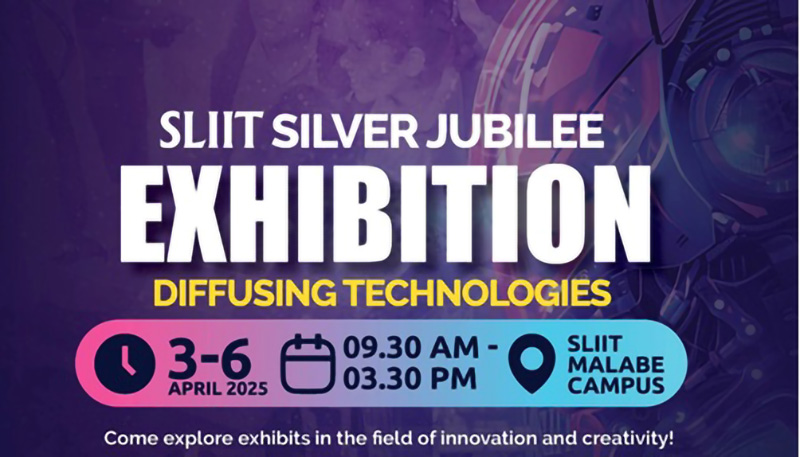
 Founded in 1999, with its main campus in Malabe and multiple centres across the country—including Metro Campus (Colombo), Matara, Kurunegala, Kandy (Pallekele), and Jaffna (Northern Uni)—SLIIT provides state-of-the-art facilities for students, now celebrating 25 years of excellence in 2025.
Kandy Campus
SLIIT is a degree-awarding higher education institute authorised and approved by the University Grants Commission (UGC) and Ministry of Higher Education under the University Act of the Government of Sri Lanka. SLIIT is also the first Sri Lankan institute accredited by the Institution of Engineering & Technology, UK. Further, SLIIT is also a member of the Association of Commonwealth Universities (ACU) and the International Association of Universities (IAU).
Founded in 1999, with its main campus in Malabe and multiple centres across the country—including Metro Campus (Colombo), Matara, Kurunegala, Kandy (Pallekele), and Jaffna (Northern Uni)—SLIIT provides state-of-the-art facilities for students, now celebrating 25 years of excellence in 2025.
Since its inception, SLIIT has played a pivotal role in shaping the technological and educational landscape of Sri Lanka, producing graduates who have excelled in both local and global arenas. This milestone is a testament to the institution’s unwavering commitment to academic excellence, research, and industry collaboration.
Summary of SLIIT’s
History and Status
Sri Lanka Institute of Information Technology (SLIIT) operates as a company limited by guarantee, meaning it has no shareholders and reinvests all surpluses into academic and institutional development.
* Independence from Government: SLIIT was established in 1999 as an independent entity without government ownership or funding, apart from an initial industry promotion grant from the Board of Investment (BOI).
* Mahapola Trust Fund Involvement & Malabe Campus: In 2000, the Mahapola Trust Fund (MTF) agreed to support SLIIT with funding and land for the Malabe Campus. In 2015, SLIIT fully repaid MTF with interest, ending financial ties.
* True Independence (2017-Present): In 2017, SLIIT was officially delisted from any government ministry, reaffirming its status as a self-sustaining, non-state higher education institution.
Today, SLIIT is recognised for academic excellence, global collaborations, and its role in producing IT professionals in Sri Lanka
.A Journey of Growth and Innovation
SLIIT began as a pioneering institution dedicated to advancing information technology education in Sri Lanka. Over the past two and a half decades, it has expanded its academic offerings, establishing itself as a multidisciplinary university with programmess in engineering, business, architecture, and humanities, in addition to IT. The growth of SLIIT has been marked by continuous improvement in infrastructure, faculty development, and curriculum enhancement, ensuring that students receive world-class education aligned with industry needs.
Looking Ahead: The Next 25 Years
As SLIIT celebrates its Silver Jubilee, the institution looks forward to the future with a renewed commitment to excellence. With advancements in technology, the rise of artificial intelligence, and the increasing demand for skilled professionals, SLIIT aims to further expand its academic offerings, enhance research capabilities, and continue fostering a culture of innovation. The next 25 years promise to be even more transformative, as the university aspires to make greater contributions to national and global progress.
Sports Achievements:
A Legacy of Excellence
SLIIT has not only excelled in academics but has also built a strong reputation in sports. Over the years, the university has actively promoted athletics and competitive sports by organising inter-university and inter-school competitions, fostering a culture of teamwork, discipline, and resilience. SLIIT teams have secured victories in national and inter-university competitions across various sports, including cricket, basketball, badminton, rugby, football, swimming, and athletics. SLIIT’s sports achievements reflect its dedication to holistic student development, encouraging students to excel beyond the classroom.
Kings of the pool!
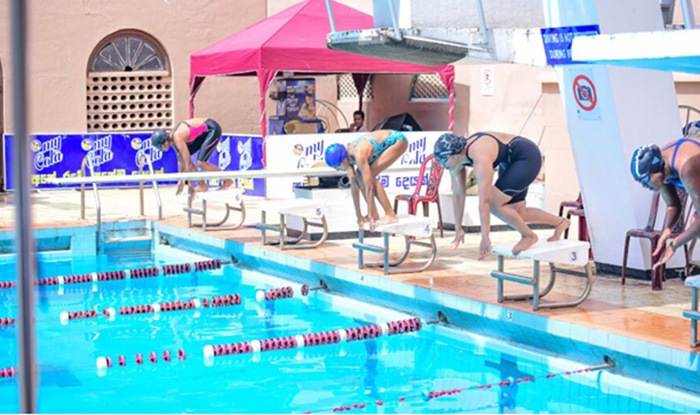
Once again, our swimmers have brought glory to SLIIT by emerging as champions at the Asia Pacific Institute of Information and Technology Extravaganza Swimming Championship 2024. They won the Men’s, Women’s, and Overall Championships. Congratulations to all swimmers for their dedication and hard work in the pool, bringing honour to SLIIT.
Winning International Competitions
SLIIT students have participated in and excelled in various international competitions, including Robofest, Codefest, and the University of Queensland – Design Solution for Impact Competition, showcasing their skills and talent on a global stage.
Here’s a more detailed look at SLIIT’s involvement in international competitions:
Robofest:
SLIIT’s Faculty of Engineering organises the annual Robofest competition, which aims to empower students with skills in electronics, robotics, critical thinking, and problem-solving, preparing them to compete internationally and bring recognition to Sri Lankan talent.
Codefest:
CODEFEST is a nationwide Software Competition organized by the Faculty of Computing of Sri Lanka Institute of Information Technology (SLIIT) geared towards exhibiting the software application design and developing talents of students island-wide. It is an effort of SLIIT to elevate the entire nation’s ICT knowledge to achieve its aspiration of being the knowledge hub in Asia. CODEFEST was first organised in 2012 and this year it will be held for the 8th consecutive time in parallel with the 20th anniversary celebrations of SLIIT.
University of Queensland – Design Solution for Impact Competition:
SLIIT hosted the first-ever University of Queensland – Design Solution for Impact Competition in Sri Lanka, with 16 school teams from across the country participating.
International Open Day:
SLIIT organises an International Open Day where students can connect with distinguished lecturers and university representatives from prestigious institutions like the University of Queensland, Liverpool John Moores University, and Manchester Metropolitan University.
Brain Busters:
SLIIT Brain Busters is a quiz competition organised by SLIIT. The competition is open to students of National, Private and International Schools Island wide. The programme is broadcast on TV1 television as a series.
Inter-University Dance Competition:
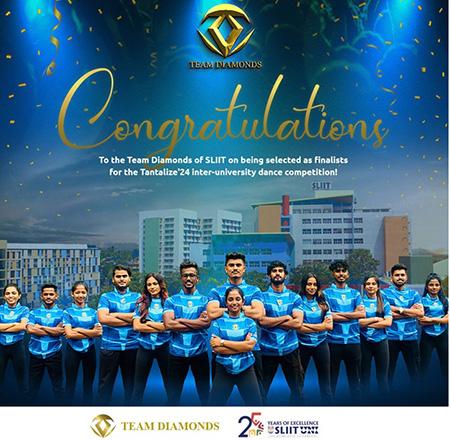
SLIIT Team Diamonds for being selected as finalists and advancing to the Grand Finale of Tantalize 2024, the inter-university dance competition organised by APIIT Sri Lanka. The 14 talented team members from various SLIIT faculties have showcased their skills in Team Diamonds and earned their spot as finalists, competing among over 30 teams from state universities, private universities, and higher education institutes.
Softskills+
For the 11th consecutive year, Softskills+ returns with an exciting lineup of events aimed at honing essential soft skills among students. The program encompasses an interschool quiz contest and a comprehensive workshop focused on developing teamwork, problem-solving abilities, leadership qualities, and fostering creative thinking.
Recently, the Faculty of Business at SLIIT organised its annual Inter-school Quiz Competition and Soft Skills Workshop, marking its fifth successive year. Targeting students in grades 11 to 13 from Commerce streams across State, Private, and International schools, the workshop sought to ignite a passion for soft skills development, emphasising teamwork, problem-solving, creativity, and innovative thinking. Recognising the increasing importance of these soft skills in today’s workforce, the programme aims to fill the gap often left unaddressed in the school curriculum.”
The winners of the soft skill competition with Professor Lakshman Rathnayake: Chairman/Chancellor, Vice Chancellor/MD Professor Lalith Gamage, Professor Nimal Rajapakse: Senior Deputy Vice – Chancellor & Provost, Deputy Vice Chancellor – Research and International Affairs Professor Samantha Thelijjagoda, and Veteran Film Director Somarathna Dissanayake.
VogueFest 2024:
SLIIT Business School organised VogueFest 2024, a platform for emerging fashion designers under 30 to showcase their work and win prizes.
T-shirt Design Competition with Sheffield Hallam University:
SLIIT and Sheffield Hallam University (SHU) UK collaborated on a T-shirt designing competition, with a voting procedure to select the best design.
SLIIT’s Got Talent
: The annual talent show, SLIIT’s Got Talent 2024, was held for the 10th consecutive year at the Nelum Pokuna Mahinda Rajapaksa Theatre on 27th September 2024. SLIIT’s Got Talent had the audience energised with amazing performances, showcasing mind-blowing talent by the orchestra and the talented undergraduates from all faculties.
Other events:
* SLIIT also participates in events like the EDUVision Exhibition organised by the Richmond College Old Boys’ Association.
* They hosted the first-ever University of Queensland – Design Solution for Impact Competition in Sri Lanka.
* SLIIT Business School also organised the Business Proposal Competition.
SLIIT Academy:
SLIIT Academy (Pvt.) Ltd. provides industrial-oriented learning experiences for students.
International Partnerships:
SLIIT has strong international partnerships with universities like Liverpool John Moores University (LJMU), The University of Queensland (UQ), Manchester Metropolitan University (MMU), and Curtin University Australia, providing opportunities for students to study and participate in international events.
(The writer, a senior Chartered Accountant and professional banker, is Professor at SLIIT University, Malabe. He is also the author of the “Doing Social Research and Publishing Results”, a Springer publication (Singapore), and “Samaja Gaveshakaya (in Sinhala).


 On being elected US President in 2008, Barack Obama famously stated: ‘Change has come to America’. Considering the questions continuing to grow out of the status of minority rights in particular in the US, this declaration by the former US President could come to be seen as somewhat premature by some. However, there could be no doubt that the election of Barack Obama to the US presidency proved that democracy in the US is to a considerable degree inclusive and accommodating.
If this were not so, Barack Obama, an Afro-American politician, would never have been elected President of the US. Obama was exceptionally capable, charismatic and eloquent but these qualities alone could not have paved the way for his victory. On careful reflection it could be said that the solid groundwork laid by indefatigable Black Civil Rights activists in the US of the likes of Martin Luther King (Jnr) and Jesse Jackson, who passed away just recently, went a great distance to enable Obama to come to power and that too for two terms. Obama is on record as owning to the profound influence these Civil Rights leaders had on his career.
The fact is that these Civil Rights activists and Obama himself spoke to the hearts and minds of most Americans and convinced them of the need for democratic inclusion in the US. They, in other words, made a convincing case for Black rights. Above all, their struggles were largely peaceful.
Their reasoning resonated well with the thinking sections of the US who saw them as subscribers to the Universal Declaration of Human Rights, for instance, which made a lucid case for mankind’s equal dignity. That is, ‘all human beings are equal in dignity.’
It may be recalled that Martin Luther King (Jnr.) famously declared: ‘I have a dream that one day this nation will rise up, live out the true meaning of its creed….We hold these truths to be self-evident, that all men are created equal.’
Jesse Jackson vied unsuccessfully to be a Democratic Party presidential candidate twice but his energetic campaigns helped to raise public awareness about the injustices and material hardships suffered by the black community in particular. Obama, we now know, worked hard at grass roots level in the run-up to his election. This experience proved invaluable in his efforts to sensitize the public to the harsh realities of the depressed sections of US society.
Cynics are bound to retort on reading the foregoing that all the good work done by the political personalities in question has come to nought in the US; currently administered by Republican hard line President Donald Trump. Needless to say, minority communities are now no longer welcome in the US and migrants are coming to be seen as virtual outcasts who need to be ‘shown the door’ . All this seems to be happening in so short a while since the Democrats were voted out of office at the last presidential election.
However, the last US presidential election was not free of controversy and the lesson is far too easily forgotten that democratic development is a process that needs to be persisted with. In a vital sense it is ‘a journey’ that encounters huge ups and downs. More so why it must be judiciously steered and in the absence of such foresighted managing the democratic process could very well run aground and this misfortune is overtaking the US to a notable extent.
The onus is on the Democratic Party and other sections supportive of democracy to halt the US’ steady slide into authoritarianism and white supremacist rule. They would need to demonstrate the foresight, dexterity and resourcefulness of the Black leaders in focus. In the absence of such dynamic political activism, the steady decline of the US as a major democracy cannot be prevented.
From the foregoing some important foreign policy issues crop-up for the global South in particular. The US’ prowess as the ‘world’s mightiest democracy’ could be called in question at present but none could doubt the flexibility of its governance system. The system’s inclusivity and accommodative nature remains and the possibility could not be ruled out of the system throwing up another leader of the stature of Barack Obama who could to a great extent rally the US public behind him in the direction of democratic development. In the event of the latter happening, the US could come to experience a democratic rejuvenation.
The latter possibilities need to be borne in mind by politicians of the South in particular. The latter have come to inherit a legacy of Non-alignment and this will stand them in good stead; particularly if their countries are bankrupt and helpless, as is Sri Lanka’s lot currently. They cannot afford to take sides rigorously in the foreign relations sphere but Non-alignment should not come to mean for them an unreserved alliance with the major powers of the South, such as China. Nor could they come under the dictates of Russia. For, both these major powers that have been deferentially treated by the South over the decades are essentially authoritarian in nature and a blind tie-up with them would not be in the best interests of the South, going forward.
However, while the South should not ruffle its ties with the big powers of the South it would need to ensure that its ties with the democracies of the West in particular remain intact in a flourishing condition. This is what Non-alignment, correctly understood, advises.
Accordingly, considering the US’ democratic resilience and its intrinsic strengths, the South would do well to be on cordial terms with the US as well. A Black presidency in the US has after all proved that the US is not predestined, so to speak, to be a country for only the jingoistic whites. It could genuinely be an all-inclusive, accommodative democracy and by virtue of these characteristics could be an inspiration for the South.
However, political leaders of the South would need to consider their development options very judiciously. The ‘neo-liberal’ ideology of the West need not necessarily be adopted but central planning and equity could be brought to the forefront of their talks with Western financial institutions. Dexterity in diplomacy would prove vital.
Whispers of Lanka
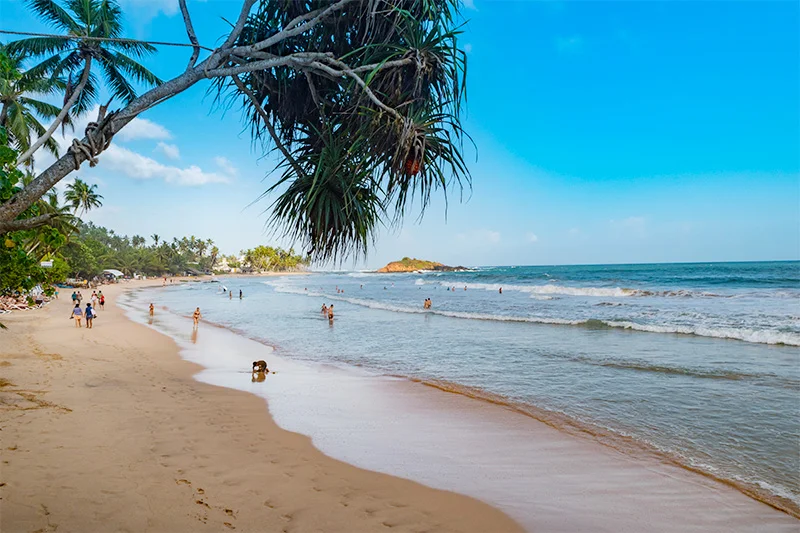
I was born in a hamlet on the western edge of a tiny teacup bay named Mirissa on the South Coast of Sri Lanka. My childhood was very happy and secure. I played with my cousins and friends on the dusty village roads. We had a few toys to play with, so we always improvised our own games. On rainy days, the village roads became small rivulets on which we sailed paper boats. We could walk from someone’s backyard to another, and there were no fences. We had the freedom to explore the surrounding hills, valleys, and streams.
I was good at school and often helped my classmates with their lessons. I passed the General Certificate of Education (Ordinary Level) at the village school and went to Colombo to study for the General Certificate of Education (Advanced Level). However, I did not like Colombo, and every weekend I hurried back to the village. I was not particularly interested in my studies and struggled in specific subjects. But my teachers knew that I was intelligent and encouraged me to study hard.
To my amazement, I passed the Advanced Level, entered the University of Kelaniya, completed an honours degree in Economics, taught for a few months at a central college, became a lecturer at the same university, and later joined the Department of Census and Statistics as a statistician. Then I went to the University of Wales in the UK to study for an MSc.
The interactions with other international students in my study group, along with very positive recommendations from my professors, helped me secure several jobs in the oil-rich Middle Eastern countries, where I earned salaries unimaginable in Sri Lankan terms. During this period, without much thought, I entered a life focused on material possessions, social status, and excessive consumerism.
Life changes
Unfortunately, this comfortable, enjoyable life changed drastically in the mid-1980s because of the political activities of certain groups. Radicalised youths, brainwashed and empowered by the dynamics of vibrant leftist politics, killed political opponents as well as ordinary people who were reluctant to follow their orders. Their violent methods frightened a large section of Sri Lanka’s middle class into reluctantly accepting country-wide closures of schools, factories, businesses, and government offices.
My father’s generation felt a deep obligation to honour the sacrifices they had made to give us everything we had. There was a belief that you made it in life through your education, and that if you had to work hard, you did. Although I had never seriously considered emigration before, our sons’ education was paramount, and we left Sri Lanka.
Although there were regulations on what could be brought in, migrating to Sydney in the 1980s offered a more relaxed airport experience, with simpler security, a strong presence of airline staff, and a more formal atmosphere. As we were relocating permanently, a few weeks before our departure, we had organised a container to transport sentimental belongings from our home. Our flight baggage was minimal, which puzzled the customs officer, but he laughed when he saw another bulky item on a separate trolley. It was a large box containing a bookshelf purchased in Singapore. Upon discovering that a new migrant family was arriving in Australia with a 32-volume Encyclopaedia Britannica set weighing approximately 250 kilograms, he became cheerful, relaxed his jaw, and said, G’day!
Settling in Sydney
We settled in Epping, Sydney, and enrolled our sons in Epping Boys’ High School. Within one week of our arrival from Sri Lanka, we both found jobs: my wife in her usual accounting position in the private sector, and I was taken on by the Civil Aviation Authority (CAA). While working at the CAA, I sat the Australian Graduate Admission Test. I secured a graduate position with the Australian Bureau of Statistics (ABS) in Canberra, ACT.
We bought a house in Florey, close to my office in Belconnen. The roads near the house were eerily quiet. Back in my hometown of Pelawatta, outside Colombo, my life had a distinct soundtrack. I woke up every morning to the radios blasting ‘pirith’ from the nearby houses; the music of the bread delivery van announcing its arrival, an old man was muttering wild curses to someone while setting up his thambili cart near the junction, free-ranging ‘pariah’ dogs were barking at every moving thing and shadows. Even the wildlife was noisy- black crows gathered on the branches of the mango tree in front of the house to perform a mournful dirge in the morning.
Our Australian neighbours gave us good advice and guidance, and we gradually settled in. If one of the complaints about Asians is that they “won’t join in or integrate to the same degree as Australians do,” this did not apply to us! We never attempted to become Aussies; that was impossible because we didn’t have tanned skin, hazel eyes, or blonde hair, but we did join in the Australian way of life. Having a beer with my next-door neighbour on the weekend and a biannual get-together with the residents of the lane became a routine. Walking or cycling ten kilometres around the Ginninderra Lake with a fit-fanatic of a neighbour was a weekly ritual that I rarely skipped.
Almost every year, early in the New Year, we went to the South Coast. My family and two of our best friends shared a rented house near the beach for a week. There’s not much to do except mix with lots of families with kids, dogs on the beach, lazy days in the sun with a barbecue and a couple of beers in the evening, watching golden sunsets. When you think about Australian summer holidays, that’s all you really need, and that’s all we had!
Caught between two cultures
We tried to hold on to our national tradition of warm hospitality by organising weekend meals with our friends. Enticed by the promise of my wife’s home-cooked feast, our Sri Lankan friends would congregate at our place. Each family would also bring a special dish of food to share. Our house would be crammed with my friends, their spouses and children, the sound of laughter and loud chatter – English mingled with Sinhala – and the aroma of spicy food.
We loved the togetherness, the feeling of never being alone, and the deep sense of belonging within the community. That doesn’t mean I had no regrets in my Australian lifestyle, no matter how trivial they may have seemed. I would have seen migration to another country only as a change of abode and employment, and I would rarely have expected it to bring about far greater changes to my psychological role and identity. In Sri Lanka, I have grown to maturity within a society with rigid demarcation lines between academic, professional, and other groups.
Furthermore, the transplantation from a patriarchal society where family bonds were essential to a culture where individual pursuit of happiness tended to undermine traditional values was a difficult one for me. While I struggled with my changing role, my sons quickly adopted the behaviour and aspirations of their Australian peers. A significant part of our sons’ challenges lay in their being the first generation of Sri Lankan-Australians.
The uniqueness of the responsibilities they discovered while growing up in Australia, and with their parents coming from another country, required them to play a linguistic mediator role, and we, as parents, had to play the cultural mediator role. They were more gregarious and adaptive than we were, and consequently, there was an instant, unrestrained immersion in cultural diversity and plurality.
Technology
They became articulate spokesmen for young Australians growing up in a world where information technology and transactions have become faster, more advanced, and much more widespread. My work in the ABS for nearly twenty years has followed cycles, from data collection, processing, quality assurance, and analysis to mapping, research, and publishing. As the work was mainly computer-based and required assessing and interrogating large datasets, I often had to depend heavily on in-house software developers and mainframe programmers. Over that time, I have worked in several areas of the ABS, making a valuable contribution and gaining a wide range of experience in national accounting.
I immensely valued the unbiased nature of my work, in which the ABS strived to inform its readers without the influence of public opinion or government decisions. It made me proud to work for an organisation that had a high regard for quality, accuracy, and confidentiality. I’m not exaggerating, but it is one of the world’s best statistical organisations! I rubbed shoulders with the greatest statistical minds. The value of this experience was that it enabled me to secure many assignments in Vanuatu, Fiji, East Timor, Saudi Arabia, and the Solomon Islands through the World Bank and the International Monetary Fund after I left the ABS.
Living in Australia
Studying and living in Australia gave my sons ample opportunities to realise that their success depended not on acquiring material wealth but on building human capital. They discovered that it was the sum total of their skills embodied within them: education, intelligence, creativity, work experience and even the ability to play basketball and cricket competitively. They knew it was what they would be left with if someone stripped away all of their assets. So they did their best to pursue their careers on that path and achieve their life goals. Of course, the healthy Australian economy mattered too. As an economist said, “A strong economy did not transform a valet parking attendant into a professor. Investment in human capital did that.”
Nostalgia
After living in Australia for several decades, do I miss Sri Lanka? Which country deserves my preference, the one where I was born or the one to which I migrated? There is no single answer; it depends on opportunities, prospects, lifestyle, and family. Factors such as the cost of living, healthcare, climate, and culture also play significant roles in shaping this preference. Tradition in a slow-motion place like Sri Lanka is an ethical code based on honouring those who do things the same way you do, and dishonour those who don’t. However, in Australia, one has the freedom to express oneself, to debate openly, to hold unconventional views, to be more immune to peer pressure, and not to have one’s every action scrutinised and discussed.
For many years, I have navigated the challenges of cultural differences, conflicting values, and the constant negotiation of where I truly ‘belong.’ Instead of yearning for a ‘dream home’ where I once lived, I have struggled, and to some extent succeeded, to find a home where I live now. This does not mean I have forgotten or discarded my roots. As one Sri Lankan-Australian senior executive remarked, “I have not restricted myself to the box I came in… I was not the ethnicity, skin colour, or lack thereof, of the typical Australian… but that has been irrelevant to my ability to contribute to the things which are important to me and to the country adopted by me.” Now, why do I live where I live – in that old house in Florey? I love the freshness of the air, away from the city smog, noisy traffic, and fumes. I enjoy walking in the evening along the tree-lined avenues and footpaths in my suburb, and occasionally I see a kangaroo hopping along the nature strip. I like the abundance of trees and birds singing at my back door. There are many species of birds in the area, but a common link with ours is the melodious warbling of resident magpies. My wife has been feeding them for several years, and we see the new fledglings every year. At first light and in the evening, they walk up to the back door and sing for their meal. The magpie is an Australian icon, and I think its singing is one of the most melodious sounds in the suburban areas and even more so in the bush.
by Siri Ipalawatte
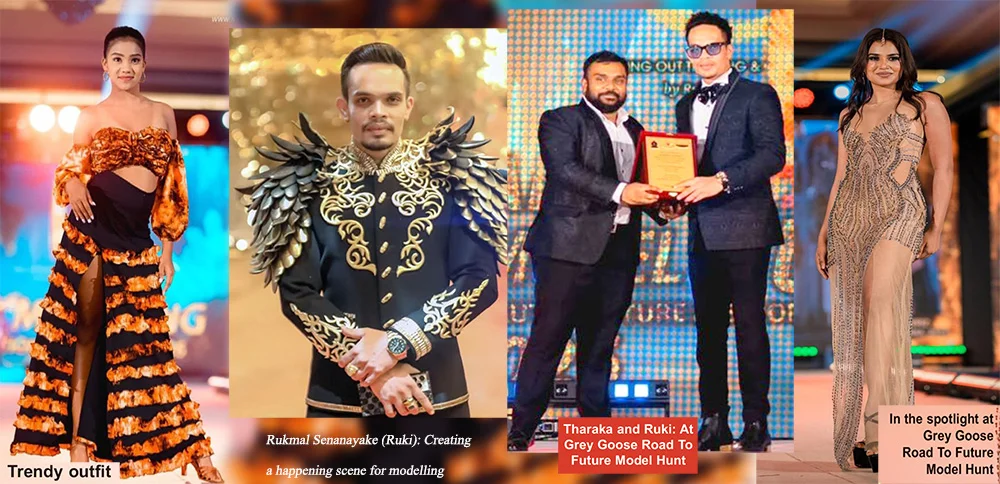
Modelling has turned out to be a big scene here and now there are lots of opportunities for girls and boys to excel as models.
Of course, one can’t step onto the ramp without proper training, and training should be in the hands of those who are aware of what modelling is all about.
Rukmal Senanayake is very much in the news these days and his Model With Ruki – Model Academy & Agency – is responsible for bringing into the limelight, not only upcoming models but also contestants participating in beauty pageants, especially internationally.
On the 29th of January, this year, it was a vibrant scene at the Temple Trees Auditorium, in Colombo, when Rukmal introduced the Grey Goose Road To Future Model Hunt.

Tharaka Gurukanda … in
the scene with Rukmal
This is the second Model Hunt to be held in Sri Lanka; the first was in 2023, at Nelum Pokuna, where over 150 models were able to showcase their skills at one of the largest fashion ramps in Sri Lanka.
The concept was created by Rukmal Senanayake and co-founded by Tharaka Gurukanda.
Future Model Hunt, is the only Southeast Asian fashion show for upcoming models, and designers, to work along and create a career for their future.
The Grey Goose Road To Future Model Hunt, which showcased two segments, brought into the limelight several models, including students of Ruki’s Model Academy & Agency and those who are established as models.
An enthusiastic audience was kept spellbound by the happenings on the ramp.
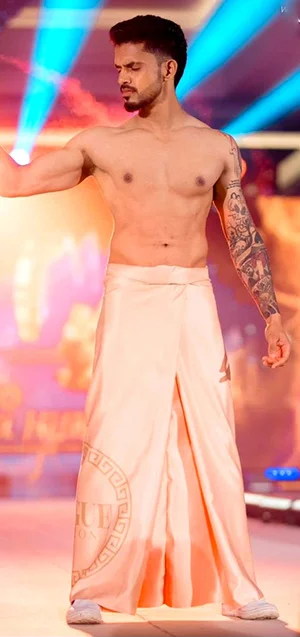
Doing it differently
Four candidates were also crowned, at this prestigious event, and they will represent Sri Lanka at the respective international pageants.
Those who missed the Grey Goose Road To Future Model Hunt, held last month, can look forward to another exciting Future Model Hunt event, scheduled for the month of May, 2026, where, I’m told, over 150 models will walk the ramp, along with several designers.
It will be held at a prime location in Colombo with an audience count, expected to be over 2000.
Model With Ruki offers training for ramp modelling and beauty pageants and other professional modelling areas.
Their courses cover: Ramp walk techniques, Posture and grooming, Pose and expression, Runway etiquette, and Photo shoots and portfolio building,
They prepare models for local and international fashion events, shoots, and competitions and even send models abroad for various promotional events.

“Investments in Professional Education Are Investments in Institutional Strength and National Progress” – PM

Zimbabwe stun Sri Lanka to enter Super Eight unbeaten

Ex-UK Prince Andrew arrested on suspicion of misconduct in public office

Advisory for Severe Lightning issued to the Western and Sabaragamuwa provinces and Nuwara-Eliya, Galle and Matara districts

Navy and Coast Guard seize 04 Indian fishing vessels poaching in Sri Lankan waters

Hope’s 75, Forde and Joseph’s wickets help West Indies go into playoffs unconquered

‘Dates have the highest sugar content to fight Coronavirus’

Sunday Island 27 December – Headlines

#SundayIsland 17th December – Headlines

Sunday Island – 28th March

Sunday Island Headlines – 21 March

Sunday Island – 21st February – Headlines
-
 Life style5 days ago
Marriot new GM Suranga
-

 Business4 days ago
Ministry of Brands to launch Sri Lanka’s first off-price retail destination
-
 Features5 days ago
Monks’ march, in America and Sri Lanka
-
 Features5 days ago
The Rise of Takaichi
-
 Features5 days ago
Wetlands of Sri Lanka:
-
 News5 days ago
Thailand to recruit 10,000 Lankans under new labour pact
-
 News5 days ago
Massive Sangha confab to address alleged injustices against monks
-
 News3 days ago
IMF MD here