
Business
Can we stop university ragging?


Following the tragic demise of a Sabaragamuwa University undergraduate, more than fifty articles have appeared in the media expressing views on various aspects of the barbaric tradition of ragging in Sri Lankan universities. However, this discussion is taken into an unprecedented height by the landmark decision by the Supreme Court (SC/FR/216/2020 on 2025-Jul-09) pertaining to a grievous act of ragging that took place in 2020, twenty-two years after ragging was made illegal by the Prohibition of Ragging and Other Forms of Violence in Educational Institutions Act No. 20 of 1998.
One needs not be a constitutional scholar to understand the responsibilities of the three branches of the government; the Supreme Court has fulfilled the responsibility of the judiciary. Now, the other two branches will have to step up. Anyone reading the 48-page judgement or the recent opinion pieces referred to earlier, will clearly see that the core issue is the failure to implement the 1998 law. Those responsible for the failure, as listed in the judgement, include everyone in the University Grants Commission’s payroll, the Head of Police, and the Attorney General. Anything new here?
No, there is no mystery about not being able to stop ragging, it is another clear and loud statement about our broken system: complete disregard for law and order for decades. Generations of elected officials, bureaucrats, and most public using their services broke the law with impunity, while others abated it or put up with it for survival, leading to the current socioeconomic bankruptcy of the country. Let us have no doubt, what is happening in universities and other institutions is not any different from what happened in the country since independence: callous disregard for law and order with complete impunity. This national habit of normalisation of criminal behaviour must be stopped, universities are no exception.
The supreme Court has read the riot act, but that is of limited utility. This is where the legislative and executive branches need to act. If we are to eradicate this menace, there must be a zero-tolerance policy, and the penalties must be swift, substantial, and well publicised to be a deterrent. A slap of the wrist as often happens, or negotiated settlements between the student union and academics sympathetic or connected to the student union are not any worse than ignoring the wrongdoing. The current law must be amended to include a mandatory, minimum one-year suspension for any violation. That is in addition to any criminal and civil penalties.
There will be those who cry foul; such severe punishments will impact on the whole life of a student, they may say. There are several responses to that misguided reasoning. Do we want to eliminate ragging or maintain it in a different form or level? What about the victims – aren’t their lives permanently affected? Other important questions are, was the violation an unintended result of performing a vital function, or was it the result of a provocation, loss of property, dignity, or some other harm to the perpetrator? All such questions can be addressed with a clear negative response, as ragging is a deliberate act that yields no constructive results. Ragging is a well-organised, premeditated activity. The element of planning and prior intent is considered an aggravating factor, meaning it increases the severity of the crime and harsher penalties can be justified.
It must be made compulsory for university students to read and understand the Prohibition of Ragging Act in its entirety. After assessing their comprehension of the law, they should be made to give their consent to abide by such laws by signing a legally binding document, in which the minimum one-year suspension is clearly spelled out, at the beginning of each academic year as a constant reminder of the severity of the consequences. A copy must be sent to their parents or guardians, so that they can do their part in bringing up responsible citizens. This practice must be extended to other affected institutions as well.
The Supreme Court judgement implicated the university and law enforcement communities for failing to implement the law. While the court did not give reasons, the fifty plus writers pointed out the reasons why the university community did or could not perform their duty. With my apologies to those few caring souls who had done their best and were treated as outcasts by their peers, a few of those reasons are worth repeating here.
Most academics have been subjected to mental conditioning of ragging during their own student days, and as a result they have developed sympathy and apathy towards ragging. According to one report, one vice chancellor has asked the perpetrators to limit ragging to two hours, when caught in the act! Is that the right mentality? Another issue is the politicisation of the academic and administrative appointments, which manifests in their perceptions of their roles, their interactions with the university system, and their engagement with social justice issues. Their loyalty is to their political handlers, and they are not answerable to the community.
Politicisation goes into ragging itself. This writer was there to witness how JVP systemised ragging into the sophisticated system found today, including dress codes, cards and so forth, as a recruiting and fundraising machine. It is not the intention to hold the present NPP responsible for past actions as they have clearly changed their ways, but to appeal to their desire and the potential for bringing forth change at grassroots level to do some good. The public, on the other hand, must force the political parties to make it a policy issue to put a stop to the ruinous practice of ragging. They should know that its effects are not limited to the minority that enters the universities, but they permeate through the economy and the culture at large.
The argument can continue, but it is too much for the university community to handle all three aspects of implementation of law, investigation, and prosecution of incidents, and delivering penalties as the first option. Entire university community, everyone in the UGC pay roll for that matter, must be held responsible for the enforcement of the law. They must be trained and held accountable as part of their job description. Unfortunately, due to many decades of conditioning, the university community has become insensitive to this issue. Changing the attitude of the entire university community, from vice chancellors to grounds keepers, and getting all of them involved must be given priority. The student unions, trade unions, and alumni associations can play a leading role in this endeavour.
As for investigation, apprehension, and prosecution of offenders, a separate independent entity must be created. This entity, preferably under the purview of the Attorney General, may be comprised of resources drawn from existing judiciary functions, but it must be a dedicated one so that cases can be concluded swiftly for maximum impact, preferably within weeks, not months. This could be limited to the initial determination of the violation, and the imposition of the compulsory one-year suspension if found guilty.
The criminal and civil cases arising from such offences can continue separately. This may sound like an expensive preposition, but if implemented properly, its services will not be needed after three to four years. We are dealing with the best and brightest of the nation, and they will learn fast, especially when they risk thirteen years of effort, parents’ investments and hopes, and the entire future.
The general sentiment expressed by most writers is that ragging cannot be stopped. As it is so deeply entrenched, only compromises can be made, some of them reasoned. This writer disagrees; if there is a collective will, there are ways for a civilised society to stop barbarism. The Prime Minister has appointed a task force to investigate it, but its scope is a much broader one: review and overhaul the education system.
There is no doubt that the entire education system must be modernised to meet the needs of the 21st century, but this ruinous practice must be stopped immediately as it is a major contributor to the degradation of society. Let us not forget that ragging is the plague that mentally cripple the generation destined to lead the country into prosperity. Without irradicating it, we will be wasting our sparce resources to further degrade our already dysfunctional society, not to mention the economy, and continue to feed an utterly unnecessary cyclical process.
Now that the country has committed to breaking away from the past, this is an ideal opportunity to grab the proverbial bull by the horns and do away with it. The task force appointed by the Prime Minister can facilitate it. This is a problem that can be easily solved, since it is of limited scope compared to irradicating corruption, even though both have common origins. We are focusing on the problem of the nation’s young adults who are fed, sheltered, and supported by the hardworking citizenry to the tune of half a million rupees per student in 2020 money, not to mention the blood, sweat, and heartache of parents.
The question here is whether society should give in to the juvenile whims of a small minority of young adults, whose only qualification thus far is box checking to get through an archaic examination system, or show them the right path. Young minds can be trained; their attitudes can be adjusted. Enlighten them that they are dependent on society, answerable to it, and that they are subjected to the country’s laws. Let them know in no uncertain terms that the times are changing and this behaviour is not acceptable. This goes for those who aid and abate or ignore this behaviour, the academics, administrators, law makers, enforcers, parents, and most importantly the student unions and their behind-the-scenes handlers.
For an administration intent on establishing a just society, stopping a minority that is misguided by a baseless ‘ideology’ of ‘university subculture’ that gives an inviolable right to rag since we were ragged, is undoubtedly within their capabilities. The Prime Minister’s task force must recommend the following: strengthening the Prohibition of Ragging act to make all relevant parties accountable. Establish a dedicated prosecutorial body independent of the university system.
Empower university martials to turn all university employees into a cohesive movement against ragging. Ensure that university students understand the law and that they are not above it, and the repercussions of violations are severe. The systematic brainwashing of the first-year students, even before they enter the university, by politically motivated entities must be stopped. Above all, the executive branch of the government must make sure that the laws are implemented without exception and make everyone accountable with a zero-tolerance policy. Provided they have the political will, which they have demonstrated so far, this curse can be eliminated before their current term ends. At the same time, the public should give their full support to the administration as if they do not do so, their dream of a happy and prosperous society will be just that, a pipe dream.
by Geewananda Gunawardana, Ph.D. ✍️



The latest earnings report for Sampath Bank PLC (SAMP), analysed by First Capital Research (FCR), firmly supports a positive outlook among investors. The research firm has stuck with its “MAINTAIN BUY” recommendation , setting optimistic targets: a Fair Value of LKR 165.00 for 2025 and LKR 175.00 for 2026. This signals strong belief that the bank is managing the economy’s recovery successfully.
The key reason for this optimism is the bank’s shift towards aggressive, yet smart, growth. Even as interest rates dropped across the market, which usually makes loan income (Net Interest Income) harder to earn, Sampath Bank saw its total loans jump by a huge 30.2% compared to last year. This means the bank lent out a lot more money, increasing its loan book to LKR 1.1 Trillion. This strong lending, which covers trade finance, leasing, and regular term loans, shows the bank is actively helping businesses and people spend and invest as the economy recovers.
In addition to loans, the bank has found a major new source of income from fees and commissions, which surged by 42.6% year-over-year. This money comes from services like card usage, trade activities, and digital banking transactions. This shift makes the bank less reliant on just interest rates, giving it a more stable and higher-profit way to earn money.
Importantly, this growth hasn’t weakened the bank’s foundations. Sampath Bank is managing its funding costs better, partly by improving its low-cost current and savings account (CASA) ratio to 34.5%. Moreover, the quality of its loans is getting better, with bad loans (Stage 3) dropping to 3.77% and the money set aside to cover potential losses rising to a careful 60.25%.
Even with the new, higher capital requirements for systemically important banks, the bank remains very strong, keeping its capital and cash buffers robust and well above the minimum standards.
In short, while the estimated profit for 2025 was adjusted slightly, the bank’s excellent performance and strong strategy overshadow this minor change. Sampath Bank is viewed as a sound stock with high growth potential , offering investors attractive total returns over the next two years.
By Sanath Nanayakkare

The Asian Development Bank (ADB) has approved a $200 million loan to support the ongoing Mahaweli Development Program, Sri Lanka’s largest multiuse water resources development initiative.
The program aims to transfer excess water from the Mahaweli River to the drier northern and northwestern parts of Sri Lanka. The Mahaweli Water Security Investment Program Stage 2 Project will directly benefit more than 35,600 farming households in the North Central Province by strengthening agriculture sector resilience and enhancing food security.
ADB leads the joint cofinancing effort for the project, which is expected to mobilize $60 million from the OPEC Fund for International Development and $42 million from the International Fund for Agricultural Development, in addition to the ADB financing.
“While Sri Lanka has reduced food insecurity, it remains a development challenge for the country,” said ADB Country Director for Sri Lanka Takafumi Kadono. “Higher agricultural productivity and crop diversification are necessary to achieve food security, and adequate water resources and disaster-resilient irrigation systems are key.”
The project will complete the government’s North Central Province Canal (NCPC) irrigation infrastructure, which is expected to irrigate about 14,912 hectares (ha) of paddy fields and provide reliable irrigated water for commercial agriculture development (CAD). It will help complete the construction of tunnels and open and covered canals. The project will also establish a supervisory control and data acquisition system to improve NCPC operations. Once completed, the NCPC will connect the Moragahakanda Reservoir to the reservoirs of Huruluwewa, Manankattiya, Eruwewa, and Mahakanadarawa.
Sri Lanka was hit by Cyclone Ditwah in late November, resulting in the country’s worst flood in two decades and the deadliest natural hazard since the 2004 tsunami. The disaster damaged over 160,000 ha of paddy fields along with nearly 96,000 ha of other crops and 13,500 ha of vegetables.
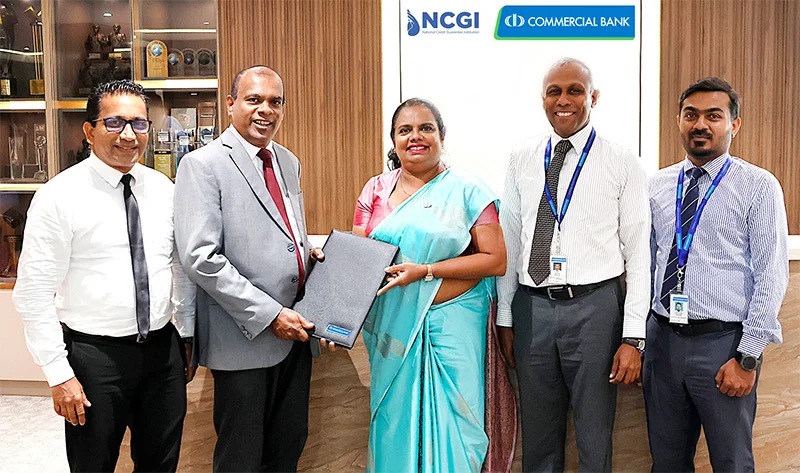
The Commercial Bank of Ceylon has reaffirmed its long-standing commitment to advancing women’s empowerment and financial inclusion, by partnering with the National Credit Guarantee Institution Limited (NCGIL) as a Participating Shareholder Institution (PSI) in the newly introduced ‘Liya Shakthi’ credit guarantee scheme, designed to support women-led enterprises across Sri Lanka.
The operational launch of the scheme was marked by the handover of the first loan registration at Commercial Bank’s Head Office recently, symbolising a key step in broadening access to finance for women entrepreneurs.
Representing Commercial Bank at the event were Mithila Shyamini, Assistant General Manager – Personal Banking, Malika De Silva, Senior Manager – Development Credit Department, and Chathura Dilshan, Executive Officer of the Department. The National Credit Guarantee Institution was represented by Jude Fernando, Chief Executive Officer, and Eranjana Chandradasa, Manager-Guarantee Administration.
‘Liya Shakthi’ is a credit guarantee product introduced by the NCGIL to facilitate greater access to financing for women-led Micro, Small, and Medium Enterprises (MSMEs) that possess viable business models and sound repayment capacity but lack adequate collateral to secure traditional bank loans.

Several spells of showers will occur in the Northern, North-Central, Eastern, Uva and Central provinces

Bondi Beach gunmen who killed 15 after targeting Jewish celebration were father and son, police say

Govt. urged to take action against deputy minister

India sends stock of life-saving medicines

George Keyt Foundation contributes to national disaster relief efforts

New Ambassador to South Korea appreciates job opportunities for Lankans

‘Dates have the highest sugar content to fight Coronavirus’

Sunday Island 27 December – Headlines

#SundayIsland 17th December – Headlines

Sunday Island – 28th March

Sunday Island Headlines – 21 March

Sunday Island – 21st February – Headlines
-

 Features5 days ago
Finally, Mahinda Yapa sets the record straight
-

 News6 days ago
Cyclone Ditwah leaves Sri Lanka’s biodiversity in ruins: Top scientist warns of unseen ecological disaster
-

 Features5 days ago
Handunnetti and Colonial Shackles of English in Sri Lanka
-

 Business4 days ago
Cabinet approves establishment of two 50 MW wind power stations in Mullikulum, Mannar region
-

 News7 days ago
Jetstar to launch Australia’s only low-cost direct flights to Sri Lanka, with fares from just $315^
-
 News4 days ago
Gota ordered to give court evidence of life threats
-

 Features6 days ago
An awakening: Revisiting education policy after Cyclone Ditwah
-

 Features4 days ago
Cliff and Hank recreate golden era of ‘The Young Ones’