
News
Brain drain impediment to hospitality industry – Dr.Jayasinghe

By Harischandra Gunaratna
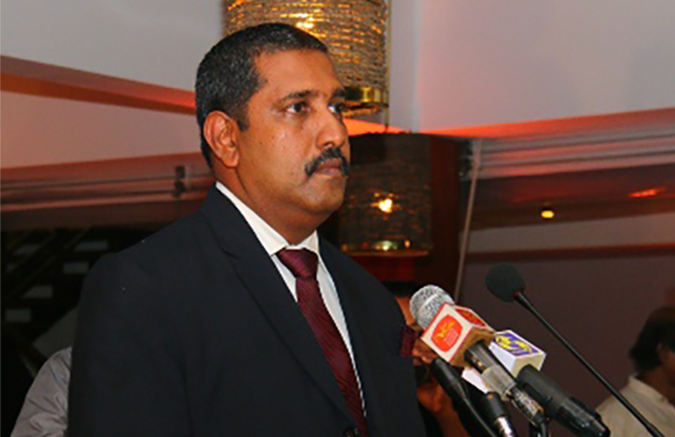
Chairman of the Institute of Hospitality, Dr. Harsha Jayasinghe on Tuesday said the brain drain in the country had not only led to a serious loss of talent but also hampered the industry’s ability to provide high-quality services and meet the demands of national and international visitors.
Speaking at the 31st AGM of the Institute of Hospitality Sri Lanka at Movenpick Colombo, Dr. Jayasinghe said Sri Lankans were leaving the country in droves seeking greener pastures and the hospitality industry had lost a large number trained personnel as a result, leaving the industry in dire straits.
Dr. Jayasinghe warned that if the authorities did not take immediate steps to address the issue, the country’s hospitality industry would suffer a crippling blow. He said the hotel industry played a pivotal role in Sri Lanka’s tourism sector, providing essential services and contributing to the economy. However, the shortage of skilled workers poses a significant challenge to the growth and development of this vital sector. Many skilled individuals including chefs, housekeepers, and other service staff, were leaving the country in search of better opportunities abroad.
The senior hotelier said the hospitality industry in Sri Lanka had a tremendous potential to spur economic growth, job creation, and cultural exchange. Stressing the importance of addressing the challenges of security concerns, infrastructure limitations, sustainable practices, and skilled labour shortages, the Chairman of the Institute of Hospitality said:
“In my opinion, inadequate road networks, unreliable public transportation, and a lack of proper waste management systems can deter tourists from exploring the beauty of our country. Investment in infrastructure development is crucial to attract and accommodate more visitors, ensuring their comfort and convenience during their stay.
“Moreover, the lack of skilled human resources in the tourism sector poses a significant challenge. It is essential to invest in training programmes to enhance the skills and knowledge of those working in the industry, including tour guides, hotel staff, and service providers. By providing quality training and education via SLTDA, CHSGA and Institute of Hospitality Sri Lanka from other relevant Hotel schools (NSBM etc.), we can ensure that our visitors have a memorable experience, leading to positive reviews and recommendations, ultimately boosting tourism.
“Lack of skilled labour in Sri Lanka’s hotel industry and the concerning trend of skilled workers migrating elsewhere is a grave problem when it comes to boosting tourism objectives of the Government. This matter highlights the importance of investing in training programs and the significance of hotel schools in preparing the youth for rewarding careers in the hospitality sector.
“IH & CSHGA, NAITA, TVEC help bridge the gap between theoretical knowledge and practical skills. Students are exposed to real-world scenarios and industry-specific challenges, enabling them to develop problem-solving abilities and adaptability. Moreover, hotel schools, IH and NAITA often collaborate with established hotels and resorts, providing students with internship opportunities that further enhance their practical skills and expose them to the inner workings of the industry.
“I am proud to announce that IH Sri Lanka has taken an active role in organising training programmes covering different sections of the Hospitality Industry. In 2022/2023 region-wise trainings were conducted for Hotel Staff and Military Personnel on Food & Beverage, Housekeeping and Front Office services”.
“Institute of Hospitality contributes to the overall professionalism and reputation of the hotel industry. Hotel Schools are producing well-trained graduates, these institutions elevate the standards of service and hospitality, attracting more tourists and improving the country’s image as a desirable destination. Skilled workers who have received quality training are more likely to provide exceptional customer experiences, leading to positive reviews and repeat visits, thus contributing to the success and sustainability of the industry.”
Dr.Jayasinghe was re-elected Chairman of IH Sri Lanka unanimously for a second term.









Latest News
Heat Index likely to increase up to ‘Caution level’ at some places in the Western, Sabaragamuwa, Southern and North-western provinces and in Anuradhapura, Monaragala, Mannar and Vavuniya districts


Warm Weather Advisory
Issued by the Natural Hazards Early Warning Centre of the Department of Meteorology
at 3.30 p.m. on 21 March 2026, valid for 22 March 2026.
Heat index, the temperature felt on human body is likely to increase up to ‘Caution level’ at some places in the Western, Sabaragamuwa, Southern and North-western provinces and in
Anuradhapura, Monaragala, Mannar and Vavuniya districts.
The Heat Index Forecast is calculated by using relative humidity and maximum temperature and this is the condition that is felt on your body. This is not the forecast of maximum temperature. It is generated by the Department of Meteorology for the next day period and prepared by using global numerical weather prediction model data.

Effect of the heat index on human body is mentioned in the above table and it is prepared on the advice of the Ministry of Health and Indigenous Medical Services.
ACTION REQUIRED
Job sites: Stay hydrated and takes breaks in the shade as often as possible.
Indoors: Check up on the elderly and the sick.
Vehicles: Never leave children unattended.
Outdoors: Limit strenuous outdoor activities, find shade and stay hydrated.
Dress: Wear lightweight and white or light-colored clothing.
Note:
In addition, please refer to advisories issued by the Disaster Preparedness & Response Division, Ministry of Health in this regard as well. For further clarifications please contact 011-7446491.

The Ceylon Petroleum Corporation (Ceypetco) has announced a revision of fuel prices, effective from midnight today (21).
Accordingly,
Auto Diesel – Rs. 382 (increased by Rs. 79)
Super Diesel – Rs. 443 (increased by Rs. 90)
Petrol 92 Octane – Rs. 398 (increased by Rs. 81)
Kerosene – Rs. 255. (increased by Rs. 60)
Petrol 95 Octane – Rs. 455 (increased by Rs. 90)

Latest News
Advisory for Severe Lightning issued for Galle, Matara, Kaluthara and Rathnapura districts
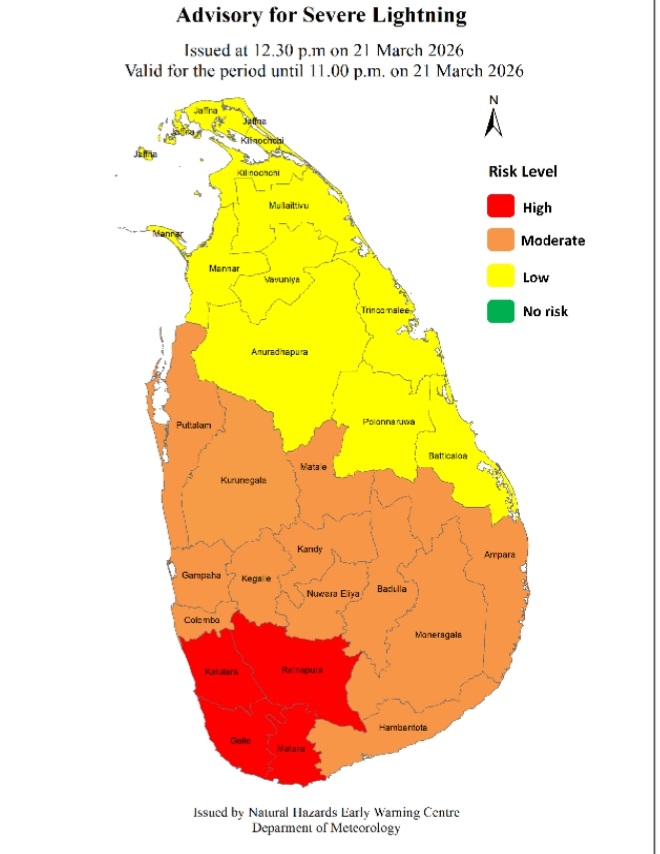
Advisory for Severe Lightning Issued by the Natural Hazards Early Warning Centre Issued at 12.30 p.m. 21 March 2026, valid for the period until 11.00 p.m. 21 March 2026
Thundershowers accompanied with severe lightning are likely to occur at some places in the Galle, Matara, Kaluthara and Rathnapura districts after 1.00 p.m.
There may be temporary localized strong winds during thundershowers. General public is kindly requested to take adequate precautions to minimize damages caused by lightning activity.
ACTION REQUIRED:
The Department of Meteorology advises that people should:
Seek shelter, preferably indoors and never under trees.
Avoid open areas such as paddy fields, tea plantations and open water bodies during thunderstorms.
Avoid using wired telephones and connected electric appliances during thunderstorms.
Avoid using open vehicles, such as bicycles, tractors and boats etc.
Beware of fallen trees and power lines.
For emergency assistance contact the local disaster management authorities.

Heat Index likely to increase up to ‘Caution level’ at some places in the Western, Sabaragamuwa, Southern and North-western provinces and in Anuradhapura, Monaragala, Mannar and Vavuniya districts

CEYPETCO Fuel prices increased from midnight today (21)

Advisory for Severe Lightning issued for Galle, Matara, Kaluthara and Rathnapura districts

Sri Lanka says it denied US request to land two aircraft at Mattala airport

Eid celebrations dimmed by war and displacement across Middle East

Showers may occur at several places in the Western, Sabaragamuwa, Northwestern and Uva provinces and in Galle, Matara, Kandy and Nuwara-Eliya districts after 1.00 pm.

‘Dates have the highest sugar content to fight Coronavirus’

Sunday Island 27 December – Headlines

#SundayIsland 17th December – Headlines

Sunday Island – 28th March

Sunday Island Headlines – 21 March

Sunday Island – 21st February – Headlines
-

 Business6 days ago
Browns EV launches fast-charging BAW E7 Pro at Rs. 5.8 million
-

 Life style7 days ago
From culture to empowerment: Indonesia’s vision for Sri Lanka
-

 News4 days ago
CIABOC questions Ex-President GR on house for CJ’s maid
-

 Life style7 days ago
Ranjith Fernando celebrates cricketing journey with Hob Nails to Spikes
-

 News5 days ago
Sri Lankan marine scientist Asha de Vos honoured at UNGA opening
-

 Features6 days ago
Achievements of the Hunduwa!
-

 Latest News7 days ago
QR code system will be implemented for fuel with effect from 06.00 a.m. today (15th)
-

 News5 days ago
Australian HC debunks misleading travel risk claims for Sri Lanka