
Business
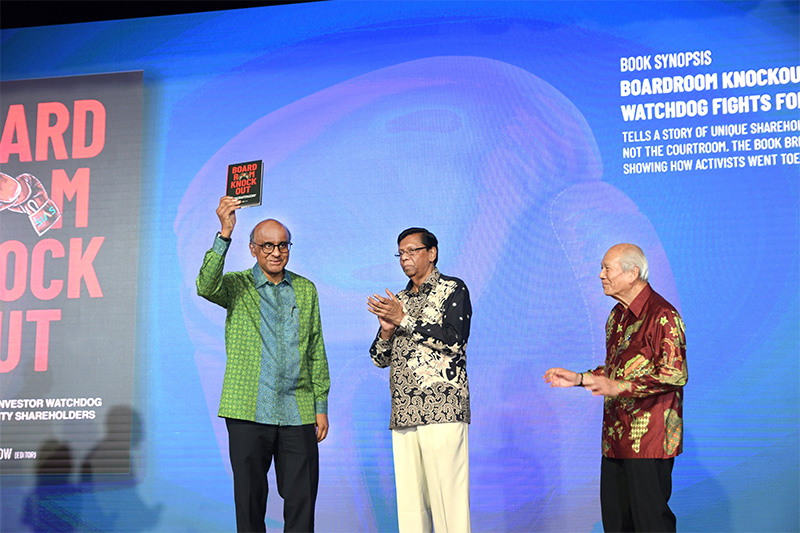
‘Boardroom Knockout’: How Singapore’s investor watchdog fights for minority shareholders

By Ifham Nizam
The story of David Gerald and the work he has done for minority investors has been nothing short of extraordinary. Here is a man who had no experience in investing, or in stock markets, but was willing to risk his reputation to stand up against the Malaysian government, internationally known author, Aaron Low said. The author of a landmark book titled, ‘Boardroom Knockout’, featuring share market issues, Low spoke to The Island Financial Review recently in an exclusive interview.
Extracts from the interview:
Q: What inspired you to tell the story of David Gerald’s early experiences centering on injustice in Ceylon and on how they shaped his career and mission?
A: The reason why he did so is simple: justice. When the Malaysian government shut down the Central Limit Order, a system that facilitated the trading of Malaysian shares by Singaporean investors, more than 172,000 investors in Singapore found their funds locked up and frozen in a foreign land. The total? More than S$7 billion.
I asked him why he would even contemplate such a move. After all, he was already in his 50s and approaching what would be the prime of his career as a litigator. He told me that he has always been inspired by a sense of justice. When he was a boy growing up in Ceylon, he saw a group of soldiers brutally assaulting a young man, who was also deaf and mute. Shocked, Gerald wanted to do something for the youth but was frozen by fear. That, he said, was a turning point and he swore he would not let anyone down again – even if that meant taking on a foreign government.
Q: How did David Gerald’s legal work under Singapore’s celebrated criminal lawyer, David Marshall, influence his later advocacy for small investors?
A: If the incident with the youth in Ceylon sparked his desire to pursue justice, his work with David Marshall brought the fight for justice to life. Marshall was Gerald’s mentor and the epitome of what it was to be a criminal justice lawyer. His passion for legal work and commitment to his clients inspired Gerald to do the same.
You can see this in the work he does at SIAS – all of it is geared towards helping the mom and pop investors, who are not the most sophisticated of stock market players.
Q: The founding of SIAS in 1999 was a pivotal moment for small investors in Singapore. What were the biggest challenges SIAS faced when tackling the CLOB issue with Malaysia?
A: The biggest issue that SIAS faced was that they couldn’t even get the Malaysian government to engage them! I mean, it’s not surprising right? Why would the federal government of Malaysia want to even pay attention to a small group of amateurs?
So the first thing that SIAS needed to do was to get recognition that it was a serious player that represented the aggrieved investors. Gerald knew this, which was why one of the first things he did was to get thousands of people to sign up as SIAS investors.
The second big challenge was that the issue was toxic cocktail of tense history between Singapore and Malaysia as well as anti-foreigner sentiments, in the aftermath of the Asian Financial Crisis.
Q: Could you elaborate on SIAS’s approach to resolving corporate governance issues, especially its preference for negotiation over litigation?
A: SIAS has become such an important institution in Singapore’s corporate landscape. Let me put it this way: Asians hate public confrontation. Losing face is as bad as losing money – and in an ugly public fight, chances are both parties will lose both.
Instead, perhaps inspired by consultative communalism, SIAS has decided to go with a “let’s talk about it” approach. Part of the reason why it did so was simply the recognition that SIAS was never going to be so well-resourced to take on corporations that had hundreds of millions of dollars in its bank accounts to fight off lawsuits.
Another, and arguably, more important reason, is that seeking consensus has the highest probability of achieving something when nothing else works. The truth is that angry minority investors turning up at corporate annual general meetings is a common sight. But it is also common that these same investors hardly get anything for their troubles, except maybe that they feel good for a few minutes venting their frustrations in the open.
SIAS prefers to work with companies behind closed doors, over tea and not threats, to resolve issues amicably. SIAS can do so because it carries the weight of thousands of minority shareholders with them; companies also much prefer talking to a rational party rather than emotional angry individuals. This way, the hope is that a compromise may be met. Maybe the company won’t pay the book value of $10 for a company but it is willing to up its price to $7.50 from $5 if SIAS can broker a deal with investors.
I think corporates like to deal with them, while minority investors trust SIAS. This balance is not an easy one to achieve and it took SIAS many years before it could find its equilibrium.
Q: What lessons can today’s corporate leaders and investors learn from SIAS’s unique approach to resolving conflicts outside courtrooms?
A: That life is nothing but a series of compromises because we are all deeply flawed in one way or another. No one is perfect and even good people do bad things in a time of weakness and temptation.
So instead of judging, approach each situation with empathy, honesty and truth. It’s a high ideal but sometimes laying all your chips on the table is the best way to resolve the worst of conflicts.


The corridors of power in Sri Lanka’s Parliament became a theater of intense debate on April 7, 2026, as lawmakers confronted the fallout of the National Development Bank (NDB) fraud scandal. What began as a Securities Exchange Commission (SEC) disclosure has now transformed into a scathing critique of the nation’s financial regulatory domain.
Opposition MP Ravi Karunanayake took to the floor to demand accountability, not just from the bank, but from the regulatory authorities themselves. Highlighting the alarming jump in reported losses – from an initial LKR 380 million on April 2nd to a massive LKR 13.2 billion by April 6th – Karunanayake questioned how such a systemic breach could occur undetected.
“I want to focus your attention on the operations… and its supervision process,” Karunanayake told the House. “I was more shocked about what we heard at the Public Finance Committee… as there was no one to take the responsibility for detecting this earlier”.
The MP emphasised that his intention was not to trigger a ‘run’ on the bank, but to ‘purify’ oversight mechanisms, which he suggested had failed in their primary duty of early detection.
The gravity of the situation was underscored by Minister Bimal Ratnayake, who confirmed that the President has been formally briefed on the fraud. The Minister assured Parliament that the administration would take all necessary actions to ensure ‘financial sector’s discipline’ in the wake of this fraud.
Regulatory authorities have already moved to assert authority, issuing a statement on April 5, 2026, to provide oversight and maintain liquidity stability. However, the ‘appropriate regulatory support’ mentioned came with heavy strings attached as follows:
Dividend Freeze: The bank was ordered to immediately suspend cash dividends scheduled for distribution in April 2026.
Operational Curbs: NDB has been directed to restrict discretionary spending and halt all branch expansions until further notice.
Forensic Mandate: Under regulatory and board pressure, NDB is appointing an independent forensic auditor to conduct an impartial review of its systems.
The LKR 13.2 billion fraud is estimated to impact NDB’s unaudited total asset base by 0.7%. While NDB Chairman Sriyan Cooray and CEO Kelum Edirisinghe were noted for their expertise by Ravi Karunanayake, the focus has shifted toward the systemic vulnerability of the sector. As the criminal investigation and internal inquiries proceed, the primary question remains: how did a fraud of this magnitude remain invisible to the regulators until it reached the breaking point?
With the Public Finance Committee now involved, the NDB incident is no longer just a corporate crisis – it is a test of the integrity of Sri Lanka’s entire financial supervisory framework.
By Sanath Nanayakkare

The Ceylon Chamber of Commerce announces a planned and orderly leadership transition, underscoring its commitment to strong governance, leadership continuity, and long-term institutional stability.
Accordingly, Shiran Fernando has been appointed Secretary General and Chief Executive Officer, effective 8th May 2026, succeeding . Buwanekabahu Perera, who will conclude a three-year tenure at the helm of the Chamber.
Commenting on the transition, Krishan Balendra, the Chairperson of The Ceylon Chamber of Commerce stated:
“This leadership transition reflects the Chamber’s long-standing belief that strong institutions are built through continuity, sound governance, and deliberate succession planning. Over the past three years, the Chamber has been further strengthened institutionally, allowing us to move forward with confidence. The Board is fully assured that this transition will ensure stability while positioning the Chamber to meet the evolving needs of our members and the broader economy.”
Supporting this transition, institutional stability is further reinforced by the continued leadership of Ms. Alikie Perera, who serves as Deputy Secretary General, Chief Operating Officer / Financial Controller and CEO of GS1 Lanka. With over three decades of service spanning multiple leadership cycles and governance eras, including service under 16 successive Chairpersons, she has been instrumental in sustaining the Chamber’s operational integrity and financial discipline. Notably, she has played a key role over two decades in steering the Chamber’s flagship platforms, including the Sri Lanka Economic and Investment Summit (SLEIS) and the Best Corporate Citizens Awards [BCC Awards], both of which have become nationally and internationally recognised benchmarks. Her continued role provides assurance that institutional memory and organisational continuity remain firmly intact.
Business
Dialog Finance Launches Next-Generation Virtual Debit Card, Elevating Digital Payments in Sri Lanka

Dialog Finance PLC, Sri Lanka’s leading fintech innovator, announced the launch of its Virtual Debit Card, the first in Sri Lanka to enable customers to generate multiple virtual cards for different purposes within a single app. This cutting-edge, digital-first payment solution is designed to deliver smarter control, enhanced security, and effortless everyday transactions, making online payments safer, more flexible, and fully manageable through the Genie app.
Designed for today’s mobile-first lifestyle, the Virtual Debit Card is managed seamlessly within the Genie app, allowing customers to generate multiple virtual cards tailored for specific use cases such as subscriptions, individual merchants, or shared spending scenarios. Each card offers customizable spending limits, real-time transaction tracking, and the option to delete or deactivate it once its defined use is complete. By isolating transactions across different purposes, this approach significantly enhances online payment security while providing complete visibility and control.
Issued on the UnionPay International network, the Virtual Debit Card ensures wide global acceptance for online and in-store payments. It also paves the way for future enhancements, including Tap to Pay functionality on NFC-enabled smartphones, enabling fast, contactless in-store transactions scheduled to be activated soon as part of Dialog Finance’s ongoing product evolution.
Commenting on the launch, Nazeem Mohamed, CEO & Director of Dialog Finance PLC, said, “This launch strengthens our position as Sri Lanka’s leading fintech provider. By offering multiple virtual cards, and intuitive in-app controls, we are delivering a secure, flexible digital payment experience that perfectly aligns with modern customer needs.”
The Dialog Finance Virtual Debit Card is now available exclusively through the Genie mobile app, allowing customers to instantly generate, manage, and control their cards from a single interface. This milestone further solidifies Dialog Finance’s leadership in delivering customer-centric, innovation-led digital payment solutions in Sri Lanka.
Dialog Finance PLC, a subsidiary of Dialog Axiata PLC, is a licensed finance company regulated by the Central Bank of Sri Lanka. The Company offers a range of digital-first financial solutions to individuals, businesses, and corporations, and is backed by a strong Fitch Rating of AA (lka), reflecting its financial stability, robust governance, and high creditworthiness.

PSL 2026: Iftikhar’s all-round show seals last-ball win for Zalmi

BCCI curbs movement of benched IPL players in latest rules

Prasidh trumps Miller in last-ball finish as Gujarat Titans clinch thriller

Greece to ban social media for under-15s from next year

Showers will occur at a few places in the Western, Sabaragamuwa and North-western provinces and in Galle, Matara, Kandy, Nuwara-Eliya and Mannar districts after 2.00 p.m.

Sun directly overhead Chilaw, Bingiriya, Halmillawewa, Panduwasnuwara, Gokarella, Kawudupelella, Koppaveli and Kirankulam about 12:12 noon. today (09)

‘Dates have the highest sugar content to fight Coronavirus’

Sunday Island 27 December – Headlines

#SundayIsland 17th December – Headlines

Sunday Island – 28th March

Sunday Island Headlines – 21 March

Sunday Island – 21st February – Headlines
-

 Features5 days ago
Ranjith Siyambalapitiya turns custodian of a rare living collection
-

 News5 days ago
Global ‘Walk for Peace’ to be held in Lanka
-

 News3 days ago
Lankan-origin actress Subashini found dead in India
-

 Features5 days ago
Beyond the Blue Skies: A Tribute to Captain Elmo Jayawardena
-

 Opinion7 days ago
Hidden truth of Sri Lanka’s debt story: The untold narrative behind the report
-

 Features5 days ago
Aspects of Ceylon/Sri Lanka Foreign Relations – 1948 to 1976
-

 Business22 hours ago
Hayleys Mobility introduces Premium OMODA C9 PHEV
-

 Editorial6 days ago
Brouhaha over a book