
Sports
Blair Tickner and Zak Foulkes seal tense win to complete 3-0 sweep of England

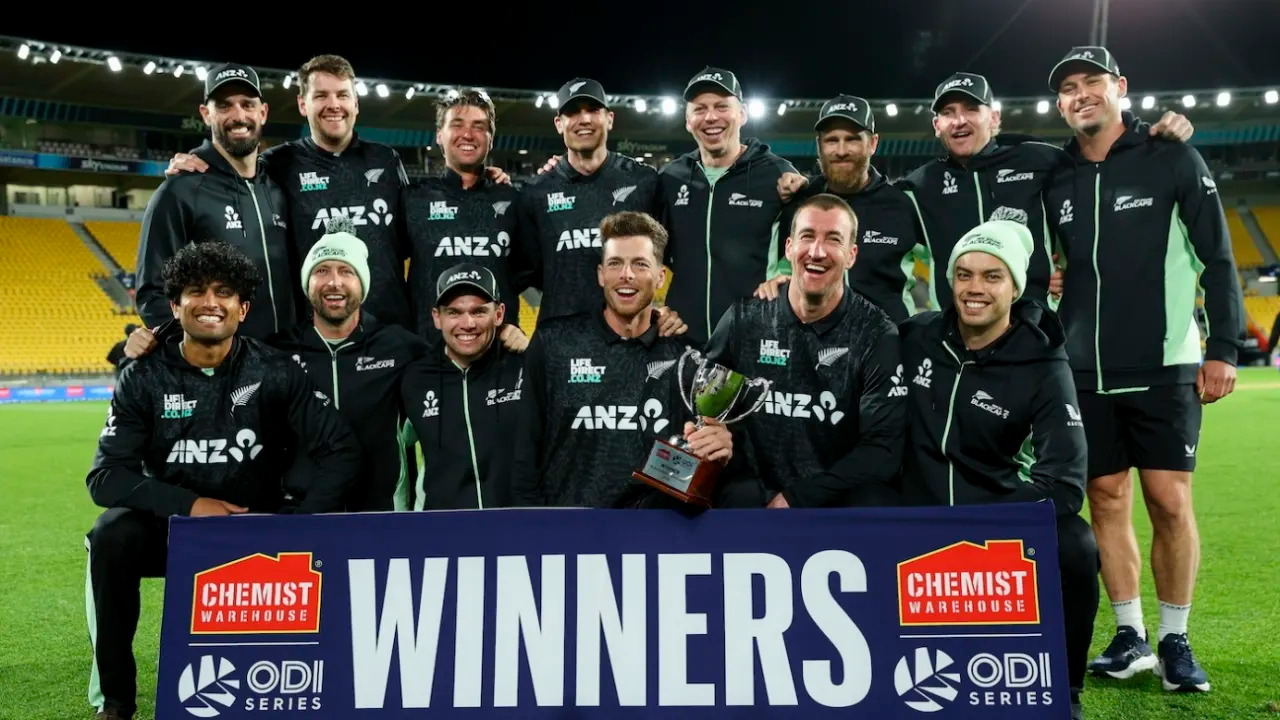
New Zealand scrambled to a tense two wicket victory in Wellington to seal a 3-0 sweep of the ODIs after England’s top-order was filleted once again. Jamie Overton slammed 68 off 62 from No. 8 to help England make a game of it but the armchair Ashes critics were given plenty more ammunition by another misfiring display before they hop across the Tasman.
It had appeared New Zealand would get the job done in routine fashion, as Daryl Mitchell anchored their chase of 223. But from 188 for 5 they slid to 196 for 8, with Mitchell the eighth man out for 44, edging Sam Curran behind. With more than 10 overs still to be bowled, however, there was time enough for Blair Tickner and Zak Foulkes to tick off the runs required in an unbroken ninth-wicket stand.
Tickner had earlier claimed his second consecutive four-wicket haul after new-ball pair Jacob Duffy and Foulkes had knocked over the England top five inside 10.1 overs.
New Zealand’s chase was given a solid start by a 78-run opening stand between Devon Conway and Rachin Ravindra. The run-out of Conway backing up – one of two such dismissals in the innings – triggered a mini-collapse, with three wickets falling in as many overs, but Mitchell once again provided the steady hand in another small chase, following up scores of 78 not out in Mount Maunganui and 56 not out in Hamilton.
Conway had replaced Kane Williamson, absent with a groin niggle, and endured some testing moments against Jofra Archer, who regularly touched 90mph/145kph during his opening spell. A checked drive for six over extra cover got him going, while Ravindra eased into gear with a series of boundaries off Brydon Carse. When Archer switched ends for the final powerplay over and saw it disappear for 24, New Zealand were 64 for 0 and coasting.
The stand was broken by a moment of fortune for England, with Overton again the catalyst as he attempted to field a drive from Ravindra only to see the ball deflect off his wrist, through his legs and into the non-striker’s stumps with Conway stranded. Ravindra was then bowled through the gate by Curran, before Overton ended Will Young’s unproductive series by having him caught behind off a steepling top edge.
Tom Latham, remarkably, was also run out when failing to get his bat back after Carse this time redirected a Mitchell drive into the stumps at the other end. Adil Rashid, having been held back until the 30th over, then struck with his second ball as Michael Bracewell holed out to deep midwicket with New Zealand still requiring 76.
Mitchell Santner struck two fours and two sixes in a breezy knock to bring victory in sight, but England kept chipping away. Santner holed out off Carse, Overton brought one back sharply to castle Nathan Smith, before Mitchell’s push at Curran left New Zealand having to scrap for the last few runs.
In a series billed in some quarters as an extension of England’s Ashes warm-ups – as many as seven of this XI could play the first Test in Perth in three weeks’ time – the batting suffered another malfunction. Having already conceded the series, there was to be no revival in fortunes, despite showing fight until the very end at Sky Stadium.
Inserted for the third game running, they plunged to 44 for 5 with none of the top four reaching double-figures. Two fifty stands – between Jos Buttler and Curran, then Overton and Carse – helped save face. Overton struck 10 fours and two sixes in his highest List A score, but the target for New Zealand still looked light.
England had actually been in a worse position in the first ODI when falling to 33 for 5, only for Harry Brook’s incendiary 135 to give them a similar score to bowl at. Here Brook was caught at second slip looking to defend as England were again found wanting in ideal conditions for seam and swing.
Foulkes continued his impressive maiden ODI series by striking with his fourth ball, Jamie Smith feathering a cut behind the ball after almost being bowled by an in-ducker – although it required DRS to detect the edge.
Ben Duckett heaved Duffy into the boundary boards for a six in the third over, but Foulkes was at it again in his next, pinning Joe Root with an inswinger. Duckett then toe-ended a swipe off Duffy to mid-on and when Brook nicked a Duffy outswinger, England were 31 for 4 inside the powerplay.
It meant that England set a world record for the fewest runs scored by a team’s top four batters (84) in an ODI series, where they batted at least three times.
Buttler was lucky to survive another peach from Duffy first ball, while Jacob Bethell almost ran himself out looking for a non-existent single. Bethell became the first England batter into double-figures, but an impetuous slash at the first ball outside the powerplay saw him off, courtesy a flying catch from Mitchell at slip.
With Duffy and Foulkes bowling unchanged through the first 14 overs, England had to retrench. Buttler then shifted through the gears against the change bowlers, as he and Curran brought up the fifty stand from 62 balls.
Tickner broke through, a combination of pad and inside edge taking the ball on to Curran’s stumps. He then bowled Buttler in more emphatic fashion, nipping a full delivery inside an expansive drive to topple off stump.
Overton had got off the mark with a pulled four, and his third scoring shot was a flat six that punched a hole in the low wall around the boundary. Carse joined the counterattack, hitting four towering sixes in 36 off 30 balls before top-edging a swipe at Tickner high into the covers. Archer managed a couple of boundaries before holing out to mid-on.
By then Overton was motoring, back-to-back thumps off Tickner helping to raise a run-a-ball half-century – his first in List A cricket, coming off the back of a career-best 46 in the first ODI. England’s last-wicket yielded 36 runs, but again the top-order deficiencies proved decisive.
Brief scores:
New Zealand 226 for 8 in 44.4 overs (Devon Conway 34, Rachin Ravindra 46, Daryl Mitchell 44, Mitchell Santner 27; Jamie Overton 2-22, Sam Curran 2-46) beat England 222 in 40.2 overs (Jos Buttler 38, Jamie Overton 68, Brydon Carse 36; Blair Tickner 4-64, Jacob Duffy 3-56, Zak Foulkes 2-27) by two wickets
[Cricinfo]

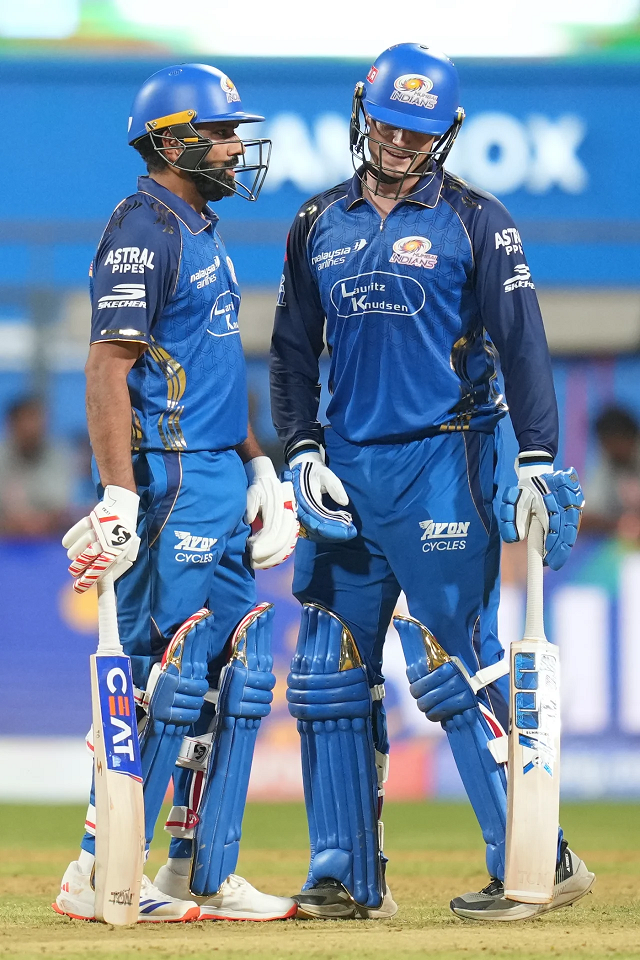
Before Sunday, Mumbai Indians had never chased down a 220-plus target in their previous seven attempts. MI had never won their opening game of the IPL since 2012. On day two of IPL 2026, MI broke two jinxes as they chased down 221 in 19.1 overs to begin their season with a comfortable six-wicket win over Kolkata Knight Riders. Rohit Sharma wound back the clock, smashing 78 off 38 balls, while Ryan Rickelton thumped 81 off 43, the duo adding 148 runs for the opening wicket off 71 balls.
That KKR were coming into this opening game severely depleted on the bowling front was known. The extent of it was visible on Sunday night with Vaibhav Arora and Blessing Muzarabani toothless, Varun Chakravarthy ineffective and Sunil Narine a shadow of his former self.
At the halfway mark, KKR might have been happy reaching 220 for 4, their second-highest score against MI in the IPL. Ajinkya Rahane, who at the toss said that he had “never seen so much of grass at Wankhede”, scored 67 off 40 balls while Angkrish Raghuvanshi, another Mumbai lad, made 51 off 29 as KKR breached the 220 mark. But against a KKR unit missing several of their frontline seamers, MI barely had any hiccups, completing the highest-successful IPL chase at the Wankhede with five balls to spare.
It was a typical Rohit innings that Wankhede has witnessed so many times, laced with some of the most pristine shots. He was on 12 off eight at one stage, but once in, he lit up Mumbai like only he can. Coming into the game, he had a strike rate of less than 100 against Varun in T20s. So, what did he do? He lofted the spinner inside-out over covers first ball and then lifted him for six the next ball. By the time the powerplay was done, Rohit had raced to a 23-ball fifty, his fastest in the IPL and MI’s chase was on course.
They raced to 80 in the first six, past 100 in 8.1 overs and by the time Rohit fell, thanks to a lovely catch by Anukul Roy running back from mid-off, MI’s required rate had gone below nine, which at the start of the innings was above 11 an over.
There were a few raised eyebrows when Rickelton was picked over the more experienced Quinton de Kock , but the former justified his selection. Rickelton needed just the first couple of overs to get a hang of the surface and once he did, there was no stopping him. He deposited Arora for back-to-back sixes, one over extra cover and then over deep midwicket, and that kickstarted a brutal takedown of the KKR bowlers.
While he saw Rohit do his thing in the powerplay, Rickelton took on Narine after the six-over mark. He slog swept him over deep midwicket in his first over and then launched him over the ropes twice in three balls in the next to raise a 24-ball fifty.
He didn’t stop there and only fell courtesy a stunning direct hit from the deep by Anukul. Suryakumar Yadav, the Impact Sub, came and went, but Hardik Pandya and Tilak Varma took MI closer. Hardik finished on an unbeaten 18 off 11 balls, while Naman Dhir hit the winning runs off Anukul as MI started their IPL 2026 in style.
Finn Allen brought his stellar form international cricket to the IPL. After facing five dot balls against Hardik, he went after MI debutant AM Ghazanfar, pumping him to the deep square fence and then spanking him for an 86-metre six over wide long-on. Another six capped off Ghazanfar’s opening over. Rahane then went after Hardik, thumping him for back-to-back sixes and Allen then got on strike and went 4, 4, 4. A monster 26-run over against Hardik helped KKR race past fifty in 3.5 overs, their fastest against MI in the IPL.
Shardul Thqkur, on MI debut, then brought his experience into play and sent back Allen who shoveled a slower length ball to long-off but Rahane carried on. He struck two fours off Thakur as KKR finished on 78 for 1 in six overs.
Two Mumbai boys on opposite ends were critical to their team’s cause. After removing Allen, Thakur sent back Cameron Green, whose innings lasted just ten balls and he then dismissed Rahane with a hard length delivery outside off that was mistimed to extra cover. At this point, KKR were still going at over ten an over but had lost steam, thanks to some terrific bowling from Bumrah, Trent Boult and Thakur.
Enter the other Mumbai boy, Raghuvanshi. He was on 17 off 14 at one stage but found a new lease of life after being dropped by Rohit at long-on. He closed out the 15th over with a four and six against Ghazanfar and then launched Thakur over long-on. Raghuvanshi added 60 off 30 balls with Rinku Singh for the fourth wicket, reaching his fifty off 28 balls as KKR raced past 200 in the 19th over.
Rinku struck unbeaten on 33 off 21 as KKR finished on 220 for 4 but it wasn’t enough.
Brief scores:
Mumbai Indians 221 for 4 in 19.1 overs (Ryan Rickelton 81, Rohit Sharma 78, Suryakumar Yadav 16, Tilak Varma 20, HardikPandya 18*; Vaibhav Arora 1-52, Kartik Tyagi 1-43, Sunil Narine 1-30) beat Kolkata Knight Riders 220 for 4 in 20 overs (Ajinkya Rahane 67, Finn Allen 37, Cameron Green 18, Angkrish Raghuvanshi 51, Rinku Singh 33*; Hardik Pandya 1-39, Shardul Thakur 3-39) by six wickets
[Cricinfo]


Sri Lankan champion thrower Rumesh Tharanga created history with yet another world-leading effort when he shattered his own national record at the Champions Track and Field event held at Diyagama Mahinda Rajapaksa Stadium on Saturday.
Tharanga produced a massive throw of 89.37 metres in his final attempt, a distance which, once ratified by World Athletics, is expected to stand as the fourth-longest throw ever recorded in Asia. The outstanding performance further cemented his status as one of the region’s leading javelin throwers.
Despite facing little competition from his rivals at the meet, Tharanga displayed the composure and determination of a true champion. Rising above the field, he delivered the record-breaking throw in dramatic fashion with his final effort of the competition.
Coming into the meet, Tharanga already held the world-leading mark of 83.07 metres for the season. Saturday’s performance elevated him to a new level, strengthening his reputation as a strong medal prospect for Sri Lanka on the global stage this year.
Tharanga first attracted widespread international attention when he set a Sri Lankan national record with a throw of 86.50 metres, a performance that earned him the gold medal at an international meet and secured direct qualification for the World Athletics Championships.
The former athlete of St. Peter’s College Colombo has continued to impress since then, producing consistent world-class performances while competing against some of the best javelin throwers in the world. Among his major achievements is reaching the final of the 2025 World Athletics Championships, becoming the first Sri Lankan male javelin thrower to reach the final stage of the event.
With his latest record-breaking performance, Tharanga has once again demonstrated that he is ready to shine and carry Sri Lanka’s hopes at the highest level of international athletics.
By Reemus Fernando
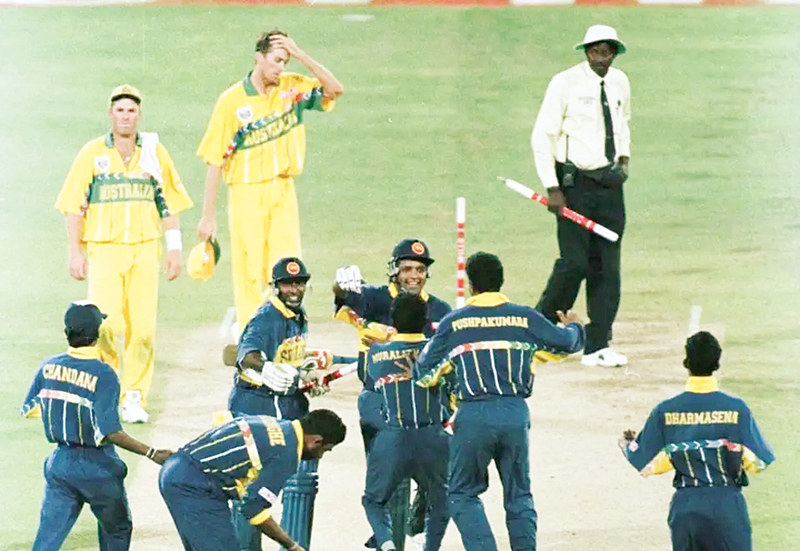
Sri Lanka’s trailblazing 1996 World Cup-winning side will roll back the years when they take on a World XI in Kuala Lumpur, marking three decades since their watershed triumph that changed the game’s field settings for good.
The exhibition match, hosted by the historic Royal Selangor Club, an institution that has been part of Asia’s sporting fabric since 1884, will be preceded by a gala dinner before the old warhorses lace up their boots once more against a Rest of the World XI.
It promises to be more than a nostalgic lap around the park.
“Some of the players took the initiative and I thought it was a splendid idea,” Arjuna Ranatunga, the captain who marshalled his troops like a seasoned general in 1996, told Telecom Asia Sport. “It helps us come together again and more importantly, inspire the next lot coming through.”
Beyond the boundary ropes, the legends will don the coach’s hat, conducting sessions aimed at passing on the baton to aspiring youngsters.
Former Malaysian cricketer Devindran Ramanathan, one of the chief architects behind the event, is keen that this is not just a walk down memory lane but a springboard for the future.
“This isn’t only about celebrating a World Cup win,” Ramanathan said. “It’s about showing young players what’s possible when you dare to dream.”
“When players of that calibre turn up, it shouldn’t end with autographs and photographs. It must open doors and broaden horizons,” he added.
In a heartening initiative, around 20 youngsters from Malaysia’s interior, players who have been making steady strides despite limited facilities, will be brought to the capital on May 15 and 16 to witness the action up close.
For many of them, it will be a once-in-a-lifetime opportunity to rub shoulders with giants of the game, a chance to trade dusty nets for the bright lights and perhaps believe that they, too, can one day play on the big stage.
“The real impact is not the match or the dinner,” Ramanathan noted. “It is whether a young player walks away believing they can go further.”
Malaysia, steadily padding up as a regional cricket hub, has already hosted events like the Under-19 World Cup and continues to expand its footprint in the game. In a sporting landscape dominated by motor racing, racquet sports and football, visits from former world champions in cricket could well help the sport get a firmer grip.
All 14 members of Sri Lanka’s 1996 squad are expected to travel to Malaysia in the second week of May, even as life has taken many of them to different corners of the globe.
Their famous triumph over Australia in Lahore remains one of cricket’s most defining moments, a victory that didn’t just tilt the balance of a final, but shifted the axis of the modern game itself.
(telecomasia.net)

Electricity tariffs to be increased from 1st April

A QR code system to be introduced for agricultural lands and other sectors requiring fuel

Rickelton, Rohit, Shardul break Mumbai’s first-game jinx

Oil tops $116 a barrel as Iran accuses US of preparing invasion

Iranian attack damages Kuwait power and desalination plant, kills worker

Warm weather conditions prevailing over the island are expected to continue

‘Dates have the highest sugar content to fight Coronavirus’

Sunday Island 27 December – Headlines

#SundayIsland 17th December – Headlines

Sunday Island – 28th March

Sunday Island Headlines – 21 March

Sunday Island – 21st February – Headlines
-

 News6 days ago
Senior citizens above 70 years to receive March allowances on Thursday (26)
-

 Features3 days ago
A World Order in Crisis: War, Power, and Resistance
-

 News4 days ago
Energy Minister indicted on corruption charges ahead of no-faith motion against him
-

 News5 days ago
US dodges question on AKD’s claim SL denied permission for military aircraft to land
-

 Business5 days ago
Dialog Unveils Dialog Play Mini with Netflix and Apple TV
-

 Business7 days ago
Postponement of Sri Lanka Investment Forum 2026
-

 News6 days ago
CEB Engineers warn public to be prepared for power cuts after New Year
-

 Sports4 days ago
SLC to hold EGM in April