
Latest News
Bethell the headline act as Brook era begins with crushing 238-run win


Born in Barbados but stunning in Birmingham, Jacob Bethell’s devastatingly crisp 82 from 53 deliveries led England to 400 for 8, their second-highest score at Edgbaston, on their way to burying West Indies by 238 runs at the start of this three-match ODI series.
For Harry Brook’s first assignment as full-time limited-overs captain, it was the perfect start. However one-sided this might have been, the dominance goes some way towards bolstering confidence at the start of a new era. The result alone is a godsend, ending a run of seven consecutive defeats.
Bethell, 21, had only just arrived back from an IPL stint with Royal Challengers Bengaluru. And yet having missed the one-off Test match against Zimbabwe, he clicked through the gears, striking the majority of his eight fours and five sixes at the back end, to remind the world – and his head coach Brendon McCullum – of his unignorable claim for multi-format berths. This second half-century in the format also reinforced the scale of the talent England have pilfered from the Caribbean.
Bethell’s was the lead hand in an innings littered with impressive but unfulfilled starts, including half-centuries for Ben Duckett, Joe Root and Brook. The scoreboard pressure was suffocating enough before Saqib Mahmood – Brummie-born – produced an opening burst of 3 for 32 from his opening seven overs. The last of those three to fall was Shai Hope, stunningly clutched by a back-peddling Brydon Carse about five yards in from the deep square boundary.
It was an impressive piece of athletics from Carse, returning to international duty after a toe injury ended his Champions Trophy campaign prematurely. He looked back to his best with the ball with the dismissal of Brandon King – a Test-match length and nip away finding the edge through to Jos Buttler behind the stumps – and his fielding effort was in keeping with a broader, altogether more energetic performance with Brook leading from the front.
Stationed in the ring, Brook took five catches – having previously managed just three in 26 previous ODIs – level with the record for the most taken by a fielder in format (Jonty Rhodes against West Indies in 1993). It was Brook’s second dalliance with a record after he was one of seven batters to score 30 or more in the same innings – the first time that had been achieved in a one-dayer.
A shellacking of this magnitude was far from Hope’s mind when he won the toss and chose to bowl, but the game was up at the halfway stage when his side were faced with a record target and already shorn of the explosive Evin Lewis, who damaged his groin in training on Wednesday. But for the final-wicket stand of 38 between Alzarri Joseph and Jayden Seales, whose 29 makes him the seventh No.11 to top-score in an ODI innings, this would have been a record defeat. In the end, they were dismissed for 162 with 23.4 overs left on the table.
The travails of missing the 2023 50-over World Cup and the uncertainty that remains in the air regarding automatic qualification for 2027’s edition was reason enough to insert an experimental-looking England batting line-up on a muggy Thursday afternoon in the midlands. And West Indies, to their credit, stayed afloat for the majority of their time with the ball.
Alas, they were completely blown out of the water in the death overs. Seales’ figures of 4 for 84 from nine overs showed that even the few with rewards bore scars. The fast bowler, given the nod ahead of Shamar Joseph, suffered his most grotesque punishment in his penultimate over, sent for 19 as part of a bumper 98-run stand for the sixth wicket. Bethell was the aggressor, but Will Jacks, making his first appearance for England since November 2024, played an accomplished hand, bagging 39 off 24 from his first go at No.7 in ODIs.
The onus was immediately on a newly ordered, albeit not new-look, England batting card. The initial focus was on Jamie Smith, front and centre to face the first ball, moved to open for the first time in List A cricket.
His failures at No. 3 during the ICC Champions Trophy suggested more exposure to the new ball would not go down well. But Smith made hay, strumming crisp drives with the odd shuffle down the pitch, backing up McCullum’s view that the Surrey keeper-batter has the wares to cope with the early movement. Alas, having reached 37 in quick time, his 24th delivery – the number of runs he managed in three Champions Trophy knocks – stung the palms of Brandon King at midwicket, who held the catch, putting to shame Seales who had misjudged a far easier opportunity at mid-on the ball before.
Smith’s departure, at the end of the seventh over, with 64 on the board, probably should have been a hint for at least one of the others to bat through. And yet the senior trio of the top-order punched their cards without lasting the course.
Duckett looked the best of them, and probably should have set the platform for others to launch after moving through to a breezy half-century from 34 deliveries. But when he was done in at the start of the 20th over – Roston Chase taking a stunning one-handed grab leaping at backward point – both Root and Brook had to tend to a half-finished foundation.
The Yorkshire duo set about their task well, Root typically calm as Brook targetted Justin Greaves’ medium pace, striking him for two sixes in three deliveries – down the ground, then behind square – for his first boundaries. Then Root, after registering his 59th fifty-plus score in the format, opted for a booming drive to nick Seales through to Hope.
That was Seales’ first of three, the second coming when Brook lazily carved what was ultimately a long-hop out to deep point. By then, Jos Buttler was at the crease, stepping back having stepped down, with 4 off 6 to Brook’s 27 off 19 in their brief stand of 33.
The stage looked set for Buttler to return to the pack in blockbuster fashion, as he brought out the classics – charging Greaves for a straight six, then a slapped four before ramping Seales down the line. Alas, a well-disguised cutter from the latter meant a heave to leg landed neatly in the hands of midwicket.
It was at that point that Bethell took over, with 58 balls remaining in the innings. From 26 off 30, Bethell took it upon himself to put the game out of sight. From the 43rd over up to the 47th, Bethell hit a six in each over, before Jacks, who had played the straight man, tagged in for the 47th to blitz a six and four fours off Matthew Forde. That devastating five-over period brought 86 runs and effectively settled the match given the scale of the mountain West Indies had to climb.
Granted, it could have been far greater. The dismissal of Jacks – well-bumped by Greaves – and another special catch from Chase (this time running over his shoulder from mid-off to claim a steepling catch off Overton) kept the boundaries down to ensure Bethell was off strike for the entirety of the penultimate over. Regaining strike for the final over, a thin slice on a cut through to Hope brought his time to an end.
Just when it seemed West Indies were going to close out the final two overs without a boundary, and thereby deny England their 400, Seales’ well-directed yorker shot out of the footmarks, nutmegging Carse and flying away to the advertising boards to bring up the landmark from the final ball of the innings.
Once the first six West Indian batters had been seen off in the opening 12 overs, Brook was able to mix up his attack. That worked particularly well for Overton, who was able to finish with career-best figures of 3 for 22 despite having to leave the field during the eighth over after damaging his right hand trying to take a return catch off his second delivery.
Bethell completed Overton’s over, before Mahmood picked back up at the City End to claim two more dismissals. Overton, however, was back on the field to bowl the 16th over, bouncing out both Chase (caught Jacks at deep square leg) and Matthew Forde (caught Mahmood at fine) before fooling Gudakesh Motie with a slower delivery that was looped to point for Brook’s fifth and final catch.


Oil prices leapt to nearly $110 a barrel after Iranian media reported an airstrike hitting a facility on the world’s largest natural gas field.
The Brent crude oil benchmark hit $109.91 a barrel just after 14:30 GMT, more than 5% higher than Tuesday’s prices, but has since fallen slightly.
The benchmark UK gas price also jumped by 6% to 143.53p a therm before falling back below the 140p mark.
The surge followed reports Iran’s petrochemical complex on the South Pars gas field had been hit. Several hours later, Qatar reported that there was “extensive damage” at the Ras Laffan industrial site following threats from Iran.
While the price of both oil and gas spiked, they remained below highs seen earlier in the conflict.
Oil reached $116.78 a barrel on 9 March, while UK gas reached 162.55p a therm on 3 March.
Iran’s oil ministry said a fire at the petrochemical complex was under control, according to Tasnim, a news agency affiliated with the Islamic Revolutionary Guard Corps.
Iran’s military warned it would take “decisive action” in response to the strike on its energy infrastructure.
“As previously warned, if the fuel, energy, gas, and economic infrastructures of our country are attacked by the American-Zionist enemy, in addition to a powerful counterattack against the enemy, we will severely strike the origin of that aggression as well,” the military said in a statement published by Tasnim.
“We consider targeting the fuel, energy, and gas infrastructures of the countries of origin legitimate and will retaliate strongly at the earliest opportunity.”
Qatar also operates facilities on the gas field, which it calls North Dome.
But the country, which produces a fifth of the world’s liquefied natural gas, had halted production earlier in March in response to the conflict.
Qatar’s foreign ministry spokesman Majed Al Ansari said strikes against energy infrastructure “constitutes a threat to global energy security”.
Just after 1815 GMT, the Qatari interior minister said it was responding to “a fire in the Ras Laffan area following an Iranian targeting”. Qatar’s petrol firm QatarEnergy later said there was “extensive damage” at the site.
The interior minister said just after 1900 GMT that it had “initially brought the fire in Ras Laffan under control, with no injuries reported”.
Ras Laffan was among the sites listed by Iran in a warning that it would take “decisive action” after its South Pars gas field facilities were reportedly hit by Israeli strikes.
‘Energy markets will likely remain volatile’
AJ Bell’s head of financial analysis Danni Hewson said the attack and retaliation by Iran had “helped dial up the temperature once again and put renewed upward pressure on oil prices”.
“Any solution to the blockage of the Strait of Hormuz looks pretty distant at this point and until there is progress on that front, energy markets will likely remain volatile,” she added.
The White House on Wednesday responded to the rising oil price by saying it was suspending the Jones Act — a 1920 law that says only American-made ships can be used to transport goods between US ports.
US Press Secretary Karoline Leavitt said the 60-day waiver of the rules, which are intended to boost shipbuilding, will allow “vital resources like oil, natural gas, fertiliser, and coal to flow freely” as non-American-made ships can now be used.
However, maritime groups in the US said the effect would be minimal, noting that oil prices, not shipping costs, are behind rising prices at the pump.
Experts say earlier efforts by world leaders to ease price pressures, including an unprecedented release of oil reserves, have done little to reduce oil prices.
Meanwhile, Iran has also suspended the flow of gas to Iraq to shore up domestic supplies, a senior Iraqi official told Reuters.
The vast majority of Iran’s gas supply – 94% – is used domestically, according to data from the Gas Exporting Countries Forum.
[BBC]
Latest News
Heat Index at ‘Caution Level’ in the Western, Sabaragamuwa, North-central, Southern and North-western provinces and in Monaragala, Mannar, Vavuniya and Mullaitivu districts
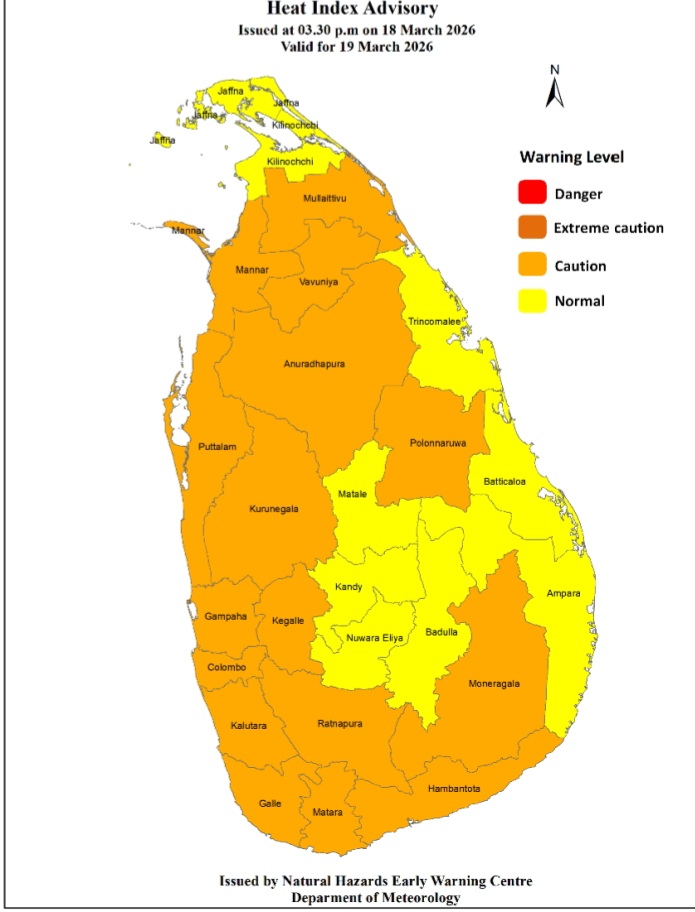
Warm Weather Advisory Issued by the Natural Hazards Early Warning Centre of the Department of Meteorology at 3.30 p.m. on 18 March 2026, valid for 19 March 2026
The general public are cautioned that the Heat index, the temperature felt on human body is likely to increase up to ‘Caution level’ at some places in the Western, Sabaragamuwa, North-central, Southern and North-western provinces and in Monaragala, Mannar, Vavuniya and Mullaitivu districts.
The Heat Index Forecast is calculated by using relative humidity and maximum temperature and this is the condition that is felt on your body. This is not the forecast of maximum temperature. It is generated by the Department of Meteorology for the next day period and prepared by using global numerical weather prediction model data.
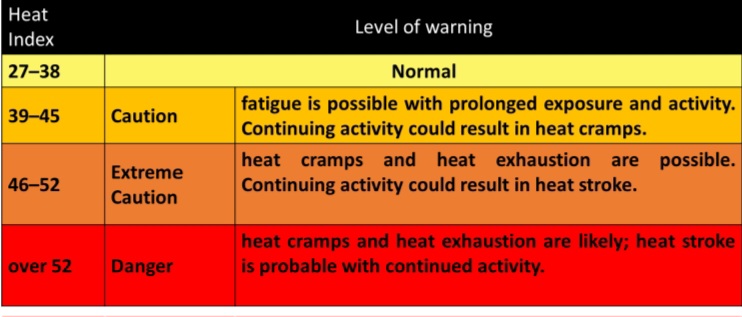
Effect of the heat index on human body is mentioned in the above table and it is prepared on the advice of the Ministry of Health and Indigenous Medical Services.
ACTION REQUIRED
Job sites: Stay hydrated and takes breaks in the shade as often as possible.
Indoors: Check up on the elderly and the sick.
Vehicles: Never leave children unattended.
Outdoors: Limit strenuous outdoor activities, find shade and stay hydrated.
Dress: Wear lightweight and white or light-colored clothing.
Note:
In addition, please refer to advisories issued by the Disaster Preparedness & Response Division, Ministry of Health in this regard as well. For further clarifications please contact 011-7446491.

Four persons including a Budhist monk died and 32 others were injured when two SLTB buses collided head on at Weerawila at arond 12 noon today (18).
Three of the deceased were women. 22 of the injured were admitted to the Hambanthota Hospital while 10 others have been admitted to the Debarawewa hospital.

King Charles praises ‘living bridge’ with Nigeria at glitzy banquet

Our objective is to ensure that the Commission to Investigate Allegations of Bribery or Corruption operates as an independent institution, free from any external influence – PM

Showers above 50 mm can be expected at some places in the Central, Sabaragamuwa and Uva provinces and in Ampara district.

Oil nears $110 a barrel after gas field strike

Iran’s intelligence minister Esmail Khatib killed in air strike

Heat Index at ‘Caution Level’ in the Western, Sabaragamuwa, North-central, Southern and North-western provinces and in Monaragala, Mannar, Vavuniya and Mullaitivu districts

‘Dates have the highest sugar content to fight Coronavirus’

Sunday Island 27 December – Headlines

#SundayIsland 17th December – Headlines

Sunday Island – 28th March

Sunday Island Headlines – 21 March

Sunday Island – 21st February – Headlines
-

 Business4 days ago
Browns EV launches fast-charging BAW E7 Pro at Rs. 5.8 million
-

 Life style5 days ago
From culture to empowerment: Indonesia’s vision for Sri Lanka
-

 News2 days ago
CIABOC questions Ex-President GR on house for CJ’s maid
-

 Opinion7 days ago
M. D. Banda: Memories of Appachchi – II
-

 Business6 days ago
Sri Lanka Institute of Information Technology raises the bar for academic excellence
-

 Latest News5 days ago
QR code system will be implemented for fuel with effect from 06.00 a.m. today (15th)
-

 News3 days ago
Australian HC debunks misleading travel risk claims for Sri Lanka
-

 Life style5 days ago
Ranjith Fernando celebrates cricketing journey with Hob Nails to Spikes