
News
Batalanda: Why only now and what about the others, asks Mujibur

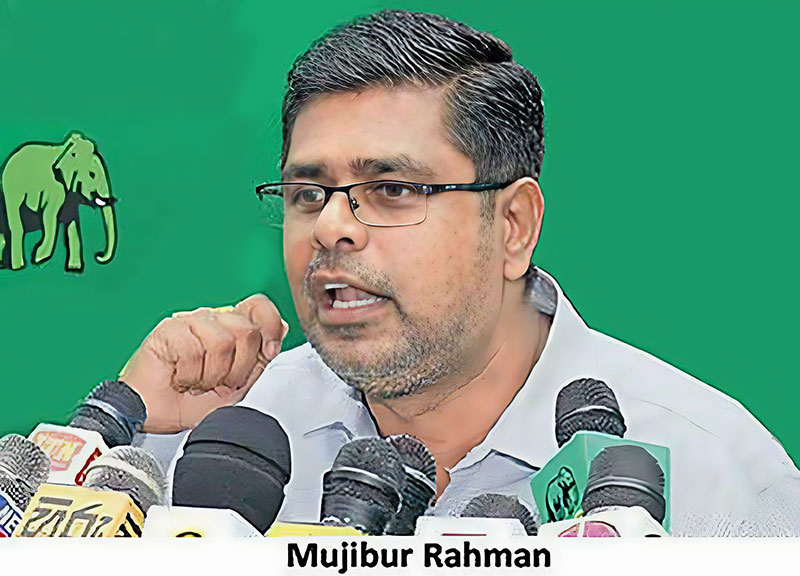
SJB Colombo District MP Mujibur Rahuman launched a fierce critique of the political hypocrisy surrounding the Batalanda Commission report during Thursday’s (10) parliamentary session.
Rahuman pointed to the violent actions of the JVP, which had devastating effects on politicians, police officers, and civilians, as detailed in the Commission’s final report.
He said that the violence had disrupted vital services and created a state of lawlessness, severely affecting the public.
The MP accused political opponents of exploiting the Batalanda issue for electoral advantage, noting that for 36 years, no proposals were made to investigate the assassination of JVP leader Rohana Wijeweera.
He criticized the JVP for forming “probationary” governments with Chandrika Kumaratunga and backing Ranil Wickremesinghe in the yahapalana effort, yet failing to address the Batalanda issue during their tenures.
Rahuman also questioned the current attacks on Wickremesinghe, highlighting that many of his critics had previously collaborated with him. He called attention to the JVP’s statements regarding Gotabaya Rajapaksa’s alleged involvement in a Matale mass grave and the distribution of pamphlets on the subject during the 2022 Galle Face protests.
The MP called for accountability, questioning why no proposals were put forward on these issues when the current government came into power. He also criticized the NPP for its leaders, who, despite being involved in suppressions during the 80s and 90s, now sought positions within the government. Rahuman accused them of hypocrisy, warning against dragging the Batalanda issue into the ongoing election.Rahuman said that the historical wrongs committed by JVP political leaders cannot be erased, regardless of attempts to downplay them.





Latest News
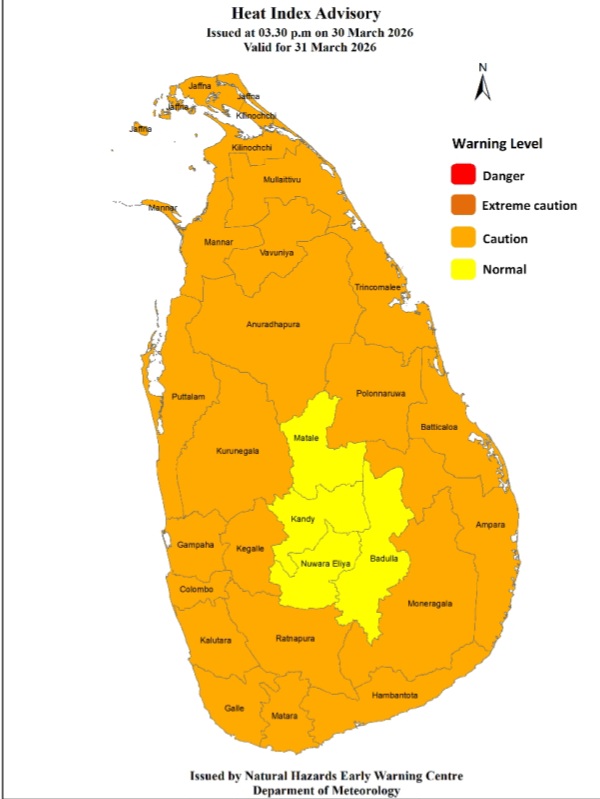
Heat Index at ‘Caution Level’ in the Western, Sabaragamuwa, Southern, Eastern, North-western, Northern and North-central provinces and in Monaragala district

Warm Weather Advisory
Issued by the Natural Hazards Early Warning Centre
Issued at 3.30 p.m. on 30 March 2026, valid for 31 March 2026.
The Heat index, the temperature felt on human body is likely to increase up to ‘Caution level’ at some places in the Western, Sabaragamuwa, Southern, Eastern, North-western, Northern and North-central provinces and in Monaragala district.
The Heat Index Forecast is calculated by using relative humidity and maximum temperature and this is the condition that is felt on your body. This is not the forecast of maximum temperature. It is generated by the Department of Meteorology for the next day period and prepared by using global numerical weather prediction model data.

Effect of the heat index on human body is mentioned in the above table and it is prepared on the advice of the Ministry of Health and Indigenous Medical Services.
ACTION REQUIRED
Job sites: Stay hydrated and takes breaks in the shade as often as possible.
Indoors: Check up on the elderly and the sick.
Vehicles: Never leave children unattended.
Outdoors: Limit strenuous outdoor activities, find shade and stay hydrated.
Dress: Wear lightweight and white or light-colored clothing.
Note:
In addition, please refer to advisories issued by the Disaster Preparedness & Response Division, Ministry of Health in this regard as well. For further clarifications please contact 011-7446491.

The Public Utilities Commission of Sri Lanka (PUCSL) has granted approval to increase electricity tariffs with effect from 1st April .
The Ceylon Electricity Board (CEB) requested a 13.56% electricity tariff revision for the second quarter of this year.
The revision announced by the PUCSL for domestic consumers:
0–30 units category, electricity tariffs will rise by 4.3%,
31–60 units category, tariffs will rise by 6.9%,
61–90 units category, tariffs will rise by 6.9%,
91–120 units category, tariffs will rise by 7.2%,
Above 180 units, electricity tariffs will rise by 25.3%
The PUCSL has decided not to increase electricity tariffs for religious and charitable institutions that consume below 180 units monthly and a 9.6% increase for institutions that consume above 180 units.
Ectricity tariffs for the general and household consumer categories has been increased by 8%, while the electricity tariff increase for the industrial sector is 8.7%, the increase in tariff for government institutions is 14.4%.

It was decided at the committee appointed to oversee the distribution of essential goods to appoint five officials from the Ceylon Petroleum Corporation to cover all ministries in order to examine fuel-related issues and undertake the necessary interventions.
It was further discussed that the responsibility of these officials would be to examine fuel-related issues arising in institutions under each ministry and to intervene in providing solutions by maintaining coordination with the Corporation.
These matters were discussed at a meeting of the committee appointed to oversee the distribution of essential goods, chaired by Minister of Transport, Highways and Urban Development Bimal Rathnayake held on Friday (27) at the Presidential Secretariat.
It was also noted, with particular attention, that requests have been made by industrialists indicating that the current fuel quota allocated to vehicles for the distribution of their products across the country is insufficient. It was further discussed that, if these concerns are not addressed, there is a likelihood of an increase in the prices of goods, which could in turn cause significant hardship to the public during the festive season.
The committee also discussed the issuance of fuel for the distribution of essential food items by state and private institutions, including supermarkets such as Sathosa, wholesale importers, tourism-related service providers, hotels and other service-providing organisations.
Accordingly, it was discussed that requests for fuel quotas submitted by these institutions should be carefully considered and prompt action taken as necessary and that such requests should be forwarded to the Ministry of Energy through the relevant ministries.
Attention was also drawn to the need for the swift implementation of a QR code system for the issuance of fuel to other sectors, including agriculture and the fisheries industry, based on letters issued on the recommendations of the relevant government officials, including agricultural research officers, instead of the previous method of direct fuel allocation.
Minister Bimal Rathnayake emphasised the need to ensure a continuous and properly managed fuel supply, with particular focus on providing goods to the public without shortages and preventing excessive price increases during the forthcoming Sinhala and Hindu New Year season.
The discussion was attended by a group of government officials, including Minister of Trade, Commerce, Food Security and Cooperative Development Wasantha Samarasinghe, Deputy Minister of Power Arkam Ilyas, Senior Additional Secretary to the President, Kapila Janaka Bandara and Chairman of the Ceylon Petroleum Corporation, D. J. Rajakaruna.

Heat Index at ‘Caution Level’ in the Western, Sabaragamuwa, Southern, Eastern, North-western, Northern and North-central provinces and in Monaragala district

Electricity tariffs to be increased from 1st April

A QR code system to be introduced for agricultural lands and other sectors requiring fuel

Rickelton, Rohit, Shardul break Mumbai’s first-game jinx

Oil tops $116 a barrel as Iran accuses US of preparing invasion

Iranian attack damages Kuwait power and desalination plant, kills worker

‘Dates have the highest sugar content to fight Coronavirus’

Sunday Island 27 December – Headlines

#SundayIsland 17th December – Headlines

Sunday Island – 28th March

Sunday Island Headlines – 21 March

Sunday Island – 21st February – Headlines
-

 News6 days ago
Senior citizens above 70 years to receive March allowances on Thursday (26)
-

 Features3 days ago
A World Order in Crisis: War, Power, and Resistance
-

 News4 days ago
Energy Minister indicted on corruption charges ahead of no-faith motion against him
-

 News5 days ago
US dodges question on AKD’s claim SL denied permission for military aircraft to land
-

 Business5 days ago
Dialog Unveils Dialog Play Mini with Netflix and Apple TV
-
 Business7 days ago
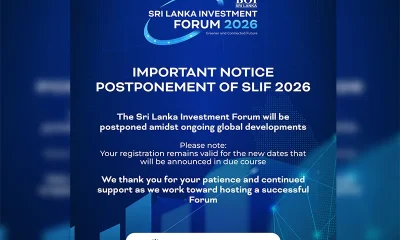
Postponement of Sri Lanka Investment Forum 2026
-

 News6 days ago
CEB Engineers warn public to be prepared for power cuts after New Year
-

 Sports4 days ago
SLC to hold EGM in April