
News
Basil puts on hold controversial deal awarded to blacklisted Indian company


By Saman Indrajith
Finance Minister Basil Rajapaksa has put on hold the controversial deal of getting a blacklisted Indian company to print fool-proof stickers for bottles of liquor following the requests by Excise unions.
Co-Secretary of the Unity of Excise Trade Unions Nirosh Jayakody told The Island that they had met the new Finance Minister and explained to him that the controversial scheme had tarnished the image of the Department.
“We pointed out that the deal struck between the Finance Ministry of the former government and discredited Madras Security Printers (MSP) of India had given rise to many controversies and corruption charges because there seemed to be many underhand deals. The minister listened to our complaints and then questioned the Commissioner General of Excise, who responded that the whole process of procurement and selecting the MSP had been done by his predecessors and he was only carrying out the follow-up procedure. The minister then informed us that he would put this on hold and look into the matter.”
Jayakody said that seven members of the Unity of Excise Trade Unions covering all unions in the Excise Department and the staff grade officials of the department had Minister Rajapaksa at the auditorium of the ministry on Monday. The meeting was attended by the top officials of the ministry and the Treasury.
“We pointed out to the minister that Matara District SJB MP Buddhika Pathirana too has raised this issue in Parliament several times and the documents tabled in parliament by the MP were authentic to prove the corruption behind the deal. Some Cabinet ministers of the yahapalana government and some officials cut a deal to hand over a tender to a blacklisted Indian company to print the stickers.
“The tender to print stickers and then the bar-codes was awarded to MSP without following due procedure. The officials concerned protested. This deal should be investigated by the government, and the wrongdoers including the politicians and the officials will be exposed.”
The foolproof sticker is a requirement to be introduced to curb the mushrooming illicit liquor producers in the market and to reduce the loss in state revenue caused by it. But this scheme would not be able to achieve the targeted results,” Jayakody said, adding that Minister Rajapaksa was of the opinion that not a single US dollar should be allowed to leave the country unnecessarily and put the project on hold pending further inquiries.”


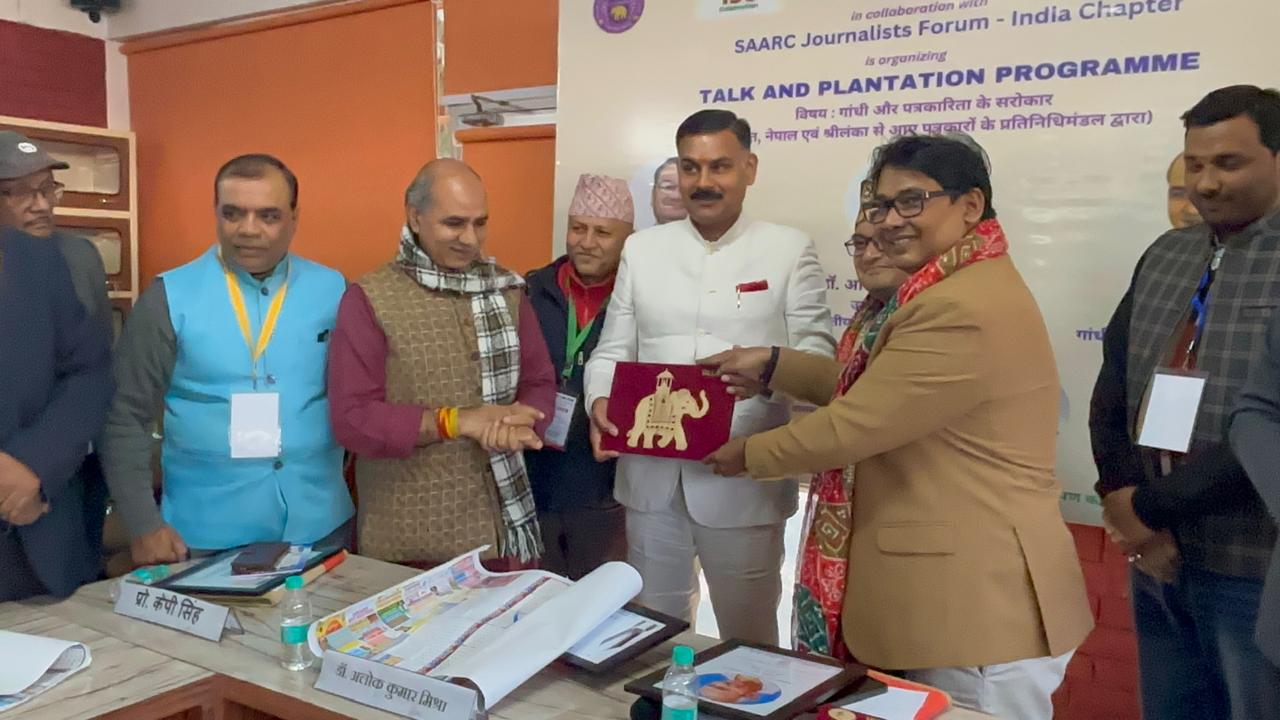
Members of the South Asian Journalists Forum have gathered at the University of New Delhi for a two day conference themed ‘Peace and Co-operation’.
Journalists from Bangladesh, Nepal, Sri Lanka and India are attending the conference hosted by the University of Delhi in collaboration with the India Chapter of SJF, and will deliberate on how the media can act as a catalyst for regional stability and mutual coexsistence.
A tree plantation campaign was also held at the Ghandi Bhawan premises of the University to mark the event and symbolize growing regional ties.
The Sri Lanka delegation is led by President of SJF’s Sri Lanka Chapter Rahul Samantha Hettiarachchi.

The Governor of the of Gujarat, Acharya Devvrat, along with the Deputy Chief Minister of Gujarat, Harsh Sanghvi, met with Prime Minister Dr. Harini Amarasuriya on Thursdy [February 05] at the Parliamentary Complex to discuss the arrangements related to the exposition of the Devnimori Sacred Relics of Lord Buddha, which have been brought to Sri Lanka under the patronage of Indian Prime Minister Narendra Modi and the Government of India.
These sacred relics of Lord Buddha were discovered during archaeological excavations conducted in the 1960s at the historic Devnimori site in Gujarat, the home state of Indian Prime Minister Narendra Modi. Until now, these relics had never been taken outside India. As a result of discussions held between President Anura Kumara Dissanayake and Indian Prime Minister Narendra Modi during his recent visit to Sri Lanka, the people of Sri Lanka have been granted this rare opportunity to venerate these sacred relics.
The exposition of the relics is being held for a period of seven days, from February 05 to February 11, at the Gangaramaya Temple in Hunupitiya, Colombo. Discussions were held between both parties regarding the arrangements related to this event.
The discussion was attended by Samar Nanda, Joint Secretary of the Indian Ministry of Culture; Dr. Satyanjal Pandey, Acting High Commissioner of India in Sri Lanka; Abhijit Halder, Director General of the International Buddhist Confederation; along with several others.
[Prime Minister’s Media Division]

The Indian Naval Ship (INS) GHARIAL made a port call in Colombo for operational turnarounds on 04 Feb 26. The Sri Lanka Navy welcomed the visiting ship in compliance with naval traditions.
Commanded by Commander Gaurav Tewari, INS GHARIAL is a vessel with a length of 124.8 meters.
During this visit, ten (10) Bailey Bridges, brought by ship, through the coordination of the High Commission of India in Sri Lanka, will be handed over to the Disaster Management Center. These bridges will provide temporary transportation links while bridges damaged across the island by adverse weather conditions are repaired.
The crew’s itinerary features scheduled goodwill activities with the Sri Lanka Navy, alongside visits to several tourist attractions across the island.

The SSC finally steps out of the sunshine and into the floodlights

SAARC journalists meet in New Delhi

Governor of Gujarat met with Sri Lanka PM to discuss exposition of Devnimori Relics

India chase sixth Under-19 World Cup title, England their first since 1998

Meet the women protecting India’s snow leopards

Louvre Museum crown left crushed but ‘intact’ after raid

‘Dates have the highest sugar content to fight Coronavirus’

Sunday Island 27 December – Headlines

#SundayIsland 17th December – Headlines

Sunday Island – 28th March

Sunday Island Headlines – 21 March

Sunday Island – 21st February – Headlines
-

 Business6 days ago
Hayleys Mobility ushering in a new era of premium sustainable mobility
-

 Business3 days ago
SLIM-Kantar People’s Awards 2026 to recognise Sri Lanka’s most trusted brands and personalities
-
 Business6 days ago
Advice Lab unveils new 13,000+ sqft office, marking major expansion in financial services BPO to Australia
-
 Business6 days ago
Arpico NextGen Mattress gains recognition for innovation
-

 Business5 days ago
Altair issues over 100+ title deeds post ownership change
-

 Editorial6 days ago
Govt. provoking TUs
-

 Business5 days ago
Sri Lanka opens first country pavilion at London exhibition
-

 Business4 days ago
All set for Global Synergy Awards 2026 at Waters Edge