
News
Authorities turn blind eye to construction of hotels on elephant corridor

By Rathindra Kuruwita
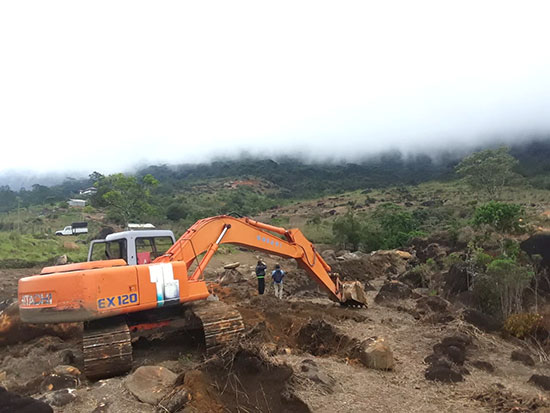
Two businessmen were constructing hotels blocking the Menikkawatta, Bowitiyatenna elephant corridor, which is used by elephants to cross from Morning Side, a part of the Sinharaja Forest Reserve to Dellawa – Walankanda forest, environmentalist Sajeewa Chamikara said yesterday.
Chamikara told The Island that one hotel was being built by the son-in-law of a wealthy gem merchant in Kalawana; seven acres of forest land have already been cleared.
The Kalawana Pradeshiya Sabha had allowed the construction of the hotel, despite violation of the environmental laws, he said.
According to Chamikara, the other hotel was being built by a businessman from Godakawala ; he has cleared eight acres of forest land in Bowitiyatenna.
Chamikara said: “Because of these constructions, lives and property of those living in Rambuka, Thanawela, Ellagama, Handiyakade, Kajugaswatta, Pothupitiya, Kopikella and Cypresswatta will be in danger. Recently, a lot of new land was attached to the Sinharaja Forest Reserve but using political and economic power these businessmen are building hotels, destroying the environment.
He said the area was prone to landslides. Given the importance of the area, any development activity would have to be highly regulated.
“All constructions here are highly regulated. According to the gazette notification 772/22 issued under the National Environmental Act, no 47 of 1980; an Environmental Impact Assessment (EIA) has to be carried out when engaging in development activities over a hectare. An EIA has to be conducted when any development activity is carried out within 100 metres of a protected forest area. But neither of these hotels has obtained any environmental approvals.”
Chamikara said that the Central Environmental Authority (CEA) had the power to take legal action against those violations. Unfortunately, the authorities had not taken any action, he said.

Latest News
Sun directly overhead Pandatharippu, Thellippalai, Varuthaleivilan, Vasavilan, and Manatkaadu about 12:10 noon today (15)


On the apparent northward relative motion of the sun, it is going to be directly over the latitudes of Sri Lanka from the 05th to 15th of April in this year.
The nearest areas of Sri Lanka over which the sun is overhead today (15th) are Pandatharippu, Thellippalai, Varuthaleivilan, Vasavilan, and Manatkaadu about 12:10 noon.
Latest News
Heat Index at ‘Caution Level’ in the Northern, North-central, North-western, Western, Eastern and Southern provinces and in Monaragala district

Warm Weather Advisory
Issued by the Natural Hazards Early Warning Centre
Issued at 3.30 p.m. on 14 April 2026, valid for 15 April 2026.
The Heat index, the temperature felt on human body is likely to increase up to ‘Caution level’ at some places in the Northern, North-central, North-western, Western, Eastern and Southern
provinces and in Monaragala district.
The Heat Index Forecast is calculated by using relative humidity and maximum temperature and this is the condition that is felt on your body. This is not the forecast of maximum temperature. It is generated by the Department of Meteorology for the next day period and prepared by using global numerical weather prediction model data.

Effect of the heat index on human body is mentioned in the above table and it is prepared on
the advice of the Ministry of Health and Indigenous Medical Services.
ACTION REQUIRED
Job sites: Stay hydrated and takes breaks in the shade as often as possible.
Indoors: Check up on the elderly and the sick.
Vehicles: Never leave children unattended.
Outdoors: Limit strenuous outdoor activities, find shade and stay hydrated.
Dress: Wear lightweight and white or light-colored clothing.
Note:
In addition, please refer to advisories issued by the Disaster Preparedness & Response Division, Ministry of Health in this regard as well. For further clarifications please contact 011-7446491.
Latest News
“I extend my heartfelt wishes to all Sri Lankans for a peaceful and joyous Sinhala and Tamil New Year!” – President

President Anura Kumara Dissanayake, issuing a New Year message, extend his heartfelt wishes to all Sri Lankans for a peaceful and joyous Sinhala and Tamil New Year!
The Sinhala and Tamil New Year, which symbolises the aspiration for renewal both physically and spiritually, is the foremost cultural festival of the people of this country.
During the Sinhala and Tamil New Year, traditional customs are upheld, with priority accorded to rituals and religious observances, and activities undertaken collectively at a common auspicious time. This shared cultural practice vividly reflects our nation’s identity before the world, as well as the strong socio-cultural bonds that exist among our communities.
We firmly believe that the future path of national development can only be shaped in harmony with this invaluable culture and our distinguished historical heritage. Accordingly, it must be recalled that all our future development plans have been formulated upon the firm foundation of these precious traditions and cultural values.
Moreover, the common aspiration embodied in the customs and rituals associated with the solar transition is the nurturing of a compassionate individual who values togetherness, respects others, and lives in harmony with nature. I believe that the virtues and values of unity reflected in these New Year traditions should not be confined to these few days alone, but should instead be demonstrated throughout the year in our daily conduct.
In the face of the most significant recent natural disaster challenge encountered in the past year, we demonstrated to the world our resilience and capacity to withstand internal shocks. At the same time, in responding to the external challenges arising from the conflict in the Middle East, the Government has already set in motion a well-planned and effectively managed programme to overcome these difficulties.
As a nation, in overcoming these challenges together, I call upon all of you to further dedicate yourselves to enriching your lives through the values of togetherness, sharing, and solidarity exemplified during the Sinhala and Tamil New Year season.
As we strengthen the achievements we have secured and move forward with unwavering resolve in the face of emerging challenges, I invite everyone to join hands in unity to realise the vision of “A Thriving Nation – A Beautiful Life” for all.
I extend my heartfelt wishes to all Sri Lankans for a peaceful and joyous Sinhala and Tamil New Year!

Chennai Super Kings win two in a row for the first time since April 2024

250 missing after migrant boat sinks in Indian Ocean

Trump hints Iran talks could resume this week as US port blockade continues

Sun directly overhead Pandatharippu, Thellippalai, Varuthaleivilan, Vasavilan, and Manatkaadu about 12:10 noon today (15)

Showers will occur at several places in the Western, Sabaragamuwa, Central, Southern, and North-western provinces, and in Anuradhapura district after 1.00 pm.

Heat Index at ‘Caution Level’ in the Northern, North-central, North-western, Western, Eastern and Southern provinces and in Monaragala district

‘Dates have the highest sugar content to fight Coronavirus’

Sunday Island 27 December – Headlines

#SundayIsland 17th December – Headlines

Sunday Island – 28th March

Sunday Island Headlines – 21 March

Sunday Island – 21st February – Headlines
-

 News3 days ago
CEB orders temporary shutdown of large rooftop solar systems
-

 News6 days ago
AG: Coal procurement full of irregularities
-

 Business5 days ago
Israeli attack on Lebanon triggers local stock market volatility
-
 Features3 days ago
From Royal College Platoon to National Cadet Corps: 145 years of discipline, leadership, and modern challenges
-

 Business6 days ago
Hayleys Mobility introduces Premium OMODA C9 PHEV
-

 Business5 days ago
HNB Assurance marks 25 years with strategic transformation to ‘HNB Life’
-

 Sports6 days ago
DS to face St. Anthony’s in ‘Bridges of Brotherhood’ cricket encounter
-

 Latest News3 days ago
PNS TAIMUR & ASLAT arrive in Colombo