
Foreign News
Australia PM Albanese makes stunning comeback with landslide win


Labor’s Anthony Albanese has defied the so-called “incumbency curse” to be re-elected Australia’s prime minister in a landslide win.
Official vote counting won’t finish for days, but Albanese’s centre-left government will dramatically increase its majority after the conservative Liberal-National coalition suffered a thumping defeat nationwide.
“Today, the Australian people have voted for Australian values: for fairness, aspiration and opportunity for all; for the strength to show courage in adversity and kindness to those in need,” Albanese said.
Coalition leader Peter Dutton, who lost his own seat of 24 years, said he accepted “full responsibility” for his party’s loss and apologised to his MPs.
Following the result, UK Prime Minister Sir Keir Starmer and US Secretary of State Marco Rubio both said they looked forward to deepening their bilateral relationships with Australia.
Labor has seen swings towards them right across the country – a rare feat for a second-term government in Australia – and Albanese becomes the first prime minister to win back-to-back elections in over 20 years.
The party’s success has also tempered a trend of voters abandoning the two major parties, which was the big story of the last election in 2022.
Labor is on track to finish with 85 seats, the Coalition about 40, and the Greens Party with one or two, according to projections by the Australian Broadcasting Corporation (ABC). Other minor parties and independents are ahead in nine seats.
That represents an increase of nine for Labor and a significant drop in support for the Greens. However most “teal” independents have been returned in their more conservative, inner-city electorates.
It’s a remarkable turnaround from the start of the year, when polling put Albanese’s popularity at record lows after three years of global economic pain, tense national debate, and growing government dissatisfaction.
The five-week campaign was dominated by cost-of-living concerns – particularly the affordability of healthcare and housing – with issues like energy and climate change, international relations, and migration also rearing their heads.
Albanese touched on most of them on Saturday night. He reiterated his promises to make healthcare – most critically GP appointments – more affordable, put buying a house in reach for more Australians, and do more to address climate change and protect the environment.
Notably, he also vowed to advance reconciliation for First Nations people: “We will be a stronger nation when we Close the Gap between Indigenous and non-Indigenous Australians.”
It’s a veiled referenced to the biggest moment of Albanese’s tenure, the failed Voice referendum of October 2023, which sought to recognise Aboriginal and Torres Strait Islander people in the constitution, and simultaneously establish a parliamentary advisory body for them.
Australia remains the only Commonwealth country to have never signed a treaty with its Indigenous people.
The Voice was one of Albanese’s most defining policies, and his most striking setback – it was overwhelmingly rejected after months of often toxic and divisive national debate.
Indigenous Australians have told the BBC they feel like they’ve been forgotten by policymakers since.
The prime minister also found difficulty trying to walk a middle path on the Israel-Gaza war, raised eyebrows after buying a multi million dollar beach pad as voters grappled with a housing crisis and, like other leaders globally, grappled with tough economic conditions.
With tanking poll numbers, Albanese was broadly seen as the underdog coming into the election, and was poised to be the next victim of the “incumbency curse” – a term to explain a global trend where struggling constituents were turfing out governments after a single term.
Dutton, on the other hand, looked like he was writing a great political comeback – he was on the edge of bringing his party from its worst loss in 70 years back into office in a single term.
It has been almost a century since a first-term government has failed to win re-election, but as Australian National University Emeritus Professor John Warhurst said: “Dutton entered the campaign [year] in front. It was his to lose.”
Instead tonight Dutton has overseen a party loss so emphatic he has lost his own electorate of Dickson, to Labor’s Ali France.
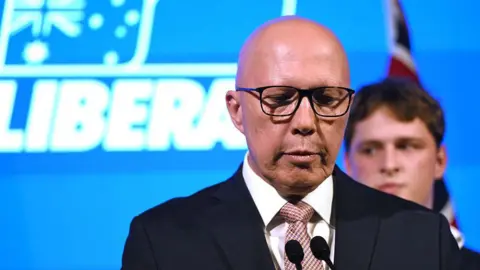
“I love this country and have fought hard for it,” he told supporters in Brisbane, conceding defeat.
“We have been defined by our opponents in this election which is not a true story of who we are, but we will rebuild from here and we will do that because we know our values, we know our beliefs, and we will always stick to them.”
His campaign was marred by unforced errors: including a series of policy backflips which caused confusion, awkward mistakes on important issues like cost of living and, perhaps most memorably, accidentally booting an AFL ball into a cameraman’s head.
[BBC]


Former Malaysian Prime Minister Najib Razak has been jailed for 15 years for abuse of power and money laundering, in his second major trial for a multi-billion-dollar state funds scandal.
Najib, 72, was accused of misappropriating nearly 2.3 billion Malaysian ringgit ($569m; £422m) from the nation’s sovereign wealth fund 1Malaysia Development Berhad (1MDB).
On Friday afternoon a judge found him guilty in four charges of abuse of power and 21 charges of money laundering.
The former PM is already in jail after he was convicted years ago in another case related to 1MDB.
Friday’s verdict comes after seven years of legal proceedings, which saw 76 witnesses called to the stand.
The verdict, delivered in Malaysia’s administrative capital Putrajaya, is the second blow in the same week to the embattled former leader, who has been imprisoned since 2022.
He was handed four 15-year sentences on abuse of power charges, as well as five years each on 21 money laundering charges. The jail terms run concurrently under Malaysian law.
On Monday, the court rejected his application to serve the remainder of his sentence under house arrest.
But the former prime minister retains a loyal base of supporters, who claim that he’s a victim of unfair rulings and who have showed up at his trials calling for his release.
On Friday, dozens of people gathered outside the court in Putrajaya in support of Najib.
The 1MDB scandal made headlines across the world when it came to light a decade ago, embroiling prominent figures from Malaysia to Goldman Sachs and Hollywood.
Investigators estimated that $4.5bn was siphoned from the state-owned wealth fund into private pockets, including Najib’s.
Najib’s lawyers claim that he had been misled by his advisers – in particular the financier Jho Low, who has maintained his innocence but remains at large.
But the argument has not convinced Malaysia’s courts, which previously found Najib guilty of embezzlement in 2020.
That year, Najib was convicted of abuse of power, money laundering and breach of trust over 42 million ringgit ($10m; £7.7m) transferred from SRC International – a former unit of 1MDB – into his private accounts.
He was sentenced to 12 years in prison, but saw his jail term halved last year.
The latest case concerns a larger sum of money, also tied to 1MDB, received by his personal bank account in 2013. Najib said he had believed the money was a donation from the late Saudi King Abdullah – a claim rejected by the judge on Friday.
Separately Najib’s wife, Rosmah Mansor, was sentenced to ten years in jail in 2022 for bribery. She is free on bail pending an appeal against her conviction.
The scandal has had profound repercussions on Malaysian politics. In 2018 it led to a historic election loss for Najib’s Barisan Nasional coalition, which had governed the country since its independence in 1957.
Now, the recent verdicts has highlighted fissures in Malaysia’s ruling coalition, which includes Najib’s party United Malays National Organisation (UMNO).
Najib’s failed house arrest bid on Monday was met with disappointment from his allies but celebrated by his critics within the same coalition.
Malaysia’s Prime Minister Anwar Ibrahim called for politicians on all sides to respect the court’s decisions.
Former Malaysian lawmaker Tony Pua told the BBC’s Newsday programme that the verdict would “send a message” to the country’s leaders, that “you can get caught for corruption even if you’re number one in the country like the prime minister”.
But Cynthia Gabriel, founding director of Malaysia’s Center to Combat Corruption and Cronyism, argued that the country has made little headway in anti-corruption efforts despite the years of reckoning after the 1MDB scandal.
Public institutions have not been strengthened enough to reassure Malaysians that “the politicians they put into power would actually serve their interests” instead of “their own pockets”, she told Newsday.
“Grand corruption continues in different forms”, she added. “We don’t know at all if another 1MDB could occur, or may have already occurred.”
(BBC)

A pile-up involving at least 50 vehicles on a highway in central Japan has left two people dead and 26 injured, according to police.
The incident was caused by a crash between two trucks, sparking a chain reaction that set at least 10 vehicles on fire, local police said.
A 77-year-old woman from Tokyo was killed, and another body was discovered in the driver’s seat of a burnt-out truck. Five people were seriously injured and 21 suffered minor injuries, police said.
There was a heavy snow warning in place at the time of the crash. Police believe icy surfaces likely caused the trucks to skid on the roads.
The crash happened on the Kan-etsu Expressway in Minakami, Gunma prefecture, about 160km (100 miles) north-west of Tokyo, at about 19:30 local time (10:30 GMT) on 26 December.
It took about seven and a half hours to put out the fire, police said.
Following the incident, a section of the highway was closed, with a long line of vehicles, many charred beyond recognition, stuck in the outbound lane. Work is under way to tow them away.
A man in his 60s, whose vehicle was involved in the accident, told local media outlet NHK he heard a loud explosion from the far end of the pile-up and saw fire during the crash. The blaze then spread to other vehicles, he said.
He said he was evacuated to a nearby toll gate with about 50 other people and spent the night in the hallway there.
Nexco, which operates the road, said checks were needed to see if the surface was damaged by the fire.
The company is warning travellers not to use the highway.
(BBC)

New York has woken up to its heaviest snowfall in nearly four years after a winter storm blanketed parts of the US north-east.
New York City’s Central Park recorded 4.3in (11cm) of snow, its highest since January 2022, while other parts of the state saw up to 7.5in of snow, said the US National Weather Service (NWS).
New York Governor Kathy Hochul declared a state of emergency for more than half of counties in the state ahead of the storm.
On Saturday, more than 900 flights were cancelled, mostly in the New York area, while more than 8,000 were delayed nationwide, according to tracking website FlightAware.
(BBC)

Navy seizes an Indian fishing boat poaching in northern waters

Mandhana, Shafali and Ghosh help India edge run-fest to go 4-0 up

Showers predicted in several provinces today (29th December)

Delay in govt. response to UK sanctions on ex-military chiefs, and others causes concern

Sri Lanka outlines seven key vectors of international cooperation at Moscow forum

Sri Lanka third most preferred destination for Indians

‘Dates have the highest sugar content to fight Coronavirus’

Sunday Island 27 December – Headlines

#SundayIsland 17th December – Headlines

Sunday Island – 28th March

Sunday Island Headlines – 21 March

Sunday Island – 21st February – Headlines
-

 News7 days ago
Members of Lankan Community in Washington D.C. donates to ‘Rebuilding Sri Lanka’ Flood Relief Fund
-

 News5 days ago
British MP calls on Foreign Secretary to expand sanction package against ‘Sri Lankan war criminals’
-

 Features7 days ago
General education reforms: What about language and ethnicity?
-
 News7 days ago
Suspension of Indian drug part of cover-up by NMRA: Academy of Health Professionals
-
 Sports5 days ago
Chief selector’s remarks disappointing says Mickey Arthur
-
 News4 days ago
Street vendors banned from Kandy City
-

 Editorial7 days ago
A very sad day for the rule of law
-

 News7 days ago
US Ambassador to Sri Lanka among 29 career diplomats recalled