
Latest News
Fears of global instability drive Singapore voters into ruling party’s arms


Singapore’s ruling People’s Action Party (PAP) has won by a landslide in an election dominated by concerns over the cost of living and the country’s future economic stability.
Led by Prime Minister Lawrence Wong in his first election since he became party leader last year, the PAP clinched 65.6% of the vote and an overwhelming majority of the 97 seats in parliament.
Singaporeans went to the polls on Saturday worrying about inflation, wage stagnation and job prospects.
The result will be widely seen as a flight to safety to the PAP amid fears of global turbulence.
“Singapore feels particularly vulnerable given its economy’s size and exposure to international forces… Also we are notoriously risk-averse voters,” said Ian Chong, an associate professor in political science at the National University of Singapore (NUS).
The main opposition, the centre-left Workers’ Party (WP), failed to capture more seats but continued to hold on to its 10 seats in parliament.
The centre-right PAP has governed Singapore continuously since 1959, making it one of the longest-ruling political parties in the world.
It has enjoyed strong support from Singaporeans, particularly from older generations that have seen the country flourish under PAP rule.
But while elections have been free from fraud and irregularities, critics also say the party maintains an unfair advantage through gerrymandering and a tightly controlled media.
In the last three polls prior to Saturday’s result, the PAP saw two of its lowest-ever vote shares, while the WP made increasing inroads in parliament.
The PAP won a reduced majority in the 2020 election, in what was seen as a referendum on their handling of the Covid outbreak.
But Saturday’s result saw the PAP return to form, as voters gave Wong a strong mandate.
In a televised address early on Sunday, he thanked voters and said the results “will put Singapore in a better position to face this turbulent world”.
“Many are watching the election closely, whether it’s international media, investors or foreign governments, they would have taken note of tonight’s results,” he said.
“It’s a clear signal of trust, stability and confidence in your government. Singaporeans, too, can draw strength from this and look ahead to our future.”
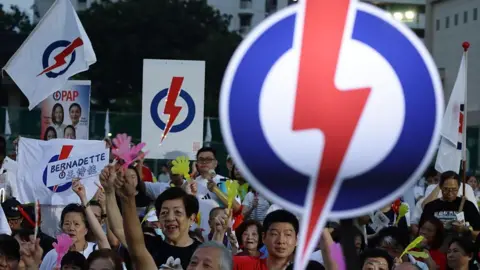
While its open and globalised economy remains fairly buoyant, Singapore saw inflation surge in the last few years.
The government has attributed this to external factors such as the Ukraine and Gaza wars and supply chain disruptions. Critics however say a controversial goods and services tax hike exacerbated it.
With the US-China trade war under way and a 10% US tariff looming, authorities and experts have warned of shocks to the economy and possibly a technical recession.
Against this backdrop, the PAP campaigned on a message of stability.
Wong repeatedly promised that his team would “steer Singapore through the storm”, while warning that if more opposition MPs were elected, he would lose capable ministers at a time when good governance was most needed.
It was a message that resounded with many voters. One PAP supporter, a start-up owner who only wanted to be known as Amanda, told the BBC that her business has been affected with clients pausing some projects due to the economic climate. “The headwinds are not great, there’s a lot of uncertainty… I want a party with experience running the government,” she said.
Though the PAP saw a series of scandals in recent years, including one involving a cabinet minister. this was hardly a talking point during the election period. Analysts said it was further from people’s minds given more immediate concerns about the economy.

Some see the result as a sign of confidence in Wong, who led Singapore’s Covid taskforce and became a familiar face as he regularly addressed the public during the pandemic.
“He’s shown that he is capable, with the Covid taskforce giving him credence. He was the guiding hand on that rudder… and he projects that stability for future global financial uncertainties,” said Rebecca Tan, a political science lecturer with NUS.
Wong is the first PAP prime minister to have improved the party’s vote share in his first election. Previous PMs saw dips in the polls in what analysts used to call the “new PM” effect”, or a reflection of voters’ uncertainty in a new leader.
The PAP’s strong result was also partly due to a fragmented opposition, with 10 parties going up against them. With few exceptions, most performed poorly.
Teo Kay Key, a research fellow at the think tank Institute of Policy Studies, said that despite recent elections showing there was a desire for political diversity, the latest result “shows that people are happy with the number of opposition MPs” for now.
But, she added, Singaporeans also “seem to be more selective” now when it comes to casting votes for the opposition, pointing to the WP’s performance.
The WP had campaigned on a platform of lowering the cost of living and strengthening the safety net.
While it failed to win more seats, it also saw increased vote shares in the constituencies it retained and close fights with the PAP in others, cementing its status as the country’s strongest opposition party.
It turned in a robust performance despite recent controversial cases involving a former Workers’ Party MP and WP leader Pritam Singh, who were both found guilty of lying to parliament. Many in the WP’s support base believe the case, against Singh especially, was politically motivated.
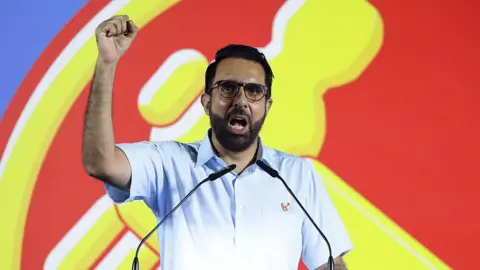
Addressing supporters shortly after the results for his constituency were declared, Singh acknowledged that “it was always going to be a difficult election”.
But he added: “The slate is wiped clean, we start work again tomorrow, and we go again.”
[BBC]


The head of AI company Anthropic has called for the pace of development of artificial intelligence models to slow down and to be closely monitored.
In an essay, Dario Amodei said developing AI was not in question, but the risks associated with it were “serious” and companies and governments must be given time to address them.
The bosses of two rival AI firms, Sam Altman of OpenAI and Elon Musk, have both said they agree with Amodei.
There have been growing concerns recently about the technology’s potential risks. An AI researcher who left Anthropic this week told the BBC that “if we don’t slow down at the current rate of progress, there is a strong chance that we could all die in the immediate future”.
Jacob Coxon told Laura Kuenssberg that people working at AI companies were “genuinely frightened… genuinely concerned about the fate of humanity in the next two years”.
“It’s not at all an exaggeration to say that the people who are involved with both founding these companies and building the tech believe there is a possibility of human extinction,” Coxon said.
“Many of the people who are sort of deep in the weeds on actually coding the thing believe that there is like a greater than ten percent chance, or even greater. Some smaller, but they all have different numbers for a probability that humans might die. And they all keep this in their head on a daily basis while working on the technology.”
In Amodei’s essay, called We Must Pace the Frontier and made public on Saturday, he proposed a three-point plan that includes independent monitoring of AI models as they are developed, industry-wide regulation and global regulation.
As his proposal made the rounds, even competitors voiced support for the idea of third-party monitors who could evaluate the safety of models as they are developed.
“I agree with Dario that we need to pace the frontier,” wrote OpenAI CEO Sam Altman on X. He called independent evaluators “a great idea.”
In a new interview with Fortune Magazine, Altman had sounded similar safety concerns, saying standards were “not at a place” to push AI capabilities much further.
He added that he believed AI beyond human control is “absolutely” possible.
Elon Musk meanwhile said the Anthropic boss was “right”.
The warnings have prompted calls to action, but US President Donald Trump has so far rejected such fears, saying on Thursday he was concerned “if we don’t win AI, we’re going to be put in a very bad position”.
Cyber-security concerns have grown as new models have exhibited more and more powerful hacking capabilities.
Anthropic withheld its Mythos model from public use when it was announced in April that it could independently escape the testing environment, known as the sandbox.
In the run-up to the release of its most recent Astra model, OpenAI cited cybersecurity concerns as it explained it had paused certain aspects of the model’s development.
Safety has also taken centrestage in the rivalry between Anthropic and OpenAI.
Amodei, who had previously worked as a vice president at OpenAI, has said he co-founded Anthropic in 2021 so he could build safer and more trusted AI models.
In his essay, Amodei pointed out that AI had advanced “drastically faster” including its “ability to build the next generation of AI” – and mentioned an incident involving rival OpenAI which has revealed that agents conducted cybersecurity attacks on targets they were not asked to attack in July.
The OpenAI agents had “essentially acted as a fanatically devoted collective”, Amodei said. OpenAI has said it is slowing down training of certain advanced AI models and tools as a result.
Amodei called for “building AI at a balanced rate that aims to ensure its safety while still achieving its benefits”.
This would not mean “halting model training or technical progress, but ensuring companies take adequate time to align and safeguard their models, and for third party evaluators to confirm this”.
He was committing Anthropic to this “unilaterally” – as well as calling on governments “to require other frontier companies to match”.
Amodei said he recognised that regulation might not be able to keep up with the pace of AI, and therefore called on AI companies to “voluntarily work together to set standard” in parallel with regulation.
The Anthropic CEO went on to address the impact that a slowdown would have on the industry and competition with leading developers worldwide, particularly China.
“I believe that if slowing down bought us even an extra year or two before models reach critical levels of capability, and we used that time to advance alignment, we could greatly reduce the risk that something goes seriously wrong,” Amodei said.
This would have to be done in a co-ordinated manner “without sacrificing commercial advantage or the United States’ lead in AI”. Any slowdown would have to be limited, he said, to avoid allowing China to pull ahead.
He urged the US government to take measures so that US companies’ AI chips could not be sold to China – or the technology shared with authoritarian countries.
His former employee, Jacob Coxon, told the BBC, however, that the initiative to slow down must go beyond the US – “there’ll need to be some sort of co-ordinated slowdown with China if we’re going to avoid a race at an international scale”.
Amodei’s post has prompted a wide range of responses.
Clement Delangue, the CEO of the AI platform Hugging Face, said he was launching a new project called the Open Alignment Initiative, adding he wanted to be among “embedded evaluators” that Amodei proposed could be part of a solution.
Hugging Face was hacked by OpenAI agents earlier this year prompting an outcry over AI safety.
“Let’s make AI safer by making it more transparent,” Delangue wrote on X.
Elon Musk also voiced his support, writing that “Dario is right”.
Musk, whose SpaceXAI makes the controversial chatbot Grok, once called Anthropic “evil” but has changed his tone since signing a $15bn deal to sell compute capacity to Anthropic in May.
However some observers suggested that Amodei’s post was less about safety than about consolidating control over AI technology.
“Dario makes the case to stop open source and concentrate enormous technological and economic power with Anthropic,” wrote Chamath Palihapitiya, investor and co-host of the tech podcast “All-In”.
Notions of slowing down or even pausing AI development have long been met with such cynicism in certain corners of Silicon Valley, with critics accusing leading AI developers of hyping their technology as a marketing ploy.
Anthropic and OpenAI are both reportedly preparing for potentially record-setting initial public offerings.
[BBC]

If spin is to decide the Women’s T20 Asia Cup final, both India and Sri Lanka have plenty to call upon. India’s spin attack, led by Deepti Sharma, has taken 26 wickets in the tournament, the most by a side. Sri Lanka are next with 25. That makes it seem like a spin vs spin and more spin kind of title contest.
On the plus side for India is that they have appeared well-rounded on the whole. Smriti Sharma and Shafali Verma have scored the bulk of the runs.
Sri Lanka, by contrast, have had to fight for momentum with the bat on the slow Dubai pitches. They were 33 for 4 in the semi final against Pakistan before Hrshitha Samarawickrema and Kavisha Dilhari revived and then completed the chase. Prior to that, they were 44 for 5 against Bangladesh and had to depend on Samarawickrama’s composed knock to seal their semi-final spot. They were also 45 for 5 against Indonesia in the league stage, before Nilakshi Silva lifted them.
That batting order has looked shaky. Chamari Athapaththu allying just 63 runs from four innings and Imesha Dulani 64 from four innings is a concern. And India’s bowling – quick bowler Nandani Sharma has been in good form too – might be tougher to handle than what Sri Lanka have faced so far.
India’s recent record against Sri Lanka also makes them favourites. They swept the five-match T20I series in December 2025 at home, and have won nine of their last ten T20Is against them.
But Sri Lanka’s one victory in that stretch came in the biggest game of all: the 2024 Asia Cup final in Dambulla, when they chased down 166 with eight wickets to spare to win the title.
That means Sri Lanka have both a challenge and a cause for optimism. They will need their batters to withstand Nandani and India’s spin trio – Deepti, N Shree Charani and Prema Rawat – and find a way to build partnerships, rather than leave too much for the middle and lower-middle order to do.
India have the balance and form while Sri Lanka, the defending champions, know better than most that a final can reset the equation. Not to forget, despite their struggles with the bat, Sri Lanka have an all-win record in the Asia Cup so far, the same as India.
Shafali Verma has made fast starts a recurring theme, scoring 168 runs in four matches at an impressive strike rate of 169.69. Two of her knocks have been 64s, and she has shown little sign of taking her foot off the accelerator. In the final, how she sets up the innings could be crucial.
Sri Lanka have found ways to recover from early collapses, with different players stepping up at different stages. But they need their talisman, Chamari Athapaththu, to come to the fore in the final. Athapaththu has made an impact with the ball – she is the tournament’s joint-highest wicket-taker – but her batting is yet to click. She has crossed 30 only once in four matches, in the opener against UAE. A noteworthy contribution with the bat, to go with her threat with the ball, could give Sri Lanka the spark they need against India.
India have fielded an unchanged XI in the tournament so far and, barring injuries, should do the same.
India Women (probable): Smriti Mandhana, Shafali Verma, Pratika Rawal, Harmanpreet Kaur (capt), Richa Ghosh (wk), Bharti Fulmali, Deepti Sharma, Prema Rawat, Kranti Gaud, N Shree Charani, Nandani Sharma
Sri Lanka have used 14 of their 17 players. In the semi-final against Pakistan, they left out Vishmi Gunaratne and Chethana Vimukthi for Hasini Perera and Mithali Ayodhya, which might be their ideal XI.
Sri Lanka Women (probable): Imesha Dulani, Chamari Athapaththu (capt), Sanjana Kavindi, Harsthitha Samarawickrama, Hasini Perera, Kavisha Dilhari, Nilakshika Silva, Kaushini Nuthyangana (wk), Sugandika Kumari, Chamudi Praboda, Mithali Ayodhya

The Italian Naval Vessel ‘ITS Giuseppe Garibaldi’ departed the Port of Colombo today, 12 September 2026, after completing a replenishment stop for logistics and services.
During the ship’s stay, the Commanding Officer of ITS Giuseppe Garibaldi, Captain Marco GUERRIERO, called on the Commander Western Naval Area, Rear Admiral Harsha De Silva, at the Western Naval Command Headquarters.
Members of the visiting crew also toured several tourist attractions across the Colombo area during their port call.

If we are to live fulfilling and happy lives, we need unity, mutual understanding, harmony, as well as art – PM

Dr. Roshanie Dissanayake appointed Secretary to the Ministry of Science and Technology

Death toll from Philippines ferry fire rises to 76, with more still missing

Anthropic boss Dario Amodei calls for AI development to slow down

It’s spin vs spin as India and Sri Lanka battle for Asia Cup title

Atmospheric conditions are favorable for afternoon thundershowers in most parts of the Island today [13]

‘Dates have the highest sugar content to fight Coronavirus’

Sunday Island 27 December – Headlines

#SundayIsland 17th December – Headlines

Sunday Island – 28th March

Sunday Island Headlines – 21 March

Sunday Island – 21st February – Headlines
-

 Sports3 days ago
DDS set to lose Test captaincy
-

 Features7 days ago
After the parade: What a traffic OIC’s walk-out tells us
-

 Editorial7 days ago
Arrests as theatre
-
 News6 days ago
Thailand shuts door on undesirables from Sri Lanka
-

 Latest News7 days ago
Harshitha’s composed knock seals Sri Lanka’s semi-final berth
-

 News3 days ago
Sri Lanka faces new grid challenge as rooftop solar surges: former CEB GM
-
 Business6 days ago
CEB successor company breaks into top three in competitive BESS tender
-

 Latest News3 days ago
Shafali, Deepti power India into sixth T20 Asia Cup final