
News
Aragalaya reacts to BIA arrest, vows to oust new prez too


By Shamindra Ferdinando
Sarvapakshika Aragalakaruwo(all-party agitators), in a statement issued yesterday (27) strongly condemned the arrest of one of their key members, ‘Dhanis Ali’ by the Criminal Investigation Department (CID) at the Bandaranaike International Airport (BIA) while he was about to leave the country, in a complete new look, sans his overgrown beard and hair.
The grouping alleged that the arrest of Ali at the BIA and four other persons near the S.W.R.D. Bandaranaike statue on Tuesday (26) was part of a major government operation meant to suppress the protest movement.The grouping claimed that newly elected President Ranil Wickremesinghe was going flat out against those who made the operation against Sri Lanka’s “worst” ever President Gotabaya Rajapaksa successful. Gotabaya Rajapaksa was forced to flee the country by violent mobs pursuing him in the early hours of July 13.They asserted that the government engage in high profile operations such as the arrest made in a passenger flight as it was about to take as part its strategy to overwhelm the public.
Police headquarters said that 31-year-old Ali, a resident of Wabada, Kurunegala was under investigation over his involvement with the protest movement. Accordingly, the Fort Magistrate has issued a warrant for Ali’s arrest over the obstructing of the Finance Ministry entrance on June 20 when a group of IMF representatives was to come there, Fort Magistrate granted him bail when the police produced him in court over causing damage to public property during protest outside police headquarters on June 09, the suspect has been also wanted in connection with assault on Directorate of Military Intelligence (DMI) personnel at Galle Face on June 12, threatening personnel from Fort police on July 20 when a squad arrived at the S.W.R.D. Bandaranaike statue to inquire into reports of plans to damage it and seizing control of State Rupavahini on July 13 afternoon during violent protests.
The protest movement alleged that President Wickremesinghe appeared to have launched operations on several fronts to undermine the protest movement. The group identified six specific areas the government was on the offensive namely (1) create a rift between the protest movement and the military and police (2) portray the protest movement as an outfit opposed to the military and police (3) take tangible measures against the protest movement to appease SLPP lawmakers who voted for Ranil Wickremesinghe at the presidential contest (4) create public anger towards the protest movement (5) cause fear among those opposed to the government before the next round of major protest campaign and (6) stress that those who opposed the government would have to face grave consequences.
Sarvapakshika Aragalakaruwo warned President Wickremesinghe would face fate that befell Gotabaya Rajapaksa regime. They vowed to continue ongoing protest campaign regardless of the growing challenges and threats.Authoritative police and military officials said that the identities of most of those who had inspired violence since March 31 protest at ex-President Gotabaya Rajapaksa’s private residence were now known.
The State Intelligence has briefed the government parliamentary group on Tuesday of the threat posed by ‘Aragalaya’ and its strategies meant to undermine the incumbent government. The briefing has been given when the group met at the Finance Ministry under the auspices of President Wickremesinghe and Premier Dinesh Gunawardena.Government sources said that lawmakers wanted President Wickremesinghe, the military and the police to take a tough stand and take whatever measures necessary to neutralize the threat. Sources said that the government shouldn’t retreat in the face of fresh threats made by ‘Aragalaya’ and other interested parties.



News
Establishment of an Institutional Framework to Inagurate Upper Hydro Catchment Areas Management Authority

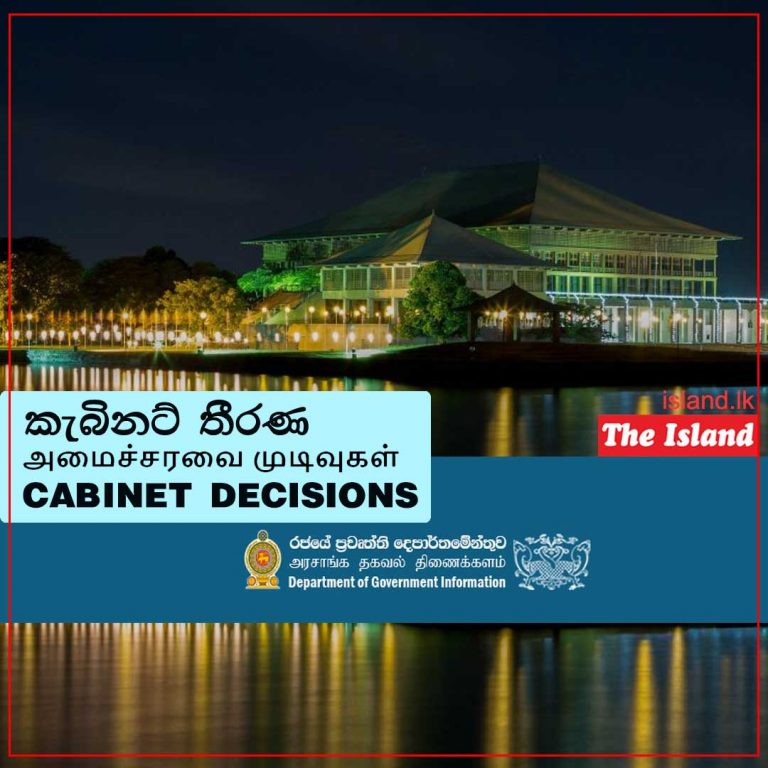
Policy approval of the Cabinet of Ministers was granted at their meeting held on 08.06.2026 to establish the Upper Hydro Catchment Areas Management Authority for identification and
execution of a formal and long – lasting remedy to secure the central hills including the upper hydro catchment areas enabling them to sustain amidst extreme weather conditions
due to natural calamities and human activities as well as to be used for the sustainable development of the country.
Accordingly, a concept paper has been prepared including
institutional structure, activities, powers, active subject area as well as administrative and coordination mechanism for the proposed authority by an expert technical committee appointed by the Secretary to the President.
Based on the said concept paper, the Cabinet of Ministers granted approval to the resolution furnished by the President to instruct the Legal Draftsman to prepare a draft bill including legal provisions required for the establishment of Upper Hydro Catchment Areas Management Authority.
News
Introduction of Flora and Fauna (Regulation of actions of the Indigenous Community within the nominated areas) Regulations
With the objective of securing the traditional livelihood and the eco system of the indigenous community, it has been recognized the necessity of introducing a formal regulation methodology to secure their engagement in livelihood activities by being more sensitive to the existing laws.
Thereby, the Fauna and Flora (regularizing) regulations under the Fauna and Flora Protection Ordinance (Authority 469) have been prepared so that nominated activities within the prescribed area to a member of the indigenous community
who has been registered for securing the rights acquired from law or custom or usage or traditional stance to execute an act within a certain state land that is fundamental to the survival of the indigenous community permission can be granted
Accordingly, the Cabinet of Ministers granted approval to the resolution furnished by the Minister of Environment to publish the said regulations in the government gazette notification and thereby submit to the Parliament for its concurrence.
Latest News
M. M. D. J. Senarathne, appointed Director General of the Department of National Botanical Gardens
The Cabinet of Ministers approved the resolution furnished by the Minister of Environment to appoint M. M. D. J. Senarathne, who is the senior most officer in Grade I of Sri Lanka Scientific Service se

Establishment of an Institutional Framework to Inagurate Upper Hydro Catchment Areas Management Authority
Introduction of Flora and Fauna (Regulation of actions of the Indigenous Community within the nominated areas) Regulations
M. M. D. J. Senarathne, appointed Director General of the Department of National Botanical Gardens

Harmanpreet Kaur steps down as India captain

Turkiye, Pakistan agree Saudi Arabia military deployment under Mecca pact

Rumesh Tharanga among nominees announced for World Athlete of the Year 2026

‘Dates have the highest sugar content to fight Coronavirus’

Sunday Island 27 December – Headlines

#SundayIsland 17th December – Headlines

Sunday Island – 28th March

Sunday Island Headlines – 21 March

Sunday Island – 21st February – Headlines
-

 Latest News7 days ago
Gold winner Tharanga gets brand-new Honda Vezel from SLAAJ
-

 News6 days ago
US-assisted ‘Ice’ detection: NPC to examine IGP’s move to transfer drug-busting team
-

 Features7 days ago
Why Sri Lanka needs an Inclusive Civic Nationalism – urgently
-

 Editorial5 days ago
Colombo Port drug bust: The plot thickens
-

 News7 days ago
Civil society activist accuses govt. of favouring Ven. Gnanasara
-
 Midweek Review7 days ago
Dappula’s Easter Sunday ‘grand conspiracy’ claim demolished
-

 Editorial7 days ago
When crime bosses rise above law and shrines
-
Editorial6 days ago
Drug busting, transfers and trust deficit