
Business
APIIT Sri Lanka hosts Kagura Film Festival


APIIT Sri Lanka’s Catalyst Club successfully concluded the third edition of Kagura, its inter-university short film festival, on 31st March at the Commercial Credit Training Center in Bolgoda. This year’s event marked the largest edition to date.
Held under the theme “The Lies We Tell,” the festival provided a platform for young filmmakers to explore truth and deception through cinema. The awards ceremony was graced by Chief Guest Kamal Addararachchi, with Damith Fonseka and APIIT Chairman Bandula Egodage as Guests of Honor. A distinguished judging panel, including Anomaa Rajakaruna and Saman Elvitigala, evaluated the entries.


The Asian Development Bank (ADB) has approved a $57.4 million financing package to help Sri Lanka expand access to affordable clean energy and reduce greenhouse gas emissions through rooftop solar aggregation and virtual net metering.
The financing consists of a $35 million concessional loan, grants of $16.9 million from the European Union and $5.5 million from the Japan Fund for the Joint Crediting Mechanism, and counterpart funding from implementing agencies, bringing total estimated project cost to $80.5 million.
The Rooftop Solar Aggregation and Virtual Net Metering Project will help two government-owned power utilities, Electricity Distribution Lanka (Private) Limited and Lanka Electricity Company (Private) Limited, to establish a scalable, utility-led model that pools electricity from large rooftop solar systems and virtually distributes credits to eligible consumers. This allows multiple users to share the benefits of solar energy without installing panels on their homes.
“This project will help Sri Lanka widen access to affordable renewable energy while strengthening grid readiness for a more resilient and inclusive power sector,” said ADB Country Director for Sri Lanka Shannon Cowlin. “It will support small businesses, advance grid modernization and digitalization, and create new opportunities for women and young people in the clean energy industry.”
The project is designed to help eligible micro, small, and medium enterprises, as well as community organizations—including those unable to install rooftop solar because of financial or space constraints—to reduce electricity costs through allocations under a social compensation mechanism.
Approximately 25 megawatt-peak of rooftop solar installations will be supported by the financing. It will also support a new aggregation and virtual net metering model, modernize and digitalize the distribution networks of the two utilities, and help build a grid ready for more distributed renewable energy. A training facility to support green skills development will be set up, women’s participation in the sector strengthened, and more capacity built on advanced low-carbon technologies.
ADB is a leading multilateral development bank supporting sustainable, inclusive, and resilient growth across Asia and the Pacific. Working with its members and partners to solve complex challenges together, ADB harnesses innovative financial tools and strategic partnerships to transform lives, build quality infrastructure, and safeguard our planet. Founded in 1966, ADB is owned by 69 members—50 from the region.
Business
University of Sri Jayewardenepura publishes international case study on Port City Colombo’s role in Sri Lanka’s economic transformation


The Faculty of Management Studies and Commerce, University of Sri Jayewardenepura, in collaboration with Port City Colombo, has co-authored and internationally published an academic case study and accompanying teaching notes for students, examining the project’s potential role in shaping Sri Lanka’s long-term economic future.
Published by Nova Publishers, New York, USA, the study titled “Port City Colombo: Catalysing Sri Lanka’s Emergence as a Global Investment Hub” provides a multidisciplinary analysis of the project’s urban planning, strategic, economic, regulatory, and sustainability dimensions. The case study is featured as a chapter in the book, “Is Sri Lanka Revitalising its Economy? An Analysis of Economic Policy and Technological Adoption,” edited by S. Perera, N. Nanayakkara, G. Samarakoon, and S. Bamunusinghe, and published under the 21st International Conference on Business Management (ICBM), the flagship conference of the Faculty of Management Studies and Commerce.
The case study explores the transformational vision of Port City Colombo as a landmark urban development and Special Economic Zone designed to support Sri Lanka’s transition from a traditional tourism-and export-dependent economy to a dynamic, service-oriented, and globally competitive investment destination. Against a backdrop of shifting global economic dynamics and increasing competition for foreign direct investment, the study examines how Port City Colombo seeks to create an enabling environment for investment, innovation, and ease of doing business while contributing to Sri Lanka’s long-term economic resilience, diversification, and integration into the global economy.
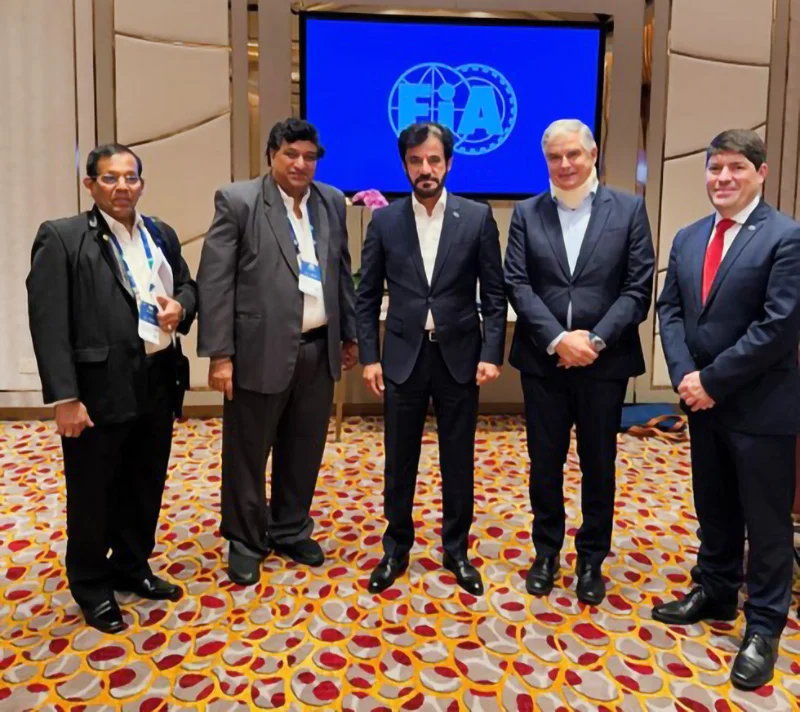
Federation Internationale de L’ Automobile(FIA) which is the world’s largest mobility sports organization located in Geneva, Switzerland, which has a membership of 245 clubs from 149 countries held an Extraordinary General Assembly hosted by The General Association of Macau, China recently.
Executive Committee members of the Automobile Association of Ceylon were also at this conference.
During the conference, Dhammika Attygalle – President AAC and Devapriya Hettiarachchi – Secretary – AAC had the opportunity to meet Dr. Mohammed Ben Sulayem – President (FIA), Carmelo Sanz de Barros – President of the FIA Senate and Alberto Villarreal, General Manager of FIA to discuss matters relating to increasing road injuries, fatalities and other road safety related subjects, such as, vertical mobility, future of EV vehicles and awareness programmes and workshops to reduce future road accidents and fatalities in Sri Lanka in line with the UN Decade of Action 2021-2030.

Morocco beat Netherlands in dramatic World Cup shootout to reach last 16

Marco Rubio meets Libyan commander as US pushes to resolve Libya crisis

Paraguay shock Germany in shootout win for one of all-time World Cup upsets

Keiko Fujimori leads in Peruvian presidential race as vote count concludes

Showers will occur at times in the Western, Sabaragamuwa and North-western provinces and in Galle, Matara, Kandy and Nuwara-Eliya districts

‘Illegal USD 1 bn transfers since 2023’: UNP challenges Prez to reveal identities of culprits

‘Dates have the highest sugar content to fight Coronavirus’

Sunday Island 27 December – Headlines

#SundayIsland 17th December – Headlines

Sunday Island – 28th March

Sunday Island Headlines – 21 March

Sunday Island – 21st February – Headlines
-

 News1 day ago
LAWASIA warns against ad hoc initiative to increase judges’ retirement ages
-

 Opinion6 days ago
Sri Lanka’s national security: Justice, reconciliation, and forward-looking vigilance
-

 News3 days ago
Another 1,132 Sri Lankan Personnel to be deployed for United Nations Peacekeeping Missions
-

 News4 days ago
Kelaniya emerges as highest ranked Lankan uni in Times Higher Education Sustainability Impact Ratings
-

 News7 days ago
US Assistant Secretary of State for South and Central Asian Affairs meets President
-

 Opinion5 days ago
A triumph for Pakistan’s skilled diplomacy at Iran-US talks
-

 Features2 days ago
People’s Bank expands digital banking network with 125th cheque deposit kiosk
-

 News3 days ago
FSP complains of irregularities in a Guinness World Record event held in Sri Lanka