
Sports
Ananda, Nalanda enter survival battle


96th Battle of the Maroons
There was a time when both Ananda and Nalanda arrived at their annual Big Match with individuals who had amassed over a thousand runs and captured more than fifty wickets in a single season — feats that underlined their dominance and added glitter to the occasion.
This year, however, neither side carries such towering personal milestones into the 96th Battle of the Maroons, which commences today at the SSC Grounds. With both teams playing comparatively fewer fixtures than in previous seasons, opportunities for players to build monumental statistics were limited. As a result, the souvenir numbers may not fully reflect the true potential within each camp.
Yet Big Matches are rarely decided on paper. Form books and statistics often fade into the background when tradition, pride and history take centre stage. Despite a season short on overwhelming positives, both Ananda and Nalanda possess enough match-winners to turn this three-day encounter into a compelling contest.
Ananda will look to their captain Kithma Widanapathirana to lead from the front. The stylish all-rounder has scored over 300 runs, including a century, while maintaining a strike rate of 100. More significantly, his off-spin has made him the side’s leading wicket-taker with over 30 scalps, making him a genuine dual threat.

Nalanda College Team (Front row from left) Nuwan Soyza (Head Coach), Kapila Nanda Kumara (Master in Charge), Viraj de Silva (PoG), Anupa Weerararthe (Deputy Principal), Osanda Hettiarachchi (Captain), Iran Champika Silva (Principal), Nadul Jayalath (Vice Captain), Charitha Kushan (Vice Principal), Deepthi Kulathunga (Asst. Principal), Monishan Chathuranga (Asst. MiC), Nimanth Pieris (Asst. Coach). Back row from left), Thiviru Ranasinghe, Sahas Godage, Ranmith Senarath, Methuka Perera, Hasith Rathnayaka, Santhul Wijerathna, Omith Rathnayaka, Lithum Wijekumara, Malsha Fernando, Dunitha Anusara, Nemindu Akmeemana, Mihin Soyza, Dunal Sendanayaka, Gayuka Herath, Gevindu Manamperi, Sadew Wijesekara.
Lithma Perera has also crossed the 300-run mark with a century to his name and will be expected to anchor the innings. Himira Kudagama, another key performer with over 250 runs this season, spearheads the pace attack and provides balance to the side. Meanwhile, left-arm spinner Sharada Jayaratne appears to be peaking at the right time. His six-wicket haul against Richmond lifted his season tally to 24 wickets and signalled his readiness for the big stage.
Nalanda, too, have their share of dependable performers. Captain Osanda Hettiarachchi, along with Ranmith Dinuwara, Mihin Zoysa, Nadul Jayalath and Gevindu Manamperi, have been among the runs in recent outings, giving the batting unit much-needed stability. In the bowling department, Hasith Rathnayake, Dunitha Anusara, Malsha Fernando and Sahash Godage have delivered impactful spells and will shoulder the responsibility of containing Ananda’s batting.
However, Nalanda will be eager to put behind them some unwanted records from the season. They conceded the highest team total among top Division sides when Mahinda piled up 507 for seven declared — a performance that exposed vulnerabilities in their bowling attack. With three days of intense Big Match cricket ahead, Nalanda’s bowlers will be determined to avoid a repeat of such circumstances.
While the absence of extraordinary individual milestones may be evident this year, the essence of the Battle of the Maroons remains unchanged. Tradition, pride and the unpredictability of schoolboy cricket promise a fiercely fought encounter where new heroes can emerge and lasting memories can be created.
(RF)


This series picks up from Bangladesh’s finest red-ball hour against arguably Pakistan’s bleakest one. Two years ago, Bangladesh came to Pakistan with six away Test wins in their history, and increased that tally by two in two weeks. Pakistan had never lost a Test to Bangladesh before that, but during late summer 2024 in Rawalpindi, a page turned in their cricketing relations.
This time around, the series takes place at an odd, off-kilter time. Neither side has played any Test cricket in six months, with Bangladesh’s last series a straightforward home wipeout of Ireland. Pakistan hosted South Africa in October, splitting the two Tests down the middle. This is the only red-ball international cricket Pakistan have played in 14 months.
Pakistan have filled that time going all in on T20 cricket, preparing for the recent T20 World Cup, before throwing themselves into a full PSL season. There will be just four days between the end of the PSL and the first day in Mirpur.
Bangladesh, meanwhile, have endured a more barren time. They refused to travel to India for the T20 World Cup and that has meant their only international cricket all year was an ODI series against Pakistan and New Zealand’s visit for a white-ball series [ODIs and T20Is]. Wins in all three mean they have a perfect record in international series in 2026 – a record that Pakistan will hope to put to a sterner test than they managed two years ago.
In 2024, Bangladesh’s seam attack outshone Pakistan’s, with Hasan Mahmud and Taskin Ahmed’s movement, and Nahid Rana’s rapid pace, causing more trouble than their Pakistani counterparts. If anything, Rana is in even better form, cutting Pakistan down in the sides’ ODI series, before shining in the recent PSL final for Zalmi, for which the BCB granted him special permission. Bangladesh’s four-man pace attack also includes Shoriful Islam and Ebadot Hossain, alongside Rana and Taskin, and could pose its own challenges against Pakistan.
Pakistan may hope the pitches allow a spin-bowling face-off instead. Soon after Bangladesh’s humbling of Pakistan in that 2024 series, Pakistan volte-faced from playing an all-seam attack in the first Test. Instead, their pitches assisted spin from ball one. To exploit that, Sajid Khan and Noman Ali have run riot on accommodating surfaces. If Mirpur offers assistance for the spinners, Pakistan will feel confident they have the personnel to go toe-to-toe with the hosts.
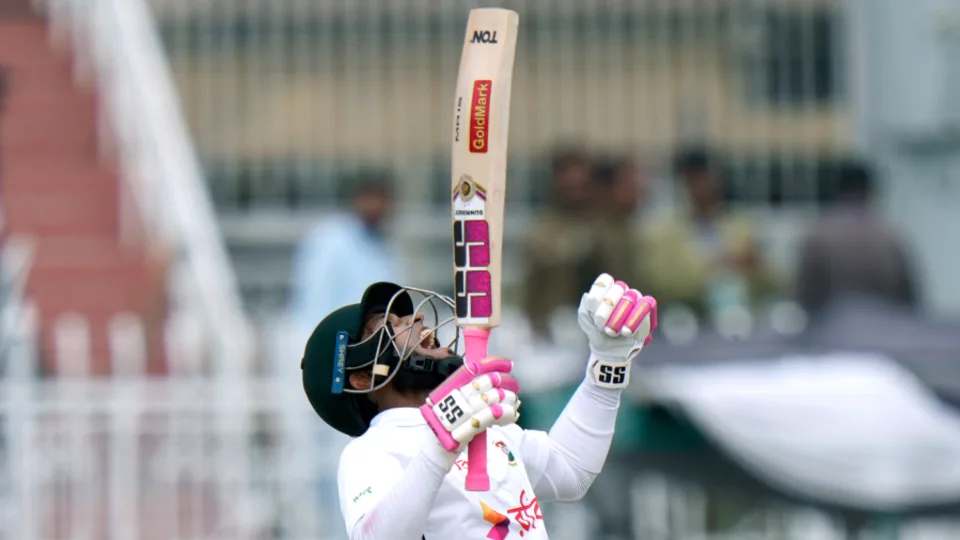
Mushfique Rahim struck a century in his 100th Test, against Ireland in November last year. He will take fresh guard against Pakistan, despite speculation about his impending retirement. Mushfiqur has resisted being pushed towards the end unless he wants to. His 191 against Pakistan in Rawalpindi was a testament to his hunger for runs, as was his celebration during this milestone 100th Test against Ireland. Mushfiqur remains a vital cog in the Bangladesh middle-order. Pakistan will be wary of him, particularly in Dhaka.
Sajid Khan has found his international opportunities limited to home Tests, but this wasn’t always the case. His first six Test matches all took place away from home, with his finest away moment coming in Bangladesh, at this very ground in Mirpur. With rain laying waste to the best part of three days of that Test, Sajid wrenched the game from the clutches of the weather. He took eight wickets in Bangladesh’s first innings, to bowl them out for 87, and narrowly force a follow-on. Four more in the second innings saw Bangladesh bowled out on the fifth evening, giving Pakistan a sensational innings win. This series is perhaps Sajid’s best chance to demonstrate he remains useful outside Pakistan.
Bangladesh are likely to bring in Taskin Ahmed and Nahid Rana in place of Khaled Ahmed and Hasan Murad, respectively. Shoriful Islam’s white-ball form would put pressure on Ebadot Hossain’s place.
Pakistan have been dealt a blow with Babar Azam* ruled out of the opening Test due to a left knee injury. His absence leaves a hole which is likely to be filled in by a debutant. The visitors will likely go in with two spinners in Sajid and Noman, which leaves them a choice of two of four fast bowlers. With Imam-ul-Haq back in the side, Pakistan are expected to hand a debut to one of Azan Awais and Abdullah Fazal at the top of the order.
Bangladesh (probable): Mahmudul Hasan Joy, Shadman Islam, Mominul Haque, Najmul Hossain Shanto (capt), Mushfiqur Rahim, Litton Das (wk), Mehidy Hasan Miraz, Taijul Islam, Taskin Ahmed, Shoriful Islam, Nahid Rana
Pakistan: Imam-ul-Haq, Abdullah Fazal/Azan Awais, Shan Masood (capt), Saud Shakeel, Mohammad Rizwan (wk), Salman Ali Agha, Amad Butt, Shaheen Afridi, Noman Ali, Khurram Shahzad/Hasan Ali, Sajid Khan
[Cricinfo]

Lucknow Super Giants’ (LSG) much-vaunted pace attack applied the skids on Royal Challengers Bengaluru (RCB) in a banana-peel clash at the Ekana Stadium. They successfully defended 219 in a rain-truncated 19-overs-a-side contest three nights after 228 didn’t seem anywhere enough against Mumbai Indians.
The orchestrator-in-chief was Mitchell Marsh, who converted his second fifty-plus score of the season into a peerless 56-ball 111, setting up the defence on a surface that offered pace, bounce and carry.
Then, Prince Yadav used these elements as his ally to bowl a ball to Virat Kohli that will perhaps make the top-five deliveries of the season. When RCB’s chase truly kicked into gear courtesy of Rajat Patidar, Prince returned to dismiss Devdutt Padikkal and Jitesh Sharma within five deliveries to turn the game around.
Patidar’s dismissal three balls later, to end a six-fest, all but sealed LSG’s third win in ten matches that keeps them alive mathematically. RCB remained third on 12 points, only a superior net run rate separating them from Rajasthan Royals and Gujarat Titans.
He manifests playing a World Cup with Virat Kohli and Rohit Sharma. On Thursday night, he bowled a ball that would make the tournament reel and get the selectors interested, if they weren’t already.
A nip-backer at high pace whooshed past Kohli’s inside edge to splay his stumps. It was Kohli’s first IPL duck since 2023. This left RCB 9 for 2 after they had lost Jacob Bethell cheaply for a fourth game on the trot.
Between finishing his second over and returning for his third, the 11th of RCB’s chase, Prince may have felt a sense of deja vu. Three weeks ago, he finished with 2 for 25 off his full quota in an innings where LSG conceded 254 against Punjab Kings. Here, Patidar threatened an incredible jailbreak as he tore into Mayank Yadav and Digvesh Rathi to pummel a 26-ball half-century.
Patidar was particularly ferocious against Rathi, hitting him for 23 off six deliveries. After some early trouble against Mayank’s high-pace, he returned the favour by nonchalantly whipping and pulling him for sixes. From 60 for 2 in seven overs, RCB ransacked 44 off the next three when Rishabh Pant summoned Prince for a third.
He began by dismissing Padikkal caught and bowled, having deceived him with a slower ball that stuck into the surface. Three balls later, he sent a ripper of a bouncer that had the woefully out-of-form Jitesh top-edge a pull to Pant. Prince now had figures of 3 for 21.
In only his second game of the season, Shahbaz Ahmed made a compelling case to start in the line-up for the rest of LSG’s campaign. He had Patidar in his first over, followed by David for a 17-ball 40 in his third, just when RCB looked like they were looking to pull off a heist. The equation came down to 33 off 12 when Krunal Pandya, promoted ahead of Romario Shepherd, hit Mohammed Shami for back-to-back sixes. With 20 needed off 6, Rathi held his nerve and conceded just one boundary as LSG won by nine runs to arrest a six-match losing streak.
Injuries forced a series of changes for LSG. Amidst a revolving door of openers – this was their fifth new pairing – Marsh has been a constant through the ten games. Thursday’s was only his second fifty-plus score of the season. He made a half-century off 20 balls, and a century off 49 balls – the fastest yet for LSG since their inception – to set the game up.
Where Marsh flew, his new opening partner Arshin Kulkarni struggled. LSG were 95 for 0 in nine overs when rain briefly stopped play. Marsh’s onslaught against his Australia mate Josh Hazlewood – lofted through the line for two sixes in his very first over – was particularly intriguing during that passage. Kulkarni went into the break amid chatter of being retired out, but he returned and fell second ball after the resumption when he hit Krunal straight to cover for 17 off 23.
Marsh’s battle against Hazlewood may have been box office, but his attack against the others wasn’t any less thrilling. He pounced on anything short from the spinners – Suyash Sharma and Krunal. Ninety of his 111 came off boundaries, and he galloped to the landmark when he hit Shepherd for three fours in his only over.
Pant then ensured the perfect finish with a cameo 32 off 10, with the last three balls of the innings, from Rasikh Dar, getting taken apart for 4, 4, 6. LSG hit 64 off their last five, which eventually made a massive difference to the end result.
Brief scores:
Lucknow Super Giants 209 for 3 in 19 overs (Mitchell Marsh 111, Arshin Kulkarni 17, Nicholas Pooran 38, Rishabh Pant 32*; Josh Hazlewood 1-49, Krunal Pandya 1-31, Rasikh Salam 1-53) beat Royal Challengers Bengaluru 203 for 6 in 19 overs (Devdutt Padikkal 34, Rajat Patidar 61, Tim David 40, Krunal Pandya 28*, Romario Shepherd 23*; Mohammed Shami 1-33, Prince Yadav 3-33, Shahbaz Ahmed 2-33) by nine runs
[Cricinfo]

Construction and Concrete waste recycling centre opened in Ekala under the Clean Sri Lanka programme

President of the Socialist Republic of Vietnam pays floral tribute to the Ho Chi Minh Statue

Urgent reforms needed to eradicate drug menace, says President

Warm welcome extended to the President of the Socialist Republic of Vietnam at the Presidential Secretariat

BCCI to conduct surprise checks on IPL teams over compliance of guidelines

President of the Socialist Republic of Vietnam arrives in Sri Lanka on State Visit

‘Dates have the highest sugar content to fight Coronavirus’

Sunday Island 27 December – Headlines

#SundayIsland 17th December – Headlines

Sunday Island – 28th March

Sunday Island Headlines – 21 March

Sunday Island – 21st February – Headlines
-

 News4 days ago
CJ urged to inquire into AKD’s remarks on May 25 court verdict
-

 News2 days ago
MIT expert warns of catastrophic consequences of USD 2.5 mn Treasury heist
-

 News5 days ago
USD 3.7 bn H’tota refinery: China won’t launch project without bigger local market share
-

 News6 days ago
Easter Sunday Case: Ex-SIS Chief concealed intel, former Defence Secy tells court
-

 News7 days ago
Ten corruption cases set for court in May, verdict ordered in one case – President
-

 Business6 days ago
Dialog Surpasses 1,000 5G Sites, Strengthening Nationwide 5G Coverage
-

 Editorial5 days ago
Deliver or perish
-

 Editorial2 days ago
Clean Sri Lanka and dirty politics