
Latest News
Amnesty accuses Israel of genocide against Palestinians in Gaza

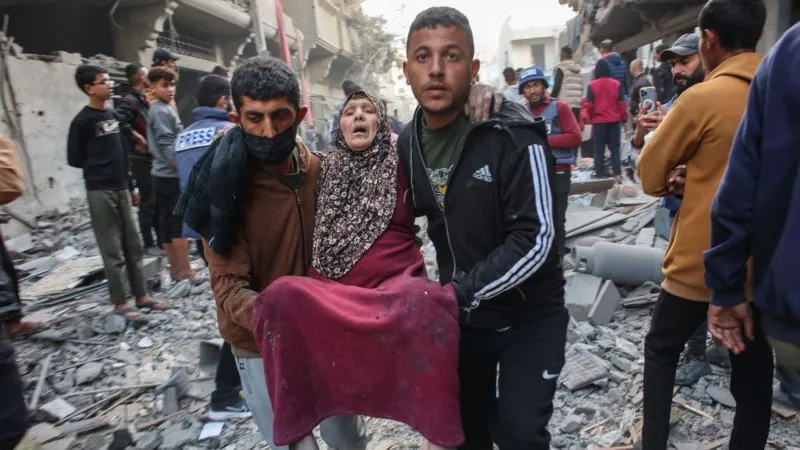
Amnesty International has accused Israel of committing genocide against Palestinians in the Gaza war, which Israel strongly denies.
The UK-based human rights group said its conclusion was based on “dehumanising and genocidal statements” by Israeli officials, digital images and witness testimony and must serve as “a wake-up call” to the international community.
Israel’s foreign ministry described the 295 page report as “entirely false and based on lies”, while the Israeli military said the claims were “entirely baseless and fail to account for the operational realities” it faces.
In the past day, meanwhile, local medics say at least 50 Palestinians have been killed in Israeli strikes in Gaza.
The biggest number of people were killed in the al-Mawasi tent camp for displaced people, where Israel says it was targeting Hamas operatives.
Amnesty says that its research over months “has found sufficient basis to conclude that Israel has committed – and is continuing to commit – genocide against Palestinians”.
The 1948 Genocide Convention, enacted following the mass murder of Jews in the Nazi Holocaust, defines genocide as “acts committed with intent to destroy, in whole or in part, a national, ethnical, racial or religious group”.
Agnès Callamard, Amnesty’s secretary general, said Israeli actions “include killings, causing serious bodily or mental harm and deliberately inflicting on Palestinians in Gaza conditions of life calculated to bring about their physical destruction”.
“Month after month, Israel has treated Palestinians in Gaza as a subhuman group unworthy of human rights and dignity, demonstrating its intent to physically destroy them,” she continued.
The report by the global campaign group comes as the UN’s top court, the International Court of Justice at The Hague, continues to examine allegations by South Africa that Israel is committing genocide in Gaza.
Israel has called the case “wholly unfounded” and based on “biased and false claims”.
Responding to the allegations by Amnesty, Israel’s foreign ministry spokesperson, Oren Marmorstein, described the human rights group as a “deplorable and fanatical organisation”.
“The genocidal massacre on 7 October 2023, was carried out by the Hamas terrorist organisation against Israeli citizens,” he stated, adding that Israel as acting in self-defence and “fully in accordance with international law”.
The Israeli military said it was “actively working to dismantle Hamas’ military infrastructure” in Gaza and that it “takes all feasible measures to mitigate harm to civilians during operations”.
About 1,200 people in southern Israel, mostly civilians, were killed during the Hamas-led attacks 15 months ago, which triggered the Gaza war.
Since then, at least 44,532 people have been killed in Gaza, mostly civilians, according to the Hamas-run health ministry, whose figures are seen as reliable by the UN.

In the past day, Israel has continued to carry out attacks across the length of the Palestinian territory.
At least 23 people were killed and many more wounded in an air strike on a camp for displaced people in al-Mawasi in Khan Younis. Social media video shows residents battling fires overnight.
At the nearby Nasser Hospital, a local BBC cameraman filmed the arrival of the wounded, including blood-stained children and a disabled man. The bodies of two small children were among the dead brought wrapped up in blankets.
Israel’s military said its attack targeted senior Hamas operatives acting in what it considers a humanitarian zone. “Following the strike, secondary explosions were identified, suggesting the presence of weaponry in the area,” it said in a statement.
It said it had taken steps “to mitigate the risk of harming civilians” and accused Hamas of using civilians “as human shields for terrorist activity”.
On Thursday, BBC footage showed people picking through the mangled wrecks of shacks and piles of ash.
“The strike hit us without any warning and did this big massacre,” Mohammed Abu Shahli said. “The people here are refugees from different places – from Rafah and the north. They came to a place they thought was safe.”
His head bandaged, Abdul Rahman Jamaa said seven members of his family were killed including his father and three brothers.
He told the BBC: “There are no protected safe areas as the Israelis say. These are all lies. May God protect us.”
[BBC]

Latest News
Flood warning issued to the Divisional Secretariat Divisions of Ganga Ihala Korale, Udapalatha, Doluwa, Udunuwara, Yatinuwara, Gangawata Korale, Harispattuwa, and Pathadumbara

Due to heavy rainfall received in the upper catchment areas of the Mahaweli River over the past few hours, there is a risk of minor flooding in the low-lying areas surrounding the Mahaweli River within the Divisional Secretariat Divisions of Ganga Ihala Korale, Udapalatha, Doluwa, Udunuwara, Yatinuwara, Gangawata Korale, Harispattuwa, and Pathadumbara.Residents living in the above mentioned areas and motorists using roads passing through these areas are urged to exercise extreme caution and remain highly vigilant regarding the prevailing situation.
Furthermore, residents living in close proximity to the Mahaweli River in these areas are advised to remain highly alert to the situation and take all necessary precautions to protect themselves from any potential flooding.The relevant disaster management authorities are requested to take all necessary measures in response to this situation.

The National Building Research Organisation [NBRO] has issued landslide Red Alerts to the districts of Kandy, Kegalle and Nuwara Eliya effective from 14:00 hrs on 20.09.2026 To 14:00 hrs on 21.09.2026
Accordingly,
LEVEL III [RED] Land Slide early warnings have been issued to the Divisional Secretaries Divisions and surrounding areas of Pasbage Korale in the Kandy district, Dehiowita, Aranayake, Deraniyagala, Mawanella and Yatiyanthota in the Kegalle district and Kothmale West, Kotmale East, Ambagamuwa and Norwood in the Nuwara Eliya district
LEVEL II [AMBER] Land Slide early warnings have been issued to the Divisional Secretaries Divisions and surrounding areas of Padukka in the Colombo district, Nagoda, Thawalama and Neluwa in the Galle district, Bulathsinhala, Palindanuwara, Walallawita and Agalawatta in the Kalutara district, Ganga Ihala Korale in the Kandy district, Bulathkohupitiya and Kegalle in the Kegalle district, Akuressa and Pitabeddara in the Matara district, Thalawakele in the Nuwara Eliya district and Pelmadulla, Ratnapura, Ayagama, Kuruwita and Ratnapura in the Ratnapura district.
LEVEL I [YELLOW] Land Slide early warnings have been issued to the Divisional Secretaries Divisions and surrounding areas of Seethawaka in the Colombo district, Niyagama and Baddegama in the Galle district, Mirigama in the Gampaha district, Ingiriya in the Kalutara district, Udapalatha and Yatinuwara in the Kandy district, Galigamuwa, Warakapola and Ruwanwella in the Kegalle district, Kotapola, Pasgoda and Athuraliya in the Matara district, and Eheliyagoda, Kalawana and Elapatha in the Ratnapura district.
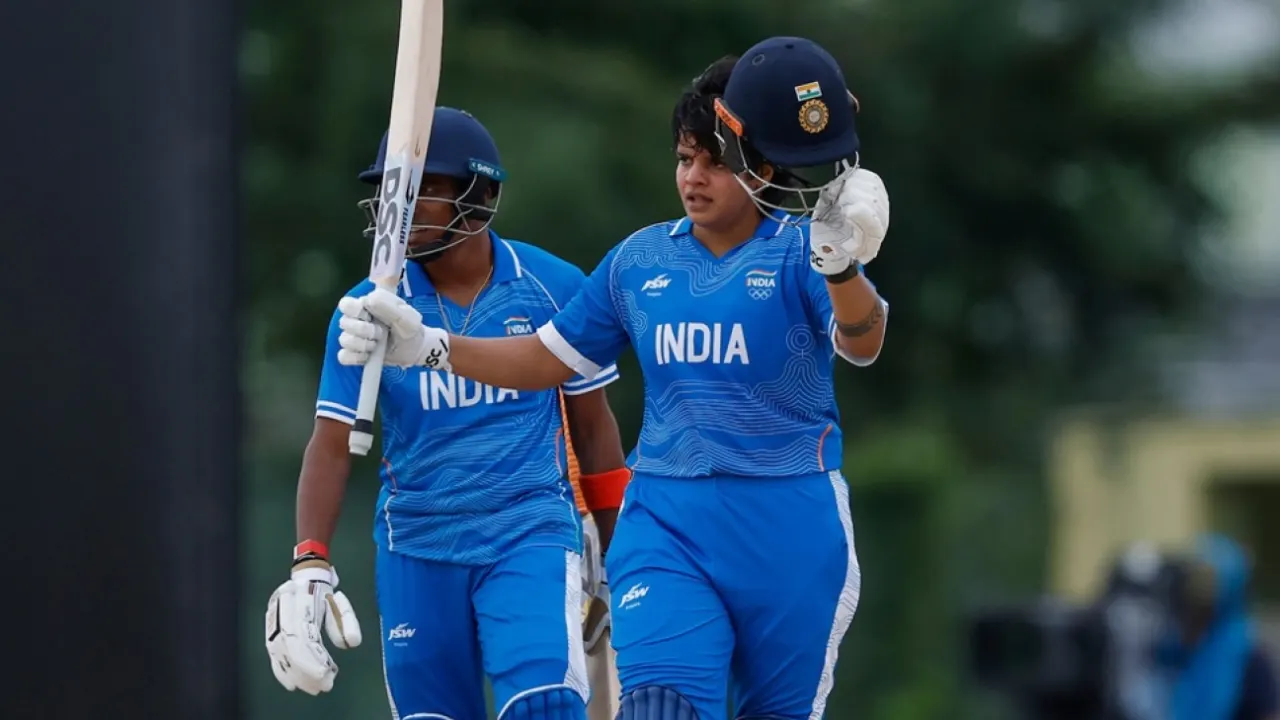
A 49-ball unbeaten hundred from Shafali Verma and three-wicket hauls apiece for Nandani Sharma and Deeoti Sharma helped India march into the final of the 2026 Asian Games in Aichi-Nagoya.
Batting first in Nisshin against Bangladesh, India posted 195 for 4, with Shafali bringing up her maiden white-ball international hundred off the final ball of the innings. She pummelled nine sixes and three fours in an innings that left Bangladesh needing a record chase to reach the final.
Smriti Mandhana gave India a rapid start with a 19-ball 37, during which she became the leading run-scorer in women’s T20Is, while Harmanpreet Kaur found some form with a 33-ball 40 from No. 4.
India’s innings began with a 36-ball opening stand of 72, with Shafali setting the pace by smashing 34 off her first 17 deliveries, while Mandhana initially played second fiddle before gaining pace. G Kamalini, at No. 3, failed to make use of another opportunity, while Richa Ghosh made only two. Harmanpreet started sluggishly, as she has tended to in the recent past, but overcame those early struggles to land some lusty blows towards the end of the innings. She added 94 off 55 balls with Shafali for the third wicket.
Bangladesh never seriously threatened the target. Dilara Akter made 27 at the top of the order, but opening partner Juairiya Ferdous was dismissed for a duck and Bangladesh’s Nos. 3 to 5 were unable to get going. Sultana Khatun, batting at No. 9, was their second-highest scorer with just 12.
Nandani got the first wicket in the second over after which fellow new-ball bowler Kranti Gaud delivered a second blow in the third over. Shree Charani then sent Nigar Sultana back in the final over of the powerplay to leave Bangladesh at 38 for 3.
There was no way in as Bangladesh failed to get any partnership going and a double-wicket 11th over from Nandani exposed the tail. Deepti then trapped Marufa Akter lbw and had Sanjida Akter holing out in the 16th over to complete the resounding win.
India will now face Sri Lanka in the gold-medal match, a repeat of the final from 2023. Bangladesh will meet Pakistan for the bronze-medal fixture.
Scores:
India Women 195 for 4 in 20 overs (Smriti Mandhana 37, Shafali Verma 100*, Harmanpreet Kaur 40: Marufa Akter 1-43, Sanjida Akter Meghla 1-25, Rabeya Khan 1-35, Nahida Akter 1-45) beat Bangladesh Women 81 in 15.4 overs (Dilara Akter 27, Sharmin Akhter 10, Sultana Khatun 12*; Kranti Gaud 1-20, Nandani Sharma 3-25. Shree Charani 2-07, Shreyanka Patil 1-22, Deepti Sharma 3-07) by 114 runs
[Cricinfo]

Flood warning issued to the Divisional Secretariat Divisions of Ganga Ihala Korale, Udapalatha, Doluwa, Udunuwara, Yatinuwara, Gangawata Korale, Harispattuwa, and Pathadumbara

Landslide Red Alerts issued to the districts of Kandy, Kegalle and Nuwara Eliya

Shafali dazzles with 49-ball unbeaten 100 and India march into Asian Games final

Development projects can deliver results to the people more quickly when the political authority and the public service work together towards a common goal – PM

Landslide Early Warnings issued to the Districts of Colombo, Galle, Kalutara, Kandy, Kegalle, Matara, Nuwara Eliya and Ratnapura

Chamari Athapaththu’s unbeaten 83 leads Sri Lanka into final

‘Dates have the highest sugar content to fight Coronavirus’

Sunday Island 27 December – Headlines

#SundayIsland 17th December – Headlines

Sunday Island – 28th March

Sunday Island Headlines – 21 March

Sunday Island – 21st February – Headlines
-

 Opinion7 days ago
From Galkissa (Mount Lavinia) to Tambuttegama
-

 News4 days ago
US embassy won’t comment on IGP’s probe into joint drug raid
-

 Features6 days ago
The emptying university: why are academics leaving?
-

 Features7 days ago
Sri Lanka’s university crisis: Brain drain and union action demand urgent reform
-

 News3 days ago
Bid for Basil’s extradition nears final stage: Police
-

 Business4 days ago
All-new Bolero MaXX unveiled in Sri Lanka
-

 Opinion7 days ago
Ashraff: From the SLMC towards the National Unity Alliance
-

 Editorial7 days ago
Muscle flexing, astroturfing and dog-and-pony shows