
Latest News
Akram Afif stakes claim as one of Asian Cup’s greatest as Qatar win back-to-back titles


Twice, the crowd roared as the dawning realisation of what was about to happen spread like waves amongst them but by the third time, they definitely knew what was coming.
For cometh the hour, cometh Akram Afif.
After positioning himself to take the 21st-minute penalty that would open the scoring in Qatar’s 3-1 win over Jordan in the Asian Cup final on Saturday evening, Qatar skipper Hassan Al-Havdos instead turned away and knocked the ball into the hands of a waiting Afif.
It was a move the Qataris have pulled before, the subtle art of mental disintegration in penalty shootouts, but the crowd responded anyway.
In the 73rd minute, with the scores locked at 1-1 after Yazan Al-Maimat had fired the gallant Jordanians level as part of an improved second-half effort, VAR intervention led referee Ma Ning to determine that Mahmoud Al-Mardi had unfairly brought down Ismaeel Mohammad in the Jordanian penalty area.
Almoez Ali stepped up, before he too turned on his heel and handed the ball off to Afif. Another roar rang out.
Then, in the 91st, following another VAR intervention, this one seeing Ning award a penalty after Jordanian keeper Yazid Abu Layla was adjudged to have brought down Afif’s burst behind the Chivalrous Ones’ lines, Almoez again stood over the spot, ball in hand.
Only this time, the crowd wasn’t going to be fooled. Nobody in Doha was fooled at this point and the Lusail Stadium thundered with a call for Afif to take the spot kick, noise that rose to another level when he moved forward.
On each occasion, the Qatari contingent of the 86,492 reported attendees emanated a sense of eager anticipation and confidence. Not only for the second consecutive Asian Cup title that would soon be theirs, but for a legacy-defining moment for one of the Asian Cup’s greatest-ever players.
The 27-year-old had played a defining role in lifting his side to an upset 3-2 win over Iran in the semifinals just days prior and now, it would fall upon his shoulders once more. And on all three occasions, he was up for the challenge.
To Abu Layla’s credit, he reacted quickly after Afif’s stutter-step run-up and side-footed effort on the first penalty, coming agonisingly close to getting a hand to the shot as he moved down and to his right. But the shot was hit with too much direction and power, nestling into the bottom corner of the net and putting Qatar into the ascendancy.
The Jordanian keeper would again guess right on the second but, once again, prove unable to get a hand to a wickedly hit effort as it flew beyond him and into the back of the net.
Afif then got one up on the keeper when he sealed his hat trick at the death, burying a shot into the bottom right corner as the keeper dived to his left. Qatar’s status as just the fifth Asian nation to defend its crown was now secured off the boot of its talisman.
In 2019, Afif provided ten assists and netted once as Qatar secured their first continental crown. This time around, propelled by his hat-trick in the decider, he has taken out the tournament’s Golden Boot with eight goals, as well as grabbing a further three assists.
More than one and a half goal involvements across two Asian Cups, a key cog in one title and a figure without which a second one simply does not happen — the attacker earning deserved recognition as best on ground and player of the tournament in the aftermath of Saturday’s final.
After his first penalty, he reached into his sock and pulled out a trading card featuring his likeness in celebration of his first goal, showing it to the camera and kissing his ring finger before performing a sleight-of-hand trick to reveal an ‘S’ drawn on the other side. He confirmed post-game that it was a tribute to his wife, who was attending her first match at Lusail; Afif’s own tribute as he was etching his name into the annals of Asian Cup history.
Indeed, to watch Afif in action on stages such as the Asian Cup is to come to engage in an act of simultaneous appreciation and selfishness; of admiration for what he is capable of on a football pitch and a yearning to see someone of his talents tested against the world’s best.
His work to win the penalty was a devastating case in point.
Seconds before Ma pointed to the spot, he had been bearing down the left flank, cushioning perfectly a pass from Lucas Mendes to accelerate beyond defender Abdallah Nasib and towards the Jordanian penalty area in one smooth movement. A lethal blur of afro hair and maroon kit, he would subtly shift his body weight one way and then the other to gain a step on his pursuer before bursting towards the box, with Nasib’s attempts to recover only resulting in the pair’s right legs clipping into each other.
The 27-year-old had brief spells in Spain and Belgium earlier in his career but settled himself at Qatar Stars League side Al Sadd in 2018 — but what if?
That’s not to be dismissive of Qatar’s domestic league, moreso an almost yearning to see just what would happen if this dynamo, one seemingly at the peak of his powers, was tested week in and week out against some of the world’s best defenders while deployed alongside the world’s best attackers. Post-game, he would speak of that of course the idea appeals to him but that it’s not just up to him about his future, that there are many views to be heard, not the least of which is his wife.
“If it’s meant to be, it’s meant to be,” he reflected, “it’s destiny.”
It’s funny that he spoke of destiny, because just before halftime there looked like there was going to be a cruel twist of it when Afif sent a brief scare through the crowd after remaining on the turf after going down without contact, with the stretcher called for to carry him off.
He would soon re-emerge, but the soreness remained as he was beaten to a ball into the box by Jordan’s leading light Musa Al-Taamari with Mohammed Waad forced to stage a last-ditch intervention to deflect it away.
He was fine, staying out there as Jordan would refuse to bow in the face of adversity, something they have done all tournament. But alas for coach Hussein Ammouta, the magic that had come to define their run to the final in Doha didn’t have anything left to give in Lusail.
They would hurl numerous attacks forward in their attempt to get into the game before Al-Naimat’s leveller, improving in the second half but unable to get past the brick wall that was Qatari keeper Meshaal Barsham.
Trailing for much of the game, or attempting to capitalise on the momentum of their equaliser, they were forced to take the initiative and control of the ball, denied their free-flowing transition game and instead needed to work against a settled Qatari defence, who in turn could play in transition.
Jordan would end the game with 58% of the ball and 16 shots but with just six of them on target, as Qatar picked their moments and moved the ball into areas where they could win their spot kicks — the timing of which Ammouta’s admitted post-game came at the worst possible time for his squad, while refusing to take issue with any of their awarding.
Of course, to some extent, while Jordan was already a winner having advanced to this point, Qatar needed this win.
After their three straight defeats at a home World Cup a lot of their reputation — the reputation of 2019 — rested on what they could do at home.
Now, perhaps one of the biggest takeaways from the 2023 Asian Cup is just how much Qatar bungled their preparations for the 2022 World Cup, their long overseas tours inadvertently setting them up to perform at a level so below what they should have been able to.
Furthermore, Saudi Arabia’s increasing investment and moves to monopolise major events in the region also threaten to put them in the shade in the years ahead, even if a large number of the soft power, reputational laundering, economic, and infrastructural benefits of hosting major footballing events have already been banked.
Whatever happens, though, they’ll now always be back-to-back Asian champions. And Afif will always be one of the Asian Cup’s greatest ever.
(ESPN)











Nadine de Klerk’s sensational late onslaught, eerily reminiscent of the heist that turned the tables on India at the 2025 ODI World Cup, catapulted RCB to a sensational opening-night win over defending champions Mumbai Indians at the DY Patil Stadium.
That de Klerk pulled it off without Smriti Mandhana, Grace Harris or Richa Ghosh – all gone inside eight overs with RCB still needing 90 – made it even more sensational.
Needing 18 off the final over, de Klerk played out two dot balls, before going 6,4,6 to bring the equation down to 2 off 1. Then with the field in to save the single, she backed away to drill Nat Sciver-Brunt back over the bowler to clinch an improbable win.
MI could have killed the game at the start of the 19th over with RCB needing 29. Sciver-Brunt putting down a straightforward chance at long-off first ball. Off the fourth, MI missed two opportunities – Amelia Kerr spilled de Klerk’s miscued swipe at deep square, and G Kamal8ni failed to gather the return cleanly for a run out as de Klerk tried to scramble back for a second.
Amid the chaos, Prema Rawat, not called upon to bowl a single over of legspin, still found a way to contribute, walloping two priceless boundaries, including one in the penultimate over, to finish 8 not out.
She couldn’t lay bat on ball earlier in the game, but Kerr’s wickets of Radha Yadav and the dangerous Richa Ghosh in quick succession left RCB – playing a batter short – gasping at 65 for 5 in the eighth over. RCB’s fiery start – they hit seven fours and a six in the first three overs alone – courtesy Grace Harris and Smriti Mandhana, was suddenly being undone. It needed a 52-run partnership from de Klerk and Arundhati Reddy – who made 20 off 25 – to bring RCB’s chase back within the realms of possibility, before de Klerk cut loose.
Lauren Bell set the tone early with a spell of high-class swing bowling. Kerr, opening in Hayley Matthews’ absence due to an illness, was beaten eight times in her first ten deliveries as she failed to combat Bell’s late outswing. She finally scraped off the mark only off her 11th ball.
Bell was trusted with a third over in the powerplay and she finished the job by sending back Kerr with a hard-length delivery she sliced to cover, making 4 off 15. Bell’s figures of 4-1-14-1 underlined just how much she had suffocated MI.
Kamalini briefly dazzled, as did Harmanpreet. If the short-arm jab in front of square off Bell was a teaser, the lofted inside-out hit over extra cover off Shreyanka Patil was blockbuster. The signs were ominous, but a hack off de Klerk saw Harmanpreet nick one to Richa Ghosh to leave MI 67 for 4 in 11 overs.
Promoted ahead of the more accomplished Amanjot Kaur, Sajana survived two chances in as many overs – first by D Hemalatha at midwicket, then by substitute Sayali Satghare at mid-off. At the other end, the pressure was mounting on debutant Nicola Carey, who limped to 14 off 14. MI needed to flick a switch, and Sajana did.
Radha’s left-arm spin was taken for 15 in the 15th over. Then, she clinically took down de Klerk when she returned for her third by using long levers and brute force to muscle big hits in the arc between long-on and deep midwicket for three fours. Overs 14-17 fetched MI 41, and they were back on the move.
Between them, Carey, all timing, and Sajana, gloriously agricultural, contributed 85 to ensure MI would make a match of it, which they did, only to be pipped at the finish line.
Brief scores:
Royal Challengers Bengaluru Women 157 for 7 in 20 overs (Nadine de Klerk 63*, Arundhati Reddy 20; Nat Sciver-Brunt 1-47, Shabnim Ismail 1-26, N8cola Carey 2-35, Amanjot Kaur 1-18. Amelia Kerr 2-13) beat Mumbai Indians Women 154 for 6 in 20 overs (Gunalan Kamalini 32, Harmanpreet Kaur 20, Sajeevan Sajana 45, Nicola Carey 40; Lauren Bell1-14, Nad8ne de Klerk 4-26, Shreyanka Patil 1-32) by three wickets
(Cricinfo)

Iran’s Supreme Leader Ayatollah Ali Khamenei has called anti-government protesters “troublemakers” and “a bunch of vandals” just trying “to please the president of the US”.
He accused crowds of destroying buildings because Donald Trump said he “supports you”. Trump has warned Iran that if it kills protesters, the US would “hit” the country “very hard”.
The protests, in their 13th day, erupted over the economy and have grown into the largest in years – leading to calls for an end to the Islamic Republic and some urging the restoration of the monarchy.
At least 48 protesters and 14 security personnel, have been killed, according to human rights groups. An internet blackout is in place.
Khamenei remained defiant in a televised address on Friday.
“Let everyone know that the Islamic Republic came to power through the blood of several hundred thousand honourable people and it will not back down in the face of those who deny this,” the 86-year-old said.
Since protests began on 28 December, in addition to the 48 protesters killed, more than 2,277 individuals have also been arrested, the US-based Human Rights Activist News Agency (HRANA) said.
The Norway-based Iran Human Rights (IHRNGO) said at least 51 protesters, including nine children, had been killed.
BBC Persian has spoken to the families of 22 of them and confirmed their identities. The BBC and most other international news organisations are barred from reporting inside Iran.
The Islamic Revolutionary Guard Corps issued a statement on Friday saying it would not tolerate the continuation of the current situation in the country.
Reza Pahlavi, the son of Iran’s last shah who was overthrown by the 1979 Islamic revolution, called on Trump on Friday to “be prepared to intervene to help the people of Iran”.
Pahlavi, who lives close to Washington DC, had urged protesters to take to the streets on Thursday and Friday.

Protests have taken place across the country, with BBC Verify verifying videos from 67 locations.
On Friday, protesters amassed after weekly prayers in the south-eastern city of Zahedan, videos verified by BBC Persian and BBC Verify show. In one of the videos, people can be heard chanting “death to the dictator”, referencing Khamenei.
In another, protesters gather near a local mosque, when several loud bangs can be heard.
Another verified video from Thursday showed a fire at the office of the Young Journalists Club, a subsidiary of state broadcaster Irib, in the city of Isfahan. It is unclear what caused the fire and if anyone was injured.
Photos received by the BBC from Thursday night also show cars overturned and set alight at Tehran’s Kaaj roundabout.
The country has been under a near-total internet blackout since Thursday evening, with minor amounts of traffic returning on Friday, internet monitoring groups Cloudfare and Netblocks said. That means less information is emerging from Iran.
IHRNGO director Mahmood Amiry-Moghaddam said in a statement that “the extent of the government’s use of force against protesters has been increasing, and the risk of intensified violence and the widespread killing of protesters after the internet shutdown is very serious”.
Nobel laureate Shirin Ebadi has warned of a possible “massacre” during the internet shutdown.
One person who was able to send a message to the BBC said he was in Shiraz, in southern Iran. He reported a run on supermarkets by residents trying to stock up on food and other essentials, expecting worse days to come.
(BBC)
Latest News
Deep Depression likely to cross the Sri Lankan coast between Trincomalee and Jaffna during the morning today (10 January 2026)
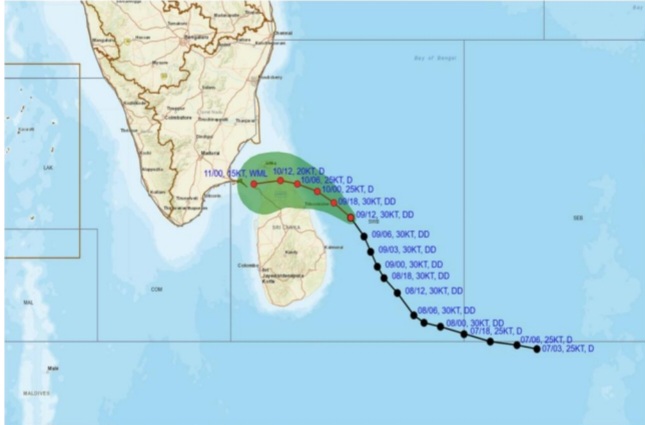
Warning for deep depression to the East of Sri Lanka.
Issued by the Natural Hazards Early Warning Centre of the Department of Meteorology at 01.30 a.m. on 10 January 2026 for the period until 01.30 a.m. on 11 January 2026
The deep depression over the southwest Bay of Bengal was located about 50 km North-northeast of Trincomalee at 01:00 a.m. on 10 January 2026. It is very likely to move northwestwards and cross the Sri Lankan coast between Trincomalee and Jaffna during the morning today (10 January 2026).

The Government does not grant protection based on Status. – PM

Heavy showers above 100 mm are likely at some places in the Northern province

De Klerk comes clutch as RCB steal last-ball thriller against Mumbai Indians

Speaker bars Parliamentary probe into Judicial Service Commission

Elephant calf killed in collision with lorry on Anuradhapura–Padeniya Road

Devananda granted bail

‘Dates have the highest sugar content to fight Coronavirus’

Sunday Island 27 December – Headlines

#SundayIsland 17th December – Headlines

Sunday Island – 28th March

Sunday Island Headlines – 21 March

Sunday Island – 21st February – Headlines
-

 News5 days ago
Interception of SL fishing craft by Seychelles: Trawler owners demand international investigation
-
 News5 days ago
Broad support emerges for Faiszer’s sweeping proposals on long- delayed divorce and personal law reforms
-

 Opinion2 days ago
The minstrel monk and Rafiki, the old mandrill in The Lion King – II
-

 Features2 days ago
The Venezuela Model:The new ugly and dangerous world order
-

 News4 days ago
Prez seeks Harsha’s help to address CC’s concerns over appointment of AG
-

 News6 days ago
Private airline crew member nabbed with contraband gold
-

 Business13 hours ago
Sevalanka Foundation and The Coca-Cola Foundation support flood-affected communities in Biyagama, Sri Lanka
-

 Latest News2 days ago
Warning for deep depression over South-east Bay of Bengal Sea area