
News
Ahead of 49 Geneva sessions: FM questions UK duplicity; UN interference in parliamentary functions


By Shamindra Ferdinando
Foreign Minister Prof. G. L. Peiris has questioned the conduct of the British government, a member of the Geneva-based United Nations Human Rights Council, in addition to being the leader of Sri Lanka Core Group at the UNHRC, the extraordinary efforts it had made to suppress wartime dispatches from Colombo.
Prof. Peiris underscored the irrationality in the British action as they were reportedly so keen to establish the truth, pertaining to unsubstantiated war crimes allegations directed at the then political leadership and the military.
The Foreign Minister said so addressing a selected group of armed forces and police officers at the National Defence College, Kollupitiya.
Prof. Peiris addressing the officers on the invitation of Maj. Gen. Amal Karunasekara, Commandant of the NDC, Prof. Peiris explained how the British worked overtime to prevent a senior member of House of Lords Michael Wolfgang Laurence Morris from securing classified documents.
At the onset of the discourse, Prof. Peiris acknowledged that Sri Lanka was high on the Geneva agenda at the forthcoming 49th session of the UNHRC scheduled to commence just two weeks later.
The controversial dispatches authored by Lt. Colonel Anthony Gash, the then Colombo-based Defence Attaché dealt with the ground situation on the Vanni front (January to May 2009) as troops surrounded the remaining fighting cadre of the LTTE.
Sri Lanka brought the war to a successful conclusion on May 19, 2009 on the banks of the Nanthikadal lagoon.
Emphasising the importance of the British dispatches sent simultaneously as the fighting was taking place on the Vanni east front, Prof. Peiris asked whether the British questioned the credibility of their own employee based in Colombo.
The UK succeeded the US as the leader of Sri Lanka Core Chair in June 2018 in the wake of the then President Donald Trump quitting the UNHRC calling the UN body a cesspit of political bias. The US returned to the Geneva body in the wake of Joe Biden’s election as the President.
Prof. Peiris discussed why Lord Naseby hadn’t been able to secure the dispatches until he sought the intervention of the Information Commissioner’s Office in terms Freedom of Information Act 2000. However, the Foreign and Commonwealth Office (DCO), the custodian of the classified documents pertaining to the Vanni war, released a heavily censored section of them, Prof. Peiris said, questioning the British motive. The Foreign Minister emphasized that the British documents would have helped those really concerned about accountability issues to ascertain the Vanni situation.
Declaring that he had perused the heavily detracted British diplomatic cables, Prof. Peiris explained how they helped Sri Lanka to prepare its defence. A particular cable questioned the very basis of the UN allegation pertaining to the death of over 40,000 civilians during the final phase of the ground offensive.
During the course of the one-hour lecture, Prof. Peiris assured the military that in terms of international laws applicable to wars/conflict Sri Lankan personnel couldn’t be hauled up before international war crimes court under any circumstances. Twice Foreign Minister Prof. Peiris emphasized there was absolutely no danger or risk in them being subjected to such action as the international law was very clear in this regard.
Prof. Peiris served as the foreign minister during 2010-2015 President Mahinda Rajapaksa’s presidency. President Gotabaya Rajapaksa brought him back as the FM last August in place of Dinesh Gunawardena.
Prof. Peiris also dealt with what he called critically important work undertaken by an international Advisory Council appointed to assist the Presidential Commission to Investigate Complaints Regarding Missing Persons. The Advisory Council comprises three legal luminaries namely the late Sir Desmond de Silva (chairman), Sir Geoffrey Nice, and Prof. David Crane.
Referring to current international ‘flashpoints,’ Prof. Peiris expressed shock and dismay over the way a section of the international community had responded to the Sri Lanka accountability issue. Prof. Peiris was harsh on the creation of a special mechanism to gather information on Sri Lanka against the backdrop of UN Human Rights Commissioner Michelle Bachelet declaration that they have developed an information and evidence repository with nearly 120,000 individual items already held by the UN.
A resolution adopted in March 2021 allows the UN “to collect, consolidate, analyze and preserve information and evidence, and to develop possible strategies for future accountability processes for gross violations of human rights or serious violations of international humanitarian law in Sri Lanka, to advocate for victims and survivors, and to support relevant judicial and other proceedings.”
Questioning the credibility of the Geneva process Prof. Peiris asked how evidence and individual items that hadn’t been subjected to examination whatsoever could be used against Sri Lanka.
“How could unsubstantiated claims made under the condition of anonymity be accepted without being verified?” Prof. Peiris asked, accusing Geneva of what the academic called cynical violation of the basic law.
Reiterating Sri Lanka’s commitment to the UN processes, Prof. Peiris questioned the necessity of a special mechanism at the UN’s expense in spite of the availability of UPR (Universal Periodic Review) to inquire into the conduct of all countries. Alleging that war winning Sri Lanka had been singled out and treated unfairly, Prof. Peiris said that the human rights issue was being used as a tool to interfere in domestic affairs.
Prof. Peiris pointed out that Geneva was even interfering in the functions of the Parliament. Referring to Geneva resolutions and statements from therein, Prof. Peiris said: “the devolution of power, reorganisation of the armed forces, reorganization of the police force, the balance of authority between the Central government and the Provincial Councils, the Prevention of Terrorism Act and its reforms are matters that should be decided by the Parliament and the people of Sri Lanka.
Instead of giving local mechanisms much needed support, the UNHRC was pushing to impose solutions, Prof. Peiris said, declaring such measures weren’t durable.
Prof. Peiris stressed the importance of the role played by mechanisms-namely the OMP (Office of Missing Persons), OR (Office of Reparations) and ONUR (Office of National Unity and Reconciliation) in current efforts to address accountability issues. Reference was also made by Prof. Peiris to the Truth and Reconciliation Commission of South Africa while explaining the work undertaken by Commission of Inquiry (CoI) appointed under the chairmanship of sitting Supreme Court judge Abdul Hameed Dileep Nawaz to investigate, inquire into and report, or take required actions, regarding the findings of the former Commissions, or Committees, that investigated human rights violations, serious violations of International Humanitarian Law (IHL) and other such offences.
Declaring that Sri Lanka was ready to cooperate fully with UNHRC, Prof. Peiris said that Geneva couldn’t substitute the Parliament.







Former first lady Shiranthi Rajapaksa, wife of former President Mahinda Rajapaksa was produced before the Hulftsdorp court, after being arrested by officers of the Commission to Investigate Allegations of Bribery or Corruption (CIABOC) and produce
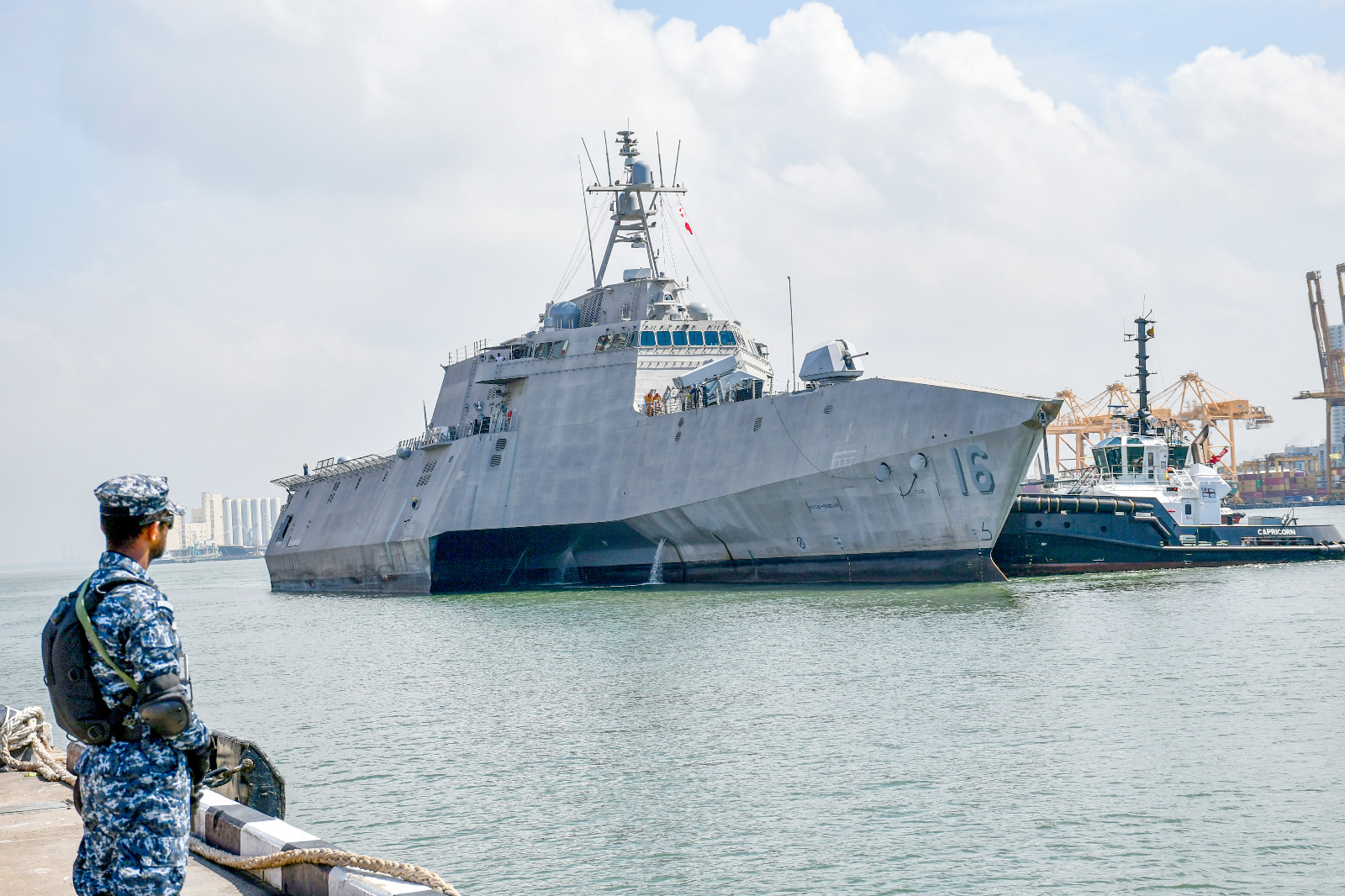
The U.S. Navy ship USS Tulsa (LCS 16) arrived at the Port of Colombo this morning, 7 October 2026 for replenishment purposes.
The visiting ship was welcomed by the Sri Lanka Navy in accordance with naval traditions.
The 127.7-metre-long platform is a Littoral Combat Ship commanded by Commander BM Wanier. Commissioned on 16 February 2019, USS Tulsa has since been in service with the US Navy.
The ship previously made a port call in Sri Lanka on 27 August 2025.
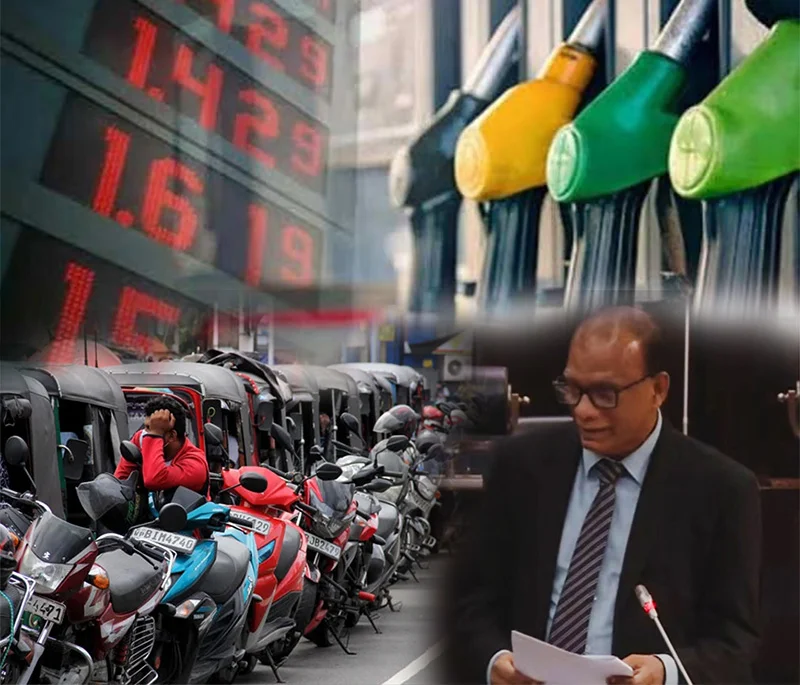
Govt. tells fuel distributors to maintain stocks to ensure uninterrupted supplies
by Saman Indrajith and Norman Palihawadane
The government had instructed private fuel distributors to maintain minimum stocks and ensure uninterrupted supplies to the market, Energy Minister Anura Karunathilaka told Parliament yesterday (06).
Karunathilaka said the Ministry of Energy Secretary had notified the relevant companies of the requirement, following a reduction in supplies by some private distributors, amid higher international fuel prices.
The Minister said private companies had informed the government that they were facing losses because international prices had risen while fuel was being sold, locally, at prevailing prices. As a result, some companies had reduced the volumes released to the market.
The reduced supplies had increased the burden on the Ceylon Petroleum Corporation (CPC), whose share of the diesel market had risen from about 54% to 82%, the Minister said.
“The CPC currently holds an 82% share of the market,” he said, adding that it had increased its supplies, compared with February, to compensate for the reduction by private distributors.
Karunathilaka said the government could not, under the existing agreements with private companies, specify the quantities they should supply to individual filling stations. However, it could require them to maintain minimum stocks in the country.
The Minister said the Energy Ministry had already instructed companies that had failed to maintain the required stocks to take steps to prevent supply disruptions.
The Minister attributed the queues reported at some filling stations to reduced supplies from private distributors, as well as normal variations in fuel distribution. He also said demand for CPC fuel had increased because private companies generally did not provide fuel to dealers on credit, while the CPC offered a three-day credit facility.
“We expect that, as the Ceylon Petroleum Corporation takes on this additional burden, the problem will ease to some extent by Wednesday or Thursday,” Karunathilaka said.
He said instructions had also been issued to increase supplies to CPC filling stations. A special discussion on the issue is scheduled for today (07), with officials of the Energy Ministry and CPC expected to participate,
along with President Anura Kumara Dissanayake.
Meanwhile, Petroleum Dealers’ Association officials have called for an early solution to the supply issue. Association Chairman D.V. Shantha Silva said queues had been reported at many filling stations, mainly those operated by private distributors.
He said the situation was not due to an overall shortage of fuel, but was linked to reduced orders by Lanka IOC, Sinopec and R.M. Parks amid concerns over losses incurred on fuel sales.
The Ceylon Petroleum Private Tanker Owners Association has urged motorists to refrain from panic buying, saying there was no nationwide disruption to fuel supplies.
The government earlier increased fuel prices and introduced a per-litre diesel subsidy following concerns raised by distributors over rising international prices.

Showers above 100 mm are likely at some places in the Western, Sabaragamuwa, Central, Uva and Southern provinces and in Anuradhapura district

Remembering Juvenal, Coke, Acton and Machiavelli

West Asian conflict undergoing manifold complications

Nissanka absence opens door for Sri Lanka’s young guns

The prelate who walked the talk

Needs of populace hit by Cyclone Ditwah seen as waiting to be addressed

‘Dates have the highest sugar content to fight Coronavirus’

Sunday Island 27 December – Headlines

#SundayIsland 17th December – Headlines

Sunday Island – 28th March

Sunday Island Headlines – 21 March

Sunday Island – 21st February – Headlines
-

 Editorial6 days ago
Colombo Port drug bust: The plot thickens
-

 Features4 days ago
The first woman in the foreign service or Ceylon Overseas Service it was then called
-

 Editorial5 days ago
Fuelling discontent and protest
-

 News3 days ago
Geneva takes up Sallay’s case and govt. ignores opportunity to answer accusations
-

 Latest News5 days ago
Tharindu Rathnayake, bowlers secure Asian Games Bronze for Sri Lanka
-
 Foreign News5 days ago
Ten injured after car crashes into rugby supporters in Australia
-

 Features3 days ago
Sri Lanka Cricket Bill: Governance reform is not yet a cricket strategy
-
 News4 days ago
Nearly 20 Iranian tankers stranded off Lanka amid US sanctions