
News
AG’s Dept. asked to explain why no action taken on Zahran file


PCoI probing Easter Sunday attacks
By Rathindra Kuruwita
It was only three weeks after the Easter Sunday attacks that the Attorney General’s Department had paid attention to the file on NTJ leader Zahran Hashim, sent by Terrorism Investigation Division (TID) in early June 2017, seeking its advice, Deputy Solicitor General, Azard Navavi, on Saturday (05) told the PCoI probing the Easter Sunday attacks.
The witness, however, insisted that their delay could not be considered as having led to the attacks.
The PCoI had summoned a group of officers who handled Zahran’s file at the AG’s Department. Besides Navavi, State Counsel Malik Azeez also testified.
Chairman of the PCoI asked Navavi what the AG’s Department had done about the file on Zahran, sent by the TID for legal advice.
Navavi said that he had received the file on 07 June 2017 and he instructed Azeez, who was under him, to handle it.
Chairman of the PCoI: “Why did you assign Azeez? Was there a particular reason?
Navavi: “The file had two video clips of Zahran and his brother M.C. Zainee. These were in Tamil, that’s why I gave it to Azeez.”
However, the TID had sent Sinhala translations of what was said in the clips.
Chairman of the PCoI: “When did you pay attention to the file again?”
Navavi: “There was a meeting at the Presidential Secretariat, three weeks after the Easter Sunday attacks. The then head of the TID said they had sent a file on Zahran to us, for legal advice. Until then I had had no recollection of this file. Then I asked Azeez, who briefed me on it.’
Chairman of the PCoI again asked Navavi why he had entrusted the case to a Muslim officer.
Navai said that since the case was about Islamism, he believed it was better if a Muslim handled it.
Cross examining the witness, Shamil Perera, PC, asked if Easter Sunday attacks could have been prevented if he had taken action on the file before 21 April 2019.
Navavi insisted that he could not accept that claim.
Navavi said: “This idea became popular because it came up before the Parliament Select Committee (PSC) on Easter Sunday attacks. People started believing that if action had been taken on the file, the attacks could have been prevented. However, the investigators had not told us enough although they had ample evidence about the threat posed by Zahran to national security. So, I don’t think it’s fair to link a delay about this file to the attack. If they didn’t arrest someone for two years after obtaining a warrant, that’s not our fault.”
State Counsel Malik Azeez, who testified earlier, said that on March 12, 2019 there had been a meeting with several TID officers on the file and only at that point had the officers mentioned that the TID obtained arrest warrants twice to arrest Zahran.
“The arrest warrants were not attached to the file or the AG’s Department had not been informed of it until March 2019,” he said.
Azeez informed the Commission that the TID had added documents to the file twice, in 2017 and 2018. None of them included the two arrest warrants or statements recorded from Zahran’s mother and his wife.
Without such important documents, the AG’s Department officials could not detect a threat to National Security, Azeez said.
“The TID sent only some screen shots of the NTJ website and some speeches of Zahran’s brother. Along with the file the TID had attached a letter requesting legal advice on banning the NTJ website, Zahran’s Facebook account and arresting him. No proper inquiry had been conducted and there were no supporting documents. Until the consultation meeting on March 12, 2019 we had not been aware that the TID had obtained arrest warrants twice against Zahran.”
The next witness was Deputy Solicitor General Dileepa Peiris. He that a moulavi, from a group that was attacked by NTJ members at Alliyar Junction on 10 March 2017, had handed over to the AG’s Department a letter highlighting the issues they were faced with.
Peiris said he had called the OIC of Kattankudy Police on 09 November 2017 for a discussion on the issue.
“I asked him what they were doing. By that time Zahran and his supporters had fled Kattankudy. I felt that the OIC was under political pressure and was hesitant to tackle action.
Chairman of the PCoI showed Peiris the files the TID had sent to the AG’s Department on Zahran.
Chairman: “Can you tell me if you feel that this man posed any threat to national security?”
“It seems so. This is on extremism,” Peiris said.





Latest News
Sun directly overhead Beruwala, Gurulubadda, Rakwana, Godakawela, Udawalawe and Thanamalwila at about 12:13 noon today (06)


On the apparent northward relative motion of the sun, it is going to be directly over the latitudes of Sri Lanka during 05th to 15th of April in this year.
The nearest areas of Sri Lanka over which the sun is overhead today (06th) are Beruwala, Gurulubadda, Rakwana, Godakawela, Udawalawe and Thanamalwila at about 12:13 noon.
Latest News
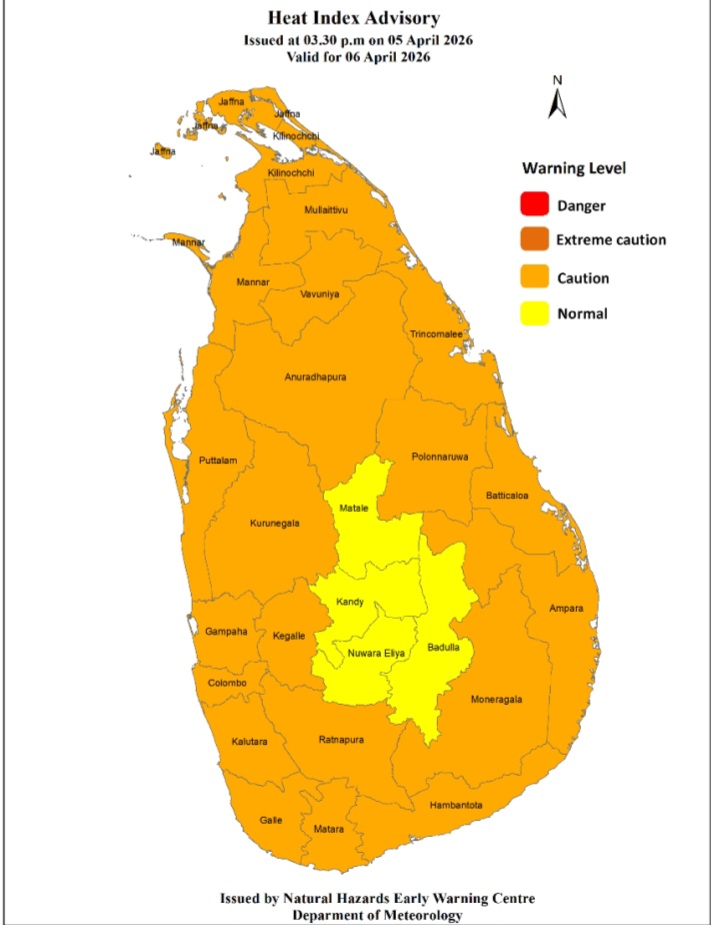
Heat Index at Caution Level in the Western, Sabaragamuwa, Southern, Eastern, North-western, Northern and North-central provinces and in Monaragala district
Warm Weather Advisory
Issued by the Natural Hazards Early Warning Centre
Issued at 3.30 p.m. on 05 April 2026, valid for 06 April 2026.
The Heat index, the temperature felt on human body is likely to increase up to ‘Caution level’ at some places in the Western, Sabaragamuwa, Southern, Eastern, North-western, Northern and North-central provinces and in Monaragala district.
The Heat Index Forecast is calculated by using relative humidity and maximum temperature and this is the condition that is felt on your body. This is not the forecast of maximum temperature. It is generated by the Department of Meteorology for the next day period and prepared by using global numerical weather prediction model data.

Effect of the heat index on human body is mentioned in the above table and it is prepared on the advice of the Ministry of Health and Indigenous Medical Services.
ACTION REQUIRED
Job sites: Stay hydrated and takes breaks in the shade as often as possible.
Indoors: Check up on the elderly and the sick.
Vehicles: Never leave children unattended.
Outdoors: Limit strenuous outdoor activities, find shade and stay hydrated.
Dress: Wear lightweight and white or light-colored clothing.
Note:
In addition, please refer to advisories issued by the Disaster Preparedness & Response Division, Ministry of Health in this regard as well. For further clarifications please contact 011-7446491.

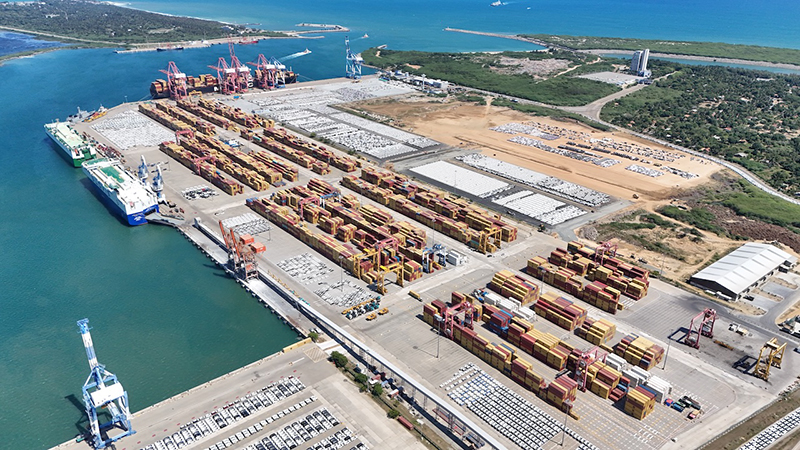
The ongoing West Asia war, triggered by joint Israel-US attack on Iran on 28 Februar, has benefited the China-run Hambantota International Port (HIP).With Iran imposing restrictions on the Strait of Hormuz shipping, in retaliation for unprovoked attack, thereby choking vital shipping routes, particularly for crude oil and refined oil products, HIP situated, along the East-West shipping corridor, has received the anticipated attention.
Soon after the sinking of an unarmed Iranian frigate, just outside Sri Lanka’s territorial waters, in India’s backyard, Indian External Affairs Minister Subrahmanyam Jaishankar categorised HIP as a foreign military base, along with Diego Garcia, Bahrain and Djibouti, where both the US and China maintained major bases.
HIP, in a press release issued on Sunday (05), declared that the Port has significantly expanded its operational capacity, in response to a sharp surge in global shipping volumes, resulting from the West Asia conflict.
The company asserted that the developing situation reinforced its position as a key alternative hub along the East–West shipping corridor.
The port has doubled its Roll-on/Roll-off (RoRo) yard capacity and increased its container yard capacity by 30%, as shipping lines divert operations away from disrupted routes in search of stable and efficient alternatives.
HIP is situated just 10 nautical miles from the main East–West shipping route, allowing vessels to divert with minimal deviation while maintaining schedule integrity.
The Chinese government-owned China Merchant Port Holdings (CMPort) under controversial circumstances acquired controlling interests of the Hambantota port in 2017 during the Yahapalanaya administration. Although the Sri Lankan government repeatedly said that Sri Lanka was paid USD 1.12 bn according to the HIP website CMPort invested $974 mn in the HIP and held 85 percent of the shares.
The 2017 agreement granted CMPort a 99-year lease to develop, manage and operate the Port area. The Supreme Court dismissed a fundamental rights petition filed by lawmaker Vasudeva Nanayakkara pointing out that the original agreements pertaining to the Hambantota port had been signed in 2012 and 2013 during Mahinda Rajapaksa’s tenure as the president when he was a member of the Rajapaksa Cabinet.
The HIP press release quoted CEO of HIP Wilson Qu as having said: “What we are witnessing today is a structural shift in global shipping patterns. At HIP, we have focused on building the capacity and operational agility to respond to such changes. Our ability to scale quickly, combined with our location, allows us to support global shipping lines when reliability becomes critical. Looking ahead, we will continue to invest in infrastructure and capabilities to strengthen Hambantota’s role as a key logistics and transshipment hub in the region.”
The rise in both vehicle transshipment and container volumes has driven yard utilization levels to the highest in HIP’s history, highlighting the scale of ongoing supply chain disruptions and the port’s growing strategic importance in global trade.
To accommodate increased throughput, HIP has rapidly expanded yard space across both cargo segments, enabling it to handle higher volumes while maintaining operational efficiency and minimizing congestion. Expanding capacity within a short time frame in a live port environment presents considerable operational and technical challenges and requires significant investment. However, through close coordination across management, engineering and operational teams, HIP was able to deliver these enhancements in step with rising demand.
The HIP statement added: “The expansion reflects Hambantota International Port’s continued development as a resilient logistics platform in the Indian Ocean, as geopolitical developments reshape established maritime routes and increase demand for alternative hubs. As infrastructure scales in tandem with demand, HIP is increasingly positioned to capture a larger share of regional transshipment volumes while supporting the continuity of global supply chains.”
Amidst the continuing uncertainty caused by war and growing threat to international shipping the Hambantota International Port Group (HIPG) the owning group of HIP recently finalised an agreement to invest USD 108 mn to procure new container handling equipment- six quay cranes, 16 rubber-tyred gantry cranes (RTGs) and 40 trailers, under the initial phase of the port’s Phase II container terminal development.
By Shamindra Ferdinando

Trump threatens ‘hell’ for Iran over Hormuz Strait as deadline approaches

Tim David, Rajat Patidar inflict bruising defeat on Chennai Super Kings

Shami sets up Lucknow Super Giants victory before Pant fifty takes them home

Showers or thundershowers will occur at several places in the Northern, Eastern, North-central, Central and Sabaragamuwa provinces and in Puttalam, Galle and Matara districts after 2.00 p.m.

Sun directly overhead Beruwala, Gurulubadda, Rakwana, Godakawela, Udawalawe and Thanamalwila at about 12:13 noon today (06)

Heat Index at Caution Level in the Western, Sabaragamuwa, Southern, Eastern, North-western, Northern and North-central provinces and in Monaragala district

‘Dates have the highest sugar content to fight Coronavirus’

Sunday Island 27 December – Headlines

#SundayIsland 17th December – Headlines

Sunday Island – 28th March

Sunday Island Headlines – 21 March

Sunday Island – 21st February – Headlines
-

 News5 days ago
2025 GCE AL: 62% qualify for Uni entrance; results of 111 suspended
-

 Features2 days ago
Ranjith Siyambalapitiya turns custodian of a rare living collection
-

 News7 days ago
Tariff shock from 01 April as power costs climb across the board
-

 Business6 days ago
Hour of reckoning comes for SL’s power sector
-

 News2 days ago
Global ‘Walk for Peace’ to be held in Lanka
-

 Editorial5 days ago
Search for Easter Sunday terror mastermind
-

 Features7 days ago
Seychelles … here we come
-

 Opinion7 days ago
Sri Lanka has policy, but where is the data?