
Features
After Iranian frigate sinks near Sri Lanka, a call for a Colombo-based framework to prevent regional spiral

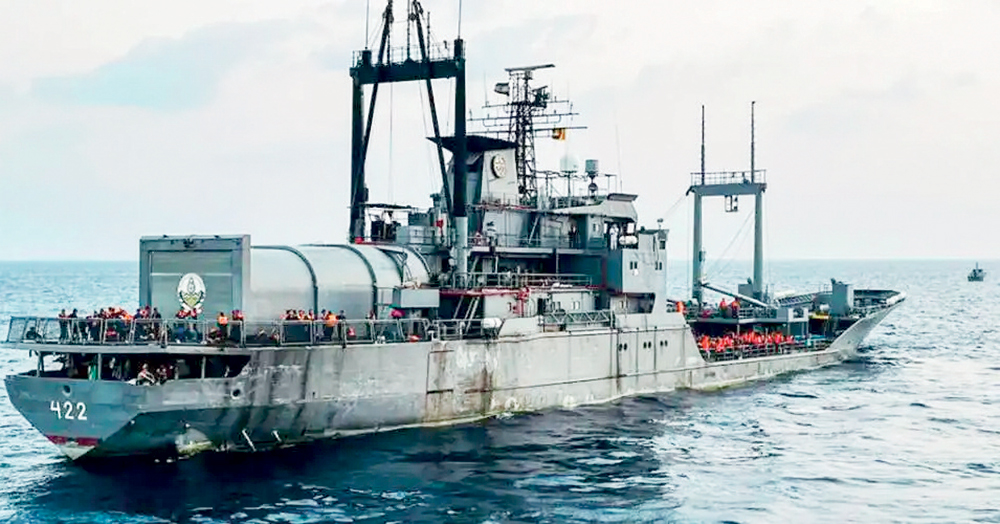
The US Navy’s sinking of an Iranian frigate IRIS Dena just off Sri Lanka’s southern coast has done more than disturb the waters of the Indian Ocean. It has jolted a small island nation into the gravitational pull of a geopolitical drama that is no longer confined to Tehran’s crumbling political architecture. Sri Lanka did not seek this moment. Yet history has a habit of choosing its bystanders, and the detonation beneath the waves has now placed Colombo at the fault line of Iran’s post regime turmoil. What had been a fractured and uncertain transition has suddenly acquired a maritime focal point, one that carries the potential for escalation, misjudgment, and the opportunistic meddling of regional powers eager to shape the emerging order.
In response, Sri Lanka has moved with a discipline that belies its size. Naval vessels were dispatched within hours to secure the wreck site. A formal inquiry was announced even before public speculation could harden into rumor. Senior officials established discreet channels with the International Maritime Organization to ensure that the investigation proceeds within an internationally recognized framework. Throughout these actions, the government has maintained a posture of strict neutrality. Yet the neutrality itself is a message. It signals that Sri Lanka intends to steady the situation without becoming entangled in the rivalries now radiating outward from Iran’s internal collapse.
For weeks, analysts have warned that Iran’s unfolding transition was approaching a dangerous tipping point. That warning has now come to pass. The crisis is no longer political alone. It is no longer a matter of rival factions disputing legitimacy in distant capitals. It has become a security crisis with consequences that wash onto the shores of states that never imagined they would be pulled into the vortex.
It is into this unpredictable moment that I have advanced the proposal known as the Colombo Accord. It is presented not as a government blueprint, but as a scholarly intervention grounded in the mechanics of negotiated transitions and the realities of regional security. The Accord outlines a multi-phase framework for structured dialogue among Iran’s four principal factions and relevant international stakeholders. In any week, the initiative would have been timely. In this week, with Sri Lanka thrust into the story by the accident of geography and the violence of the sea, its logic has become unavoidable. The stakes have risen. So has the urgency.
A Maritime Tragedy Highlights a Political Vacuum
The sinking of the Iranian frigate, still the subject of an evolving investigation, has unleashed a torrent of speculation that mirrors the broader uncertainty consuming Iran’s post regime landscape. Tehran’s provisional authorities have already gestured toward sabotage. Within Iran’s rival factions, whispers circulate that the incident may be a settling of scores disguised as misfortune. Regional analysts, quick to see the hidden hand of intelligence services, suggest the possibility of covert action by states with long standing grievances against Tehran. No version of events has been substantiated, yet each interpretation reveals the same unsettling truth. A nation struggling to define its political future is now projecting its instability outward, and the tremor has been felt far beyond its territorial waters.
In the aftermath, Iran’s political factions have turned upon one another with renewed ferocity. The sinking has become a canvas on which competing narratives of legitimacy are being hastily painted, each faction scrambling to depict itself as the victim of a conspiracy and its rivals as the likely authors of national humiliation. As Tehran’s internal quarrels intensify, regional powers have begun repositioning their naval assets nearer to the Indian Ocean’s key transit routes. The maritime movements speak more loudly than the official communiqués. They betray a quiet preparation for whatever comes next, whether escalation, opportunity, or a larger realignment triggered by the vacuum in Iran.
For Sri Lanka, the event has created a delicate and unfamiliar burden. The country now finds itself attempting to preserve its neutrality while managing the political sensitivities of hosting the wreckage of a foreign military vessel barely beyond its shoreline. Every statement must be calibrated, every operational decision measured. An island that has long viewed geopolitical turbulence as something observed from afar must now contend with the fact that great power politics can arrive not by choice or invitation, but as debris drifting toward its beaches.
The tragedy at sea has made unmistakably clear what distant observers sometimes forget. Geography offers no immunity when instability expands beyond its point of origin. In a world where maritime space is both the arena of commerce and the stage of strategic rivalry, even a nation seemingly far from the epicenter of conflict can find itself drawn into its orbit.
Why Colombo Now Matters More Than Ever
My proposal for the Colombo Accord predates the sinking of the Iranian frigate, yet the incident has given the framework a sharper edge and a sense of immediacy that no academic theorizing could have supplied. Iran’s transition has long been fractured among four principal blocs. Monarchists cling to the memory of a political order that once anchored Iran in a very different world. The National Council of Resistance of Iran (a coalition of Iranian dissident groups) and the People’s Mojahedin Organization of Iran (MEK)—an exiled Iranian opposition group advocating for the overthrow of the Islamic Republic to establish a secular, democratic state—operate with a disciplined organizational machinery that inspires both loyalty and unease. The technocrats and remnants of the Artesh, the conventional Islamic Republic of Iran Army, represent the continuity of a state apparatus that refuses to vanish with the fall of its governing ideology. The democratic coalitions, particularly those rooted in Iran’s ethnic peripheries, carry their own visions of a future that balances autonomy with nationhood. Their rivalry has always posed a significant risk to Iran’s internal stability, but until now it remained largely contained within the fractured political landscape of a country struggling to reinvent itself.
The loss of the frigate near Sri Lanka’s waters has altered the nature of the crisis. What had been an internal contest for legitimacy has tipped outward. It has become transnational, touching actors and geographies that never sought to be involved. The sinking is not merely a maritime accident. It is an early signal that Iran’s instability possesses a centrifugal force capable of drawing in distant states through the mechanisms of happenstance, miscalculation, or opportunistic interference. When a nation in turmoil radiates uncertainty into the sea lanes of the Indo Pacific, it is no longer possible to treat its troubles as an isolated matter.
The Colombo Accord argues that Sri Lanka, or any similarly neutral Indo Pacific venue, provides both psychological distance and geopolitical safety essential for meaningful dialogue. This distance is not a luxury. It is a structural requirement for factions that have spent decades regarding one another as existential threats. Colombo’s neutrality was once a diplomatic asset, useful but not indispensable. After the frigate incident, that neutrality has acquired a different kind of weight. It has become a stabilizing counterpoint to the suspicion that now permeates the region. When the waters grow crowded with vessels watching one another, calculating advantages, and anticipating the next provocation, a neutral shoreline becomes more than a symbolic refuge. It becomes a strategic terrain upon which the first steps toward de-escalation can plausibly be taken.
Sri Lanka did not ask for this role, yet circumstances have placed the island in a position where neutrality is no longer simply a posture. It is a form of strategic relevance. The calm that Colombo projects in the face of a foreign frigate resting near its coast demonstrates a kind of quiet capability that the region increasingly needs. The Accord seeks to build upon this moment, not to entangle Sri Lanka in the ambitions of others, but to offer a platform on which Iran’s fractured actors might finally find a way out of their zero sum contest.
A Scholar’s Framework for a Global Crisis
The Colombo Accord remains, at its core, an intellectual construct rather than an instrument of statecraft. It was conceived not in the corridors of a foreign ministry, but in the analytical space where theory, history, and strategic necessity intersect. Yet the fact that it is an academic design does not diminish its relevance. On the contrary, scholarly frameworks often precede political action, especially when governments find themselves reacting to crises they did not anticipate and do not fully understand. The Accord offers a disciplined structure for a transition that has so far unfolded as a series of disconnected improvisations by actors who distrust one another far more than they fear the consequences of inaction.
The framework proceeds in three distinct movements that reflect the logic of negotiated transitions. The first is a period of stabilisation talks that addresses the most immediate sources of danger. These include the custodial control of Iran’s nuclear infrastructure, the architecture of sanctions relief, and the assurance of safe navigation through the Strait of Hormuz. The frigate incident has now broadened this agenda. Maritime stability is no longer separable from the wider Indo Pacific environment, and any discussion of navigational security must take into account the possibility that Iran’s turmoil can spill outward into seas once considered peripheral to its internal struggles.
The second movement concerns the formation of a Transitional National Council. This requires closed negotiations in which the factions confront the difficult questions of representation, authority, and temporal limits. It demands that monarchists, technocrats, armed political organizations, and democratic regional coalitions attempt to imagine a shared political future after decades of mutual suspicion. A council of this nature cannot be imposed from outside. It must be assembled by the factions themselves yet guided within a structured environment that prevents the stronger parties from overwhelming the weaker and the weaker from derailing the process through fear of exclusion.
The third movement culminates in the drafting of two foundational texts. A Stabilisation Communiqué formalizes the immediate agreements necessary to prevent a descent into chaos. A Transitional National Council Framework sets the rules of the interim governance period and outlines the path toward elections or constitutional ratification. These documents, once completed, would not require Sri Lanka to act as guarantor. They would instead be presented to the United Nations by states willing to sponsor a viable path forward without seeking to dominate its content.
The sinking of the frigate does not alter the design of these phases. What it alters is the timeline. Crises at sea have a way of compressing political space. Maritime insecurity forces actors to confront the possibility that the next miscalculation could ignite a conflict far larger than anyone intends. The Colombo Accord, once a conceptual blueprint, now functions as an urgent scaffolding for de-escalation. It offers a disciplined alternative to the drift that currently characterizes the regional response. The longer the vacuum persists, the more likely it becomes that events will unfold according to the logic of accident rather than the logic of strategy. The Accord exists to prevent that outcome.
Sri Lanka’s Dilemma: Neutrality in the Eye of a Storm
Colombo’s response in the days since the sinking has been marked by a quiet discipline that reflects both prudence and an awareness of the moment’s gravity. Naval patrols have been extended across the affected waters in an effort to ensure that no foreign actor exploits the wreck or attempts to manipulate the scene for strategic advantage. The government has initiated a joint maritime safety review aimed at reassuring international observers that Sri Lanka intends to handle the incident with full transparency and in accordance with international maritime norms. Diplomats have opened discreet channels with Tehran, New Delhi, Washington, and several Gulf capitals, not as an act of alignment, but to prevent premature narratives from hardening into geopolitical assumptions that could force Sri Lanka into positions it has no desire to occupy.
Neutrality, however, becomes most fragile precisely when events press hardest against its boundaries. The sight of foreign debris washing ashore has created a symbolic intrusion that no government can simply cordon off with patrols or press releases. The island now occupies a liminal space between spectator and participant, and this is a position familiar to many small states navigating the undertow of great power rivalry. Their neutrality becomes most prized by the international community at the exact moment it becomes most difficult for them to preserve. It is a paradox that is neither new nor avoidable. It is the structural reality of a world where crises migrate unpredictably across borders and through seas.
Sri Lanka now confronts a moment in which the temptation to withdraw into studied silence must be balanced against the need to shape the narrative before larger powers do so on its behalf. This is where the logic of the Colombo Accord becomes most compelling. The framework is not only a mechanism for easing Iran’s internal fragmentation. It is also a means for Sri Lanka to assert a form of agency that does not compromise its neutrality. By offering a venue for structured dialogue, the island positions itself not as a partisan actor, but as a stabilizing presence in a region increasingly defined by uncertainty at sea and volatility on land. In doing so, Sri Lanka shapes events before events shape Sri Lanka, which is the essential choice required of any state forced, however reluctantly, into the center of a crisis not of its own making.
The Narrowing Window
The sinking of the frigate has emerged as a stark emblem of a deeper reality. Iran’s transition is no longer a distant abstraction that can be managed at diplomatic arm’s length. It has shed the illusion of containment. The crisis now lives simultaneously in contested territorial waters, in competing claims of political legitimacy, and in the widening space between what factions assert and what realities unfold. Its center of gravity remains in Tehran, but its shockwaves have reached Colombo with an insistence that can no longer be ignored.
This moment reveals a simple but unforgiving truth. Statements will not steady the situation, and sanctions will not guide a fractured nation toward coherence. The forces now in motion are too varied, too suspicious of one another, and too willing to interpret every event as either an opportunity or an existential threat. The wrecked frigate near Sri Lanka’s shores is a reminder that crises born of political collapse do not respect geography. They travel outward until they encounter resistance or structure, and at present there is no structure worthy of the name.
The Colombo Accord does not pretend to offer a miracle. It offers something far more modest and far more necessary. It creates a disciplined mechanism within which Iran’s competing actors can confront one another without turning the region into their arena. It provides a framework for de-escalation at a moment when the absence of structure risks inviting a cascade of increasingly dangerous misunderstandings. The Accord is not a promise of peace. It is an attempt to slow the march toward catastrophe long enough for reason to reenter the conversation.
As investigations proceed and diplomats circle carefully around the wreckage, this one fact will not change. Without a neutral venue that can host structured dialogue, the next Iranian crisis will not limit itself to a sinking offshore. It will break outward in ways that no state in the region, and few beyond it, are prepared to manage. History rarely gives much warning before the window for action closes. Sri Lanka now finds itself standing at that window, and the world would be unwise to ignore the view from its shore.
Dr. Achala GunasekaraRockwell is a Sri Lankan–born scholar of international security affairs whose work focuses on political transitions, regional security architectures, and defence strategy. She holds advanced degrees from the University of Wisconsin and has published widely on geopolitical dynamics across the IndoPacific, South Asia, and the Middle East. Her research emphasizes negotiated transitions, smallstate diplomacy, and the intersection of security with political instability. Dr. GunasekaraRockwell writes in her personal capacity, and her views represent her own scholarly analysis.
Disclaimer
The views, interpretations, and analyses presented in this article are solely those of the author. They do not represent, reflect, or imply any official position of the US Government, the Department of Defense, the Department of the Air Force, Air University, or any other federal entity. This work was produced entirely in the author’s personal capacity, outside the scope of her official duties, and is completely unrelated to her employment or responsibilities within the US Government.
By Dr. Achala Gunasekara Rockwell





by Jehan Perera
The death sentence on Sivarasa Anojan, a Sri Lankan citizen convicted of blasphemy in Saudi Arabia has taken a central place in national consciousness for the past several weeks. It has been in the headline news since it was first reported last month. There have been many initiatives taken locally to get a more lenient sentencing by the Saudi authorities. There is also an undercurrent that is critical of both the culture and religion from which this sentencing emanates. This also sustains the widespread publicity being given nationally to the issue. By way of contrast, the controversy caused by the forcible removal of the Thileepan statue in Jaffna has not significantly impacted upon the national consciousness. There was only passing mention of the incident in the national media which has been overtaken by other events.
However, in the north and east of the country, and in the diaspora, the removal of the Thileepan statue has become a major issue. It has led to protest marches led by university students and widespread condemnation by civil society and political groups. The issues underlying the Thileepan statue have deep undercurrents in the Tamil consciousness particularly in the north and east which time is unlikely to dispel. The real test of harmony in a multi-ethnic, multi-religious society like Sri Lanka is not whether communities coexist peacefully when nothing controversial is at stake. Rather, the test is how they respond when an event touches their identities and grievances. The death sentence imposed on Anojan in Saudi Arabia and the removal of the Thileepan statue in Jaffna carry the risk of becoming grievances to entire communities.
In the case of Anojan, a young Tamil migrant worker, he was first sentenced to five years imprisonment and a fine of three million Saudi riyals over a Facebook comment. Both he and the Saudi prosecution appealed, with the appeal court raising the sentence to death. This has led to public sympathy for him in Sri Lanka.
Appeals for clemency have come from the President, government and opposition leaders, clergy of all faiths and Muslim political leaders. At the same time there is a need to reject attempts to turn the case into a source of anti-Muslim sentiment or collective blame. Peacebuilding therefore has to be within Sri Lanka as well as diplomatic. Religious leaders and civil society in the country should be ready to quell rumour, even as Muslim, Buddhist, Hindu and Christian leaders stand together publicly.
Thileepan Statue
The Thileepan controversy has had a different trajectory. Many Tamils admire Thileepan, the LTTE name of Rasaiah Parthipan, who died on 26 September 1987 after a twelve-day fast. His demands were addressed to India but included matters pertaining to the Sri Lankan government including the release of detainees held under the Prevention of Terrorism Act. The statue put up during this year’s commemoration was removed by police in the early hours of 27 September, a day after the commemoration ended. The government’s legal concern, as articulated by its spokesperson, was the LTTE remains a proscribed organisation and before removing the statue, police had presented facts to the court. But law and memory answer different questions and the depth of Tamil anguish cannot be disregarded.
For many Tamils, remembrance of Thileepan is connected to their sense of loss and historical memory. The memorial has been destroyed and rebuilt more than once, and each destruction has added to the meaning it carries. Many who mourn Thileepan are grieving a young man who died without violence and by his own fast. They also grieve an era of loss of the struggle for Tamil rights and self-determination for which Thileepan has become a symbol. The Office for Reparations Act, No. 34 of 2018, provides for collective reparations and gives the Office for Reparations a role in policies on memorialisation. This does not automatically permit any particular statue, nor does it override laws on public places or proscribed organisations. But it shows that memorialisation is recognised within Sri Lanka’s framework for reparations and reconciliation. There is also a wider question of equality.
The JVP that now leads the NPP government was itself once proscribed when it took up arms against the state in which tens of thousands died, later entered democratic politics, and now for many years has publicly commemorated its own fallen. The opportunity to remember those who died should not belong to one community alone.
A commitment to peacebuilding requires that the same trust that has been given to former militants of one community needs to be given to members of other communities if equal citizenship and equal rights are to have meaning. Further, the Office for Reparations Act provides for reparations through livelihood. It is today a fact that those former LTTE members who went through the government’s rehabilitation process find it difficult to get jobs in the private sector.
Private sector employers are reluctant to come under surveillance for employing former LTTE members. There needs to be equal access to employment and removal of unjustified barriers to reintegration, with targeted public programmes where necessary. Until this situation is realized on the ground, the government needs to consider employing those who went through the government’s rehabilitation process and still unable to find suitable employment.
Continuing Peace
The challenge that post-war Sri Lanka faces, a full 17 years after the end of war, is to strengthen the foundations of trust between communities rather than deepen existing suspicions. Anojan is an individual Sri Lankan citizen facing a severe sentence in another country. His case should not become a reason to blame Sri Lankan Muslims. Thileepan is remembered differently by different communities, but the dispute over his memorial should not become a reason to revive the communal divisions of the past. The cases are also mirror images in an important respect. In the Anojan case, the state is an advocate pleading before another government. In the Thileepan case, the state is the actor whose decision is being judged. The first calls for quiet diplomacy and restraint in public language. The second calls for fairness and explanation, and the burden on the state is heavier.
The common roots of the two cases lie in mistrust that does not belong to one community alone. It has been produced by experiences of discrimination, violence, insecurity and loss that have been interpreted differently by different communities. Grievances turn communal when an individual is seen as a representative of a community, when institutions seem to treat communities unequally, and when people feel their pain goes unacknowledged. Each of these can be addressed. The system change that the Sri Lankan people voted for in 2024 would need to include a government that rejects collective blame, acknowledges grief and explains its decisions openly. It also requires state institutions to act transparently and consistently, so that no citizen feels that the law protects some communities more than others.
This peacebuilding imperative requires enlightened leadership as much as legal authority. It requires leaders who will speak to their own communities against prejudice, even when this is politically inconvenient. It requires religious leaders who will demonstrate solidarity across religious boundaries. And it requires civil society to recognise that peacebuilding is not simply preventing violence after tensions have risen, but is addressing the mistrust and grievances that allow tensions to rise in the first place. Sri Lanka has learned, at great cost, that communal divisions can become much larger than the events that initially give rise to them. The Anojan and Thileepan cases give Sri Lanka an opportunity to demonstrate that it has learned from its past. The test of Sri Lanka’s continuing peace is whether we can address difficult grievances without turning them into communal ones.
By Sarath S. Kodithuwakku
President, Institute of Management of Sri Lanka; Senior Professor, University of Peradeniya
(Continued from yesterday)
Representation, Independence and Decision-Making
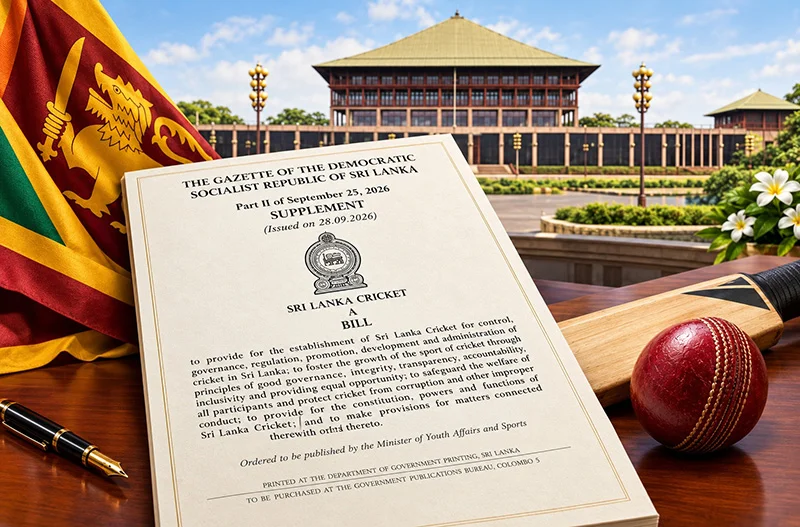
The membership-based electoral structure should provide representation without becoming a substitute for executive management. The seven Elected Directors would bring the perspectives of the SLC membership into the Board, while the seven Independent Directors would provide additional professional expertise and independence. The model’s effectiveness will, therefore, depend on whether the Board can integrate these perspectives into coherent strategic decisions while maintaining a clear boundary between governance and day-to-day management.
The equal division between Elected and Independent Directors also raises a governance-design question. An even-numbered Board can create a tie. The Bill addresses this directly: in the event of equality, the Chairperson has a casting vote; in the Chairperson’s absence, the Deputy Chairperson has a casting vote; and if both are absent, an Independent Director, elected to preside, has the casting vote. The issue is, therefore, not whether a tie can be resolved, but how this mechanism affects the balance between representation, independence and accountability.
The leadership structure reinforces this balance: the Chairperson is elected from among the Independent Directors and the Deputy Chairperson from among the Elected Directors. The casting-vote arrangement makes the Chairperson’s role and perceived independence particularly important, especially when a major strategic decision divides the two components of the Board.
The Bill’s committee provisions could support a disciplined model of delegation, but implementation will depend heavily on the terms of reference adopted by the new Board. The framework could be strengthened by requiring a published cricket-development strategy, a clear division of powers among the Board, executives and selection committees, transparent principles for major development allocations, and periodic reporting on outcomes across men’s, women’s, schools and domestic cricket. These measures would strengthen accountability without legislating the details of team selection or tournament scheduling.
From Measurement to Strategic Accountability
If the Board is to hold management accountable for strategy rather than simply for short-term results, it needs a performance framework that captures both outcomes and the capabilities that produce them.
SLC should consider requiring an explicit multi-year cricket-development strategy, supported by measurable objectives and an annual strategy review. Such a strategy should identify the development pathway from schools and grassroots cricket through domestic competitions to high performance; define major capability priorities such as coaching, sports science, data and analytics; set resource-allocation principles; and establish indicators against which progress can be assessed.
The purpose would not be to turn cricket into a bureaucratic exercise. Strategic accountability simply creates a disciplined basis for asking whether the organisation is doing what it said it would do, whether its assumptions remain valid, and whether resources are producing the intended results.
From Measurement to Organisational Learning
SLC should, therefore, consider adopting a formal Balanced Scorecard. Rather than measuring success solely through international match results or annual financial audits, the framework could track four interdependent perspectives:
Financial Sustainability:
commercial growth, financial discipline and compliance.
Internal Processes:
domestic tournament quality, development pathways and selector-process integrity.
Stakeholder Value:
grassroots development, school cricket and women’s cricket expansion.
Strategic Capability:
coaching quality, sports science, talent development, data and analytics capability, and the organisation’s ability to convert investment into sustainable performance.
The purpose of such a framework would not be to reduce cricket development to a collection of numbers. Rather, it would create a disciplined process for asking four fundamental management questions:
What did we expect to achieve?
What actually happened?
Why was there a difference?
What should we change as a result?
Evaluating these dimensions periodically would help SLC move beyond performance reporting towards genuine organisational learning.
ICC as a Stakeholder in Governance Reform
The ICC is another important stakeholder whose interests should be recognised in the reform process. SLC’s governance arrangements do not operate solely within Sri Lankan law; they also have to be compatible with the governance obligations associated with ICC membership. The ICC’s Articles of Association require each Member to provide for free and democratic elections (or nominees from outside its members) and to manage its affairs autonomously, without government or other public-body interference in the governance, regulation or administration of cricket.
International experience demonstrates that ICC engagement in member governance restructuring is not unusual. In the United States, after the ICC expelled the old national association for chronic governance failures, the ICC directly oversaw a multi-year project to design a new governance model. The ICC Board formally approved the constitution for a replacement body (USA Cricket) before it was adopted. The resulting structure combined elected constituent directors with independent directors, showing that an ICC-backed framework can accommodate both forms of representation.
In Nepal, the ICC established a Nepal Advisory Group comprising stakeholders from across the game to recommend constitutional amendments, with adoption of the revised constitution and subsequent elections forming part of the conditions for reinstatement of ICC membership.[8] The ICC subsequently facilitated an independent panel that included ICC nominees together with representatives of Nepal’s National Sports Council and the existing cricket administration to map the election process, guidelines and timelines.[9] More recently, in 2026, an ICC delegation visited Bangladesh to engage with stakeholders on governance and electoral matters.[10] The ICC has also reported that its Deputy Chair and another ICC Board representative visited Sri Lanka and met relevant stakeholders to assess ongoing developments, while the ICC Board reiterated the need for elections to be held as soon as possible.
These precedents make the ICC a legitimate stakeholder in considering the governance implications of the proposed Bill. This does not mean that the ICC should determine Sri Lanka’s domestic legislation, nor that every feature of the Bill requires prior ICC approval. It does, however, suggest that early and formal engagement with the ICC would be prudent, particularly where the proposed arrangements concern Board independence, elections, government involvement and the transition to the new governance structure.
This is particularly relevant because the Bill creates two institutional arrangements that deserve careful scrutiny from an autonomy perspective. The Transformation Committee is responsible for managing the transition until the First Board is constituted, while the Nomination Committee, although structurally independent of the SLC Board, includes representatives connected with the Sports Ministry and the National Sports Council. Neither arrangement, by itself, establishes government interference. However, taken together, they make it important that the independence of the incoming Board is demonstrable through transparent procedures rather than assumed from the structure alone.
Given the professional calibre and international exposure of the members of the Transformation Committee, it would be reasonable to expect that the importance of ICC engagement would have been recognised. Although any such consultation has not been evident in the public domain, it is therefore reasonable to expect that the ICC has either already been consulted or will be consulted before the Bill is enacted. Such engagement would allow potential incompatibilities to be identified before the new structure is enacted and implemented, rather than after the fact.
The Transition Is Itself a Governance Challenge
The transition provisions introduce a significant organisational-change challenge. Replacing the existing club- and association-based governance structure with a new hybrid Board and governance architecture is not simply a legal exercise; it is an organisational change programme. The Sri Lanka Cricket Transformation Committee is required to manage the transition until the First Board is constituted and, during that period, to establish rules covering matters including tournament structure, domestic governance, selection committee appointments, committee terms of reference, the Nomination Committee process and the election of the Elected Directors.
Structural reform on paper can encounter resistance from established interests, institutional habits and existing routines. The implementation phase will therefore require a clear change-management framework, including stakeholder engagement, transparent onboarding for Independent Directors, clarification of decision rights, alignment of legacy committees, and careful transfer of information and responsibilities.
Without attention to these organisational factors, cultural friction could undermine the intended administrative improvements. The success of the reform will therefore depend not only on the text of the legislation but also on the quality of the rules, appointments, delegation arrangements and organisational behaviours that follow it.
From Governance Reform to a Cricket Strategy
The Bill deserves credit for addressing how SLC is constituted and for creating places for specialist advice. It should not be dismissed simply because it does not prescribe a batting order or a domestic fixture list. Those are not appropriate tasks for legislation.
Its limitation is more precise: the proposed governance arrangements do not, by themselves, assure the strategic capability of the Board or the quality, independence and accountability of the decisions made beneath it. They establish the architecture. The future Board and management must supply the strategy, capabilities, discipline and learning mechanisms that make the architecture work.
A stronger reform would connect four elements: a Board selected for collective strategic capability; professional cricket management with clear delegated authority; transparent but non-mechanical selection and investment processes; and systematic evaluation of development outcomes. Within the first of these, information technology and computer science should be recognised as distinct from the broader capability to understand and govern data science, analytics and emerging AI-enabled decision support.
Ultimately, the governing question is not only who gets a seat at the SLC Board table. It is whether that Board can build, fund, execute and learn from a credible strategy for Sri Lankan cricket.
References
1. Department of Government Printing, Sri Lanka. Sri Lanka Cricket Bill, Gazette Supplement, Part II of September 25, 2026, issued on 28 September 2026.
2. International Cricket Council. Media release, 15 July 2026, reporting the ICC Board discussion of Sri Lanka Cricket and the need for elections to be held as soon as possible.
3. Sport New Zealand – Ihi Aotearoa. Nine Steps to Effective Governance, particularly Step 1: Define and Agree the Board’s Role; Step 4: Provide Strategic Leadership; Step 5: Employ and Support a Chief Executive; and Step 8: Get the Right People on Board.
4. Cricket South Africa. Governance and management frameworks, including the delegation-of-authority framework, Board committees, Cricket Committee, Cricket Pipeline Committee and CEO accountability.
5. International Cricket Council. ICC Articles of Association, provisions requiring free and democratic elections and autonomous administration without government or other public-body interference. ICC. https://images.icc-cricket.com/image/upload/prd/f7vm88yw1933dc38cgtg.pdf
6. International Cricket Council. “ICC outlines proposed USACA constitution.” ICC, 2017. https://www.icc-cricket.com/news/icc-outlines-proposed-usaca-constitution
7. International Cricket Council. “Approved constitution marks historic landmark for cricket in USA.” ICC, 2017. https://www.icc-cricket.com/media-releases/approved-constitution-marks-historic-landmark-for-cricket-in-usa
8. International Cricket Council. “ICC welcomes Nepal Special General Meeting to adopt revised constitution.” ICC, 2018. https://www.icc-cricket.com/media-releases/icc-welcomes-nepal-special-general-meeting-to-adopt-revised-constitution
9. International Cricket Council. “Independent Panel meet to progress Nepal elections under revised constitution.” ICC, 2018. https://www.icc-cricket.com/media-releases/independent-panel-meet-to-progress-nepal-elections-under-revised-constitution
10. International Cricket Council. “ICC delegation visits Bangladesh to engage with stakeholders on governance and electoral matters.” ICC, 2026. https://www.icc-cricket.com/media-releases/icc-delegation-visits-bangladesh-to-engage-with-stakeholders-on-governance-and-electoral-matters
11. International Cricket Council. “ICC Board approves governance, membership and member support decisions.” ICC, 2026; see also “ICC Board Meeting,” 2026, reporting ICC representatives’ meetings with stakeholders in Sri Lanka. https://www.icc-cricket.com/media-releases/icc-board-approves-governance-membership-and-member-support-decisions
(Concluded)
by Viran Maddumage
Assistant Lecturer & PhD (Reading) Macquarie University Australia
Sanduni Rathnayake
Lecturer (Probationary) General Sir John Kotelawala Defence University
The Mediterranean is not merely a border between two continents. It is also a reminder of a relationship between Africa and Europe that was built over centuries; and whose consequences have not disappeared.
There are some borders that people cross with passports. Others are crossed by people who have run out of alternatives.
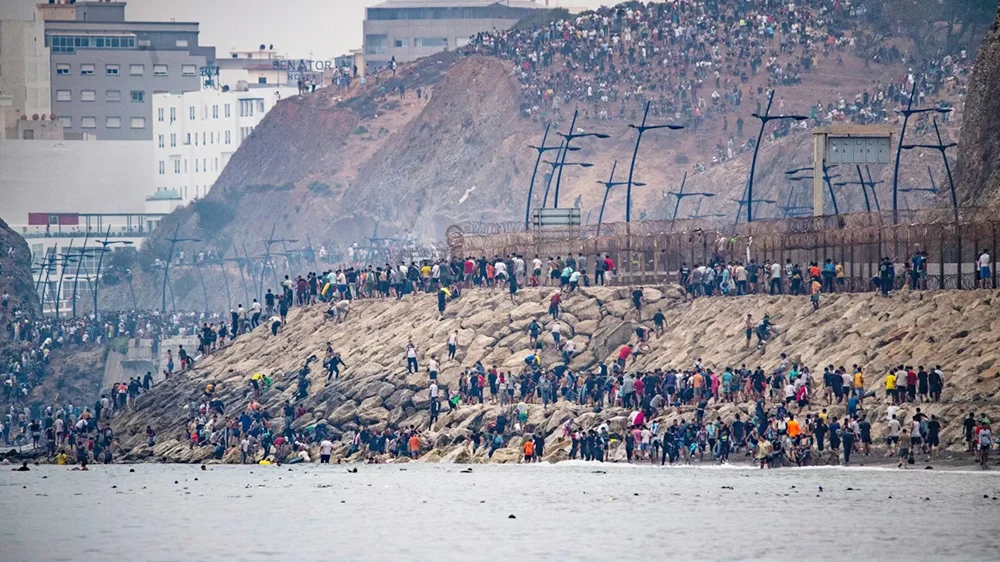
In the early hours of 30 July, 2026, thousands of people attempted to enter Ceuta, the Spanish territory on the northern coast of Africa. Spanish authorities reported that between 50,000 and 60,000 people entered the enclave irregularly during the crisis. The episode followed a Spanish Supreme Court ruling concerning the immediate rejection at the border of people who arrived by sea. Spanish authorities subsequently moved to restore the situation, while Morocco and Spain intensified their cooperation to prevent further crossings.
Ceuta is a strange place to contemplate migration. It is geographically in Africa but politically part of Spain; and therefore, part of the European Union. Its border is not simply a line separating two states. It is a physical manifestation of a much older relationship between two continents.
And perhaps the most important question is not simply: Why are people trying to enter Europe?
It is: Why does Europe remain sufficiently attractive that people are willing to risk their lives trying to reach it?
From extraction to aspiration
The contemporary migration story cannot be reduced to colonialism. Africans migrate for many reasons: employment, education, family reunification, conflict, insecurity, political conditions, environmental pressures and personal aspirations. Much African migration also takes place within Africa itself.
Yet history matters.
European colonialism profoundly reshaped African economies. In many territories, economic structures were organised around the extraction and export of primary commodities. Roads and railways were frequently constructed to connect areas of agricultural, or mineral production, to ports and external markets rather than to create integrated domestic economies. World Bank historical analyses have documented the extent to which colonial economies were dependent on a limited number of primary commodities and external markets.
This was not merely an economic arrangement. It affected what economies produced, where infrastructure was built, how labour was organised and where the value generated by production was realised.
The Congo Free State ,under King Leopold II, offers one of history’s starkest examples. The territory was subjected to a system of forced labour and violent extraction, particularly around rubber and ivory. Forced labour was legally authorised and coercive systems were used to secure production.
But Leopold’s Congo should not be presented as a metaphor for every African country or every European colonial experience. Colonial rule differed substantially across the continent. The broader point is narrower; and perhaps more consequential: colonial economies frequently connected African land, labour and resources to European markets on terms that privileged extraction and external trade.
Modern scholarship continues to examine the long-term effects of these structures. Research on colonial cash-crop economies, for example, has found that colonial production and infrastructure created lasting patterns of economic organisation, while the benefits of these systems were often geographically concentrated and domestic production linkages remained weak.
The question, then, is not whether colonialism single-handedly caused contemporary African migration.
It is whether a history in which Europe was deeply involved in shaping African economies also helped produce the unequal relationship from which today’s migration patterns emerged.
The language of migration
There is another legacy that is easy to overlook because it has become so ordinary: language.
French is spoken across substantial parts of West and Central Africa. Portuguese remains an official language in several African states. English is widely used in countries whose histories are connected to the British Empire.
These are not simply linguistic accidents.
Colonial rule created institutional, educational and administrative connections that survived independence. Those connections later became migration networks.
France, Belgium, Portugal and other European countries are, therefore, not random destinations for African migrants. Their migration relationships with particular African states have been shaped by history, including colonial connections and post-war labour recruitment. The OECD notes that the composition of immigrant populations in several European countries continues to reflect colonial legacies; France, Belgium, Portugal and the Netherlands, for example, have substantial African-born populations.
This creates something more powerful than a shared language. It creates familiarity.
A young person in an African country may have a cousin in Paris, an uncle in Brussels, a former schoolmate in Lisbon or a friend in Milan. Europe ceases to be an abstract geographical destination. It becomes a place where somebody they know already lives.
Diaspora networks can, therefore, function as social infrastructure for migration. They provide information, contacts, accommodation, employment leads and emotional reassurance. The journey may be dangerous, but the destination is no longer entirely unknown.
Why Europe?
There is an uncomfortable paradox at the heart of this story.
For centuries, European powers travelled to Africa in search of land, labour, markets and resources.
Today, Africans travel towards Europe in search of employment, security, education and opportunity.
The direction of movement has changed.
The unequal relationship has not necessarily disappeared. That does not mean Europe is uniformly prosperous while Africa is uniformly poor. Africa is a continent of 54 states with enormous differences in wealth, governance, opportunity and living standards. Nor is Europe free from unemployment, inequality or social exclusion.
But migration decisions are comparative. People do not need to believe that Europe is perfect. They need to believe that their prospects there are better than their prospects at home. That distinction matters.
A person crossing the Mediterranean may not be chasing luxury. They may be chasing a job, a university place, safety, family, dignity or simply the possibility of building a future that appears increasingly difficult to build at home.
Research on West African migration similarly identifies economic opportunity, employment, governance, development conditions and existing migration networks among the factors shaping movement.
The Mediterranean as a graveyard
The tragedy is that the Mediterranean has become not merely a migration route, but a graveyard.
The International Organisation for Migration recorded 5,305 deaths or disappearances on migration routes to Europe in 2016. More than 5,000 deaths and disappearances were recorded in the Mediterranean that year alone.
The danger has never meant that people stop moving.
Instead, when legal routes narrow, journeys can become more dangerous.
That is the central paradox of irregular migration: the more difficult it becomes to cross safely, the greater the incentives for smugglers and increasingly dangerous routes can become for people who are determined to leave.
Ceuta illustrates this geography particularly vividly. Spain and Morocco have spent years reinforcing physical barriers and security arrangements around the enclave. Yet the geographical proximity remains. Africa is only a few kilometres from Europe at its closest points.
A fence can prevent a person from crossing.
It cannot, by itself, erase the reasons that person wanted to cross.
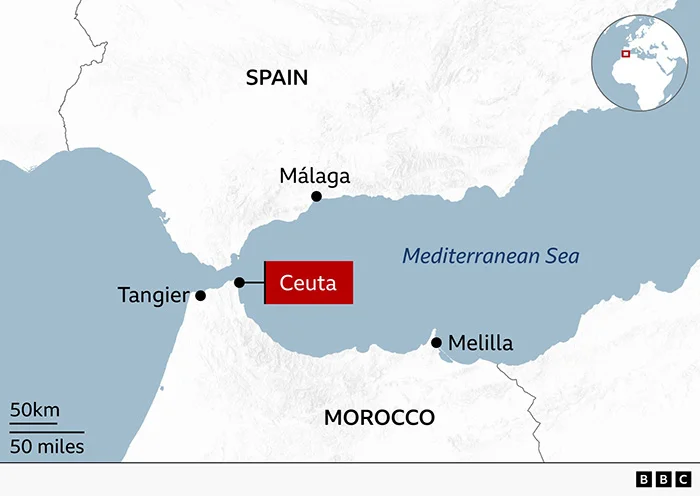
Map courtesy BBC
Europe responds with law
Europe is not without a legal response. Indeed, the European Union has spent years developing increasingly sophisticated mechanisms for managing migration and asylum. As of June 2026, the EU Pact on Migration and Asylum entered into application across EU Member States. It establishes common procedures for screening and registering irregular arrivals, asylum processing, responsibility-sharing and returns, alongside safeguards for fundamental rights.
The European Commission has simultaneously emphasised both stronger external borders and expanded pathways for legal migration, including the EU Talent Pool for workers from outside the Union.
The legal architecture, therefore, reflects competing imperatives.
States have a legitimate interest in controlling their borders.
People have rights when they cross borders.
States have obligations concerning asylum and fundamental rights.
And migrants have reasons; sometimes compelling reasons, for moving.
The challenge is that border control addresses the movement of people. It does not necessarily address the conditions that produce the desire to move.
That distinction should be at the centre of the migration debate.
The African dream of Europe
There is a phrase often encountered in discussions about African migration: that Europe represents a promised land, while Africa is left behind.
Such descriptions can be unfair to a continent that contains enormous economic, cultural and political diversity. But the aspiration itself should not be dismissed.
When a young person believes that their best chance of employment, education or security lies thousands of kilometres away, that tells us something about both the destination and the place they are leaving.
Migration, therefore, becomes a form of social commentary.
People vote with their feet; not because migration is always the right choice, but because their decisions reveal how they perceive the opportunities available to them.
This is also why migration matters for the sustainability of states.
If a country’s young people increasingly organise their lives around the possibility of leaving, the problem is larger than the loss of individual workers. Countries can lose skills, professionals, entrepreneurs, researchers and future leaders. Families may become transnational. Communities may depend increasingly upon remittances. And the political question becomes unavoidable:
What kind of country are we building if so many of our citizens imagine their future somewhere else?
Sri Lanka should understand this question.
The circumstances are obviously different from those of African states facing Mediterranean migration routes. Sri Lankan migration is shaped by its own economic, political and historical circumstances, and its principal destinations and migration channels differ considerably.
Yet the underlying question is familiar.
When leaving becomes the most attractive strategy for an ambitious young person, migration is no longer merely an individual phenomenon. It becomes a measure of confidence in the future of the country itself.
Beyond the border
Perhaps, then, Europe should not ask only how to stop people from crossing.
And African governments should not ask only how to persuade people to stay.
Both questions are too narrow.
The deeper question is why a world divided by such profound economic inequalities continues to expect people to remain content on one side of the divide while opportunity is concentrated on the other.
The answer cannot be an open border without regulation. Nor can it be a fortress surrounded by increasingly dangerous seas.
A more durable approach would require investment in economic opportunity, domestic industries, education, accountable institutions and safe and lawful avenues for migration. It would require European countries to recognise that migration management is not simply a security question. It is also an economic, historical and human-rights question.
And African states must confront an equally difficult reality: historical exploitation can explain part of today’s inequality, but it cannot become an excuse for indefinitely postponing the task of building states in which people want to remain.
The Mediterranean will continue to separate Africa from Europe geographically.
But history has already connected them.
The resources extracted from Africa helped build European economies. Colonial languages created enduring institutional links. Diaspora communities now connect African families to European cities. Labour moves in both directions. Capital moves in both directions. Ideas move in both directions.
What crosses the Mediterranean, therefore, is not merely a migrant.
It is history.
The person swimming towards Ceuta is carrying more than a small bag, if they have one at all. They may be carrying the expectations of a family, the memory of an economy shaped by generations of external relationships, the example of relatives who successfully migrated, and the belief that somewhere on the other side of the water there is a future worth risking everything to reach.
Perhaps, that is the question Europe should hear beneath the sound of the waves:
What would have to change so that crossing the sea was a choice rather than a necessity?
(The views expressed are those of the writers and do not necessarily represent those of the institutions with which the writers associated)

Establishment of an Institutional Framework to Inagurate Upper Hydro Catchment Areas Management Authority
Introduction of Flora and Fauna (Regulation of actions of the Indigenous Community within the nominated areas) Regulations
M. M. D. J. Senarathne, appointed Director General of the Department of National Botanical Gardens

Harmanpreet Kaur steps down as India captain

Turkiye, Pakistan agree Saudi Arabia military deployment under Mecca pact

Rumesh Tharanga among nominees announced for World Athlete of the Year 2026

‘Dates have the highest sugar content to fight Coronavirus’

Sunday Island 27 December – Headlines

#SundayIsland 17th December – Headlines

Sunday Island – 28th March

Sunday Island Headlines – 21 March

Sunday Island – 21st February – Headlines
-

 Latest News7 days ago
Gold winner Tharanga gets brand-new Honda Vezel from SLAAJ
-

 News6 days ago
US-assisted ‘Ice’ detection: NPC to examine IGP’s move to transfer drug-busting team
-

 Features7 days ago
Why Sri Lanka needs an Inclusive Civic Nationalism – urgently
-

 Editorial5 days ago
Colombo Port drug bust: The plot thickens
-

 News7 days ago
Civil society activist accuses govt. of favouring Ven. Gnanasara
-
 Midweek Review7 days ago
Dappula’s Easter Sunday ‘grand conspiracy’ claim demolished
-

 Editorial7 days ago
When crime bosses rise above law and shrines
-
Editorial6 days ago
Drug busting, transfers and trust deficit