
Business
A turnaround in farmers’ opinion of oil palm cultivation


Farmers who supported the ban on the crop in 2021 now want it lifted
by Sanath Nanayakkare
Oil palm cultivation which underwent heavy criticism in Sri Lanka due to environmental concerns and subsequently led to a ban imposed on it by former president Gotabaya Rajapaksa in April 2021 is now taking an interesting turn of events due to tea and rubber smallholders’ insufficient incomes and what they describe as ‘better awareness’ of oil palm cultivation.
With just over two and a half years, the very same tea and rubber smallholders who had protested against the cultivation of oil palm in their region are now appealing to the government to lift the ban and allow them to cultivate oil palm in their tea and rubber lands as an intercrop.
This surprising development in the rural agri-sector was revealed to The Island Financial Review (IFR) when it met with farmer members of Haritha Derana Society – a group of tea and rubber smallholders in Baduraliya, Matugama in Kalutara district recently.
“First of all, we must say that we were at the forefront of the campaign against oil palm cultivation which partly influenced the ban on the cultivation of oil palm in 2021 by the then president Gotabaya Rajapaksa. When we think back to what motivated us to join the protest bandwagon in 2021 and the current state of things on the ground, we feel remorse and guilt for not acting on wiser judgment. In fact, we were emotionally influenced by popular opinion that prevailed at the time, and we went with the flow without considering the true environmental science behind oil palm cultivation,” farmer Siripala Edirisinghe said.
“The effect of oil palm on groundwater resources isn’t significantly different from that of rubber. Scientifically, it is a fact that a single oil palm tree consumes about 249 litres of water per day against 63 litres by a rubber tree. However, the consumption of water per hectare of oil palm is only slightly higher than that of a hectare of rubber because fewer oil palms are planted per hectare. A hectare of rubber requires 31,500 litres of water per day while a hectare of oil palm requires 34,680 litres. This has been scientifically calculated and publicized”, farmer M.S. Samaranayake said.
“Oil palm cultivation in Galle district commenced about 50 years ago – long before in Kalutara district. However, there have been no reports to date of water shortages in Galle district due to oil palm. Kalutara district receives an annual average rainfall of about 318 millimeters and the region has 267 rainy days on average. This means it rains 73% of any given year. This year it was even more as you know. So, there is no basis for the concern that oil palm cultivation can lead to a deficit in water resource,” farmer T.A. Chandralal said.
“Lots of rain in our district has had an adverse impact on our tea and rubber plantations but not on oil palm estates. Heavy, unseasonal rains have drastically reduced rubber tapping in our region deeply eroding the income of rubber smallholders. Our tea growers also feel the impact of Climate Change on their ever-declining harvests and dwindling incomes. If you check tea brokers’ reports at the Colombo Tea Auction, you will see that the total auction offerings have declined fairly sharply and overall quality of Sri Lankan tea is barely maintained. So, the future indicates that our tea and rubber stallholders are between the devil and the deep blue sea. However, amidst these threats, we are encouraged to see the emerging awareness about oil palm as a vibrant, high-performing industry in Sri Lanka. Therefore, we urge the government to lift the ban and allow oil palm cultivations in our lands ensuring minimum side effects to the environment,” he said.
“Unlike tea and rubber, we need to work less time on oil palm lands between planting and fruit-bearing stage. It will give us a lot of time to attend our household chores and take care of our children’s wellbeing and school work and get them to attend school every day without playing truant and get better grades. I am sure if oil palm cultivation is allowed by the government, there will be a lot of female labour participation in the plantation sector. No other daily plantation work can give enough freedom to a poor working mother,” farmer Kumari Damayanthige said.


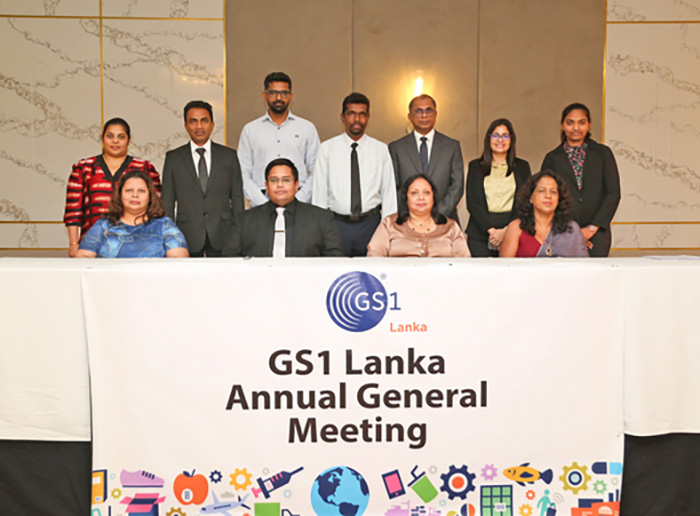
GS1 Lanka marked its 10th Annual General Meeting with a focus on the next stage of product identification in Sri Lanka, as businesses prepare for the wider adoption of 2D barcodes and the growing demand for trusted product information.
Addressing the AGM, GS1 Lanka president Revan Fernando noted that GS1 has been giving Sri Lankan products a globally recognised identity for more than 30 years. He pointed to the shift from traditional barcodes to 2D barcodes as the next major step, particularly as consumers increasingly look beyond a product’s identity to information they can trust about its origin, ingredients, authenticity and use.
GS1 Sunrise 2027 is a global industry initiative aiming to transition retail checkout systems to read 2D barcodes such as QR codes and Data Matrix codes alongside traditional 1D UPC stripes by the end of 2027
Under its Sunrise 2027 initiative, GS1 Lanka is working with the retail and healthcare sectors to prepare businesses for the transition to 2D barcodes. Unlike a conventional barcode used at checkout, a GS1 QR code can also connect consumers to a wider range of product information and support traceability and product verification through GS1 standards.
Fernando also called on brands to get involved in the transition, noting that the change will require businesses to rethink how they use the limited space on product packaging and how they communicate with consumers. GS1 Lanka will also introduce a new retail information platform to help member brands provide richer product information and improve the presentation of their products to consumers.
GS1 Lanka CEO Alikie Perera said the organisation’s work is increasingly focused on helping Sri Lankan businesses keep pace with changes in global supply chains and consumer expectations. The next phase will place greater emphasis on 2D barcodes, GS1 Digital Link, traceability and digital product information, as businesses prepare for a more connected and information-rich marketplace.
At the local level, GS1 Lanka continued its awareness programmes for entrepreneurs, SMEs, manufacturers and exporters, covering product identification, barcode standards, traceability, supply chain efficiency and market access. The organisation has also seen growing adoption of GS1 Activate and Verified by GS1, with more than 5,500 member companies registered on the platforms and over 20,000 product records uploaded.
The AGM concluded with a recognition of the contribution of GS1 Lanka’s members, partners, Board and team, while setting the direction for the organisation’s continued work to bring global standards and new product identification technologies into wider use among Sri Lankan businesses.
By Ifham Nizam
Sri Lanka’s plastic problem can no longer be treated simply as a waste-disposal issue, with the country facing mounting pressure on its coastal environment, fisheries, communities and public health, Vice Chancellor of The Open University of Sri Lanka Senior Professor P. M. C. Thilakerathne said.
The country must move beyond collecting and disposing of plastic waste and fundamentally rethink how plastics are designed, produced, consumed and recovered, Prof. Thilakerathne said, calling for a national shift towards a circular economy.
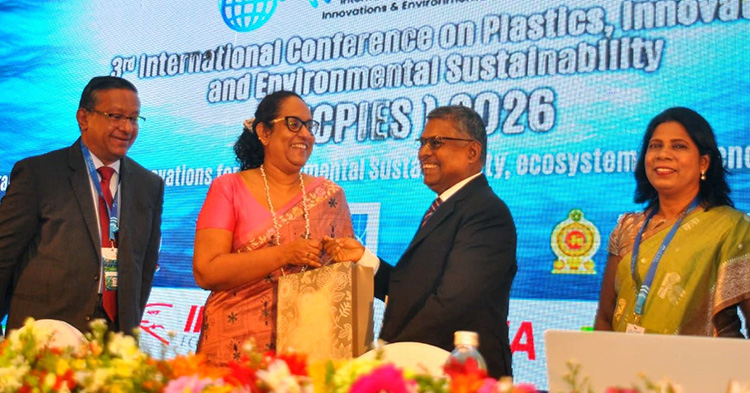
Addressing the 3rd International Conference on Plastics, Innovations and Environmental Sustainability, he said Sri Lanka’s experience, particularly the environmental fallout from the 2021 X-Press Pearl disaster, demonstrated why plastic pollution required urgent national attention.
The X-Press Pearl disaster resulted in large quantities of plastic pellets being released into Sri Lanka’s coastal waters, with impacts extending to marine biodiversity, fisheries and coastal livelihoods.
For an island nation whose economy and communities are closely connected to the sea, he said, plastic pollution could not be viewed as an environmental issue separate from national development.
” For Sri Lanka, these figures are not abstract,” Prof. Thilakerathne said, pointing to the global growth in plastic production and waste.
The world produces hundreds of millions of tonnes of plastics annually, while only a small proportion of plastic waste is recycled. A substantial amount ends up in landfills or is leaked, dumped or otherwise mismanaged.
The scale of the global problem has direct relevance to Sri Lanka, he said, because waste that is inadequately collected or managed can ultimately find its way into waterways and the ocean.
The Vice Chancellor said Sri Lanka therefore needed to strengthen not only waste collection and recycling but also the systems that determine what products enter the waste stream in the first place.
“Much of the waste problem is decided at the drawing board,” he said.
Products should be designed for reuse, recycling and disassembly, while businesses should be encouraged to adopt models based on refill, repair and reuse rather than continued dependence on single-use plastics.
He said Sri Lanka also had an opportunity to develop locally appropriate alternatives using renewable resources and agricultural residues.
The country’s coconut industry and other agricultural resources could support research into alternative materials, he said, but scientists must ensure that such substitutes were genuinely environmentally sustainable and did not simply shift the environmental burden elsewhere.
For Sri Lanka, the challenge is particularly important because plastic pollution intersects with several economic sectors.
Fishing communities depend directly on healthy marine ecosystems, while tourism depends heavily on the country’s beaches, coastal areas and natural environment.
Plastic pollution can therefore translate into economic and livelihood pressures in addition to its ecological consequences, Prof. Thilakerathne said.
He also warned that the problem extended beyond visible plastic waste.
Microplastics and nanoplastics have been detected in drinking water, food and air, while research into their potential effects on human health is continuing.
The longer-term public-health implications represented an important area for scientific research, he said.
Prof. Thilakerathne called for stronger cooperation between universities, government institutions, industry and local communities to develop solutions suited to Sri Lanka rather than relying solely on technologies or approaches developed elsewhere.
Universities, he said, had a responsibility to generate the evidence needed for national policy and to ensure that research reached the communities and industries expected to implement it.
This is where OUSL could make a particular contribution, given its nationwide network and large population of students, including working adults, teachers, professionals and learners from rural communities.
The university plans to strengthen environmental sustainability and circular-economy principles across its curriculum, expand professional education on waste management and sustainable materials, develop international research partnerships and improve sustainable practices within its own campuses and centres, he said.
Prof. Thilakerathne also called attention to the thousands of people who earn a living through informal waste collection and recycling.
Any national strategy, he said, must recognise the contribution of these workers and ensure that the transition towards a circular economy does not leave them economically vulnerable.
Sri Lanka has already introduced restrictions on a number of single-use plastic products, but the Vice Chancellor said regulations must be accompanied by enforcement, investment in recovery infrastructure, industry participation and changes in consumer behaviour.
At the international level, he said, Sri Lanka also needed to contribute actively to efforts to address plastic pollution, backed by credible national scientific research.
The global nature of the plastics trade and pollution meant that action by individual countries alone would not be sufficient.
The conference therefore provided an opportunity for Sri Lankan researchers to connect local environmental challenges with international research and technological developments, he said.
Addressing young researchers and students, Prof. Thilakerathne urged them to measure the value of their work not only by academic publications but also by its ability to produce practical change.
He encouraged researchers to work across disciplines, engage with policymakers and industry, and remain connected to communities affected by the problems they study.
“The most meaningful research is that which changes practice,” he said.
He said Sri Lanka’s plastic crisis ultimately required a change in the country’s approach to materials, consumption and waste.
“Our task is not to abandon the material that shaped the modern world but to make it compatible with the sustainable one,” Prof. Thilakerathne said.

Prepare for a theatrical experience that brings people together and celebrates life. The Peterite Arts Foundation, in proud association with World Vision Lanka, announces the showing of an amateur production arranged with Casarotto Ramsay & Associates Ltd. Every Brilliant Thing, the acclaimed solo play by Duncan Macmillan and Jonny Donahoe. Directed by Theruni Indrapala, the play’s lead is played by former Peterite Mario de Soyza. This uplifting, interactive production will run at Kamatha Studio, BMICH, Colombo, from 05 to 08 November 2026.
Every Brilliant Thing tells a deeply moving yet joyful story. At seven, the narrator begins listing everything worth living for, from ‘ice cream’ and ‘things with stripes’ to ‘rollercoasters’, hoping to help his mother through depression. Over time, the list grows to more than a million entries and becomes a lifelong source of comfort for the narrator.
What began as a short monologue in 2006 has grown into a global phenomenon, performed in more than 80 countries across five continents. Its hopeful message has reached audiences in extraordinary settings, including aboard the USS George H.W. Bush aircraft carrier. The play has also been translated into 44 languages, including Arabic and Greek, with a special Chinese adaptation titled Every Brilliant Little Thing.
The play’s need for emotional intelligence, openness and a strong connection with the audience attracted a distinguished line-up of performers. Following a successful West End run featuring Sue Perkins and Minnie Driver, the play made its Broadway debut at the Hudson Theatre, where it ran from 21 February to 9 August 2026. Tony Award winner Daniel Radcliffe opened the Broadway production, receiving critical acclaim and a Tony nomination for Best Lead Actor in a Play. Law & Order: SVU icon Mariska Hargitay then made her official Broadway debut in the role, followed by Golden Globe winner Tracee Ellis Ross, who closed the run.

Showers or thundershowers will occur at several places in the most part of the island after 1.00 p.m

GS1 Lanka drives Sri Lanka’s shift to 2D barcodes

Geneva takes up Sallay’s case and govt. ignores opportunity to answer accusations

Section of wartime KKS High Security Zone vacated to facilitate economic development in the area

Lawyer lodges complaint against Govt. Printer, Media Ministry Secy.

Sri Lankan troops in joint anti-terrorist exercise in Russia

‘Dates have the highest sugar content to fight Coronavirus’

Sunday Island 27 December – Headlines

#SundayIsland 17th December – Headlines

Sunday Island – 28th March

Sunday Island Headlines – 21 March

Sunday Island – 21st February – Headlines
-

 Latest News5 days ago
Gold winner Tharanga gets brand-new Honda Vezel from SLAAJ
-

 Features5 days ago
Why Sri Lanka needs an Inclusive Civic Nationalism – urgently
-

 News4 days ago
US-assisted ‘Ice’ detection: NPC to examine IGP’s move to transfer drug-busting team
-

 Features6 days ago
Thailand’s biggest new global star …
-
 News6 days ago
First cases taken up by SC after enactment of 22A dismissed
-

 News5 days ago
Civil society activist accuses govt. of favouring Ven. Gnanasara
-

 Editorial3 days ago
Colombo Port drug bust: The plot thickens
-

 Editorial6 days ago
Aftershocks of 22A