
Opinion
A singular modern Lankan mentor – Part III

by Laleen Jayamanne and Namika Raby
Gananath Obeysekere: In search of Buddhist conscience
(Baudha Hurdasakshiya Soya)
(Part II of this article appeared in The Island on Monday – 03)
Tissa Ranasinghe’s and Gananath’s Kannagi
Gananath’s Pattini book has a mysterious blue-black cover with an icon of Kannagi in Bronze sculpted by Lanka’s foremost Modernist sculptor Tissa Ranasinghe, commissioned by Gananath. What Appadurai termed Lanka’s links with ‘Indic culture’ is encapsulated in this image of the heroic figure Kannagi from the Tamil epic, striking a gesture of mourning for her husband Kovalan, unjustly killed by the king of Madurai. She kneels with her arms held raised around her head in the familiar triangular formation suggestive of the aniconic representation of the Yoni (an emblematic civilisational gesture of great iconic strength and power, in the Bronze lineage of India, which stretches back to the little bronze figurine of The Dancing Girl of Monhenjodaro itself), even as she laments the injustice. And those of us who know the legend also see that her left breast is missing. Kannagi, it is told, tore her breast and hurled it at the city of Madurai, setting it on fire with her righteous anger! Together, Gananath and Tissa have presented Kannagi in a most generative posture and gesture for the cover of the book on the Sinhala Pattini cult, the only Mother goddess of the Sinhala folk, borrowed from the Tamil Epic, to assuage and heal Sinhala male sexual anxieties and group trauma. This marvelous collaboration between Lanka’s celebrated Modernist Sculptor and Anthropologist was a multivalent, therapeutic intervention into Lanka’s cyclical interethnic violence. The book was published in 1984, one year after the state sponsored pogram against Tamils in July ‘83. Tissa’s modernist Kannagi demonstrates how an archaic ‘Maternal Archetype’ can be creatively mobilised by an artist, to express contemporary predicaments without diluting her orginal power and affective vitality magnified by the use of bronze, a resonant civilisational material.
Pattini is the Sinhala Buddhist incarnation of the Tamil heroic Kannagi and as far as I can tell she appears not to have the iconographic attributes of heroic rage and righteous anger which Kannagi embodies in the Tamil Epic. Kannagi is the step mother of Manimekalai who became a Buddhist nun, according to legend. Is it the case that Pattini is without progeny and so, as a Mother Goddess, rather like the West Asian mother Goddesses who were also virgins? As a girl, my mother and I were devoted to rituals of Mother Mary (mother of Jesus), also known as the Virgin-Mary from, let’s not forget, West Asia (in historic Palestine).
Professor Sunil Ariyaratne’s 2016 film Pattini, warrants a passing comment or two in this context as an example of the institutional consolidation of Neo-Liberal capitalist extraction and commodification of the residual vitality and power of the perennial syncretic Folk traditions of Lanka. It is a neo-traditionalist extravaganza in the genre of nostalgic revival of ‘the Sinhala-Buddhist Folk Heritage of Lanka’ which flourished recently with much fanfare and state patronage as a ‘Rajapaksha genre’. The film deals with the Kannagi legend just so as to reduce it to reinforcing the Sinhala-Buddhist ideology of purity and virginity for women through the exemplary tale of ‘the pure wife’ Kannagi and her step-daughter Manimekala, who becomes a Tamil Buddhist. Her dearest wish is to be reborn as a male so that she can indeed aspire to become a Buddha. The emphasis is on the preservation of virginity (Pathiwatha), and the enthroning of male sexuality as the route to attaining Buddhahood. The mythic epic figure of Kannagi who in her rage enacts heroic justice in the Tamil epic is converted into a parabolic emblem of virginal purity.
A Humanist Education
Gananath’s education is a strand very comprehensively covered in the film, a source of his immense openness to the world of ideas and refusal to accept them on authority without critical evaluation. The film opens at Gananath’s home in Kandy which he shares with Professor Ranjini Obeysekere who appears with her vibrant intellect and grace and ends there too. The couple are shown warmly welcoming the film crew to their house as they have done over their long engagement with numerous students, as they did with me both in Kandy and the US when I was tangled up and blue. It is worth remembering here that Ranjini is the Editor in Chief of the magnificent multi-volume translation project of the Jataka Tales into English, published just last year. It is only now that I can see how deeply Ranjini and Gananath’s scholarship is in conversation with each other.
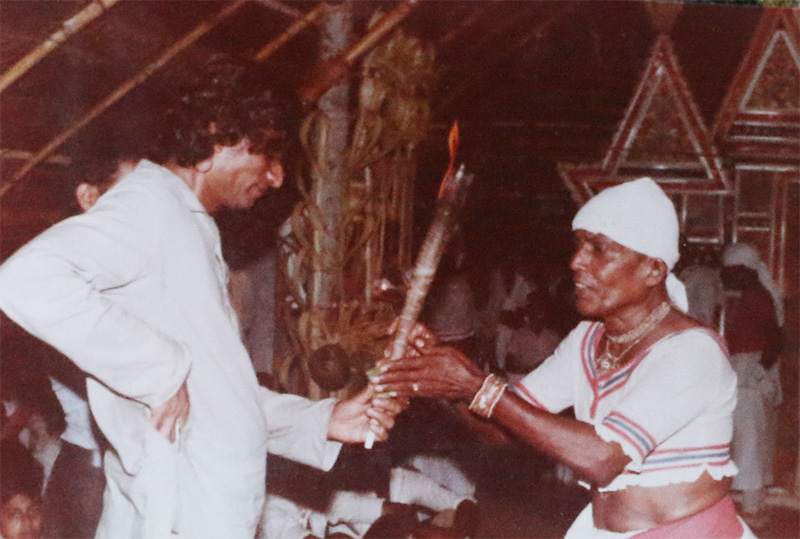
The account of Ranjini and Gananath’s meeting at Peradeniya University while studying English Literature with Professor E.F.C. Ludowyk is one of the highlights of the film for me. Ranjini acted in the plays directed by Ludowyck and they studied English Literature at honours level together. Interestingly, though Gananath followed the Dram Soc activities on campus, he didn’t participate in any of them, his interest being elsewhere. He says, whenever he could he got onto a bus or train and travelled to distant villages to talk to villagers and monks and tape their songs (kavi). Gananath says that Ludowyck was the best teacher he has ever met and that he was responsible for directing him at every key juncture of his undergraduate life and soon after when making the unusual choice of going to a US graduate school, refusing a scholarship to Cambridge because of colonial history. Gananath’s brilliant textual analysis and exegesis of texts in Sinhala of myths and legends, especially the complex corpus of the Gajabahu legend, owes a great deal to the textual training he received from Ludowyck in ‘Practical Criticism’. We are all beneficiaries of this tradition of Literary Criticism which was part of the training we received in English Lit in old Ceylon and now continued by scholars such as Professor of English, Sumathy Sivamohan and others. Ranjini tells us that it was Ludowyck who collected Rs 10,000 from ten of his friends and handed it to Gananath to go travel the country and do what he wished soon after he graduated with English Honours. All he was asked to do was to write and thank his benefactors. So, it’s this tradition of mentorship and duty of care that Gananath and Ranjini have practiced with their own students during their long working life at American Universities.
A Counter Archive of a People’s Literature, Painting and Ritual
Though I was familiar with some of Gananath’s writing and studied a couple for the film I made, there is a major topic of his research which I didn’t know anything about and as such this film has provided an important learning experience for me. In drawing from the local non-canonical texts preserved in Temples, libraries and archives, which are written, in Sinhala by the folk and as such are anonymous, not by scholar monks in Pali, the language of high learning, Gananath has been able to piece together stories, legends of migrations from India, Kerala and Tamil Nadu and the ways in which some of these waves of migrants have been incorporated into the folk Buddhist body politic and culture. The gist of which is the seemingly heretical idea (an affront to Sinhala exceptionalism and their sense of manifest destiny as ‘pure Ariya’ Sinhala-Buddhists claiming to be the only real Lankans), that at one time, all people who call themselves Sinhala in Lanka did come from India and were indigenised through various practices and this happened in waves of migration over long periods of time. This section draws from the folk archive of poetry, ritual and Temple murals and legends such as the complex Gajabahu Myth, that bear witness to these processes of migration and acculturation, to make the case for the existence of robust muti-ethnic, diverse communities dotting the island. The legendary folk tales and rituals were, he says, imaginative, fictionalised, poetic expressions of folk memory of these migratory events, not ‘false’ accounts.
Here I want to cite a longish relevant passage from Professor Patrick Olivelle’s highly acclaimed book, Ashoka: Portrait of a Philosopher King. Ramchandra Guha, the editor of the series called ‘Indian Lives‘ of which this is the first, says of the Lankan Olivelle that, ‘he is one of the greatest living scholars of Ancient India’. Here’s Olivelle’s argument, on the familiar opposition between History and Legend, which supports Gananath’s theoretical move with practical consequences for how we understand ourselves as Lankans.
“In a seminal remark, the historian Robert Lingat notes: ‘There are two Ashokas—the historical Ashoka whom we know through his inscriptions, and the legendary Ashoka, who is known to us through texts of diverse origin, Pali, Sanskrit, Chinese and Tibetan. Although essentially correct, there are two problems with Lingat’s assessment.
First it is simplistic to contrast the ‘historical with the legendary’. The portrait of Ashoka I have constructed in this book is based on Ashokan inscriptions and artefacts, yet it contains a heavy dose of interpretation, translation, imagination, narrative, perhaps bias… The ‘legendery’ is not simply false and to be dismissed; it is the reimagination of the past to serve present needs, something inherently human. These narratives were meaningful and important to the persons and communities that constructed them. Their purpose was not to do history in the modern sense of the term, but to do something much more significant to them in their own time.
….There are actually not two but several Ashokas, including modern ones”.
Following this argument, we Lankans who try to practice ‘Loving-Kindness’ must be thankful that Gananath has highlighted for us at least two Dutthagaminies, in his timely essay, Dutthagamini and the Buddhist Conscience, written in the wake of the carnage of the ‘July ‘83’ state sponsored pogrom against the Tamil people of Lanka. There is the familiar Dutthagamini, taught to us in school, as a Sinhala-Buddhist, Tamil-hating ethno-nationalist, constructed from the Mahavamsa narrative taken as incontrovertible historical fact. On the other hand, Gananath presents evidence, from the Dambulla temple paintings, for a humanist Dutthagamini, who like Ashoka himself, was contrite about the mass slaughter he conducted and his killing of Elara the Tamil king.
The film shows us how Gananath makes a radical scholarly move in the late stages of his life by researching the indigenous folk of Lanka, the Veddhas. He argues against the deep-seated idea, promulgated by the ethno-nationalist Sinhala-Buddhist ideologues, that there is an ancient historical enmity between the Sinhala and Tamil folk of Lanka going back to the days of the kings, prior to colonialism. Gananath analyses the myth of origin of the Sinhala folk as represented in temple murals that show Vijaya’s arrival in Lanka from India and his marriage with the indigenous woman Kuveni. The Veddhas are the descendants, he says, of Kuveni and her children by Vijaya and are the ‘other’ or outsider, so to speak, to the Sinhala.
Through his ethnographic work on the powerful Vadi procession (perahera) in Mahiyanganaya, Gananath is able to show the ritual means through which they are incorporated into the Sinhala community. The ethnographic film, demonstrating this robust festive ritual event of staging cultural difference and incorporation, supports Gananath’s argument that the Veddas have been the true ‘outsiders’ of the Buddhist polity (in dress, culinary habits, religion), and despite that, the Buddhist culture had ritual mechanisms of incorporation of the outsider, without resorting to slaughter, while also acknowledging and respecting the awesome power of the Veddas. This section should be shown to school kids, I think, because of its liveliness and pedagogic value. Gananath acknowledges the fine scholarship of Paul E. Peiris on the Veddas and shows the colonial hostility and violence towards these indigenous folk of Lanka. Gananath’s ‘Cook Book’, also relevant to Australia’s colonial history, would have provided a global perspective on colonisation of indigenous peoples and the violent means used in casting them as ‘uncivilised primitives’, which in turn would have prepared him well to write the book on, the Veddas, Creation of the Hunter, in 2022.
What to Do, Napuru Kaleta? (In Wicked Times)
It seems to me that young scholars and artists might be able to generate a new thought or two by reading Gananath’s essays and books in relation to Ananda Coomaraswamy’s Mediaeval Sinhalaese Art (Campden: Gloucestershire, 1908) and Olivelle’s book on Ashoka. In this way, the monodisciplinary compartmentalisation of knowledge, ideas, can be disturbed so as to gain aesthetic nourishment to create, with what’s left, after the ravages of Neoliberal cultural nationalism’s cognitive extraction of our brains. All three distinguished, visionary Lankan scholars were writing about times when material culture and the ‘Intangible Heritage’ (A UNESCO Platform for their preservation) of Lanka and India were/are being destroyed from within, extinguished.
Some ‘transversal’ or lateral ways of understanding and connecting material practices/stuff and immaterial ideas are called for now, I believe, and these three Lankan scholars have shown us many ways in which this can be done. Let me clinch my argument by citing the full title of Coomaraswamy’s indispensable book which took 60 years to be translated into Sinhala. Professor Sarath Chandrajeewa (who also taught ‘mati-weda’) gave me this information for which I am most thankful. I read it in English as an undergraduate, quite by chance. Here’s the extended title:
“Being a Monograph on Mediaeval Sinhalese Arts and Crafts, Mainly as Surviving in the 18th Century with an Account of the Structure of Society and the Status of the Craftsman.”
Gananath might well have known through Ludowyk that the first edition of this book was hand printed in England by Coomaraswamy himself over a period of 15 months on the same printing press (which he purchased), as the one in which the first edition of the complete works of the Mediaeval English poet Chaucer was printed by William Morris, one of leaders of the ‘Arts and Craft Movement’. There is a wonderful story I heard from a native informant of California, of Gananath’s freshman lecture at the University of California in San Diego, on Pilgrimages. On hearing Gananath recite an entire section from Chaucer’s Canterbury Tales ‘by heart,’ the students gave him a standing ovation!
Felix Guattari’s Three Ecologies, (namely Social Ecology, Mental Ecology, Environmental Ecology), is another a book worth reading (now freely downloadable), alongside the others as he was a radical psychotherapist trained in psychoanalysis by Lacan, and a Left Activist in France who also collaborated with the philosopher Gilles Deleuze on Anti–Oedipus: Capitalism and Schizophrenia (1968), which was a best seller. He also worked at a humane, innovative mental health institution which was part of the radical anti-psychiatry movement of the 60s and was a wild thinker who reminds me of Gananath and also had the requisite discipline, like him, to write books that crossed generations. He died all too soon, but Gananath will turn 95 on the second of February 2025.
Finally, my gratitude to the producers of this film, the Kathika Collective whose independent spirit, deep research, dedication, and not least, the love of cinema has led to the production of this film over a long period of time, which included the hiatus of the COVID pandemic. While Dimuthu is credited as researcher, script writer and director and Chathura Madhusanka with editing and camera, a great many well wishes (acknowledged in the credits), contributed freely to this film which has not received any external funding. The spirit of education that drove this film is a truly beautiful tribute to Gananath and Ranjini Obeysekere, our indispensable mentors, both.
Yahonis Pattini Kapumahattya’s haunting voice emanating from a deep folk history (which Gananath much admired and we are privileged to hear), accompanies the long credit list.
The film is dedicated:
“To all rural folk who in their diverse ways enriched the peasant Buddhist tradition and found Buddha in that”. (Concluded)


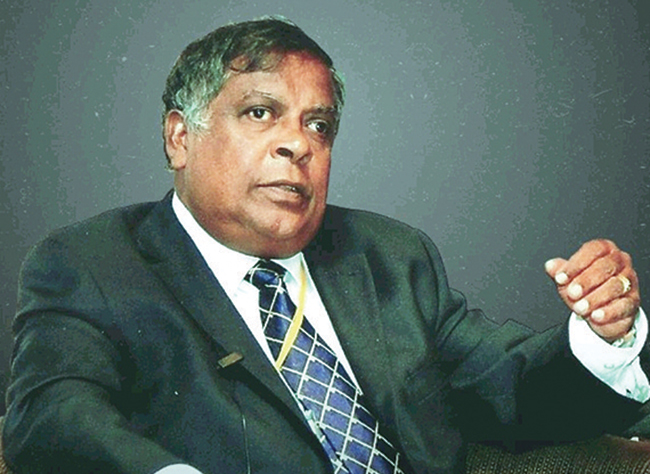
Mr. Tuli Cooray, former Deputy Director General of the Board of Investment of Sri Lanka (BOI) and former Secretary General of the Joint Apparel Association Forum (JAAF), passed away three months ago, leaving a distinguished legacy of public service and dedication to national economic development.
An alumnus of the University of Colombo, Mr. Cooray graduated with a Special Degree in Economics. He began his career as a Planning Officer at the Ministry of Plan Implementation and later served as an Assistant Director in the Ministry of Finance (Planning Division).
He subsequently joined the Greater Colombo Economic Commission (GCEC), where he rose from Manager to Senior Manager and later Director. During this period, he also served at the Treasury as an Assistant Director. With the transformation of the GCEC into the BOI, he was appointed Executive Director of the Investment Department and later elevated to the position of Deputy Director General.
In recognition of his vast experience and expertise, he was appointed Director General of the Budget Implementation and Policy Coordination Division at the Ministry of Finance and Planning. Following his retirement from government service, he continued to contribute to the national economy through his work with JAAF.
Mr. Cooray was widely respected as a seasoned professional with exceptional expertise in attracting foreign direct investment (FDI) and facilitating investor relations. His commitment, leadership, and humane qualities earned him the admiration and affection of colleagues across institutions.
He was also one of the pioneers of the BOI Past Officers’ Association, and his passing is deeply felt by its members. His demise has created a void that is difficult to fill, particularly within the BOI, where his contributions remain invaluable.
Mr. Cooray will be remembered not only for his professional excellence but also for his integrity, humility, and the lasting impact he made on those who had the privilege of working with him.
The BOI Past Officers’ Association
jagathcds@gmail.com
“As a small and open country, Singapore will always be vulnerable to what happens around us. As Lee Kuan Yew used to say: “when elephants fight, the grass suffers, but when elephants make love, the grass also suffers“. Therefore, we must be aware of what is happening around us, and prepare ourselves for changes and surprises.” – Prime Minister Lee Hsien Loong, during the debate on the President’s Address in Singapore Parliament on 16 May, 2018, commenting on the uncertain external environment during the first Trump Administration.
“When elephants fight, it is the grass that suffers”
is a well-known African proverb commonly used in geopolitics to describe smaller nations caught in the crossfire of conflicts between major powers. At the 1981 Commonwealth conference, when Tanzanian President Julius Nyerere quoted this Swahili proverb, the Prime Minister Lee Kuan Yew famously retorted, “When elephants make love, the grass suffers, too”. In other words, not only when big powers (such as the US, Russia, EU, China or India) clash, the surrounding “grass” (smaller nations) get “trampled” or suffer collateral damage but even when big powers collaborate or enter into friendly agreements, small nations can still be disadvantaged through unintended consequences of those deals. Since then, Singaporean leaders have often quoted this proverb to highlight the broader reality for smaller states, during great power rivalry and from their alliances. They did this to underline the need to prepare Singapore for challenges stemming from the uncertain external environment and to maintain high resilience against global crises.
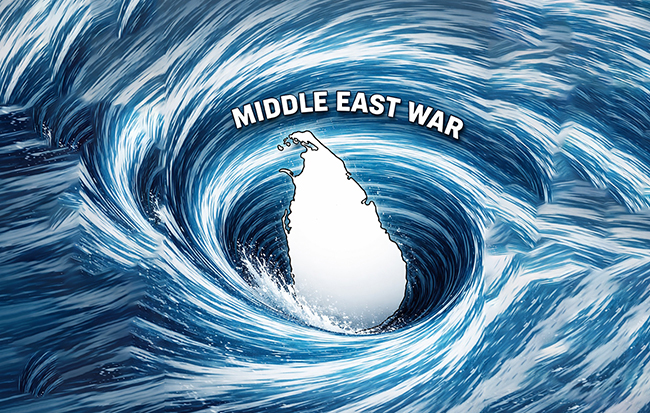
Like Singapore, as a small and open country, Sri Lanka too is always vulnerable to what happens around us. Hence, we must be alert to what is happening around us, and be ready not only to face challenges but to explore opportunities.
When Elephants Fight
To begin with, President Trump’s “Operation Epic Fury”.
Did we prepare adequately for changes and surprises that could arise from the deteriorating situation in the Gulf region? For example, the impact the conflict has on the safety and welfare of Sri Lankans living in West Asia or on our petroleum and LNG imports. The situation in the Gulf remains fluid with potential for further escalation, with the possibility of a long-term conflict.
The region, which is the GCC, Iraq, Iran, Israel, Jordan, Syria and Azerbaijan (I believe exports to Azerbaijan are through Iran), accounts for slightly over $1 billion of our exports. The region is one of the most important markets for tea (US$546 million out of US$1,408 million in 2024. According to some estimates, this could even be higher). As we export mostly low-grown teas to these countries, the impact of the conflict on low-grown tea producers, who are mainly smallholders, would be extremely strong. Then there are other sectors like fruits and vegetables where the impact would be immediate, unless of course exporters manage to divert these perishable products to other markets. If the conflict continues for a few more weeks or months, managing these challenges will be a difficult task for the nation, not simply for the government. It is also necessary to remember the Russia – Ukraine war, now on to its fifth year, and its impact on Sri Lanka’s economy.
Mother of all bad timing
What is more unfortunate is that the Gulf conflict is occurring on top of an already intensifying global trade war. One observer called it the “mother of all bad timing”. The combination is deadly.
Early last year, when President Trump announced his intention to weaponise tariffs and use them as bargaining tools for his geopolitical goals, most observers anticipated that he would mainly use tariffs to limit imports from the countries with which the United States had large trade deficits: China, Mexico, Vietnam, the European Union, Japan and Canada. The main elephants, who export to the United States. But when reciprocal tariffs were declared on 2nd April, some of the highest reciprocal tariffs were on Saint Pierre and Miquelon (50%), a French territory off Canada with a population of 6000 people, and Lesotho (50%), one of the poorest countries in Southern Africa. Sri Lanka was hit with a 44% reciprocal tariff. In dollar terms, Sri Lanka’s goods trade deficit with the United States was very small (US$ 2.9 billion in 2025) when compared to those of China (US$ 295 billion in 2024) or Vietnam (US$ 123 billion in 2024).
Though the adverse impact of US additional ad valorem duty has substantially reduced due to the recent US Supreme Court decision on reciprocal tariffs, the turbulence in the US market would continue for the foreseeable future. The United States of America is the largest market for Sri Lanka and accounts for nearly 25% of our exports. Yet, Sri Lanka’s exports to the United States had remained almost stagnant (around the US $ 3 billion range) during the last ten years, due to the dilution of the competitive advantage of some of our main export products in that market. The continued instability in our largest market, where Sri Lanka is not very competitive, doesn’t bode well for Sri Lanka’s economy.
When Elephants Make Love
In rapidly shifting geopolitical environments, countries use proactive anticipatory diplomacy to minimise the adverse implications from possible disruptions and conflicts. Recently concluded Free Trade Agreement (FTA) negotiations between India and the EU (January 2026) and India and the UK (May 2025) are very good examples for such proactive diplomacy. These negotiations were formally launched in June 2007 and were on the back burner for many years. These were expedited as strategic responses to growing U.S. protectionism. Implementation of these agreements would commence during this year.
When negotiations for a free trade agreement between India and the European Union (which included the United Kingdom) were formally launched, anticipating far-reaching consequences of such an agreement on other developing countries, the Commonwealth Secretariat requested the University of Sussex to undertake a study on a possible implication of such an agreement on other low-income developing countries. The authors of that study had considered the impact of an EU–India Free Trade Agreement on the trade of excluded countries and had underlined, “The SAARC countries are, by a long way, the most vulnerable to negative impacts from the FTA. Their exports are more similar to India’s…. Bangladesh is most exposed in the EU market, followed by Pakistan and Sri Lanka.”
So, now these agreements are finalised; what will be the implications of these FTAs between India and the UK and the EU on Sri Lanka? According to available information, the FTA will be a game-changer for the Indian apparel exporters, as it would provide a nearly ten per cent tariff advantage to them. That would level the playing field for India, vis-à-vis their regional competitors. As a result, apparel exports from India to the UK and the EU are projected to increase significantly by 2030. As the sizes of the EU’s and the UK’s apparel markets are not going to expand proportionately, these growths need to come from the market shares of other main exporters like Sri Lanka.
So, “also, when elephants make love, the grass suffers.”
Impact on Sri Lanka
As a small, export dependent country with limited product and market diversification, Sri Lanka will always be vulnerable to what happens in our main markets. Therefore, we must be aware of what is happening in those markets, and prepare ourselves to face the challenges proactively. Today, amid intense geopolitical conflicts, tensions and tariff shifts, countries adopt high agility and strategic planning. If we look at what our neighbours have been doing in London, Brussels and Tokyo, we can learn some lessons on how to navigate through these turbulences.
(The writer is a retired public servant and can be reached at senadhiragomi@gmail.com)
by Gomi Senadhira

The introduction of the QR code–based fuel quota system can be seen as a timely and necessary measure, implemented as part of broader austerity efforts to manage limited fuel resources. In the face of ongoing global fuel instability and economic challenges, such a system is aimed at ensuring equitable distribution and preventing excessive consumption. While it is undeniable that this policy may disrupt the daily routines of certain segments of the population, it is important for citizens to recognize the larger national interest at stake and cooperate with these temporary measures until stability returns to the global fuel market.
At the same time, this initiative presents an important opportunity for the Government to address long-standing gaps in regulatory enforcement. In particular, the implementation of the QR code system could have been strategically linked to the issuance of valid revenue licenses for vehicles. Restricting QR code access only to vehicles that are properly registered and have paid their revenue dues would have helped strengthen compliance and improve state revenue collection.
Available data from the relevant authorities indicate that a significant number of vehicles—especially three-wheelers and motorcycles—continue to operate without valid revenue licences. This represents a substantial loss of income to the State and highlights a weakness in enforcement mechanisms. By integrating the fuel quota system with revenue license verification, the government could have effectively encouraged vehicle owners to regularise their documentation while simultaneously improving fiscal discipline.
In summary, while the QR code fuel system is a commendable step toward managing scarce resources, aligning it with existing regulatory requirements would have amplified its benefits. Such an approach would not only support fuel conservation but also enhance government revenue and promote greater accountability among vehicle owners.
Sariputhra
Colombo 05

Electricity tariffs to be increased from 1st April

A QR code system to be introduced for agricultural lands and other sectors requiring fuel

Rickelton, Rohit, Shardul break Mumbai’s first-game jinx

Oil tops $116 a barrel as Iran accuses US of preparing invasion

Iranian attack damages Kuwait power and desalination plant, kills worker

Warm weather conditions prevailing over the island are expected to continue

‘Dates have the highest sugar content to fight Coronavirus’

Sunday Island 27 December – Headlines

#SundayIsland 17th December – Headlines

Sunday Island – 28th March

Sunday Island Headlines – 21 March

Sunday Island – 21st February – Headlines
-

 News6 days ago
Senior citizens above 70 years to receive March allowances on Thursday (26)
-

 Features3 days ago
A World Order in Crisis: War, Power, and Resistance
-

 News4 days ago
Energy Minister indicted on corruption charges ahead of no-faith motion against him
-

 News5 days ago
US dodges question on AKD’s claim SL denied permission for military aircraft to land
-

 Business5 days ago
Dialog Unveils Dialog Play Mini with Netflix and Apple TV
-

 News6 days ago
CEB Engineers warn public to be prepared for power cuts after New Year
-

 Sports4 days ago
SLC to hold EGM in April
-
 Business7 days ago
Postponement of Sri Lanka Investment Forum 2026