
News
A new agenda for ONUR once led by CBK


Suganthie Kadirgamar accommodated in newly-constituted outfit; Mujibur slams govt.
By Shamindra Ferdinando
The SLPP government has reconstituted the Office for National Unity and Reconciliation (ONUR) in the run-up to the 46th session of the Geneva-based United Nations Human Rights Council (UNHRC).
The ONUR, established in line with the prrevious Yahapalana goverment post-war reconciliation strategy, was headed by former President Chandrika Bandaranaike Kumaratunga.
The former President quit ONUR immediately after Gotabaya Rajapaksa’s victory at the Nov 2019 presidential poll.
The Justice Ministry over the weekend announced the appointment of President’s Counsel Kushan de Alwis as the new Chairperson. Former District Secretary Sunil Kannagara received appointment as ONUR’s Director General.
The ONUR formed in terms of an agreement between the then President Maithripala Sirisena and Prime Minister Ranil Wickremesinghe played a significant role in the post-war reconciliation process in the wake of their decision to co-sponsor an accountability resolution against the country in Geneva on Oct 1, 2015.
Justice Minister Ali Sabry, PC, last Friday (5), addressed the newly appointed ONUR members at the Justice Ministry; he explained the pivotal importance of post-war reconciliation process in achieving development. The minister said that achieving growth wouldn’t be possible without reconciliation.
President Gotabaya Rajapaksa included senior lawyer Suganthie Kadirgamar, the wife of assassinated Foreign Minister Lakshman Kadirgamar in ONUR. The LTTE assassinated Kadirgamar in August 2005 as he was engaged in deliberations with local and foreign parties in a bid to bring the warring parties back to the negotiating table.
The other members of the outfit are A.L. Susarith Mendis, Prof. Rizvie Hassen, Prof. M.M.A.D.S.A. Niriella, Samantha Ratwatte PC, attorney-at-law Janaka Ranatunga, Mano Sekaram, attorney-at-law Geethanjali Sumithraarachchi Dissanayake, Apsal Marrikkar and Senthil Thondaman.
Attorney-at-law Thushari Sooriyaarachchi has been named the Additional DG, ONUR. ONUR is expected to meet at its new office at Rajagiriya this week.
Political sources said that the ONUR would have to adopt an agenda suitable to the SLPP government’s policy especially against the backdrop of Sri Lanka quitting an accountability resolution 30/1 co-sponsored by the yahapalana government in 2015. The original ONUR was actually meant to ensure the successful implementation of the Geneva resolution. It played a significant role in the process leading to consensus among the Western powers, the then government and the Tamil National Alliance (TNA) as regards a hybrid war crimes investigating mechanism. In fact, the proposal for hybrid mechanism was received by Mrs. Kumaratunga, in her capacity as Chairperson, ONUR, on behalf of Sirisena-Wickremesinghe government.
Asked what would be the newly constituted ONUR’s agenda against the backdrop of the government quitting the Geneva process, Justice Minister Sabry said: “Nothing to do with the Geneva process. The new ONUR is meant to promote unity, social cohesion and understanding among communities at the grass-root level. The government is committed for sustainable and long lasting and dignified coexistence among the people.”
Minister Sabry emphasized that the ONUR would carry out the mission not to impress the world but to achieve genuine reconciliation. The minister emphasized urgent need to address the reconciliation issues.
Samagi Jana Balavegaya lawmaker Mujibur Rahman told The Island that the government had caused irreparable damage to overall reconciliation process. Colombo District MP Rahman questioned the rationale in constituting ONUR after having quit the Geneva process. The former UNP MP alleged that the SLPP administration had turned the reconciliation process upside down.
Enactment of the 20th Amendment at the expense of the 19th introduced in 2015 ruined everything, MP Rahman said, urging the government not to cause further trouble. The MP pointed out in addition to wartime accountability issues, the new Rajapaksa administration’s handling of the controversy over cremation of all Covid-19 victims regardless of religious concerns proved it didn’t care about minorities.
Lawmaker Rahman pointed out the Tamils and Muslims launching a protest march from Pottuvil to Jaffna demanding justice for war victims and to highlight other burning issues such as the cremation of Muslims. The MP pointed out that some sections of the international community had taken up the issue at hand with the government.
PIC SAVED AS KUSHAN AND Suganthie Kadirgamar

Latest News
Sun directly overhead Kalpitiya, Talawa, Sinharagama, Galkadawala, Nachchaduwa, Padikaramaduwa, Gomarankalla and Verugal about 12.10 noon today (01)


The sun is going to be directly over the latitudes of Sri Lanka from 28th of August to 07th of September due to its apparent southward relative motion.
The nearest places of Sri Lanka over which the sun is overhead today (01) are Kalpitiya, Talawa, Sinharagama, Galkadawala,
Nachchaduwa, Padikaramaduwa, Gomarankalla and Verugal about 12.10 noon.
… stresses need for action if claims were proved false
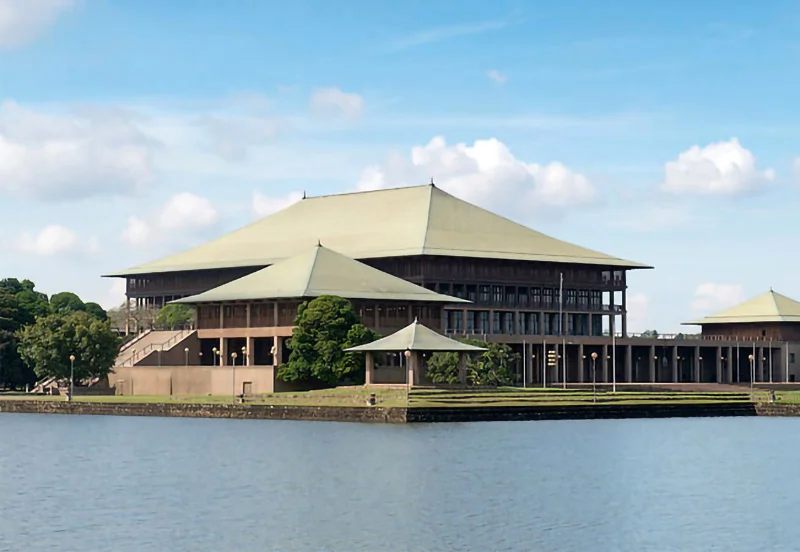
Samagi Jana Balawegaya (SJB) MP Dayasiri Jayasekera has sought a clarification from Speaker Dr. Jagath Wickremaratne regarding several allegations against Chief Justice Preethi Padman Surasena, in Parliament, recently.
In a letter dated 31 August, Jayasekera has asked the Speaker whether he received any documentary evidence from MPs in support of the allegations at issue. The SJB MP has also inquired about the steps taken by the Speaker regarding the allegations and whether the issue had been taken up with the relevant agencies authorised to probe the assets of the CJ and members of his family.
MP Jayasekera confirmed that he had raised the issue with the Speaker, following the accusations relating to the high profile X-Press Pearl case, which received significant public attention in the recent past.
The Kurunegala District MP has also asked the Speaker whether the latter contemplated taking action in case the allegations were proved false to ensure that the dignity of the Chief Justice and the judiciary was safeguarded.
Among the issues raised by MP Jayasekera are the acquisition of valuable property in Colombo by the CJ’s son, the circumstances in which he was able to procure the property, as well as accusations regarding the CJ’s birth certificate, marriage certificate and birth certificates of his children.
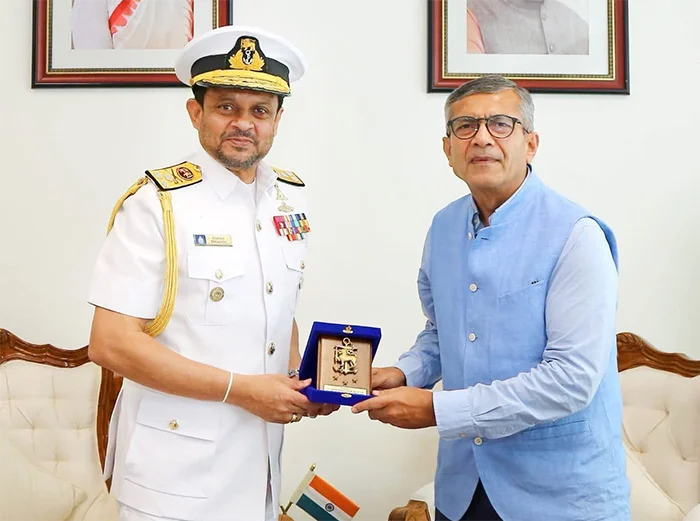
Navy Chief Vice Admiral Damian Fernando held a series of strategic-level discussions with senior Indian defence and military officials during a three-day official visit to New Delhi. He returned on Sunday (30).
Navy Headquarters said that the two sides discussed ways to further strengthen maritime security cooperation between the two Navies in support of security in the Indian Ocean region. They also exchanged views on expanding training opportunities and capacity-building programmes, as well as other areas of bilateral importance.
During his visit to New Delhi, Vice Admiral Fernando also held official discussions with India’s Chief of Defence Staff, General N.S. Raja Subramani, Defence Secretary Rajesh Kumar Singh and Vice Chief of the Air Staff, Air Marshal Ashutosh Dixit and defence industry representatives. Discussions at these meetings focused on bilateral defence cooperation, joint training programmes, and opportunities to enhance air and maritime cooperation in the Indian Ocean Region.
As part of efforts to further expand cooperation in naval training and professional development, Vice Admiral Fernando also met Vice Admiral Sameer Saxena, Flag Officer Commanding-in-Chief of India’s Southern Naval Command, at its headquarters in Kochi, Kerala. The two sides discussed existing naval training exchange programmes and opportunities for introducing and expanding further training initiatives. The meeting followed the Commander of the Sri Lanka Navy’s visit to INS Dronacharya, the Indian Navy’s training establishment where he previously completed the Long Gunnery and Missile Course.

Nahida, Marufa help Bangladesh brush aside Indonesia

Showers will occur in the Western, Sabaragamuwa, Southern and Uva provinces and in Kandy and Nuwara-Eliya districts

Sun directly overhead Kalpitiya, Talawa, Sinharagama, Galkadawala, Nachchaduwa, Padikaramaduwa, Gomarankalla and Verugal about 12.10 noon today (01)

SJB asks what Speaker intended to do about allegations against CJ

Navy Chief attends strategic-level discussions in Delhi

ICRS: Sustained and collective efforts critical to address issue of missing persons

‘Dates have the highest sugar content to fight Coronavirus’

Sunday Island 27 December – Headlines

#SundayIsland 17th December – Headlines

Sunday Island – 28th March

Sunday Island Headlines – 21 March

Sunday Island – 21st February – Headlines
-

 News4 days ago
Eight politicians in drug kingpin probe
-

 Features2 days ago
“Wrap Me Up in My Blazer”— A Gentlemanly Bradby Reminiscence
-

 Business4 days ago
Sri Lanka opens up: A new season of direct connectivity
-

 Features4 days ago
Redefining ageing in Sri Lanka
-
 Features6 days ago
Insights from Chieftains of Uva: Genealogy of two Kandyan Families – Part II
-
 Latest News5 days ago
Nepal-Tibet floods: What happened, what caused them and who is missing?
-

 Editorial6 days ago
Warning of power cuts: El Niño and corruption
-

 Features6 days ago
Export diversification: Missing the wood for the trees – Part I