
Business
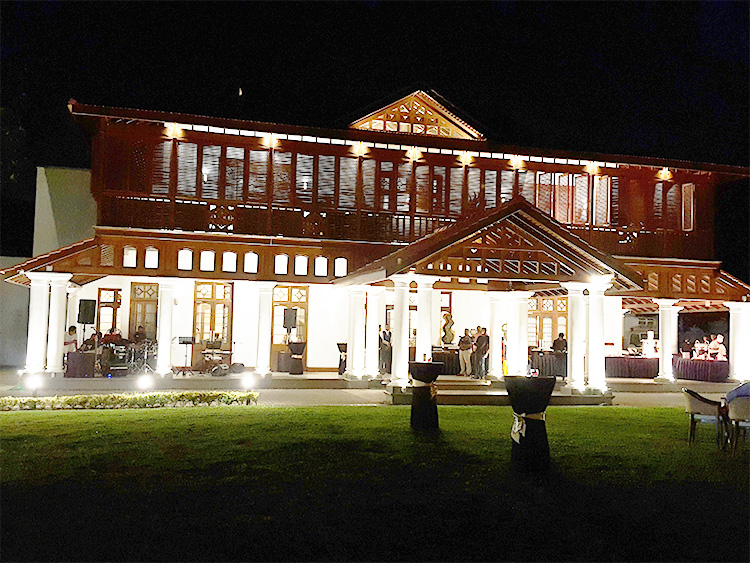
‘80 Club’ in Colombo 7 becomes public property following UDA acquisition

* Opens the doors of the members-only club to the general public
* Run by Waters Edge as a high-end restaurant at present
* UDA looking for a lessee who can fully capitalize on the property as a heritage hotel
* Colombo has plans to create a ‘heritage corridor’ like in Barcelona
by Sanath Nanayakkare
80 Club in Independence Avenue Colombo 7, an exclusive clubhouse whose doors were open only for a select group of elite members of society, was officially declared public property following its full acquisition by the Urban Development Authority (UDA) on 23rd June 2023.
Before the acquisition by UDA, 80 Club used to foster a sense of exclusivity among the country’s so-called elite on a legacy management system with only its tenants changing from time to time.
Today it’s a public property, and as a result, the general public can now have access to 80 Club’s spatial garden landscape and high-end restaurant services which were once predominantly the prerogative of the upper class.
History has it that the 80 Club of Colombo was originally established in 1939 in Kandy before moving to its current location in Independence Avenue, Colombo 7 by a group of people who had formed a club in room number 80 of the ‘Queens’ Hotel, and hence the carry- forward of the colonial-era name to its current location.
After announcing the full acquisition of the property on June 23, UDA Chairman Nimesh Herath told the media that 80 Club would have been vested in the public much earlier if not for the multiple crises the country faced.
“Under the Colombo Development Masterplan, 80 Club was taken over by UDA in November 2020 and we renovated the property with comprehensive refurbishment and restoration at a cost of Rs. 411 million of UDA funds. Even after the renovations, 80 Club remained with the tenant because it had been leased to them by the Divisional Secretary. However, after the renovations were done by UDA, we received a barrage of complaints and audit inquiries because UDA had used public funds to restore it to its previous glory but only a small elite group was still enjoying it. At this point, we came to a mutual understanding with the tenant and fully acquired it.”
Further speaking he said,” In the past few years, a survey was conducted by the governments on underutilized lands and properties in Colombo. Based on this a Cabinet paper was presented after identifying 35-40 lands that fall under this category. 80 Club is one of them, and today it is a property fully owned by UDA. The catering and other important support services at 80 Club are carried out by Waters Edge Hotel which is owned by the UDA. The public can now have their weddings, parties and other functions here. We will be running this as a high-end hotel and restaurant.”
When asked about the prices of the services, he referred to two key factors and said, “You see, we had to preserve the building’s archeological value and its features and retain its colonial grandeur which cost us a lot of money. The food and beverage and other services we provide here will be of high quality. So, we may not be able to offer very low prices, but I think the members of the general public who care to have services of these standards will find our prices reasonable.”

UDA Chairman Nimesh Herath with Waters Edge Chairman Malith Perera at
the event where UDA declared the members-only elite 80 Club as public property, on 23rd June, 2023.
However, he said that UDA wants to lease out the property to a local or foreign investor who has the technical knowhow and financial capacity to further develop the club premises and its adjoining 60-perch land as a top-notch heritage boutique hotel. “I think the value of this property should be about Rs. 3-4 billion. In line with the tender procedure, we will give a base-value, and afterwards, competitive bidding will take place and the highest bidder will get it. The lease period we are currently looking at is between 30-50 years. Such a move will also enable UDA to make a return on its investment and receive a monthly income,” he said.
Nimesh pointed out that in line with the government’s Urban Development Masterplan; Otter Club, Visumpaya, the 183-year-old Grand Oriental Hotel (GOH), Gafoor Building etc., would be taking a similar development model.
“We have already carried out renovation work on Gafoor Building and will soon be calling bids from investors to lease it out. The government’s plan is to relocate the crucial administrative infrastructure such as the President’s House, Presidential Secretariat, PM’s Office and Residence in Kotte-Battaramulla area. The feasibility studies are underway in this regard. The objective is to create space in Colombo for a heritage corridor like in Barcelona,” he said.
GOH which underwent Rs. 250 million worth of renovations is now managed by Waters Edge and a Singapore investor has reportedly expressed interest in taking the property on lease.
UDA chairman noted that they are looking for an investor to resume work on the longtime unfinished Krrish and Destiny buildings in the heart of Colombo. “Krrish has taken payments for some apartments it was supposed to complete. We are pressurizing them because they have taken our land. We are going to discuss with the senior management of Krrish and find out their latest stance on the project. Meanwhile, we are on the lookout for a new investor,” he said.
US$ 650 million Indian-developed Krrish Square came to a standstill many years ago with over 30 floors being constructed. Krrish announced the project in August 2012, outlining plans to break ground in 2013 and complete the four-tower construction in 2016, but ran into controversy almost immediately over non-payment of dues under deadlines specified in the agreement and alleged kickbacks to politicians.
UDA chairman said that the President has directed Minister Prasanna Ranatunga to submit the updated Colombo Megapolis Masterplan. Meanwhile, the authorities have had a few rounds of discussions with Surbana Jurong, the Singaporean company which is designing the Megapolis Masterplan and they have a six-month timeline to complete and submit it.
When asked about the proposed Kandy development plan he said,” We have to pick an investor who respects the cultural value of the Sacred City and its economic, social and environmental aspects. So, negotiations are being conducted to find the right balance between heritage concerns of the city and investor interests.”



Sri Lanka has reached a staff-level agreement with the International Monetary Fund to secure the next tranche of funding under its ongoing bailout programme, marking a key step in the country’s fragile economic recovery.
The agreement, announced this week, will enable Sri Lanka to access approximately USD 700 million, subject to approval by the IMF Executive Board. The funds form part of the USD 2.9 billion Extended Fund Facility (EFF) programme agreed following the 2022 economic crisis.
The latest development covers the combined fifth and sixth reviews of Sri Lanka’s reform programme, indicating that the country has made sufficient progress to move forward, while highlighting the need to sustain reform efforts.
Sri Lanka’s economy has shown signs of stabilisation in recent months, supported by improved revenue collection, easing inflation, and a gradual buildup of foreign reserves. However, the recovery remains vulnerable to both domestic and external pressures.
By Ifham Nizam

Initially CSE trading was somewhat volatile despite the ceasefire in West Asia but it experienced further volatility after Israel attacked Lebanon yesterday.
However, the IMF delegation which is now in Sri Lanka to release two tranches of its relief package created some positive sentiments for the market, analysts said.
The All Share Price Index went down by 73.06 points, while the S and P SL20 rose by 10.57 points.
Turnover stood at Rs 2.96 billion with six crossings. Those crossings were: JKH 5.5 million shares crossed to the tune of Rs 807.6 million and its shares traded at Rs 19.70, CIC Holdings two million shares crossed for Rs 54 million; its shares traded at Rs 32, Access Engineering 600,000 shares crossed for Rs 44.4 million; its shares traded at Rs 74, Central Finance 116,000 shares crossed to the tune of Rs 27.5 million ; its shares sold at Rs 237, LMF 250,000 shares crossed for Rs 22.8 million; its shares fetched Rs 91.10 and Kelani Cables 200,000 shares crossed for Rs 21 million and its shares traded at Rs 105.
In the retail market seven companies that mainly contributed to the turnover were; Dialog Rs237 million (7.5 million shares traded), LMF Rs 203 million (22 million shares traded), Colombo Dockyard Rs 199.7 million (1.1 million shares traded), HBA Foods Rs 163 million (18.5 million shares traded), JKH Rs 156 million (7.8 million shares traded), JKH Rs 156 million (7.8 million shares traded), Softlogic Holdings Rs 117 million (9.6 million shares traded) and Acme Printers Rs 107 million (15.6 million shares traded). During the day 133.3 million share volumes changed hands in 23666 transactions.
It is said that manufacturing sector counters, like JKH, performed well, while food sector counters, especially LMF and HBA Foods, performed well. Other sectors too performed somewhat well during the day.
Yesterday the rupee was quoted a Rs 315.42/48 to the US dollar in the spot market from 315.30/40 the previous day, dealers said, while bond yields were quoted higher.
By Hiran H. Senewiratne

Marking 25 years of trust, growth, and service excellence, HNB Assurance PLC has unveiled its new corporate identity, transitioning to HNB Life PLC a strategic evolution that reflects the company’s forward-looking vision and commitment to empowering lives with protection and the freedom to thrive, no matter where life takes them.
This milestone signifies more than a change in name or visual identity. It represents a deliberate transformation shaped by strong performance over the past few years, during which the company has achieved remarkable growth, strengthened its market position and enhanced its customer-centric capabilities.
The newly introduced logo, inspired by the form of a wing, symbolises HNB Life’s role as a proactive enabler. It reflects the organisation’s commitment to supporting individuals in navigating life’s journey with confidence, empowering them to pursue their aspirations and live life on their own terms.
The official unveiling took place at a launch event attended by key stakeholders, strategic business partners, well-wishers and employees.
Addressing the gathering, Chairman, Stuart Chapman highlighted the significance of this transformation, stating, “As we mark 25 years of progress, the transition to HNB Life reflects our strategic intent to evolve with the changing needs of our customers and the broader market. This new identity embodies our purpose, to enable and empower individuals to achieve what they truly aspire to in life, with confidence and security. As a company we are extremely excited on what the future holds for as, as we build on an incredible foundation laid over the past two and a half decades.”
The new Vision of the Company is “To be the leader in empowering lives with protection and freedom to thrive, no matter where life takes them”.

PM on inspection tour of newly renovated Colombo Central Bus Stand

Israel to hold direct talks with Lebanon but no ceasefire, Netanyahu says

Sun directly overhead Nagawilluwa, Galgamuwa, Sigiriya, Palugasdamana and Mankerni about 12:11 noon today (10)

Showers expected in the Western, Sabaragamuwa, Southern and Uva provinces and in Kandy and Nuwara-Eliya districts after 2.00 p.m

Opposition tells Minister Kumara Jayakody to resign

Coal tender scandal: FSP to move court against illegal deals

‘Dates have the highest sugar content to fight Coronavirus’

Sunday Island 27 December – Headlines

#SundayIsland 17th December – Headlines

Sunday Island – 28th March

Sunday Island Headlines – 21 March

Sunday Island – 21st February – Headlines
-

 Features5 days ago
Ranjith Siyambalapitiya turns custodian of a rare living collection
-

 News5 days ago
Global ‘Walk for Peace’ to be held in Lanka
-

 News3 days ago
Lankan-origin actress Subashini found dead in India
-

 Features5 days ago
Beyond the Blue Skies: A Tribute to Captain Elmo Jayawardena
-

 Features5 days ago
Aspects of Ceylon/Sri Lanka Foreign Relations – 1948 to 1976
-

 Business1 day ago
Hayleys Mobility introduces Premium OMODA C9 PHEV
-

 News1 day ago
AG: Coal procurement full of irregularities
-

 Sports1 day ago
DS to face St. Anthony’s in ‘Bridges of Brotherhood’ cricket encounter