
News
v


By Amal JAYASINGHE
As once relatively wealthy Sri Lanka suffers a dire economic crisis with shortages of everything from medicines to gas, people are returning to cooking with firewood.The switch began at the beginning of the year when more than 1,000 kitchens exploded across the country, killing at least seven people and injuring hundreds more.The reason was suppliers looking to cut costs and increasing the proportion of propane, which raised the pressure to dangerous levels.
But now, along with much else in the country of 22 million people, gas is either unavailable or too expensive for most.Some tried to shift to kerosene oil cookers, but the government did not have dollars to import it along with petrol and diesel, which are also in short supply.And those who bought electric cookers were in for a rude shock when the government imposed lengthy power blackouts as it ran out of dollars to import fuel for generators.
Niluka Hapuarachchi, 41, was miraculously unharmed when her gas range exploded soon after cooking Sunday lunch in August.
“Fortunately, no one was there at the time. There were pieces of glass all over the floor. The glass-top stove had exploded. I will never use gas for cooking. It is not safe. We are now on firewood,” she said, despite moves to address the propane problem.Roadside eatery owner M.G. Karunawathi, 67, also switched to wood and said it was a choice between closing her business or putting up with smoke and soot.
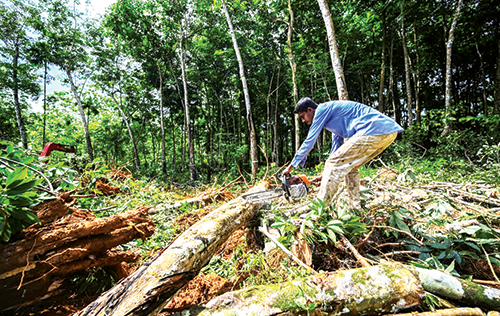
In this picture taken on June 8, 2022, a lumberjack chops trees to feed the
rising demand for firewood in Nehinna village. As once relatively wealthy
Sri Lanka suffers a dire economic crisis with shortages of everything from
medicines to gas, locals are returning to cooking with firewood. Pic by
Ishara Kodikara.
“We suffer (smoke inhalation) when cooking with firewood, but we have no choice,” Karunawathi told AFP. “It is also difficult to find firewood and it is also becoming very expensive.”
Sri Lanka used to be a middle-income country, with GDP per head comparable to the Philippines and living standards the envy of neighbouring India.
But with economic mismanagement and the crucial tourism industry hammered by Covid-19, the nation has run out of dollars needed to pay for most imports.
And the pain will likely continue for some time, with Prime Minister Ranil Wickremesinghe in parliament on Tuesday saying: “We will have to face difficulties in 2023 as well.
“This is the truth. This is the reality.”
Unofficial inflation is now second only to Zimbabwe, and the United Nations estimates about 80 percent of people skip meals because they cannot afford food.
Before the crisis, almost all households in Colombo could afford to use gas, but now woodcutter Selliah Raja, 60, is doing a roaring trade.
“Earlier we had just one customer — a restaurant that had a wood-fired oven — but we now have so many, we can’t meet the demand,” Raja told AFP.
He says his timber suppliers in the provinces have doubled their prices because of the sharp rise in demand and skyrocketing transport costs.
“Earlier, land owners paid us to uproot rubber trees that are no longer productive,” lumberjack Sampath Thushara told AFP in the tea-and-rubber-growing southern village of Nehinna.
“Today, we have to pay to get these trees.”
Foraging for wood can also be dangerous in the snake- and insect-infested forests. Last week, a father of three died from wasp stings in central Sri Lanka and four others were hospitalised.
Demand is also surging for alternative energy, and entrepreneur Riyad Ismail, 51, has seen sales light up for the hi-tech firewood stove he invented in 2008.
He has attached a small battery-powered electric fan to blow air into the barrel-shaped stove to ensure better burning, thus reducing smoke and soot associated with traditional firewood burners.
His upmarket “Ezstove” and the mass-market “Janalipa”, which uses coconut charcoal, promises a minimum 60 percent savings compared with cooking with gas.
Both his stoves — which cost around $20 and $50, respectively — have become big sellers with buyers having to go on a waiting list.
It has been so successful, Ismail says, there are several copies on the market.
“You will see many renditions of my design… other people are piggybacking (on the design),” Ismail said while making chicken satay.

Latest News
Cabinet approves relief meaures to persons affected due to the War situation in the Middle East


Approval has been granted at the Cabinet Meeting held on 30-03-2026 to provide relief by granting up to rupees 20/- per litre of 92 Octane Petrol, and up to rupees 100/- per litre of Auto Diesel utilized for public transport to minimize the impact on the day today life of the people and the entire economy as a result of escalation of fuel prices due to the war situation in the Middle East region.
Apart from that, the Cabinet of Ministers approved the resolution furnished by the President in his capacity as the Minister of Finance, Planning and Economic Development to grant the following relief for low – income generators, electricity consumers, farmers, fisheries community, and small tea planters who have been exposed to the direct impact of the energy price hike:
(i) Provision of an additional special allowance for April 2026 to low-income generating categories registered under the ‘Aswesuma’ Programme, irrespective of family size: • Providing rupees 7,500/- to a family in the extremely poor category
Providing rupees 5,000/- to a family in the poor category
Providing rupees 2,500/- to a family in the transitional category
(ii) Instead of transferring the additional cost borne for engaging thermal power plants for generating electricity due to the fuel price hike and prevailing dry weather circumstances to the electricity consumers, the additional cost is to be borne by the Government for a period of 03 months so that a relief can be provided to the electricity consumers utilizing below 90 units.
(iii) Increasing the fertilizer subsidiary of rupees 25,000/- per hectare given at present up to rupees 30,000/- per hectare for the Yala season and increasing the fertilizer subsidiary of rupees 15,000/- per hectare given for additional crops that are cultivated in the paddy fields up to rupees 18,000/- per hectare for the Yala season.
(iv) Provide a 50 kg sack of Urea required for the Yala season at a fixed price of Rupees 10,200/- for farmers through Agrarian Services Centres.
(v) Provide a subsidiary of Rupees 50/- per liter for up to 25 liters per day per single-day fishing vessel, for a maximum of 25 days per month, for a period of three (3) months.
(vi) Provide a one-time payment of Rupees 150,000/- per multi-day fishing vessel engaged in fishing activities during the next three (3) months.
(vii) Provide an additional one-time fertilizer allowance of Rs. 5,000 per 50 kg bag of fertilizer to small tea cultivators, in addition to the existing Rs. 4,000 fertilizer subsidy provided by the Sri Lanka Tea Board.

Under the Finance Act No. 35 of 2018 a tax has been imposed on the telecommunication towers and accordingly an annual tax amount of Rs. 200,000/- is levied from mobile network operators who possess telecommunication towers. However, it has been proposed in the Budget for 2026 that the said tax shall not be levied for a period of five (5) years in respect of telecommunication towers newly erected on or after 2026-01-01.
Accordingly, the Legal Draftsman has formulated a draft bill to amend the Finance Act No. 35 of 2018 including the provisions for taking necessary action, and the Attorney General has granted the clearance in the regard.
Hence, the Cabinet of Ministers approved the resolution furnished by the President in his capacity as the Minister of Finance, Planning and Economic Development to publish the said draft bill in the Government Gazette Notification and thereafter submit the same to the Parliament for its concurrence.

The cabinet of Ministers has approved the resolution furnished by the President in his capacity as the Minister of Finance, Planning, and Economic Development to publish the Value Added Tax (Amendment) Bill in the Government Gazette and thereafter submit it for the concurrence of the Parliament.

Cabinet approves relief meaures to persons affected due to the War situation in the Middle East

Amendments to the Finance Act No. 35 of 2018 to be Gazetted

Value Added Tax (Amendment) Bill to be Gazetted

H.M.J.M.Herath appointed Commissioner General of Registration of Persons

Water Resources Board Act, No. 29 of 1964, to be amended

Securing public sector employment opportunities for Athletes demonstrating National-Level sporting excellence

‘Dates have the highest sugar content to fight Coronavirus’

Sunday Island 27 December – Headlines

#SundayIsland 17th December – Headlines

Sunday Island – 28th March

Sunday Island Headlines – 21 March

Sunday Island – 21st February – Headlines
-

 Features3 days ago
Ranjith Siyambalapitiya turns custodian of a rare living collection
-

 News6 days ago
2025 GCE AL: 62% qualify for Uni entrance; results of 111 suspended
-

 News3 days ago
Global ‘Walk for Peace’ to be held in Lanka
-

 Business7 days ago
Hour of reckoning comes for SL’s power sector
-

 Editorial6 days ago
Search for Easter Sunday terror mastermind
-

 Opinion5 days ago
Hidden truth of Sri Lanka’s debt story: The untold narrative behind the report
-
Editorial7 days ago
Ideological confusion and identity crisis
-

 Opinion6 days ago
Is there hope for Palestine?