
News
21A: Sajith hits back at critics, demands removal of Rajapaksas from political scene


By Shamindra Ferdinando
Samagi Jana Balavegaya (SJB) leader Sajith Premadasa, MP, yesterday (01), said that the proposed 21st Amendment to the Constitution, aimed at protecting the Rajapaksas, had received the backing of those who couldn’t secure power through the ballot.
MP Premadasa, who is also the Opposition Leader, said the 21st Amendment, in its present form, was not acceptable as it didn’t meet the aspirations of the public, demanding a genuine system change.
The SJB leader said so in response to UNP Gen. Secretary Palitha Range Bandara’s accusations that Premadasa was shielding the Rajapaksas.
MP Premadasa said that in spite of Mahinda Rajapaksa giving up premiership, following the May 09 mayhem, the overall objectives of the ongoing ‘Go Gota Home’ campaign remained the same. The vast majority of people demanded the removal of the Rajapaksas from the political scene.
Declaring that the SJB wouldn’t support the 21st Amendment, in its present form,under any circumstances, MP Premadasa reiterated his commitment for what he called a draft of the proposed 21th Amendment, submitted by SJB General Secretary, Ranjith Madduma Bandara, to the Parliament, as a private member’s motion.
Calling the SJB’s proposal 19 plus, their aim was to ensure an end to the dictatorial Rajapaksa regime. Acknowledging that the SJB’s proposal needed 2/3 parliamentary approval, in addition to a referendum in respect of some provisions, lawmaker Premadasa asked whether the Parliament could ensure the majority for the required sections.
“Let us go ahead with the first section of the SJB’s proposal. Get it approved by Parliament and then consider the section that required approval at a referendum,” MP Premadasa said, demanding the Rajapaksas and their cronies stop causing further damage.
Commenting on the continuing economic-political-social crisis and the possibility of further deterioration, the former UNP Deputy Leader said the executive should be held responsible for the situation, caused by a spate of wrong decisions, and utterly irresponsible and unilateral decision-making process on the part of President Gotabaya Rajapaksa, MP Premadasa said.
The SJB leader said the SLPP should realize that it couldn’t turnaround the situation. The recent shocking revelations before the Committee on Public Enterprises (COPE) when the top management of the CBSL, and the Finance Ministry, appeared and confirmed the origins of the financial crisis, the SJB leader said.



The Indian Naval Ship (INS) GHARIAL made a port call in Colombo for operational turnarounds on 04 Feb 26. The Sri Lanka Navy welcomed the visiting ship in compliance with naval traditions.
Commanded by Commander Gaurav Tewari, INS GHARIAL is a vessel with a length of 124.8 meters.
During this visit, ten (10) Bailey Bridges, brought by ship, through the coordination of the High Commission of India in Sri Lanka, will be handed over to the Disaster Management Center. These bridges will provide temporary transportation links while bridges damaged across the island by adverse weather conditions are repaired.
The crew’s itinerary features scheduled goodwill activities with the Sri Lanka Navy, alongside visits to several tourist attractions across the island.

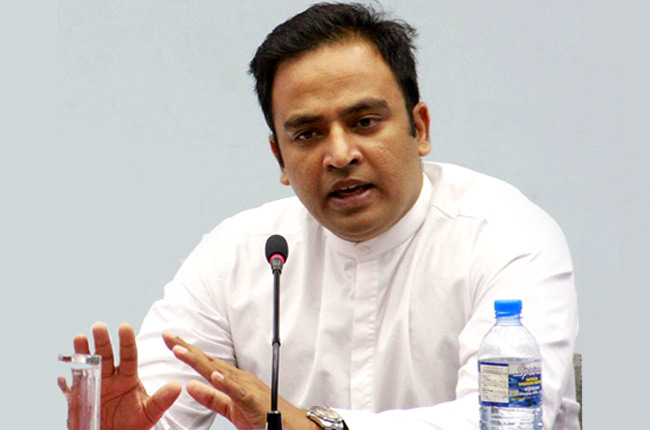
SJB Gampaha District MP Harshana Rajakaruna yesterday told Parliament that the Speaker’s Personal Secretary had written to the Secretary-General of Parliament seeking information on a complaint lodged with the Commission to Investigate Allegations of Bribery or Corruption (CIABOC) by a former Deputy Secretary of Parliament against the Speaker. Rajakaruna called for an immediate investigation into what he described as interference with an ongoing probe.
Raising the matter in the House, Rajakaruna said he had formally requested the Commission to initiate an inquiry into the conduct of the Speaker’s Personal Secretary, Chameera Gallage, questioning the authority under which such information had been sought.
Rajapakaruna tabled in Parliament a copy of the letter allegedly sent by Gallage to the Secretary-General requesting details of the bribery complaint.
Addressing the House, Rajakaruna said that the letter, sent two days earlier, had sought “full details” of the complaint against the Speaker. He maintained that seeking such information amounted to interference with an investigation and constituted a serious offence under the Bribery Act.
“The Speaker’s Secretary has no right to interfere with the work of the Bribery Commission. Under what law is he acting? What authority does he have? The Speaker, like everyone else, is subject to the law of the land,” Rajakaruna said, urging the Commission to take immediate action.
He noted that the Bribery Act treated the obstruction of investigations and the destruction of documents relating to such inquiries as serious offences punishable by law, and said he believed the Minister of Justice would concur.
The allegations sparked sharp reactions in the Chamber, as Opposition members called for accountability and due process in relation to the complaint against the Speaker.
By Saman Indrajith
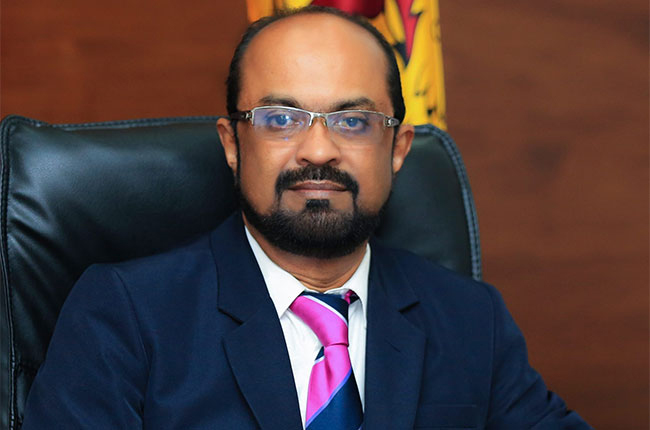
The Ceylon Electricity Board has managed to reduce the average cost of electricity generation from Rs. 37 per unit to Rs. 29, marking a 22 percent reduction, Minister of Power and Energy Eng. Kumara Jayakody told Parliament yesterday.
Responding to an oral question raised by Opposition MP Ravi Karunanayake, the Minister said that electricity tariffs cannot be reduced unless the cost of generation is brought down.
“You cannot reduce electricity tariffs without reducing the cost of generation. What we are currently doing is buying at a higher price and selling at a lower price. When we assumed office, the cost of purchasing and generating electricity was Rs. 37 per unit. We have now managed to bring it down to Rs. 29, a reduction of 22 percent.
Our target is to further reduce this to Rs. 25. Once that is achieved, we will reduce electricity tariffs by 30 percent within three years, as we promised,” Minister Jayakody said.
He added that the government has already formulated a long-term generation plan to further expand the country’s power generation capacity.
According to the Minister, key measures include increasing the absorption of renewable energy into the national grid, expanding the national transmission and distribution network, introducing renewable energy storage systems, and constructing thermal and liquefied natural gas (LNG) power plants to replace aging facilities and meet future demand.
He also said that steps would be taken to enhance the capacity of existing hydropower plants as part of the broader strategy to ensure energy security and reduce long-term electricity costs.
By Ifham Nizam

India chase sixth Under-19 World Cup title, England their first since 1998

Meet the women protecting India’s snow leopards

Louvre Museum crown left crushed but ‘intact’ after raid

US and Iran talks to begin as fears of direct conflict continue

INS GHARIAL makes port call in Colombo

ICC-PCB in back-channel talks to resolve India boycott at T20 World Cup

‘Dates have the highest sugar content to fight Coronavirus’

Sunday Island 27 December – Headlines

#SundayIsland 17th December – Headlines

Sunday Island – 28th March

Sunday Island Headlines – 21 March

Sunday Island – 21st February – Headlines
-

 Business6 days ago
Hayleys Mobility ushering in a new era of premium sustainable mobility
-

 Business3 days ago
SLIM-Kantar People’s Awards 2026 to recognise Sri Lanka’s most trusted brands and personalities
-

 Business6 days ago
Advice Lab unveils new 13,000+ sqft office, marking major expansion in financial services BPO to Australia
-

 Business6 days ago
Arpico NextGen Mattress gains recognition for innovation
-

 Business5 days ago
Altair issues over 100+ title deeds post ownership change
-

 Editorial6 days ago
Govt. provoking TUs
-

 Business5 days ago
Sri Lanka opens first country pavilion at London exhibition
-

 Business4 days ago
All set for Global Synergy Awards 2026 at Waters Edge