
Features
2024 SL presidential election: A significant shift towards liberal leftist politics

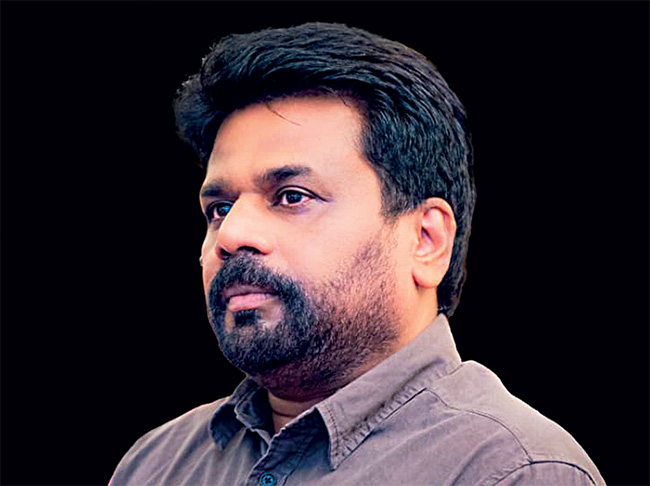
By Amarasiri de Silva
The 2024 Sri Lankan presidential election is considered a watershed moment for several key reasons. One of the most significant aspects is the peaceful transfer of power from a neoliberal administration to the left-oriented National People’s Power (NPP), led by Anura Kumara Dissanayake. The NPP, supported by the Janatha Vimukthi Peramuna (JVP), marked a significant shift in the country’s political landscape. Historically, the JVP was involved in two armed uprisings in 1971 and 1989 in attempts to seize control through revolutionary means, both of which failed and were violently suppressed by the government.
The election results in 2024 reflect the public’s disillusionment with traditional political parties, particularly in light of the economic crises that have plagued Sri Lanka since 2022. Ranil Wickremesinghe, the neoliberal incumbent, played a pivotal role in stabilising the economy after widespread protests ousted the Rajapaksa government. However, despite his efforts to gain public trust, the voters, particularly the younger generation, demanded change and were drawn to the progressive and socialist policies of the NPP.
The peaceful electoral victory of the NPP, with such a revolutionary past, marks a new chapter in Sri Lankan politics. This election reflects a shift from armed struggle to democratic participation, cementing the NPP’s position as a legitimate political force. Moreover, this outcome challenges the entrenched political elite and signals a potential restructuring of Sri Lanka’s political and economic system. Originating from a farming community in Anuradhapura, Dissanayake embodies the character of an ordinary citizen, contrasting with the traditional rulers of the country who come from the Radala high caste or high-class families. This marks a significant shift in Sri Lanka’s political landscape.
The 2024 Sri Lankan presidential election result, which saw the victory of the leftist NPP, backed by the JVP, is not just a change of government but a direct challenge to the long-standing political elite that has dominated the country for decades. This entrenched political class, primarily represented by parties like the UNP and the SLFP, or the SLPP or Pohottuwa, has been heavily associated with neoliberal policies, dynastic politics, and a failure to address deep socio-economic inequalities. The victory of the NPP, a party with socialist leanings, marks a significant departure from this status quo.
The shift signals a potential restructuring of both the political and economic systems in Sri Lanka. Politically, the NPP’s rise reflects a growing rejection of elite control and the consolidation of power among a few families, like the Rajapaksas, Bandaranaikes, and Wickremesinghe’s political lineage. For years, these elites shaped the country’s policies, focusing on liberal economic reforms, often criticized for favouring the wealthy and exacerbating income disparities. The NPP’s success, bolstered by the JVP’s revolutionary past, suggests a new direction, focusing on redistributing political power and fostering a more egalitarian economic structure. Although the percentage increase of the NPP in the presidential election is attributed to the division between the UNP and the SJB, it is deeply rooted in the people’s desire for a fundamental system change. This is clearly reflected in the significant increase in the NPP’s voter base. This dramatic rise underscores the growing public demand for change and the NPP’s ability to capture the sentiments of a population eager for a new political direction. The electorate’s growing disillusionment with traditional political parties and failure to address socio-economic inequalities and governance issues has driven voters to seek an alternative in the NPP, reflecting a broader demand for transformative change in the country’s political and economic landscape.
Ranil Wickremesinghe, representing the UNP, and Sajith Premadasa, leading the SJB, have each garnered substantial support. However, their division has fragmented the votes that would otherwise likely consolidate under one party. This indicates that if the UNP and SJB had remained unified or had formed a coalition, they would have likely outperformed the NPP, reducing the latter’s influence and growth in parliamentary electoral results.
The fragmentation in the centre-right and centre-left political spaces, dominated by the UNP and SJB, has thus contributed to a scenario where a previously smaller political force like the NPP can make significant gains, as the Opposition’s division has weakened their ability to retain a majority vote share. Therefore, the NPP’s rise does not solely reflect an increase in its inherent support but rather the strategic consequences of a divided Opposition.
Economically, the NPP victory signals a potential shift toward policies prioritising social welfare, public ownership, and economic equity. The neoliberal approach championed by past governments, which included deregulation, privatisation, and aligning with global financial institutions like the IMF, faced strong opposition from the NPP and JVP. The NPP has advocated for state intervention in key sectors, wealth redistribution, and addressing the economic needs of the working class, a stark contrast to the elite-driven policies that favoured corporate interests and foreign investments.
This outcome also challenges the traditional role of Sri Lanka in the global economy. As a small developing nation, Sri Lanka has long depended on foreign aid, loans, and investment from international actors, especially during its economic crisis. The NPP’s victory may signal a recalibration of these relationships, as the party has criticized the terms of engagement with global financial institutions, calling for more autonomy and a greater focus on domestic development. In summary, the 2024 election represents more than just a change in leadership; it signals a broader transformation in Sri Lanka’s political and economic system, aiming to dismantle elite control and refocus governance on social justice and economic equity.
Despite the strong backing of the NPP from the oppressed and working-class voters in the 2024 Sri Lankan Presidential Election, a noticeable gap emerged in support from ethnic minorities, particularly in the North and upcountry regions. These regions are home to significant and Muslim and Tamil populations, who have historically been marginalized and continue to face social, political, and economic discrimination.
While the NPP’s platform of social justice, equity, and anti-elite rhetoric resonated with many of the country’s Sinhalese working class, the party’s message did not seem to fully address the complex grievances and historical trauma faced by these ethnic minorities. The Tamil population in the Northern Province, for instance, has long held concerns over unresolved issues from the civil war, such as the demand for justice, truth-seeking for alleged war crimes, and a genuine political solution that would grant them greater autonomy. The electoral results from the Batticaloa district reveal that the Tamil population in the region has yet to demonstrate significant allegiance to the NPP in recent elections. Batticaloa, located in the Eastern Province of Sri Lanka, is predominantly inhabited by Tamils and Muslims. Tamil nationalist sentiments and concerns over ethnic rights, governance, and autonomy have historically shaped the political landscape in this region.
The NPP, primarily identified with the Sinhala-majority JVP, has traditionally struggled to gain traction in the Tamil electorate. This is mainly due to the party’s historical associations and lack of focus on the specific grievances of the Tamil community, such as demands for regional autonomy, post-war reconciliation, and devolution of power. The NPP’s broader, more nationalist platform has not resonated as strongly with the Tamil voters, who tend to align with parties that explicitly advocate for Tamil rights and representation, such as the Tamil National Alliance (TNA) and other regional parties.
This trend was visible in the 2020 parliamentary elections and other recent elections. The NPP failed to make significant inroads in Batticaloa, with most Tamil voters favouring more localised, ethnic-based parties that they perceive as better representing their political aspirations. This lack of support for the NPP in Batticaloa can also be attributed to the deep-rooted ethnic tensions in Sri Lanka’s political sphere. Many Tamil voters may view the NPP as part of the broader Sinhala-majority political establishment, which has historically been in opposition to Tamil demands for autonomy and justice for wartime grievances. Thus, the Batticaloa results underscore the NPP’s challenges in gaining support among Tamil populations, who remain more aligned with parties that advocate for their specific ethnic and regional concerns. This reflects a broader pattern in Sri Lankan politics, where ethnic identities and regional issues often dictate voting patterns.
The NPP’s position on these matters, while generally supportive of reconciliation, may have been perceived as insufficiently robust or sensitive to the specific needs of the Tamil community. Similarly, in the upcountry regions, which Tamil-speaking plantation workers of Indian origin largely inhabit, there remains a deep history of socio-economic deprivation. While the NPP’s economic agenda could benefit these groups, there may have been doubts about whether the party could deliver on its promises, given its primary appeal to a predominantly Sinhalese electorate. Ethnic minorities in these areas may also have been wary of aligning with a party rooted in Sinhalese-majoritarian political culture despite the NPP’s efforts to position itself as a multi-ethnic, inclusive political force.
The gap in minority support likely reflects a broader historical pattern in Sri Lankan politics, where minority communities have been cautious about backing new political movements, especially those with a strong base among the Sinhalese majority. Instead, many of these voters may have supported more established minority-friendly parties or candidates, such as the TNA in the North or the UNP, which was traditionally seen as more accommodating to minority concerns. This divergence underscores the deep ethnic and regional cleavages that continue to shape Sri Lankan electoral politics, even in the context of a broader desire for change.
The 2024 presidential election results highlight significant challenges for the new NPP government, led by Anura Kumara Dissanayake. Despite their platform advocating for a unified and ethnically cohesive government, the election results show that the message has not fully resonated with the country’s ethnic minorities, particularly the Tamils in the North and the upcountry Tamil communities, as well as the Muslim population. This poses a significant challenge for the NPP, which must now find ways to reconcile these disparities while fostering ethnic harmony in both economic and political spheres.
The JVP, which forms the core of the NPP, has historically struggled to build a strong base among ethnic minorities. The JVP’s revolutionary roots and prior engagement in Sinhalese-majoritarian politics during the 1971 and 1989 uprisings may have contributed to a lingering perception among minorities that the party is more focused on Sinhalese interests. Although the NPP campaigned on a platform of equality and inclusivity, it seems that these promises did not sufficiently convince the Tamil and Muslim communities, who have long demanded autonomy, recognition of their identity, and solutions to lingering post-war grievances. For the Tamil population in the Northern Province, for instance, issues such as war crimes accountability, land rights, and devolution of power remain unresolved, and the NPP’s messaging on these fronts may have lacked the specificity or reassurance they were seeking.
In the upcountry regions, where Tamil-speaking plantation workers of Indian origin face entrenched socio-economic hardships, the NPP’s broader economic reforms, while potentially beneficial, did not seem to connect with the unique struggles of these communities. Similarly, Sri Lanka’s Muslim population has faced increasing marginalization and targeted violence in recent years, and the NPP’s ability to address these concerns may be viewed with skepticism, given the JVP’s lack of a strong track record in minority issues.
The new NPP government now faces a critical challenge: how to build trust with ethnic minorities and integrate them into its broader vision of economic and political development. Achieving ethnic harmony in a deeply divided country will require more than rhetoric; it will necessitate concrete policy measures that address these communities’ historical injustices and grievances. The NPP will need to engage in meaningful dialogue with minority leaders, create mechanisms for greater political autonomy in the North and East, and ensure that economic development reaches all parts of the country, especially those that have historically been left behind. These efforts are essential not only for the success of the NPP government but also for the long-term stability and unity of Sri Lanka.
The NPP enjoyed overwhelming support from Sinhalese-majority districts in southern Sri Lanka, particularly from areas like Hambantota, Matara, and Galle. These regions are traditionally strongholds of the working and middle classes, including lower-middle-class workers, small-scale farmers, and rural laborers, including fisher folk. Many in these communities have faced longstanding economic hardships exacerbated by social disparities, stagnating wages, and a lack of equitable development. The NPP’s promise of economic reform, social justice, and redistributive policies appealed to these voters, who saw the NPP as a chance for significant change after decades of economic neglect by successive governments.
However, this support also presents a challenge for the NPP government. These regions have high expectations for concrete improvements in living standards, income growth, and social equity. The disparity between wealthier urban centers and rural southern districts has deepened over the years, and many rural voters feel marginalized by neoliberal policies that have primarily benefited Colombo and other urban hubs. Issues like insufficient access to quality education, healthcare, infrastructure development, and fair wages are critical concerns for these communities.
To redress these grievances, the NPP government must focus on policies that address rural economic development, ensure better income distribution, and enhance social welfare systems. Programmes to improve agricultural productivity, provide subsidies for small businesses, and increase state investment in public services, like healthcare and education, will be key to bridging the socioeconomic gap. Additionally, addressing structural inequalities and creating more inclusive economic growth models will be necessary to ensure that the benefits of development are shared across the country, particularly in these southern districts that supported the NPP so strongly. In short, the NPP’s support base in the south reflects deep dissatisfaction with the status quo, and delivering on their expectations will require focused, equitable development strategies to tackle the economic and social challenges that have hindered growth in these communities.
Finally, in addition to the policies they propose for the country’s development, the NPP should consider adopting practical policies proposed by their Opposition, particularly the SJB.
An essential suggestion from the SJB involves introducing a system of digital economy, including providing a digital wallet for each individual. This system would allow citizens to manage their daily transactions and major purchases in a streamlined, secure digital format. Implementing such a policy could have far-reaching benefits for the new NPP government. Firstly, a digital economy with an integrated wallet system could increase government revenue by formalizing many aspects of the informal economy. It would enable a more efficient tax collection system, helping to reduce the gap between government expenditure and income. Moving towards a direct income tax system where financial transactions are monitored and taxed appropriately, this policy could generate significant revenue quickly. This would provide the necessary funds to meet the current fiscal challenges as the state grapples with a high expenditure-income gap that demands urgent solutions.
Moreover, the digital wallet could ease day-to-day financial transactions for citizens, fostering greater economic inclusivity, particularly among marginalized or underbanked communities. Creating more transparency and encouraging savings through digital means lay the foundation for a more modernized financial infrastructure.
As the NPP forms its new government, many are eager to see whether it will adopt such forward-thinking policies. Another key concern is how the NPP, with only three members in Parliament, will approach governance. There is speculation that the NPP might quickly dissolve Parliament and call for general elections. In such a scenario, the party could potentially gain enough seats to form a majority government. However, navigating the parliamentary process and creating a robust governance structure will be critical to maintaining the public’s trust and ensuring that policies like the digital economy are implemented effectively. I personally congratulate Anura Kumara Dissanayake, the new President of the Democratic Socialist Republic of Sri Lanka.


By Ifham Nizam
Sri Lankan scientists have uncovered a remarkable long-distance migration route used by seabirds, linking the island’s shores with the Arctic—an achievement that is expected to reshape global understanding of bird movement and highlight Sri Lanka’s importance in the natural world.
The discovery, led by Professor Sampath S. Seneviratne of the University of Colombo, shows that Heuglin’s Gulls travel nearly 8,000 kilometres from Sri Lanka to breeding grounds in northern Russia, following a carefully chosen path that combines coastal travel with long inland journeys.
Prof. Seneviratne told The Island that the finding challenges the long-standing belief that seabirds depend mainly on ocean routes.
“For a long time, we assumed seabirds would stay close to the sea throughout their migration. What we are seeing here is very different. These birds are moving across land as well, using a route that connects Sri Lanka directly with the Arctic,” he said.
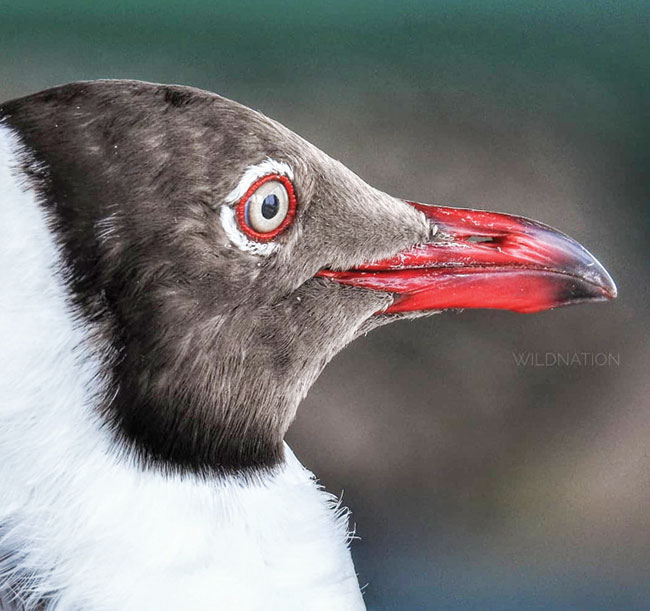
Brown headed gull- migrating from Himalayas to Mannar
The birds begin their journey from the northwestern coast of Sri Lanka, especially around Mannar—an area known for its rich birdlife and coastal habitats. From there, they cross over to India and move along the western coastline before turning inland.
Their journey then takes them through Pakistan and Afghanistan, across parts of Central Asia, and onwards to the Arctic region, where they breed during the northern summer.
What has drawn particular attention from scientists is the route chosen by the birds.
Instead of attempting to cross the world’s highest mountain ranges, or taking a much longer path over the open ocean, the gulls appear to follow a middle course that allows them to avoid harsh conditions while still maintaining a steady journey.
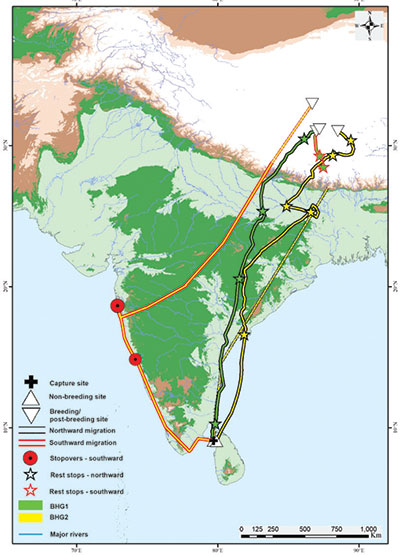
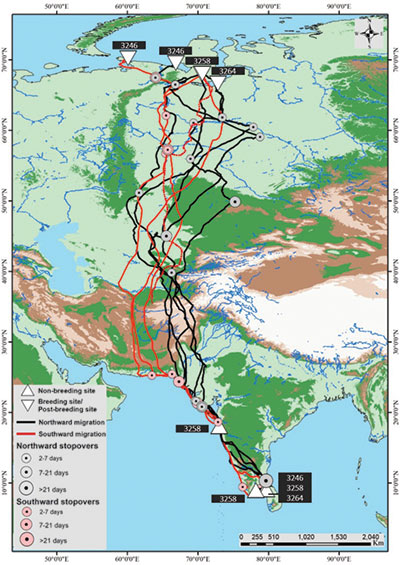
Map 1 &2 birds moving through the continent to reach the Artctic
“They are not simply taking the shortest distance,” Prof. Seneviratne explained. “They are choosing a route that gives them the best chance of survival. Along this path, they are able to find food, rest, and avoid extreme environments.”
The birds travel long distances each day, covering hundreds of kilometres, but they do not do it all in one stretch. Their journey depends heavily on stopovers—places where they pause to rest and rebuild energy.
“These stopovers are critical,” Prof. Seneviratne said. “If the birds cannot find suitable places to feed and recover, they will not be able to complete the journey.”
Co-researcher Dr. Gayomini Panagoda said the discovery sheds light on a route that had remained largely hidden until now.
“We always knew these birds were leaving Sri Lanka during certain times of the year, but we did not fully understand where they were going or how they got there,” she said. “Now we have a much clearer picture of their journey.”

Awareness among schoolchildren
She added that the findings show how closely connected different parts of the world are through nature.
“A bird that spends part of its life in Sri Lanka ends up in the Arctic. That tells us how linked these ecosystems really are,” she said.
The findings also underline the importance of Sri Lanka’s coastal areas, which serve as vital feeding and resting grounds for migratory birds before they begin their long journey north.
Veteran ornithologist , Professor Emeritus Sarath Kotagama said these habitats are of international importance and must be protected.
“These coastal regions, especially places like Mannar, provide the food and shelter these birds need before migration. If those areas are damaged, it will affect bird populations far beyond Sri Lanka,” he said.
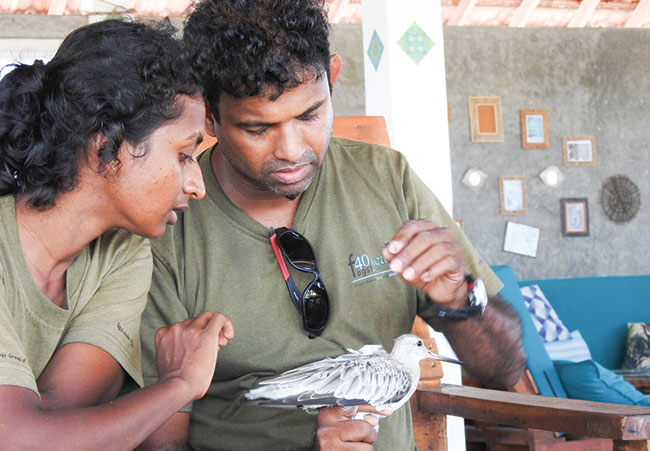
Professor Seneviratne with Dr. Gayomini Panagoda
Kotagama warned that increasing pressure on coastal ecosystems—from development, pollution, and climate change—could pose serious risks.
“We are already seeing changes in many of these birds. If we are not careful, we could lose habitats that are essential not just for local wildlife, but for species that travel across continents,” he said.
The discovery also draws attention to the wider network of migration routes that connect countries across Asia and beyond. Birds do not recognise national borders, and their survival depends on conditions in many different places along their journey.
Prof. Seneviratne stressed that protecting these birds will require cooperation between countries.
“These birds travel across several regions, and each of those regions plays a role in their survival. Conservation cannot be done by one country alone,” he said.
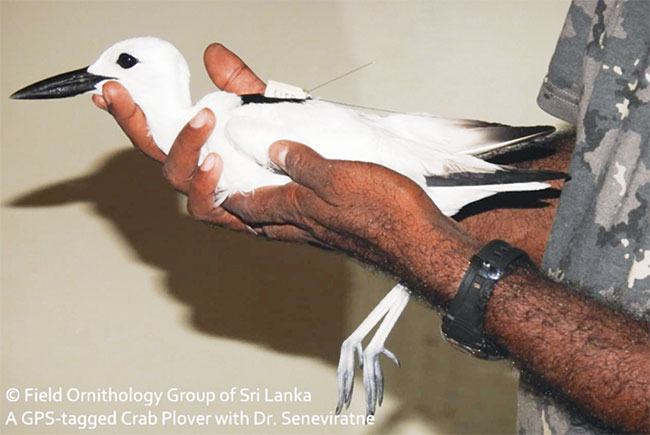
A GPS tagged Crab Plover
He added that more work is needed to understand how other species use similar routes and how changes in climate and land use may affect migration patterns in the future.
“There is still much we do not know. This is just one piece of a much larger picture,” he said.
Environmentalists say the findings should encourage stronger action to protect wetlands and coastal ecosystems in Sri Lanka, many of which are under increasing threat.
“These areas are not just important for birds,” Dr. Panagoda said. “They support fisheries, protect coastlines, and are part of our natural heritage. Protecting them benefits both people and wildlife.”
She noted that conserving these habitats will also help ensure that future generations can continue to witness the arrival and departure of migratory birds.
For Sri Lanka, the discovery is both a moment of pride and a reminder of responsibility.
It highlights the role the island plays in supporting wildlife that travels across vast distances and connects different parts of the world.
It also shows that even a small country can have a big impact when it comes to global biodiversity.
As Prof. Seneviratne put it, “What happens in Sri Lanka does not stay in Sri Lanka. These birds carry that connection across continents.”
The discovery is expected to encourage further research into bird migration in the region, as scientists continue to explore how different species move across landscapes and adapt to changing conditions.
It also reinforces the need to protect the natural environments that make such journeys possible.
In the end, the story of these birds is not just about distance. It is about survival, connection, and the delicate balance of nature.
From the shores of Sri Lanka to the frozen Arctic, their journey is a powerful reminder that the natural world is far more connected than we often realise—and that protecting one part of it helps protect the whole.

 For the morally-conscious, the tendency among some sections in Sri Lanka to promote the production of drones for national defence purposes could be deeply worrying. Besides, this proposition flies in the face of common sense and disregards the relentlessly increasing harsh economic realities coming in the wake of the current wars that could push many a southern country into beggary. In fact even the West is facing an economic recession.
To begin with the latter issues, it is a proved reality that the majority of Southern countries are descending further into poverty at present. The FAO has the ‘bleeding statistics’ . For instance, food insecurity in Asia is of such disquieting proportions that the region accounts for ‘ approximately half of the world’s 370.7 million undernourished people’.
It is against such a bleak economic backdrop that countries of the South are being called on to pump money into the production or importing of drones. Pointed reference needs to be made here to the South because drones are peddled as cutting-edge defence systems that are comparatively economical to acquire and relatively easy to operate. It is even voiced that with time drones could enable even smaller countries of the South to acquire ‘strategic parity’ with the major powers of the North and middle level powers.
Meanwhile, no thought is spared for the poor of the South who would sink steadily into poverty and powerlessness. Because more defence spending by southern countries only entrenches the ruling classes of those countries, and in some cases their military high commands, further in the systems of governance and repression.
This has essentially been the experience of the majority of post-colonial states. As aptly phrased by economic and political analyst Susan George in the seventies, it has always been a case of ‘The Other Half Dying’.
Accordingly, it cannot be perceived as to how more defence spending by the South on drones could help alleviate the latter’s principal problem of deepening poverty. As for the perceived escalating insecurities of the South, these problems are of such complexity that drones could never be seen as offering a quick fix for them. They need patient, multi-pronged managing, mainly at the negotiating table with the powers that matter. These are long- gestation projects that need to be compulsorily undertaken in view of the fact that the alternative could be indefinite conflict and war.
Since Sri Lanka too is mentioned as one of those countries that needs to look at the drone proposition with some seriousness, it is relevant to underscore that Sri Lanka is second in a list of countries that are described as facing acute material hardships at present in the wake of the economic instability bred by the Hormuz crisis. The source of such information is no less than the respected Kiel Institute for the World Economy. The first 10 such gravely affected countries are: Zambia, Sri Lanka, Taiwan, Pakistan, Equatorial Guinea, Kenya, Bangladesh, Vietnam, the Philippines and Thailand.
It is thought-provoking that among the above countries are not only those that have been traditionally seen as experiencing severe underdevelopment but also up-and-coming middle income countries that have been hitherto described as being on a fast track to development. The interesting mix proves that no country at present could consider itself immune to current economic shocks originating mainly in the Middle East that could plunge it dramatically into acute poverty virtually overnight.
We are left to conclude that ‘Bread’ or the economic well being of people could in no way be sacrificed for ‘Drones’ in democratic countries whose governments are obliged to be accountable to the people. Considering the phenomenal hardships that could be waiting to happen worldwide, the world could very well do without more ‘Guns’ or ‘Drones’.
However, if southern governments in particular opt for ‘Drones’ or an accumulation of ‘Guns’, the chances are that there could be overwhelming tides of social discontent in their countries, bred by economic want, that could then ignite indefinite war and repression. That is, a ‘No-Win’ situation for all concerned.
Ukraine has been spiritedly and admirably taking the fight back to the invading Russian forces over the past few years but its skillful use of sophisticated drones of its own making has in no way decreased the human costs the war has been incurring for itself. Ukraine has no choice but to continue with all the weaponry at its command to beat back the Russian invader but sooner rather than later it would need to take into account the immense suffering the war has been inflicting on its people and focus on the fact that the Russians are not backing down but using equally lethal weaponry against it.
The above are some of the dilemmas of the present wars that call for urgent resolution. Warring countries are obliged to address on a priority basis the misery and destruction their actions incur for their publics and consider deploying diplomacy, preferably under the aegis of the UN, to work out peaceful solutions to their enmities and differences. Considering the futility of their war Russia and Ukraine are obliged to think on these lines.
No less a power than the US should be considering deeply right now the advisability of continuing with its military interventions in the South in particular to achieve its self interests. The rising loss of American lives and the economic costs of war in the Middle East will be weighing heavily with the Trump administration and it shouldn’t come as a surprise if negotiations are given a serious try, going ahead. Ground realities in the region moreover indicate that the US ‘has bitten off more than it could chew’ and that Iran is remaining hostile and unyielding despite being bloodied.
For both sides to the war what should be inescapable is the harsh reality of continuing human suffering on a chilling scale. Sophisticated and increasingly destructive weaponry such as drones and missiles are being used but they have not brought either side any closer to victory. Instead human misery is being perpetrated mindlessly with a steady deadening of consciences and a flagrant abandoning of reason.
Accordingly, what perceived legitimate aims could drone warfare, for instance, help achieve? It is quite some time since sections of the world community came to realize the futility of violence and war. There is no choice but for humans to recognize and revere the principle of the sacredness of life. A return to fundamentals is imperative.

 Singer Rajiv Sebastian has the unique ability to woo an audience and he did just that on his recent trip to London, performing at the Funky ’70s Bash Dinner Dance.
This particular event of music, nostalgia, and celebration, was organised by the Ananda Balika Vidyalaya Old Girls’ Association – UK, and held at the DoubleTree by Hilton London Elstree, in Borehamwood, on 28th February.
They say the success of the evening was made possible through the dedication and hard work of President Devika Arrawwalage and the committed committee members of the Ananda Balika Vidyalaya OGA – UK.
Rajiv Sebastian was in top form, delivering an engaging performance that took the audience on a nostalgic musical journey through the iconic sounds of the’70s.

Doing the first set in full suit, with a fan joining in the action
He did three sets, appearing in three different outfits – suit, the normal shirt and trouser, and the sarong – and the crowd loved it.
Adding to the energy of the event, I’m told, was the music provided by the band Hasthi, made up of Sri Lankan musicians based in the UK.
At the end of a truly enjoyable and memorable event, the organisers had this to say about Rajiv Sebastian’s performance:
“On behalf of the entire team, I want to extend our heartfelt thanks to you for travelling all the way from Sri Lanka to perform at our first ever ABV dinner dance in the UK.
-

- Superb talent for captivating an audience
-
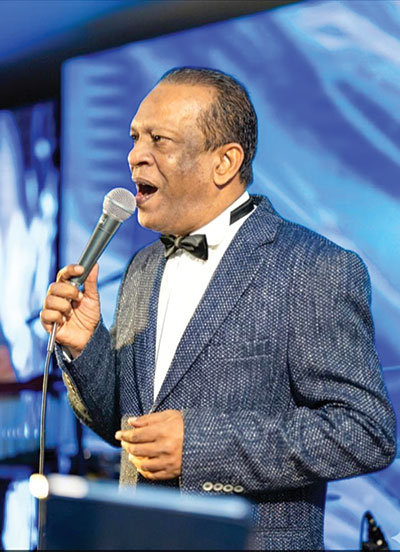
- Rajiv Sebastian
“Your performance was truly the highlight of the night. You have a superb talent for captivating an audience; from the moment you took the stage, your vibrant energy and incredible vocal range completely transformed the atmosphere.
“It was wonderful to see how effortlessly you engaged the crowd, keeping the dance floor packed and everyone in high spirits throughout the evening. You have graced the stage as a guest artiste on three separate occasions, delivering exceptional performances that set you apart from your peers.
“We feel incredibly privileged to have had an artiste of your calibre and charisma join us. You didn’t just provide music; you created an unforgettable experience that people are still talking about.
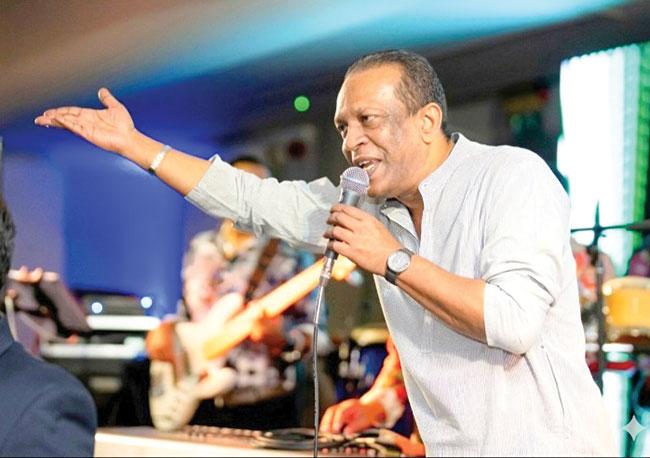
Surprises for his fans in Sri Lanka, as well
“Thank you for sharing your immense gift with us. Hope to see you back on a UK stage very soon!”
Yes, and it’s happening soon; Rajiv says he is off to London again, in mid-April, and will be performing at four different venues.
He also mentioned that he has some surprises for his fans in Sri Lanka, when he and his band, The Clan, present their 35th Anniversary concert … in June, this year.

Former Minister Mahinda Wijesekara passes away aged 83

Navy seize 323kg of heroin from fishing vessel in southwestern seas

Magnitude 7.4 quake hits off Indonesia’s Ternate, tsunami warning lifted

NASA successfully launches historic Artemis II moon mission

Sameer Rizvi arrives in the IPL to guide Delhi Capitals home in low-scoring chase

Trump to give primetime address on Iran war as questions swirl over his next move

‘Dates have the highest sugar content to fight Coronavirus’

Sunday Island 27 December – Headlines

#SundayIsland 17th December – Headlines

Sunday Island – 28th March

Sunday Island Headlines – 21 March

Sunday Island – 21st February – Headlines
-

 Features5 days ago
A World Order in Crisis: War, Power, and Resistance
-

 News6 days ago
Energy Minister indicted on corruption charges ahead of no-faith motion against him
-

 Sports6 days ago
SLC to hold EGM in April
-
 Opinion6 days ago
When elephants fight, it is the grass that suffers
-
 Latest News7 days ago
A strong Technical and Vocational Education and Training (TVET) system equips individuals with practical, relevant, and future-oriented skills helping to innovate responsibly towards a greener and sustainable future – PM
-

 Features6 days ago
Lest we forget
-

 News2 days ago
Tariff shock from 01 April as power costs climb across the board
-
 Business6 days ago
Pan Asia Bank empowers export sector as Strategic Partner of NCE Export Awards