
News
20 arrested for illegal excavations which would have posed danger to Samanala dam

By Ifham Nizam
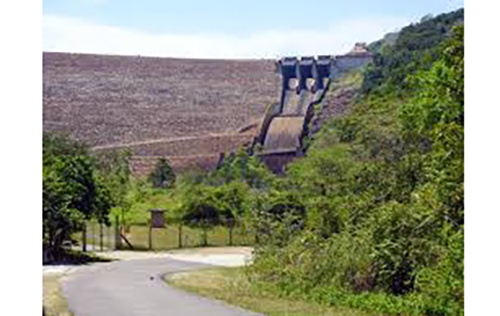
Twenty persons were arrested last week for illegally excavating calcite deposits at Pallebedda Koswetiya Kanda as their action could pose a danger even to the Samanalawewa dam by triggering massive earth tremors.
The properties of calcite make it one of the most widely used minerals. It is used as a construction material, abrasive, agricultural soil treatment, construction aggregate, pigment, pharmaceutical and more. It has more uses than almost any other mineral. Calcite is in the form of oolitic limestone.
According to the report of the Expert Committee appointed on the instructions of Environment Minister Mahinda Amaraweera to look into the possibility of tremors caused by such excavations, found that some deep underground excavations using explosives in the Balangoda area could cause earthquake-type destruction.
The Geological Survey and Mines Bureau took steps to conduct a special operation to investigate such excavations in the Balangoda area. Officers of the Geological Survey and Mines Bureau as well as the Police Special Task Force were recently able to arrest all those who were illegally excavating the calcite deposit at Pallebedda, Koswetiya Kanda, which could have caused massive destruction.
The area dug up was about 150 meters wide and 80 meters deep, and at the time of the raid, about 20 people were loading dump trucks and tractors with calcite extracted from one huge hole.
The digging operation was powered by a generator, and a large stockpile of high explosives was found near the generator, which could have easily flattened the entire mountain with a huge explosion if any of it had got ignited.
GSMB Chairman Anura Walpola said that the raiding team had confirmed that it could have caused a major calamity and caused damage to the Samanalawewa dam.
He reported the matter to Minister Amaraweera of the raid on Friday.
He said that although there had been no explosion, there was a risk of the mountain collapsing due to the nature of the excavations in the interior of the mountain. He pointed out that the pressure created by the collapse of such a massive mountain could inevitably lead to an earthquake-type situation.
An earthquake measuring 5.2 on the Richter scale has been reported in Germany after similar excavations.
However, the person who obtained the mining licence did not carry out the excavations at the place where he was permitted to dig up. Therefore, the Minister instructed the GSMB Chairman to take steps to revoke his licence and to conduct a comprehensive investigation to identify all such places in and around Balangoda.

Latest News
Heat Index at Caution level’ in the Northern, North-central, North-western, Western and Southern provinces and in Trincomalee district.


Warm Weather Advisory
Issued by the Natural Hazards Early Warning Centre
Issued at 3.30 p.m. on 12 April 2026, valid for 13 April 2026.
Heat index, the temperature felt on human body is likely to increase up to ‘Caution level’ at some places in the Northern, North-central, North-western, Western and Southern provinces and in Trincomalee district.
The Heat Index Forecast is calculated by using relative humidity and maximum temperature and this is the condition that is felt on your body. This is not the forecast of maximum temperature. It is generated by the Department of Meteorology for the next day period and prepared by using global numerical weather prediction model data.

Effect of the heat index on human body is mentioned in the above table and it is prepared on the advice of the Ministry of Health and Indigenous Medical Services.
ACTION REQUIRED
Job sites: Stay hydrated and takes breaks in the shade as often as possible.
Indoors: Check up on the elderly and the sick.
Vehicles: Never leave children unattended.
Outdoors: Limit strenuous outdoor activities, find shade and stay hydrated.
Dress: Wear lightweight and white or light-colored clothing.
Note:
In addition, please refer to advisories issued by the Disaster Preparedness & Response Division, Ministry of Health in this regard as well. For further clarifications please contact 011-7446491.

On the apparent northward relative motion of the sun, it is going to be directly over the latitudes of Sri Lanka from 05th to 15th of April in this year.
The nearest areas of Sri Lanka over which the sun is overhead today (13th) are Pesalai, Mankulam and Nedunkerny about 12:11 noon.
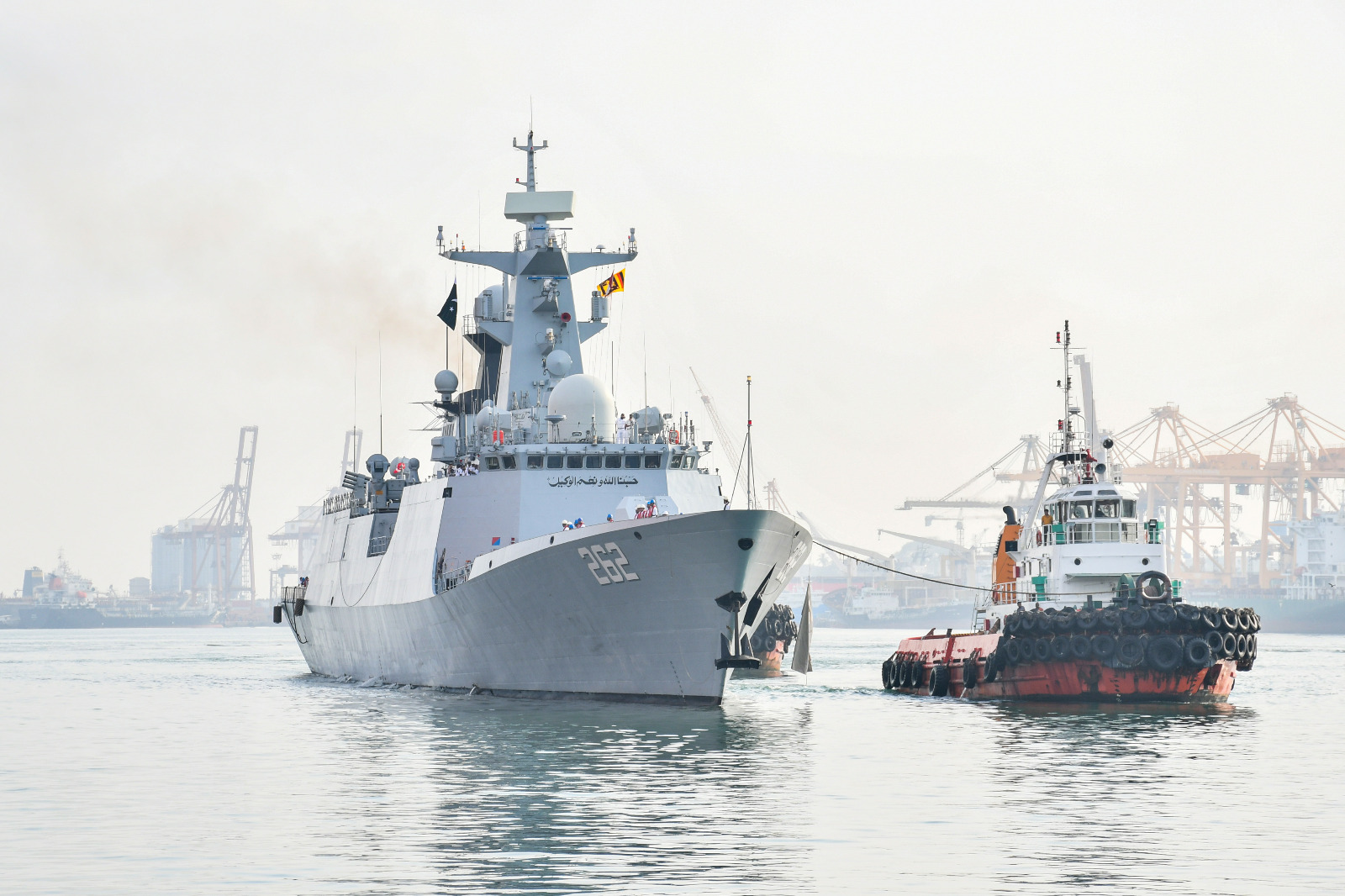
The Pakistan Navy Ship (PNS) TAIMUR and ASLAT arrived at the Port of Colombo on a goodwill visit on 12 Apr 26.
The visiting ships were welcomed by the Sri Lanka Navy in
compliance with naval traditions.
The duo of ships is commanded by Captain NIAMAT SAEED KHAN (PNS TAIMUR) and Captain NADIR MATEEN AFRIDI (PNS ASLAT).
Meanwhile, the ships are expected to conduct a Bilateral Naval Exercise LION STAR V with the Sri Lanka Navy in Colombo seas.

Salt and Patidar power RCB past Mumbai Indians

Prasidh, Buttler set up comfortable win for Gujarat Titans

Heat Index at Caution level’ in the Northern, North-central, North-western, Western and Southern provinces and in Trincomalee district.

Showers above 75 mm are likely at some places in the Western, Sabaragamuwa, Central, Southern and North-western provinces.

Sun directly overhead Pesalai, Mankulam and Nedunkerny about 12:11 noon

PNS TAIMUR & ASLAT arrive in Colombo

‘Dates have the highest sugar content to fight Coronavirus’

Sunday Island 27 December – Headlines

#SundayIsland 17th December – Headlines

Sunday Island – 28th March

Sunday Island Headlines – 21 March

Sunday Island – 21st February – Headlines
-

 News6 days ago
Lankan-origin actress Subashini found dead in India
-

 News4 days ago
AG: Coal procurement full of irregularities
-

 News1 day ago
CEB orders temporary shutdown of large rooftop solar systems
-

 Business3 days ago
Israeli attack on Lebanon triggers local stock market volatility
-

 Business4 days ago
Hayleys Mobility introduces Premium OMODA C9 PHEV
-

 Business3 days ago
HNB Assurance marks 25 years with strategic transformation to ‘HNB Life’
-

 News6 days ago
UN Regional Director launches SL’s first Country Gender Equality Profile during official visit
-

 News6 days ago
Dialog Launches ‘GanuDenu QR’, Making Cashless Transfers Free for All with eZ Cash and Dialog Finance