
Latest News
1,000-acre forest plantation project to be launched under “Clean Sri Lanka” programme


Under the “Clean Sri Lanka” programme, plans are underway to launch a 1,000-acre forest plantation project in collaboration with the private sector. This large-scale initiative is designed to operate under the Public-Private-People Partnership (4P) concept and a preliminary discussion on the project was held today (30) at the Presidential Secretariat.
The discussion focused on resolving technical aspects associated with the project and addressing the fundamental issues necessary for the land release.
The programme aims to implement several effective environmental projects in the coming year with the active participation of the private sector. These efforts are intended to safeguard the country’s biodiversity, forest cover and natural ecosystems, while also reinforcing the shared responsibility of the public, government and private sector in environmental conservation.
The discussion was chaired by Senior Additional Secretary to the President Russell Aponsu and Additional Secretary of the Clean Sri Lanka Programme S.P.C. Sugeeshwara, with the participation of senior officials from the Ministries of Agriculture, Livestock, Lands and Irrigation and Environment


Spain snuffed out France’s dream of a third World Cup triumph, taming their galaxy of forwards to win 2-0 and progress to a final against England or Argentina.
Didier Deschamps’ men were hot favourites for the trophy after a string of breathtaking displays in the United States but they met their match against the slick European champions at the semifinal stage on Tuesday.
Mikel Oyarzabal opened the scoring for the 2010 winners with an emphatic penalty in the first half in Arlington, Texas, and Pedro Porro doubled their lead in the second half.
Shell-shocked France could not find a way back into the match despite their wealth of attacking riches.
The game at the Dallas Stadium caught fire midway through the first half when Salvadoran referee Ivan Barton pointed to the penalty spot after a reckless challenge by France left-back Lucas Digne on Spain winger Lamine Yamal.
Oyarzabal hammered the ball past France goalkeeper Mike Maignan for his fifth goal of the World Cup to leave France trailing for the first time in the tournament.

Minutes later they suffered another blow when centre-back William Saliba had to leave the pitch after a recurrence of his lower back injury, replaced by Crystal Palace defender Maxence Lacroix.
Spain went agonisingly close to extending their lead after some dazzling one-touch football but Dayot Upamecano’s challenge denied Fabian Ruiz.
France finished the half without a single shot on target, and just two attempts overall.
Deschamps threw on Desire Doue for Bradley Barcola in the 57th minute in a bid to supercharge his attack but a minute later they were 2-0 down after a stunning team goal for Luis de la Fuente’s men.
Defender Porro delivered a sharp pass to the feet of Dani Olmo on the edge of the box and collected the return ball before coolly slotting past Maignan.
(Aljazeera)
Latest News
S. N. B. M. Patdmasiri appointed Director General of the Department of Government Factories

The Cabinet of Ministers approved the resolution furnished by the Minister of Housing, Construction and Water Supply to
appoint S. N. B. M. Patdmasiri who is a Special Grade officer in Sri Lanka Engineering Service and currently serving at the Department as the Additional Director General to the post of Director General of the Department of Government Factories with immediate effect.
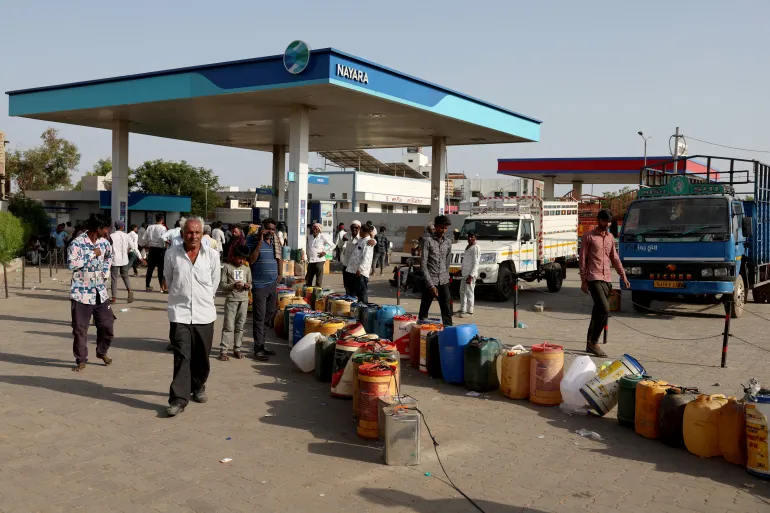
Oil prices have surged to their highest level in a month as renewed hostilities between the United States and Iran continued for a third consecutive day, dampening hopes for a return to normality in the Strait of Hormuz.
Brent crude, the primary international benchmark, rose 2.8 percent on Tuesday, extending a 9.6 percent gain from the previous day.
Brent futures for September delivery stood at $85.67 a barrel as of 07:00 GMT, the highest since June 15.
After easing to pre-conflict levels following Washington and Tehran’s signing of a memorandum of understanding (MoU) for peace last month, Brent has risen 18 percent from its price before the start of the US-Israel war on Iran in late February.
The US Central Command on Monday announced strikes on Iran for a third day, saying its forces targeted Tehran’s ability to attack “innocent civilians and commercial shipping” in the Strait of Hormuz.
Iran’s Islamic Revolutionary Guard Corps said it hit two oil supertankers in the strait and launched missile and drone strikes against US military assets in Kuwait and Bahrain in retaliation for the attacks.
Adding to the market volatility, President Donald Trump said on Monday the US would reimpose its blockade of Iranian ports and begin charging vessels transit fees as the “guardian” of the critical waterway.
“Crude oil is fast losing its strategic petroleum reserve buffer, and a violent repricing up cannot be discounted until the market sees toned-down rhetoric from both parties,” June Goh, a senior oil market analyst at Sparta Commodities in Singapore, told Al Jazeera, referring to the US government’s emergency oil stockpile, which the Trump administration has drawn on to mitigate supply constraints.
After ticking up in recent weeks amid hopes for a permanent peace deal between Washington and Tehran, traffic in the Strait of Hormuz has plummeted amid the renewed threat of violence against commercial shipping.
A total of 57 transits were recorded from Friday through Sunday, a more than 50 percent drop compared with the previous week, according to ship-tracking platform MarineTraffic.
Roughly 130 vessels transited the strait daily before the US and Israel launched their initial strikes on Iran in late February.
“Traffic through Hormuz is grinding to a halt, back to – or even below – our immediate pre-MoU pace,” Rory Johnston, founder of oil market research firm Commodity Context, told Al Jazeera.
“The oil market has proven extremely patient through this crisis, in large part thanks to an ample stock cushion upon which we were able to draw to blunt the sharpness of the supply shock,” Johnston said.
“Unfortunately, much of that cushion has now been depleted, leaving us much more vulnerable to a rerun of March and April.”
[Aljazeera]

A few showers may occur in the Western, Sabaragamuwa and North-western provinces and in Kandy, Nuwara-Eliya, Galle and Matara districts

Negombo Prison riot: No convicts among 21 inmates killed

2026: 128 elephants killed in first four-and-a-half months

Sigiriya Jungles marks 10 years with community medical camp

Protests continue in Valikamam North demanding military-held land

Dirty Money

‘Dates have the highest sugar content to fight Coronavirus’

Sunday Island 27 December – Headlines

#SundayIsland 17th December – Headlines

Sunday Island – 28th March

Sunday Island Headlines – 21 March

Sunday Island – 21st February – Headlines
-

 News5 days ago
Herath warns prospective migrant workers not to get fleeced by racketeers
-

 Features3 days ago
Prison riots and politics: NPP’s biggest challenge and Sri Lanka’s biggest opportunity
-

 Editorial4 days ago
What’s the world coming to?
-

 Foreign News5 days ago
Tensions erupt in Indian state after 11-year-old raped and murdered
-

 Features5 days ago
Devanesan Annan – in Memoriam
-

 News6 days ago
Negombo Prison riot: Ensuring protection of prisoners fundamental responsibility of the state – UN
-
Editorial5 days ago
Punishment in hellholes
-

 News6 days ago
Representatives of the Organization of Professional Associations (OPA) of Sri Lanka meet the Prime Minister