
Latest News
1,000-acre forest plantation project to be launched under “Clean Sri Lanka” programme


Under the “Clean Sri Lanka” programme, plans are underway to launch a 1,000-acre forest plantation project in collaboration with the private sector. This large-scale initiative is designed to operate under the Public-Private-People Partnership (4P) concept and a preliminary discussion on the project was held today (30) at the Presidential Secretariat.
The discussion focused on resolving technical aspects associated with the project and addressing the fundamental issues necessary for the land release.
The programme aims to implement several effective environmental projects in the coming year with the active participation of the private sector. These efforts are intended to safeguard the country’s biodiversity, forest cover and natural ecosystems, while also reinforcing the shared responsibility of the public, government and private sector in environmental conservation.
The discussion was chaired by Senior Additional Secretary to the President Russell Aponsu and Additional Secretary of the Clean Sri Lanka Programme S.P.C. Sugeeshwara, with the participation of senior officials from the Ministries of Agriculture, Livestock, Lands and Irrigation and Environment


It felt like deja vu for Delhi Capitals. On January 11, Sophie Devine defended six in the final over to help Gujarat Giants secure their second win. Sixteen days later, she was once again tasked with defending a small total – eight runs – in the final over in DC’s chase of 175, after conceding 23 in her previous. Devine delivered once again, removing Niki Prasad and Sneh Rana, to give GG a three-run win. It took them to second place on the points table and a big step towards the knockouts.
Before that dramatic finish, DC had looked dangerous, thanks to late cameos from Prasad and Rana. From 100 for 6, the duo put on a 70 off just 31 balls to almost pull off a miracle.
Anushka Sharma walked in at 1 for 19 after Devine fell to Marizanne Kapp in the third over and, in a brief but decisive stay, wrested momentum from DC. Nervy at first, she soon settled, trusting her bottom hand and playing the ball rather than the bowler. A backfoot punch past mid-off off Nandani Sharma brought her first boundary, followed by a wristy clip through midwicket that underlined her control.
Kapp, with the best powerplay economy in this WPL at under five, bore the brunt in the fifth over as Anushka opened her shoulders for three fours, driving and whipping through square leg with minimal fuss. She struck eight fours in all and looked set for a big score, but after being dropped by Chinelle Henry at mid-off off Shree Charani, she attempted a slog sweep the next ball and was caught by Minnu Mani at deep midwicket for 39, leaving GG 73 for 2 in the ninth over.
Mooney held the innings with a composed knock. She was 16 off 18 balls when Anushka departed and had managed just one boundary until then. At the halfway stage, GG were 80 for 2. Jemimah Rodrigues’ decision to bowl out Kapp in the 11th over, however, worked in Mooney’s favour as she smashed three fours off her. Having found her rhythm, Mooney hit two more boundaries to backward point to bring up her first fifty of this WPL, off 40 balls. Mooney’s stay was cut short in the 17th over by Nandani’s slower ball.
The innings then unravelled, with GG losing wickets in a cluster between the 15th and 18th overs, including Georgia Wareham, Bharti Fulmali, Kanika Ahuja, and Kashvee Gautam, as Charani struck twice in an over.
Just as DC seemed to pull the game back, Tanuja Kanwar – who had missed the previous game – lifted GG to a competitive 174 with an 11-ball 21. She capped it 15 runs off Henry in the final over, smoking a six over the bowler’s head after hitting two fours. Charani finished as DC’s best bowler, returning figures of 4 for 31.
DC made a brisk start to the chase, reaching 41 for 1 at the end of five overs. But Devine removed Lizelle Lee off the final ball of the powerplay with a slower delivery. From the seventh over onwards, Kanwar and Ash Gardner bowled tight lines to Laura Wolvaardt and Rodrigues, conceding just 15 runs across three overs.
Although Georgia Wareham was taken for 12 in the tenth, it prompted the captain to bring Devine back – and she struck immediately, rattling Rodrigues’ stumps as the batter attempted a scoop. Two balls later, Gardner removed Kapp, and by the end of 12 overs, DC’s required run rate had climbed to 11.37. Wolvaardt soon fell to Gayakwad, leaving DC 85 for 5, and it became 100 for 6 with 75 needed from 33 balls.
But Devine struck in the final over, removing Rana and Prasad. Despite a tense two-run attempt and frantic running between the wickets, Devine’s slower deliveries and smart field placements saw both batters caught in the deep, allowing GG to hold on for a dramatic win.
Brief scores:
Gujarat Giants Women 174 for 9 in 20 overs (Beth Mooney 58, Sophie Devine 13, Anushka Sharma 39, Georgia Wareham 11,Tanuja Kanwar 21; Marizanne Kapp 1-34, Chinell Henry 2-38, Nandani Sharma 1-26, Shree Charani 4-31, Minnu Mani 1-23) beat Delhi Capitals Women 171 for 8 (Shafali Verma 14, Lizelle Lee 11, Laura Wolvaardt 24, Jemimah Rodrigues 16, Niki Prasad 47, Sneh Rana 29; Sophie Devine 4-37, Rajeshwari Gayakwad 3-20,Ashleigh Gardner 1-37) by three runs
[Cricinfo]

England’s batting might have arrived in scintillating style for the third ODI against Sri Lanka as Harry Brook smoked 136 not out off 65 balls, Joe Root struck 111, and England mounted a mammoth score of 357 for 3.
On a track that has historically been unkind to chasing teams, Sri Lanka made a valiant charge at the target, led by Pavan Rathnayake, who hit a maiden international hundred in his fourth ODI.
Although Sri Lanka threatened at times, staying within range of the required rate, England’s bowlers struck too frequently, and were too economical through the middle overs. Sri Lanka were ultimately all out for 304 in the 47th over. Aside from Rathnayake’s 121 off 115, Pathum Nissanka’s 50 off 25 was the only other substantial score.
This victory hands England the ODI series 2-1 – their first away series victory since beating Bangladesh in March 2023. Sri Lanka, meanwhile, have lost their first home ODI series since going down to India in 2021.
In the second innings, England’s attack hunted together – Adil Rashid, Jamie Overton, Will Jacks, and Liam Dawson all claiming two wickets apiece before Sam Curran bowled Rathnayake to bring the match to a close. But it had been their utter domination of the first innings that set up this win. Only two of the five batters who came to the crease was dismissed for less than 50 – Jacob Bethell also hitting 65 in a 126-run stand with Root.
Even that stand didn’t compare to the partnership that was to come, however – Root and Brook put on 191 together off as few as 113 deliveries. Although Root sped up towards the death, that transforming of what would have been a good total into a gargantuan one was all Brook’s doing. He crashed nine sixes and 11 fours, reaping 101 runs off the last 40 balls he faced. The final overs were a showcase of Brook’s extraordinary clean hitting; the last five overs cost Sri Lanka a dizzying 88 runs.
In cramming their attack with spinners, Sri Lanka had banked on getting wickets in the middle overs. When England arrived at the 40th over only three down, Sri Lanka were always likely to suffer in the final 10.
The three most-experienced bowlers’ figures make for the bleakest reading – Asitha Fernando went at 8.55 runs an over, while both Wanindu Hasaranga and Jeffrey Vandersay returned figures of 1 for 76 apiece from their 10 overs. Dunith Wellalage maintained an economy rate of 4.9, but this was largely a function of him having mostly bowled out before the death. In his last over – the 45th of the innings – Wellalage also conceded 13.
Before Brook’s assault, though, Root had given the innings some substance. When he arrived at the crease in the seventh over, England had made an inauspicious start – Ben Duckett and Rehan Ahmed having plodded along at less than three an over. Things did not seem to be improving when Ahmed pulled Hasaranga to short midwicket on 24, leaving England 40 for 2 in the 11th over.
But then Bethell and Root bedded down on a surface that wasn’t especially given to run scoring. As Sri Lanka unleashed its spin-heavy attack, the batters settled on spiking the scoring rate only occasionally, before returning to accumulating steadily. Root was brisker than Bethell, getting to fifty off the 54th ball he faced, but that’s only because he is a better manipulator of the field. Of those first 50 runs, only 18 came from boundaries. In fact, of his entire 111 off 108, 61 came from singles, twos, and threes.
The innings was already moving into a higher gear when Brook arrived. But Brook energized the advance, steering his first ball for four behind square, before unleashing the more powerful strokes. After 15 balls at the crease he had hit two fours and a six, but it was after the 43rd over that he really exploded.
The off-side hitting was spectacular; Brook would frequently make room to hit both spinners and seamers over the extra cover boundary to delight the thousands of England supporters who had made the trip for this series. Root completed his 20th hundred off the 100th ball he faced, and then largely just stayed out of Brook’s way.
While midwicket and cover were Brook’s favourite zones for six-hitting, he also peppered the boundary behind square on the offside with four. He faced all but two deliveries in the last two overs, and England scored 40 runs off them.
Nissanka set the hosts racing in response. He blasted five fours and three sixes inside the powerplay to get Sri Lanka ahead of the run rate, with a little help from Kamil Mishara and Kusal Mendis, who produced early cameos. But when Nissanka was dismissed in the 10th over, Sri Lanka’s chances nosedived, with two wickets having gone down already. Before long, they were 131 for 4.
Batting at No. 4 for the first time in ODIs, Rathnayake added the substance Sri Lanka’s runaway train of a chase required, however. He was severe on errors of length especially, and used his feet against spin to devastating effect, coming down the track repeatedly to hit them aerially over midwicket.
But he progressed at roughly a run-a-ball, choosing to take the game deep even as he ran out of partners. There was a 50-run stand for the seventh wicket with Dunith Wellalage, but it wasn’t enough. England continued to take Rathnayake’s partners out.
He didn’t just close up and play for the hundred. Aside from a little hesitation in moving from 99 to a first international ton, Rathnayake continued to pursue an unlikely total, even when the required rate had climbed past 12. But in the 47th over, Curran bowled a yorker that prompted a tired shot, and Rathnayake’s stumps were rattled. He’d hit 12 fours and a six in all.
Brief scores:
England 357 for 3 in 50 overs (Harry Brook 136*, Joe Root 111*, Jacob Bethell 65; Dhananjaya de Silva 1-45) beat Sri Lanka 304 in 46.4 overs (Pavan Rathnayake 121, Pathum Nissanka 50; Jamie Overton 2-48, Liam Dawson 2-48, Will Jacks 2-43, Adil Rashid 2-61) by 53 runs

Pavan Rathnayake anchored Sri Lanka’s run-chase [Cricinfo]
[Cricinfo]
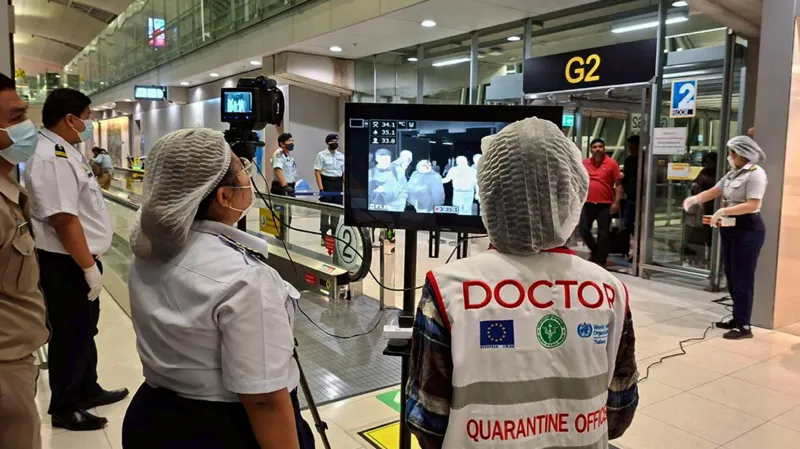
An outbreak of the deadly Nipah virus in India’s West Bengal state has sparked concern in parts of Asia, with some tightening screening measures at airports.
Thailand has started screening passengers at three airports that receive flights from West Bengal. Nepal has also begun screening arrivals at Kathmandu airport and other land border points with India.
Five healthcare workers in West Bengal were infected by the virus early this month, one of whom is in a critical condition. Some 110 people who were in contact with them have been quarantined.
The virus can spread from animals to humans. It has a high death range – ranging from 40% to 75% – as there is no vaccine or medicine to treat it.
The Nipah virus can be transmitted from animals, like pigs and fruit bats, to humans. It can also spread person-to-person through contaminated food.
The World Health Organization has described Nipah in its top ten priority diseases, along with pathogens like Covid-19 and Zika, because of its potential to trigger an epidemic.
The incubation period ranges from four to 14 days.
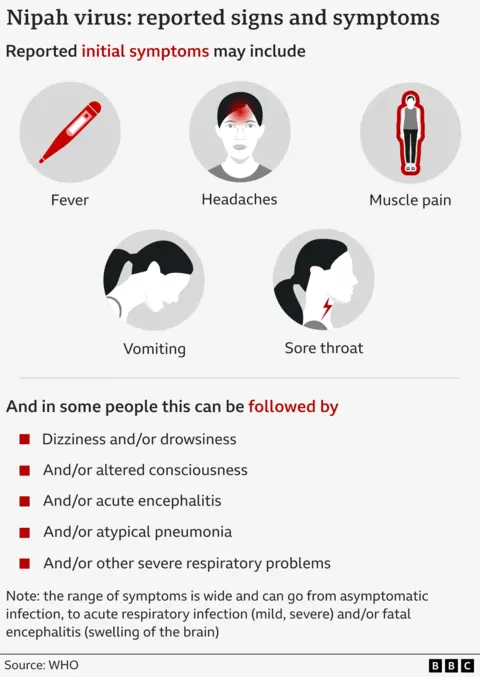
People who contract the virus show a wide range of symptoms, or sometimes, none at all.
Initial symptoms may include fever, headaches, muscle pain, vomiting and sore throat. In some people, these may be followed by drowsiness, altered consciousness, and pneumonia.
Encephalitis, a sometimes-fatal condition that causes inflammation of the brain, may occur in severe cases.
To date, no drugs of vaccines have been approved to treat the disease.
The first recognised Nipah outbreak was in 1998 among pig farmers in Malaysia and later spread to neighbouring Singapore. The virus got its name from the village where it was first discovered.
More than 100 people were killed and a million pigs culled in an effort to contain the virus. It also resulted in significant economic losses for farmers and those in the livestock trade.
Bangladesh has borne the brunt in recent years, with more than 100 people dying of Nipah since 2001.
The virus has also been detected in India. Outbreaks were reported in West Bengal in 2001 and 2007.
More recently, the southern state of Kerala has been a Nipah hotspot. In 2018, 19 cases were reported of which 17 were fatal; and in 2023, two out of six confirmed cases later died.
At least five confirmed cases were reported as of last week, all of whom were linked to a private hospital in Barasat. Two nurses are being treated in an intensive coronary care unit, one of whom remains in “very critical” condition, local media reported citing the state’s health department.
No cases have yet been reported outside India, but several countries are stepping up precautions.
On Sunday, Thailand started screening passengers at three international airports in Bangkok and Phuket that receive flights from West Bengal. Passengers from these flights have been asked to make health declarations.
The parks and wildlife department has also implemented stricter screenings in natural tourist attractions.
Jurai Wongswasdi, a spokeswoman for the Department for Disease Control, told BBC Thai authorities are “fairly confident” about guarding against an outbreak in Thailand.
Nepal, too, has begun screening people arriving through the airport in Kathmandu and other land border points with India.
Meanwhile, health authorities in Taiwan have proposed to list the Nipah virus as a “Category 5 disease”. Under the island’s system, diseases classified as Category 5 are emerging or rare infections with major public health risks, that require immediate reporting and special control measures.
[BBC]

Devine denies Delhi Capitals once again in final over

Four Chief Prelates urge President to appoint NAO official as Auditor General

PM pushes for expansion of skills and training at Davos confab

British HC meets families of missing persons

PSC to complete inquiry within three months

AKD’s Jaffna visit sparks controversy

‘Dates have the highest sugar content to fight Coronavirus’

Sunday Island 27 December – Headlines

#SundayIsland 17th December – Headlines

Sunday Island – 28th March

Sunday Island Headlines – 21 March

Sunday Island – 21st February – Headlines
-

 Business2 days ago
ComBank, UnionPay launch SplendorPlus Card for travelers to China
-

 Business3 days ago
ComBank advances ForwardTogether agenda with event on sustainable business transformation
-

 Opinion6 days ago
Remembering Cedric, who helped neutralise LTTE terrorism
-
 Business6 days ago
CORALL Conservation Trust Fund – a historic first for SL
-
 Opinion3 days ago
Conference “Microfinance and Credit Regulatory Authority Bill: Neither Here, Nor There”
-

 Opinion5 days ago
A puppet show?
-

 Opinion2 days ago
Luck knocks at your door every day
-
 Features5 days ago
‘Building Blocks’ of early childhood education: Some reflections