
News
X-Press Pearl disaster: Lanka seeks Chinese help to evaluate pollution

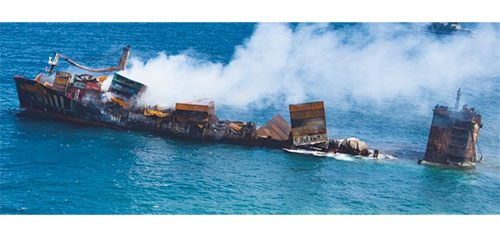
Sri Lanka has requested Chinese help to evaluate the scale of the pollution caused by the X-Press Pearl disaters, Xinhua reported on June 3.
A fire erupted on board the vessel on May 19. The government made an abortive bid to tow the vessel to deep seas. It sank on Thursday (3)
Xinhua report said: On day two after the explosion, Chinese experts from the China-Sri Lanka Joint Center for Education and Research (CSL-CER) received a request from Sri Lanka’s National Aquatic Resources Research and Development Agency (NARA), the principal national institute responsible for safeguarding aquatic resources in the country.
Through a forecast model, the CSL-CER helped evaluate the scale of the pollution caused by the debris and the extent to which the chemicals could spread.
The southwest monsoon makes frequent landfall in Sri Lanka in May. At the observation site of the CSL-CER based on the campus of the University of Ruhuna, an Automatic Weather Station (AWS) has been recently updated to study the effects of the monsoon outbreak.
Luo Yao, associate professor at the CSL-CER, told Xinhua that the AWS can improve the accuracy of forecasting models, and it can forecast marine environmental disasters caused by the burnt cargo ship.
“The AWS can monitor the atmospheric pressure, wind speed and direction, solar radiation and other marine atmospheric parameters. The accumulated data through long-term observations can be used to study the impact of climate change, sea level rise and other issues in the Indian Ocean and surrounding areas,” Luo said.
Sri Lanka is located in an area with warm currents between the Indian Ocean and Pacific Ocean and is one of the most active regions on the path of the monsoon, with frequent marine meteorological disasters. Due to the shortage of marine scientific research personnel and the lack of a mature monsoon climate forecast system, Sri Lanka is vulnerable to marine disasters.
In order to strengthen the capacity to cope with climate change, the CSL-CER was established in 2015 at the University of Ruhuna, the only university in Sri Lanka with a faculty of fisheries and marine sciences.
Vijithamuni Zoysa, former Sri Lankan minister of fisheries, once spoke highly of the observation network, saying that “the network has provided scientific and technological support for the development of the marine economy in Sri Lanka and the reduction of marine meteorological disasters caused by extreme weather such as tsunamis and storms, which are related to people’s livelihood and economic development.”
Although the COVID-19 pandemic has caused some difficulties for personnel exchanges at the center, it has not stopped its activities. In March this year, the China-Sri Lanka Joint Workshop on Monsoon Climate and Marine Environmental Resource was held as scheduled in both China and Sri Lanka simultaneously by combining online and offline methods.
“As an island country, Sri Lanka is particularly concerned about the monsoon. The enhanced cooperation between China and Sri Lanka on the monsoon issue will enable us to better understand the impact of the monsoon on the environment and reduce disasters caused by climate change,” said Tilak Gamage, co-director of the CSL-CER.
“The successive bilateral seminars on the ocean and climate have greatly enhanced Sri Lanka’s capacity to address climate issues and influence in the international arena,” Gamage said.
Zhang Changsheng, director of the CSL-CER, told Xinhua that since its establishment, the CSL-CER has not only done research but also paid attention to cultivating marine science talent in Sri Lanka.
The center has trained about 30 Sri Lankan graduate students in the fields of marine science and environmental science. They have later engaged in further scientific research in Sri Lanka.
The center has also conducted hydrological training for Sri Lankan institutions and trained personnel for meteorological observation, instrument use, and maintenance.
Charith Madusanka, a research fellow currently employed by both the CSL-CER and his alma mater the University of Ruhuna, is the first China-trained master’s degree student in oceanography from Sri Lanka.
Madusanka said, “Since I went to China, many of my classmates have turned to China.”
Nalin Wikramanayake, a senior Sri Lankan oceanographer, told Xinhua that the CSL-CER has made a major contribution to marine sciences and oceanography in Sri Lanka.

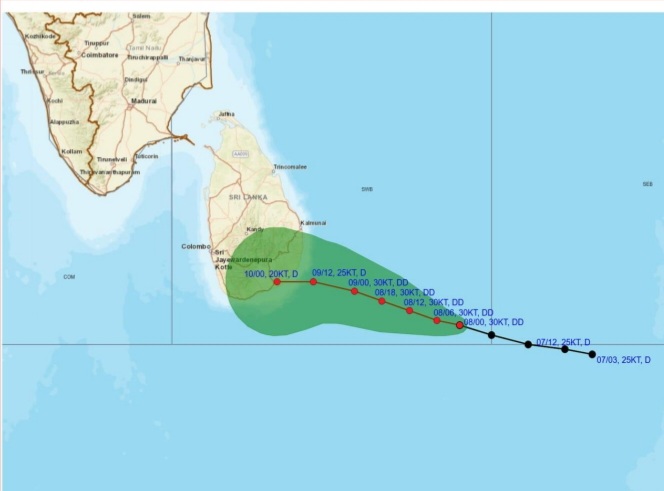
Warning for deep depression over South-east Bay of Bengal Sea area.
Issued by the Natural Hazards Early Warning Centre, Department of Meteorology at 10.30 a.m. on 08 January 2026 for the period until 10.30 a.m. 09 January 2026
The depression in the Bay of Bengal to the southeast of Sri Lanka has intensified into a deep depression and is centered near latitude 5.4°N and longitude 85.3°E, about 420 km southeast of Pottuvil at 05.30 a.m. today (08th). The above system is currently (10:00 a.m.) located about 300 km southeast of Pottuvil.
It is very likely to move west-northwestwards across the southwest Bay of Bengal and cross the Sri Lanka coast between Hambantota and Kalmunai between 5.30 p.m. to 11.30 p.m. on Friday [9th January 2026].
Hence, showery, and windy condition over the island, particularly in the Northern, NorthCentral, Eastern, Uva and Central provinces is expected to enhance from today (08th).
For the Land area:
DAMAGE EXPECTED:
• Damage to huts, temporary shelters and light structures
• Destroy the roof tops/ sheets etc.
• Damage to power and communication lines.
• Breaking of tree branches and uprooting of large avenue trees.
• Damage to paddy crops, banana, papaya trees and orchards.
• Damage to harbor yachts
• Flash flood
• Sea water inundation in low lying areas in the near coast.
Action suggested for the Land area:
• Coastal hutment dwellers are advised to move to safer places. Other people in the affected areas to remain indoors.
• People living in hilly areas (particularly landslide prone areas) and low lying areas in river basins are requested to be vigilant.
• Drivers and people using roads in the hilly areas are requested to be vigilant.
• Beware of fallen trees and power lines.
• Avoid using wired telephones and connected electric appliances during thunderstorms.
• General public is requested to be vigilant regarding impending extreme weather situation.
• For emergency assistance contact the local disaster management authorities.
• Requested to be attentive about future advisories issued by the Department of Meteorology in this regard.


Latest News
Showers above 100 mm are likely at some places in the Eastern and Uva provinces and showers about 50-75 mm in other areas


WEATHER FORECAST FOR 08 JANUARY 2026
Issued at 05.30 a.m. on 08 January 2026 by the Department of Meteorology
The depression over the Bay of Bengal, located to the southeast of Sri Lanka, was centered near latitude 5.3°N and longitude 86.0°E, about 490 km southeast of Pottuvil, at 11:30 p.m. yesterday (07). It is expected to move west-northwestwards and towards the eastern coast of the island during next 24 hours. This system is likely to intensify further into a deep depression during the next 12 hours.
Cloudy skies can be expected over most parts of the island.
Showers or thundershowers will occur at times in the Northern, North-central, Eastern, Uva, Central and Southern provinces. Showers or thundershowers may occur at several places elsewhere in the Island after 1.00 p.m. Heavy showers above 100 mm are likely at some places in the Eastern and Uva provinces. Fairly Heavy showers about (50 – 75) mm are likely at some places in the other areas of the island.
Strong winds about (50-60) kmph can be expected at times over the Eastern slopes of the central hills, the Northern, North-central, North-western and Eastern provinces and in Hambantota, Gampaha, Colombo and Monaragala districts.
The general public is kindly requested to take adequate precautions to minimize damages caused by temporary localized strong winds and lightning during thundershowers.

Minister of Public Security Ananda Wijepala told Parliament yesterday that information uncovered during ongoing investigations indicated that Pulasthini Mahendran, also known as Sara Jasmine, linked to the 2019 Easter Sunday terror attacks, was not dead.
Responding to a question raised by Opposition MP Mujibur Rahuman, the Minister said there was no confirmation that Sara Jasmine was currently in India, despite speculation to that effect. He added that investigators suspected she may have fled the country and stressed that further inquiries were underway to establish her whereabouts.
“If necessary, the government will take steps to obtain a warrant,” Wijepala said, noting that legal action related to the Easter attacks had already been initiated, based on available evidence.
Minister Wijepala said the new government had launched an thorough probe to determine whether a political or other conspiracy had been behind the attacks that killed more than 270 people in 2019. However, he declined to disclose certain details in Parliament, citing the risk of hampering investigations.
Sara Jasmine, Mohammed Hashtun, who bombed St. Sebastian’s Church, in Katuwapitiya, in 2019, was long presumed to have died in a suicide blast in Sainthamaruthu, days after the attacks. Wijepala said attempts by previous administrations to establish her death had failed, with recent reports indicating that DNA tests conducted at the time were inconclusive.
During the debate, MP Rahuman recalled that senior figures, including then-Opposition MP Nalinda Jayatissa, had previously claimed Sara Jasmine was in India. He questioned why authorities had not sought an open warrant for her arrest whether the issue had been raised in talks with Indian officials.
Wijepala, responding on behalf of Deputy Minister of Defence Arun Jayasekara, said the government would not hesitate to pursue legal action, including warrants, if necessary.
By Saman Indrajith

ECB launch ‘thorough review’ in wake of 4-1 Ashes defeat

Warning for deep depression over South-east Bay of Bengal Sea area

It’s 4-1 to Australia after Carey and Green complete stuttering chase at SCG

US seizes two ‘shadow fleet’ tankers linked to Venezuelan oil

Showers above 100 mm are likely at some places in the Eastern and Uva provinces and showers about 50-75 mm in other areas

Easter Sunday attacks: Govt. says wife of Katuwapitiya Church bomber alive

‘Dates have the highest sugar content to fight Coronavirus’

Sunday Island 27 December – Headlines

#SundayIsland 17th December – Headlines

Sunday Island – 28th March

Sunday Island Headlines – 21 March

Sunday Island – 21st February – Headlines
-

 News2 days ago
Interception of SL fishing craft by Seychelles: Trawler owners demand international investigation
-

 News2 days ago
Broad support emerges for Faiszer’s sweeping proposals on long- delayed divorce and personal law reforms
-

 News3 days ago
Private airline crew member nabbed with contraband gold
-

 News1 day ago
Prez seeks Harsha’s help to address CC’s concerns over appointment of AG
-

 News1 day ago
Govt. exploring possibility of converting EPF benefits into private sector pensions
-

 News5 days ago
Health Minister sends letter of demand for one billion rupees in damages
-

 Features2 days ago
Educational reforms under the NPP government
-

 Features3 days ago
Pharmaceuticals, deaths, and work ethics