
Latest News
WWC 2025: Sciver-Brunt ton, Ecclestone four-for help England brush aside Sri Lanka


Nat Sciver Brunt’s 10th WODI hundred and a four-wicket haul from Sophie Ecclestone helped England brush past a spirited if flawed Sri Lankan side in Colombo completing a dominant 89-run win, as they made it three wins in three at the World Cup – and with it go top of the group. It was Sri Lanka’s second defeat in as many games, though they have a point on board courtesy their washed out game against Australia.
Here, Sri Lanka were up against it with just 17 runs on the board when Chamari Athapaththu was stretchered off the ground after she pulled up with what looked like hamstring strain in the sixth over of the chase. It was later revealed to be nothing more than cramps impacting her right calf, allowing her to bat later in the innings, but at that point Sri Lanka might have been fearing the worst.
As it transpired the rest of Sri Lanka’s top order responded admirably. Vishmi Gunaratne struck consecutive boundaries off Lauren Bell to kickstart the chase, but before she could do any real damage she was done in by a ripper from Charlie Dean, turning sharply through bat and pad.
This brought Harshitha Samarawickrama to join Hasini Perera in the middle, and the pair set about stitching together Sri Lanka’s best partnership of the innings – 58 off 66. During this period, you wouldn’t have blamed the boisterous crowd, one filled with several young fans, from entertaining thoughts of a famous victory.
Sri Lanka had moved to 89 for 1 after 18 overs by the time Ecclestone – the number one ranked bowler in WODIs – was brought into the attack, but it wasn’t until her second over that she would begin to tighten her stranglehold on the game.
The first to go was Perera, who chipped one to straight to mid-on. That over would be a wicket maiden – one of three maidens she would bowl – as Ecclestone proceeded to almost singlehandedly end Sri Lanka’s chase.
Such was her impact she ended up bowling her entire 10 overs in a single spell, during the course of which she picked up the wickets of pretty much the entire Sri Lankan top order.
Samarawickrama was the next to fall, top edging a sweep off Ecclestone to short fine. Kavisha Dilhari then missed an arm ball, before arrived the coup de grace – one that dipped and turned, luring the recovered Athapaththu into a drive, before turning it viciously through bat and pad to crash into the stumps.
That last wicket silenced the crowd for good, and the remaining wickets fell with little fuss – even Sciver-Brunt was able to get in on the action, rounding out her day with the wickets of Anushka Sanjeewani and Dewmi Vihanga. Sri Lanka eventually folded for 164.
It was the proverbial icing on the cake for Sciver-Brunt who had earlier been on a one-woman mission to help her side overcome a tough pitch and Sri Lanka’s army of spinners.
England were helped by a host of misfields littered throughout their innings, though perhaps the defining moment occurred in the 14th over.
Sciver-Brunt was on three at the time, when she whipped one from Inoka Ranaweera hard and straight to Udeshika Prabodhani at midwicket, who just couldn’t hold on. It was the only drop of the innings, but ended up costing Sri Lanka north of 100 runs.
England had started strong, going at around five an over in the opening powerplay, thanks to Tammy Beaumont’s 32 off 29, but an ill-advised single saw the back of Amy Jones before Beaumont herself sliced one high to point.
From that point on though Sciver-Brunt was the common denominator as England strung together a spate of partnerships through the middle overs.
The highest was 60 from 73 between Sciver-Brunt and Heather Knight, a stand that had threatened to take the game away from Sri Lanka as the pair worked the field expertly, utilising deft sweeps and dabs, allied with calculated risks over the infield.
The partnership was broken against the run of play as Knight gloved a reverse-sweep to slip. It was given not out on the field, but keeper Sanjeewani petitioned heavily for the review to be taken – and it was eventually, with just two seconds on the clock.
That wasn’t Sanjeewani’s only intervention, as she also effected two sharp stumpings and helped complete a run out, in what was a consummate day out.
Like against India, Ranaweera once more shifted the momentum of the innings, this time through a jarring intervention in the 35th over. Emma Lamb was first bowled around her legs, before a sharp bit of glove work from Sanjeewani saw Alice Capsey short of her crease after she had been deceived in the flight.
Suddenly from 141 for 3 in the 31st over, England found themselves 168 for 6 a little over three overs later.
Prior to this England had been eyeing up a total in excess of 270 but just as they had been looking to accelerate, they had to hold back. It meant that between the 40th and 48th over just two boundaries were struck, as England and Sciver-Brunt prioritised inching the total up to decent territory, if not imposing.
The first real show of intent at the death came in the penultimate over, when Sciver-Brunt struck a sumptuous inside-out six over extra cover – to bring up her century – and followed it up with another loft down the ground.
The final two overs brought more runs, as England struck 28 runs in that patch to boost their total past the 250-mark, and in the end it proved to be more than enough.
Brief scores:
England Women 253 for 9 in 50 overs (Tammy Beaumont 32, Heather Knight 29, Nat Sciver-Brunt 117; Udeshika Prabodhani 2-55, Sugandika Kumari 2-66, Inoka Ranaweera 3-33, Kavisha Dilhari 1-34) beat Sri Lanka Women 164 in 45.4 overs (Hasini Perera 35, Harshitha Samarawickrema 33, Nilakshika Silva 23; Sophie Ecclestone 4-17, Nat Sciver-Brunt 2-25, Charlie Rean 2-47) by 89 runs
[Cricinfo]


Donald Trump had been warning for months that a Supreme Court decision like this would be catastrophic.
If the court curtailed his ability to impose these tariffs, he had said, it would be an “economic and national security disaster”.
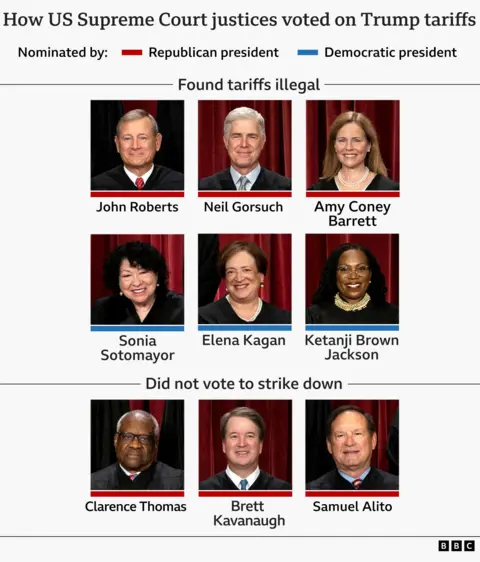
A six-justice majority of the Supreme Court, in ruling against the president on Friday, didn’t care much about his concerns.
Congress, not the president, has the power to impose tariffs, the justices ruled. And nothing in the law that the president based his tariffs on, the Emergency Economic Powers Act of 1977, delegated such sweeping powers to Trump.
The court’s decision represents a rare check on this president’s broad use of executive authority.
A majority of the justices over the past year have shown a willingness to allow Trump to press ahead with his agenda, particularly on immigration and reshaping the federal government, even as legal challenges work their way through the court system.
This case, which was fast-tracked through the court system as an emergency, slams the door on one such expansive use of presidential authority.
With several other major cases involving controversial uses of executive power, such as efforts to end birthright citizenship and to dismiss a Federal Reserve governor based on alleged improprieties, this may not be Trump’s only setback in the coming months.
At the very least, this decision weakens Trump’s hand when trying to force other nations to make concessions to the US and tarnishes his veneer of invincibility.
Weakness begets weakness, and America’s trading partners may be emboldened to take a tougher line with the US now that the president’s tariff powers have been curtailed.
It also opens up the possibility that the Trump administration may have to give back much of the tariff revenue it collected over the past year.
While the justices left this thorny issue to be decided by a lower court, Brett Kavanaugh in his dissent warned that the process is likely to be a “mess”.
The Trump administration had plenty of time to prepare for Friday’s decision.
Supreme Court precedent, and the attitude of many of the justices when the case was argued in court last November, indicated that an adverse outcome for the president was quite possible.
Jamieson Greer, Trump’s top trade adviser, said last month that the White House has “a lot of different options” on how to proceed if the tariffs were struck down.
“The reality,” he said, “is the president is going to have tariffs as part of his trade policy going forward.”
The other options that could be at Trump’s disposal are more limited, however.
They require government agencies to produce detailed reports to justify imposing tariffs, and they have limits on their scope and duration.
Gone are the days when the president could threaten, or enact, triple-digit tariffs with the wave of a pen or the click of a Truth Social post.

New tariffs will require a longer lead-in time before they are imposed.
That could limit the kind of economic disruption that took place when the president announced his expansive “Liberation Day” tariffs last year, and would give other nations more time to prepare their responses.
If Trump wants to restore his free hand to impose new tariffs, he could always ask Congress for the kind of explicit authorisation that the Supreme Court has said is necessary. But with narrow Republican majorities in the House and Senate, and midterm elections looming, the success of such a move seems unlikely.
In fact, some of Trump’s conservative allies in Congress may be breathing somewhat easier with this decision.
The president’s tariffs – and the costs they have imposed on consumers – have been unpopular among many Americans. Republican candidates in battleground states and congressional districts would have been open to Democratic attacks for supporting Trump’s policies.
That area of vulnerability has been reduced for now.
Friday’s decision will set up an awkward moment on Tuesday, when Trump delivers his annual State of the Union Address to a joint session of Congress. Traditionally, many of the Supreme Court justices sit in the front row of the chamber.
The president, after spending months issuing dire warnings against the court, could stand eye-to-eye with the justices who eroded one of the key pillars of Trump’s second-term agenda.
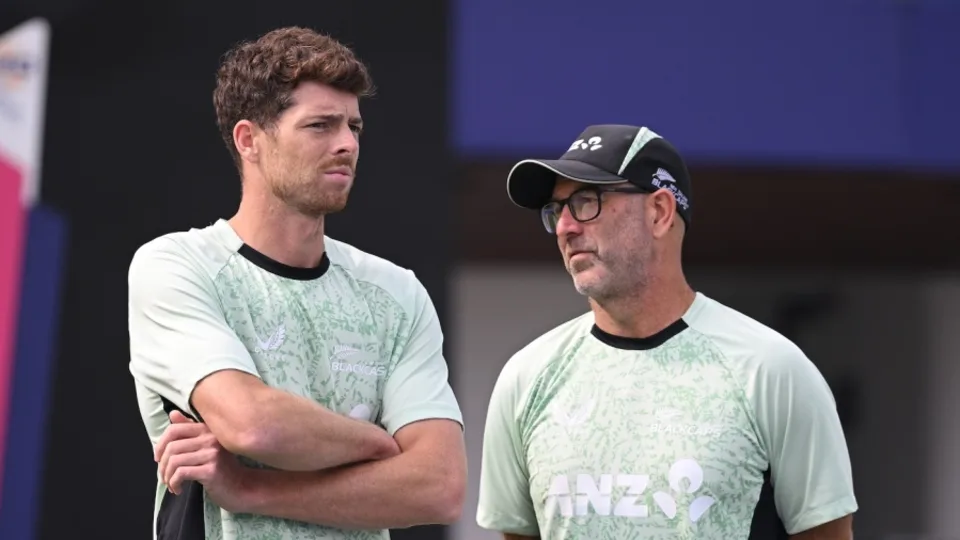
41: That’s the number of times New Zealand and Pakistan faced each other across formats in a 30-month period between October 2022 and April 2025. Twenty four of those meetings came in T20Is, with the sides compensating for a tour which New Zealand abandoned in 2021, citing security concerns by piling on as many bilateral engagements as is it was possible to fit in a calendar.
Aside from a T20 World Cup semi-final in Sydney in 2022, none of those games mattered as much as the one in Colombo on February 21. Both sides have much convincing to do as credible title-contenders after a group stage which saw them ease past lower-ranked teams while getting thumped by the one powerhouse they played. In New Zealand’s case, it was South Africa who gave them a battering, while Pakistan were left similarly bruised by an Indian side that has otherwise not quite hit its straps.
For New Zealand, the biggest challenge is the switch of venue. They played all of their games in Chennai and Ahmedabad, and relied on a balance between seam and spin that leaned towards the former, with Mitchell Santner the only frontline spinner and Rachin Ravindra or Glenn Phillips chipping in with the odd over. In Colombo, that balance is likely to reverse as the slower bowlers take centre stage, something Pakistan have deployed so effectively in most of their matches.
Santner’s men have not tinkered much with the batting order, which has held up remarkably well for the most part. Against weaker oppositions, some combination of openers Finn Allen and Tim Seifert, or top order batters Ravindra and Phillips, have showcased enough firepower to ease home. Opposition attacks have also struggled to puncture their way through, with New Zealand losing just 14 wickets in four games, the second fewest for any side in this tournament.
Unlike New Zealand, Pakistan know this city intimately well by now. Three of their four games may have been played at the SSC – the other Colombo ground – but their match against India here at the RPS was, like Saturday’s contest, also an evening game, giving them a valuable read into the pitch and conditions. It is the venue they used more spin on than any other, with captain Salman Ali Agha suggesting that would only continue in the Super Eight.
Pakistan’s top order has the explosiveness to blow teams away, even if they have struggled to translate that potential with form for Saim Ayub. Sahibzada Farhan at the other end has taken on the mantle for powerplay run-scoring as runs for Agha having dried up before the game against Namibia, and Babar Azam no nearer to maximising his ability. That fragility too quickly brings up a middle order comprising too many bowling allrounders or the untested Khawaja Nafay, a situation that led to a near-defeat against the Netherlands and a decisive defeat against India.
This is two teams situated among the middle powers of this World Cup, eager to demonstrate they’re better than what they managed against true superpowers like India and South Africa. What matters, ultimately, is which of them can show they’re better than the middle power they face off against on Saturday.
Jacob Duffy takes a wicket against Pakistan every 10.5 deliveries. Among bowlers with at least 15 scalps against Pakistan, no one in the world matches that strike rate. Eighteen of his 62 wickets have come against Saturday’s opponents, at an average of 12.77, comfortably the best amongst teams he has played more than five games against. The catch, however, is that all but one of those wickets have come in New Zealand, in conditions very different to what’ll be in front of him at the Premadasa in Colombo. But Hardik Pandya, who boasts an almost equally impressive record against Pakistan, did not find this very venue an impediment against bowling effectiveness against Pakistan. Duffy will hope to have similar success.
Abrar Ahmed was, arguably harshly, dropped against Namibia after an off-day against India. But his longer-term form makes it unlikely he will stay out of the side again in the raised stakes of the Super Eight. He was Pakistan’s second-highest wicket-taker in 2025, and at the Asia Cup last year, his economy rate of 5.36 in spin-friendly conditions was by far the most miserly in the tournament. All of that points to the India game being an aberration, with Pakistan needing him at his best for the business stages. He was Pakistan’s best bowler in the two series against Sri Lanka and Australia prior to this World Cup, and how he responds to the wake-up call of his axing may go some distance to determining the fate of Saturday’s game.
Abrar Ahmed is expected to come back into the side, but Pakistan will not want to make wholesale changes to a team that delivered so handsomely in their must-win game against Namibia.
Pakistan: Sahibzada Farhan, Saim Ayub, Salman Ali Agha (capt) Babar Azam, Khawaja Nafay, Shadab Khan, Usman Khan (wk) Mohammad Nawaz/Faheem Ashraf, Salman Mirza, Usman Tariq, Abrar Ahmed
New Zealand will take a late call on Lockie Ferguson, who gets into Sri Lanka on Friday night after being granted paternity leave. It will be interesting to see how New Zealand manage to incorporate more spin into their XI to reconcile with Sri Lankan conditions. That might bring Ish Sodhi in for his first game this World Cup.
New Zealand: Tim Seifert (wk), Finn Allen, Rachin Ravindra, Glenn Phillips, Mark Chapman, Daryl Mitchell, Mitchell Santner (capt), Jimmy Neesham, Matt Henry, Ish Sodhi Jacob Duffy
[Cricinfo]
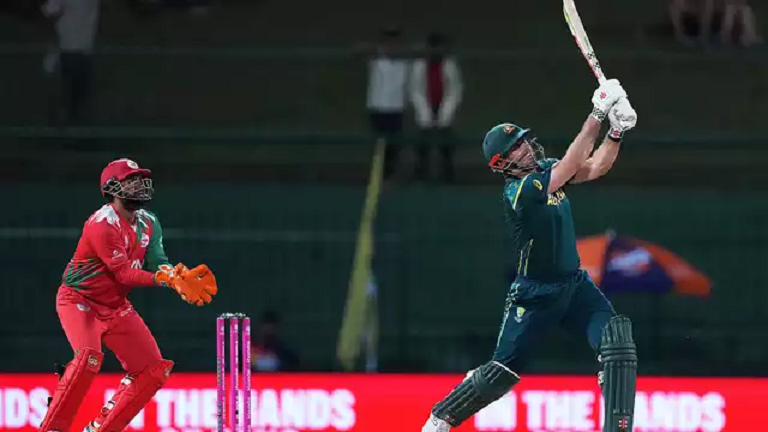
Oman 104 in 16.2 overs (Jatinder Singh 17, Karan Sonavale 12, Hammad Mirza 16, Wasim Ali 32; Marcus Stoinis 1-16, Nathan Ellis 1-14, Adam Zampa 4-21, Glenn Maxwell 2-13, Xavier Bartlett 2-27) lost to Australia 108/1 in 9.4 overs (Mitchell Marsh 64*, Travis Head 32, Josh Inglis 12*; Shakeel Ahmed 1-29) by 9 wickets

Tariffs ruling is major blow to Trump’s second-term agenda

New Zealand meet familiar opponents Pakistan at spin-friendly Premadasa

Bowlers, Marsh orchestrate consolation Australia win

Development activities in schools within plantation areas should be carried out in coordination with District Coordinating Committees – PM

Asos co-founder dies after Thailand apartment block fall

BCB central contracts: Taskin, Mushfiqur demoted; no player in A+ category

‘Dates have the highest sugar content to fight Coronavirus’

Sunday Island 27 December – Headlines

#SundayIsland 17th December – Headlines

Sunday Island – 28th March

Sunday Island Headlines – 21 March

Sunday Island – 21st February – Headlines
-

 Life style6 days ago
Marriot new GM Suranga
-

 Business5 days ago
Ministry of Brands to launch Sri Lanka’s first off-price retail destination
-

 Features6 days ago
Monks’ march, in America and Sri Lanka
-

 Features6 days ago
The Rise of Takaichi
-

 Features6 days ago
Wetlands of Sri Lanka:
-

 News6 days ago
Thailand to recruit 10,000 Lankans under new labour pact
-

 News6 days ago
Massive Sangha confab to address alleged injustices against monks
-

 Sports1 day ago
Old and new at the SSC, just like Pakistan