
News
World Bank report highlights key achievements and challenges in South Asian regional cooperation in 2024

2024 was a year marked by political change across South Asia, with elections and political upheavals dominating the headlines in countries such as Bangladesh. Amidst this political backdrop, regional cooperation saw both progress and setbacks, according to a new report by the World Bank.
The report described regional connectivity and cooperation as a “marathon”—with some areas moving ahead swiftly while others progressed more slowly. However, the overarching trend was the growing recognition among South Asian countries that certain challenges, such as air pollution and climate change, require collective action.
One of the standout achievements of 2024 was the strengthened regional consensus on tackling air pollution. Countries in the Indo-Gangetic Plain and Himalayan Foothills—namely Bangladesh, Bhutan, Nepal, India, and Pakistan—have come together to combat air pollution as a cross-border issue. In June, the second Science Policy Dialogue on Air Quality Management in Bhutan reaffirmed the need for multisectoral and transboundary collaboration. These efforts are proving to be not only more cost-effective but also faster, delivering results at 45% lower costs compared to ad hoc measures. The group set an ambitious goal of reducing annual PM2.5 concentrations to less than 35 µg/m³ by 2035.
In addition to air pollution, there is growing momentum to tackle plastic pollution, particularly marine plastic. Regional efforts are also focused on innovation in plastic usage and production to reduce waste and pollution.
Addressing climate risks continues to be a priority, with increased regional cooperation in meteorological and hydrological services. The World Bank-supported South Asia Hydromet Forum has fostered collaboration across the region, enhancing consensus forecasting and early warning systems. This cooperation is already saving lives, with improved marine forecasting helping Sri Lanka’s fishing community prepare for extreme wave heights. This example highlights the effectiveness of collaboration in mitigating climate risks.
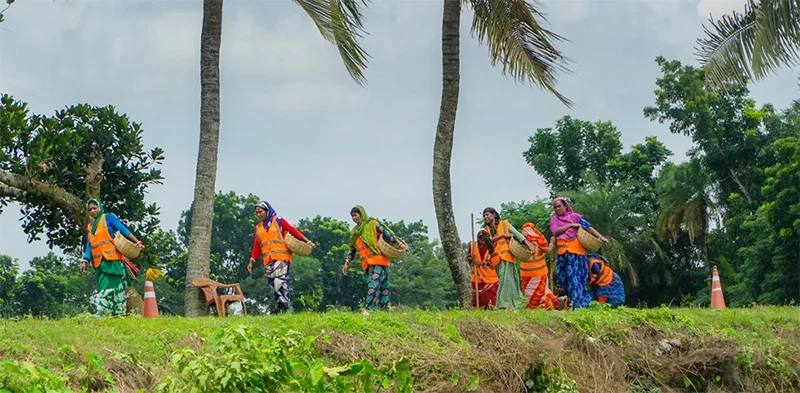
The report also spotlighted women’s increasing participation in regional development, particularly in traditionally male-dominated sectors like trade, transport, and infrastructure. Women’s inclusion in these sectors is vital to the region’s economic growth, and initiatives such as providing on-site childcare, access to separate restrooms, and well-lit spaces are helping to break down barriers. For example, women like Halima Begum in Bangladesh, employed in the construction and maintenance of regional transport corridors, and Runu Hazarika in Assam, who operates an inland water transport business, are exemplars of the region’s growing focus on gender inclusivity.
The WePower network, which supports women in the energy sector, also made significant strides in 2024, with 101 South Asian women engineers completing a leadership training program in the power sector.
A significant milestone in regional cooperation came in November 2024, when Nepal began exporting 40MW of hydroelectricity to Bangladesh via India’s grid. This historic power-sharing agreement marks the beginning of a broader energy trade between Nepal and Bangladesh, with future expansion expected. Additionally, Bhutan’s Druk Green Power Corporation signed an agreement with Tata Power in India to develop 5,000 MW of clean energy. These collaborations illustrate the critical role of private sector involvement in the clean energy transition.
The World Bank’s analysis predicts that South Asia’s energy demand will double by 2050, with emissions rising by 30%. However, the region could cut its emissions by up to 40% by leveraging cross-border electricity markets, renewable energy, and energy efficiency measures.
The South Asian Economics Students’ Meet (SAESM) marked its 20th anniversary in 2024, further emphasizing the importance of engaging the region’s youth in shaping the future of South Asia. The network brings together undergraduate economics students from across the region to foster academic exchange and strengthen regional ties. Over 90% of the SAESM alumni reported that the meet facilitated their first visit to a neighboring South Asian country, and more than 80% have maintained lasting relationships through the network.
With South Asia having the largest youth population globally, tapping into the collective energy and innovation of young people is seen as key to sustainable development and regional cooperation. These young voices are considered critical drivers of progress in the region, contributing to the vision of a unified #OneSouthAsia.
The report concludes by acknowledging that while significant progress has been made in 2024, much work remains to be done. The challenges and opportunities for collaboration will evolve, but the trajectory of regional cooperation remains positive. “This is not a sprint, but a marathon, with a long-term vision,” the report stated, reflecting the slow yet steady pace of progress that defines South Asia’s path to greater regional cooperation.







Latest News
Heat Index at Caution Level in the Northern, North-central, North-western, Western, Sabaragamuwa, Eastern and Southern provinces and in Monaragala district.


Warm Weather Advisory
Issued by the Natural Hazards Early Warning Centre
at 3.30 p.m. on 20 April 2026, valid for 21 April 2026
The Heat index, the temperature felt on human body is likely to increase up to ‘Caution level’ at some places in the Northern, North-central, North-western, Western, Sabaragamuwa, Eastern and Southern provinces and in Monaragala district.
The Heat Index Forecast is calculated by using relative humidity and maximum temperature and this is the condition that is felt on your body. This is not the forecast of maximum temperature. It is generated by the Department of Meteorology for the next day period and prepared by using global numerical weather prediction model data.

Effect of the heat index on human body is mentioned in the above table and it is prepared on the advice of the Ministry of Health and Indigenous Medical Services.
ACTION REQUIRED
Job sites: Stay hydrated and takes breaks in the shade as often as possible.
Indoors: Check up on the elderly and the sick.
Vehicles: Never leave children unattended.
Outdoors: Limit strenuous outdoor activities, find shade and stay hydrated.
Dress: Wear lightweight and white or light-colored clothing.
Note:
In addition, please refer to advisories issued by the Disaster Preparedness & Response Division, Ministry of Health in this regard as well. For further clarifications please contact 011-7446491.
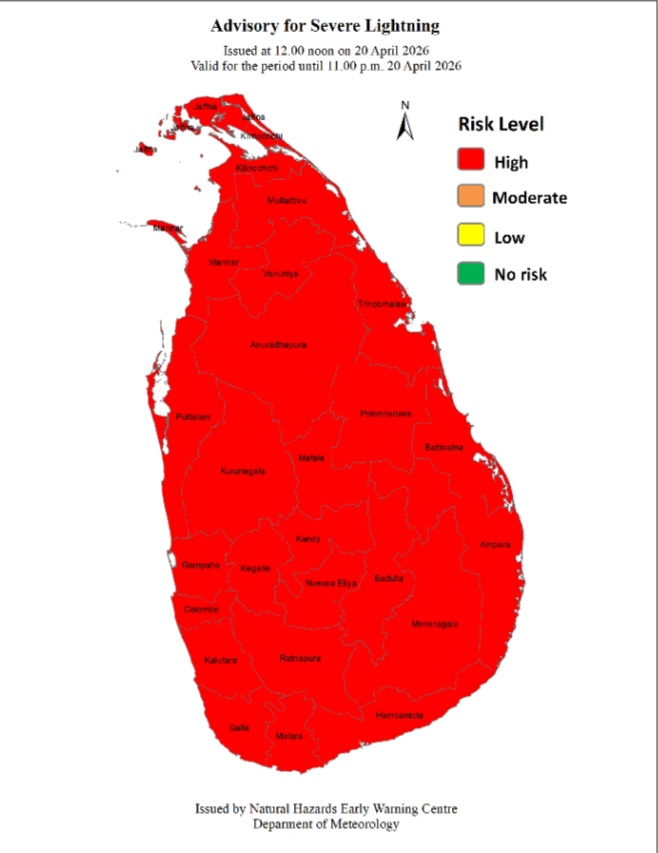
Advisory for Severe Lightning
Issued by the Natural Hazards Early Warning Centre
Issued at 12.00 noon 20 April 2026 valid for the period until 11.00 p.m. 20 April 2026
Thundershowers accompanied with severe lightning are likely to occur most places in the island after 1.00 p.m.
There may be temporary localized strong winds during thundershowers. General public is kindly requested to take adequate precautions to minimize damages caused by lightning activity.
ACTION REQUIRED:
The Department of Meteorology advises that people should:
Seek shelter, preferably indoors and never under trees.
Avoid open areas such as paddy fields, tea plantations and open water bodies during thunderstorms.
Avoid using wired telephones and connected electric appliances during thunderstorms.
Avoid using open vehicles, such as bicycles, tractors and boats etc.
Beware of fallen trees and power lines.
For emergency assistance contact the local disaster management authorities.
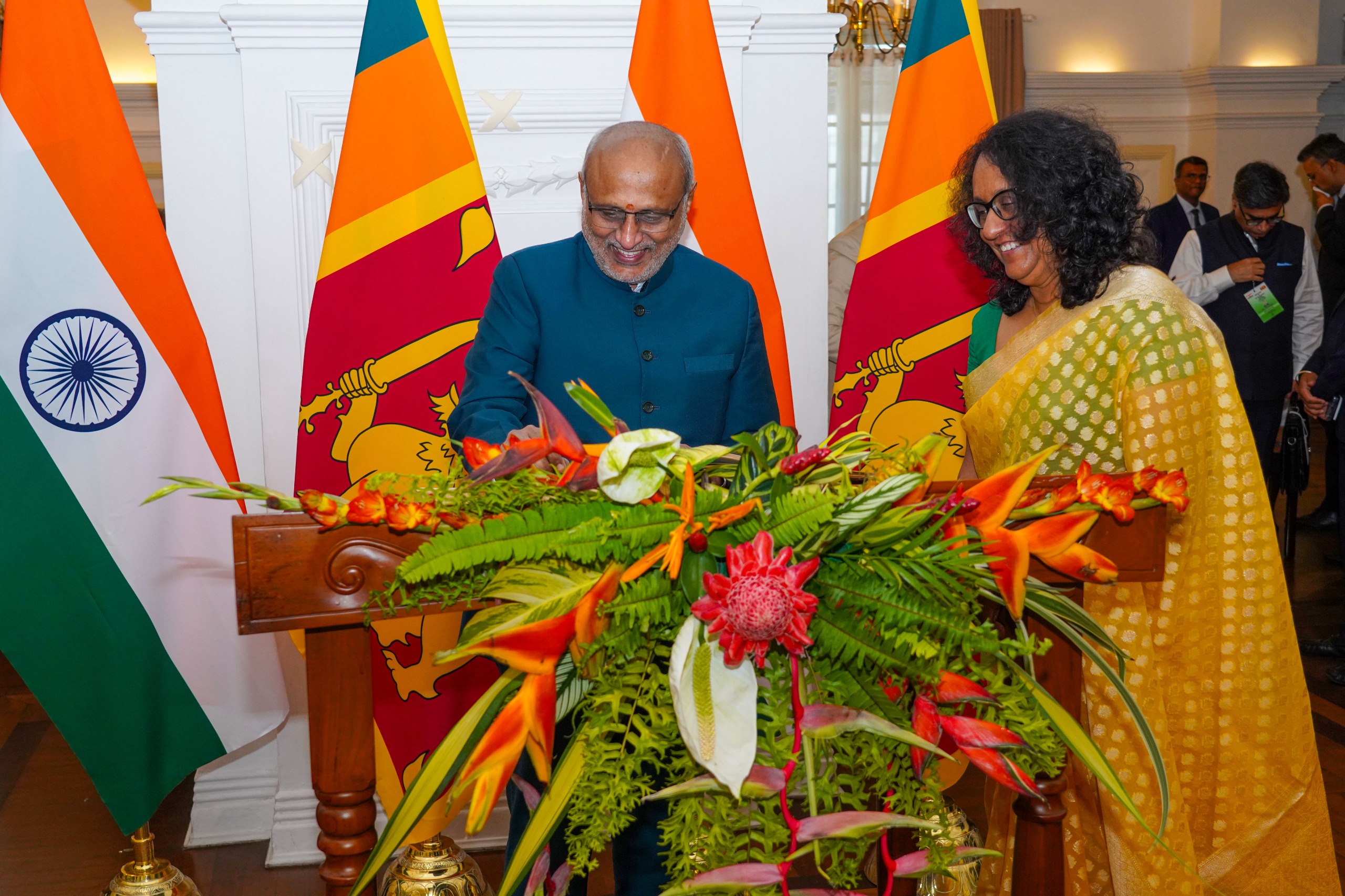
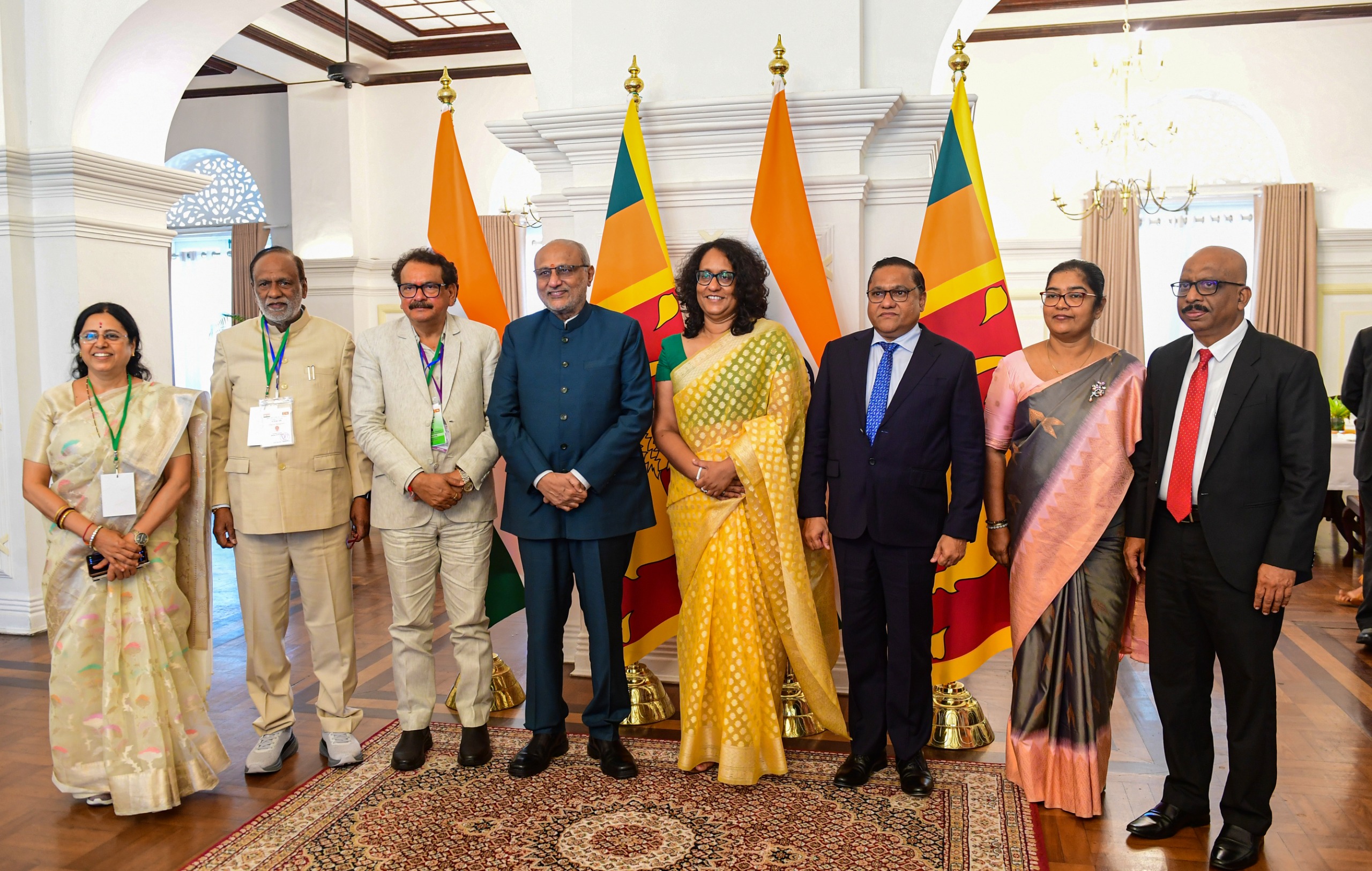
The Vice President of India, C.P. Radhakrishnan, who is currently on a two-day official visit to Sri Lanka, held a bilateral discussion with Prime Minister Dr. Harini Amarasuriya on Sunday (19) morning at Temple Trees.
Upon his arrival at Temple Trees, the Indian Vice President was received by Prime Minister Dr. Harini Amarasuriya. The Prime Minister also extended her congratulations to C.P. Radhakrishnan on his appointment as the Vice President of India.
During the meeting, the Vice President noted that this is his first official visit to Sri Lanka and expressed his appreciation for the warm welcome and hospitality extended to him during his stay.
The occasion was attended by the Minister of State for Fisheries, Animal Husbandry and Dairying, Prof. S.P. Singh Baghel; Members of Parliament Dr. K. Laxman and Dr. Medha Vishram Kulkarni; Foreign Secretary Vikram Misri; and the High Commissioner of India to Sri Lanka, Santosh Jha, and representing the Government of Sri Lanka the Minister of Foreign Affairs, Foreign Employment and Tourism Vijitha Herath; Minister of Sports Sunil Kumara Gamage; Minister of Women and Child Affairs Saroja Savithri Paulraj; Secretary to the Prime Minister Pradeep Saputhanthri; Secretary to the Ministry of Finance Harshana Suriyapperuma; Secretary to the Ministry of Education Nalaka Kaluwewa; and several other officials.
[Prime Minister’s Media Division]

Heat Index at Caution Level in the Northern, North-central, North-western, Western, Sabaragamuwa, Eastern and Southern provinces and in Monaragala district.

Dasun Shanaka handed one-year PSL ban

Nahid, Tanzid help Bangladesh level New Zealand series

Five UAE cricketers given citizenship through naturalisation

Moni, Sharmin help Bangladesh register maiden ODI win against Sri Lanka

Advisory for Severe Lightning issued for all provinces of Sri Lanka

‘Dates have the highest sugar content to fight Coronavirus’

Sunday Island 27 December – Headlines

#SundayIsland 17th December – Headlines

Sunday Island – 28th March

Sunday Island Headlines – 21 March

Sunday Island – 21st February – Headlines
-

 News5 days ago
PNS TAIMUR & ASLAT set sail from Colombo
-

 Business3 days ago
Harnessing nature’s wisdom: Experts highlight “Resist–Align” path to resilience
-

 News3 days ago
Gratiaen Trust announces longlist for the 33rd Annual Gratiaen Prize
-

 Latest News7 days ago
“I extend my heartfelt wishes to all Sri Lankans for a peaceful and joyous Sinhala and Tamil New Year!” – President
-

 News2 days ago
From Nuwara Eliya to Dubai: Isha Holdings markets Agri products abroad
-
 News3 days ago
Heroin haul transported on 50-million-rupee contract
-
 Latest News4 days ago
Singapore Zoo’s first Sri Lankan leopard cubs make their public debut
-
 Latest News7 days ago
US blockade of Iran would worsen global energy crisis, analysts say