Connect with us

Sports

Women’s IPL franchises to be unveiled on January 25

Published

on

The BCCI is likely to unveil the names of the five franchises that will contest the inaugural Women’s Indian Premier League (WIPL), and the cities they will operate from, on January 25.

The financial bids of these franchises, currently submitted in sealed envelopes, will be opened on that day. However, the BCCI has pointed out in its tender document that it is “not obliged to accept the highest monetary offer” and will look for ways for the bidders to work towards enhancing the growth of women’s cricket in India.

Last week, the BCCI released the tender inviting bids to own and operate the five franchises in the WIPL, which is likely to be held from March 5 to 23. In the Invitation to Tender (ITT) document, the summary of which has been seen by ESPNcricinfo, the BCCI has pointed out that a single bidder can contest for more than one city.

Ten cities on offer

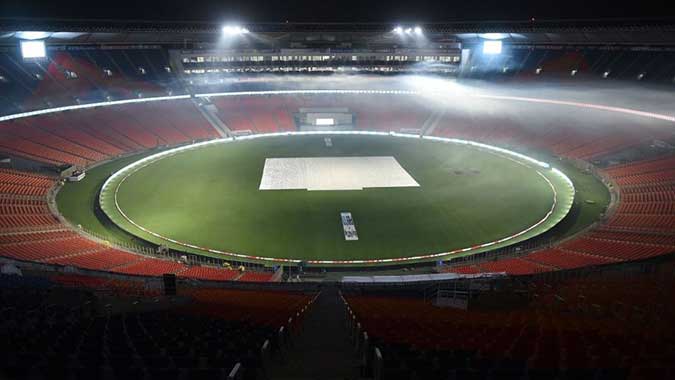
The BCCI has shortlisted a pool of 10 cities and listed the venues, including their respective capacities, in the tender. The list includes Ahmedabad (Narendra Modi stadium, capacity 112,560), Kolkata (Eden Gardens, 65,000), Chennai (MA Chidambaram stadium, 50,000), Bangalore (M Chinnaswamy stadium, 42,000), Delhi (Arun Jaitley stadium, 55,000), Dharamsala (HPCA stadium, 20,900), Guwahati (Barsapara Stadium, 38,650), Indore (Holkar stadium, 26,900), Lucknow (AB Vajpayee Ekana cricket stadium, 48,800) and Mumbai (Wankhede / DY Patil / Brabourne Stadiums). While three venues have been listed for Mumbai, the BCCI has said one of three grounds will be utilised based on “availability and other factors.”

The current plan to have a pool of 10 cities differs from the one the BCCI had originally submitted to the state associations at its annual general body meeting last year. Back then, the BCCI said it intended to either pick one city from each of the six zones across the country, or hold the tournament in a half-a-dozen cities without proper home bases for the five teams.

Determining the highest bid

Barring Dharamsala, Guwahati and Indore, the remaining seven cities already serve as home bases for the men’s IPL teams. While the BCCI has set no base price, bidders have been asked to quote a price for 10 seasons. Bidders have been given the option of contesting more than one franchise/city, but the BCCI has said the successful bidder will only be given one franchise.

“The stadium with the highest bid amount will be awarded first,” the BCCI said. “Thereafter, the stadium with the next highest bid amount will be awarded.”

In case two of the highest bids for a single venue are equal, the BCCI has said there will be a re-bid. If the highest bids for two venues from two different bidders are the same, the BCCI will have the “discretion to decide the order.” In the case of a bidder raising the top bid for more than one ground, the BCCI has the liberty to decide the venue.

(Cricinfo)



Continue Reading
Advertisement
Click to comment

Leave a Reply

Your email address will not be published. Required fields are marked *

Features

Samarawickrama’s rise gives Sri Lanka a second pillar

Published

on

By

Harshitha Samarawickrama's advance as a T20 batter has opened up a new frontier in Sri Lanka's batting performance [Cricinfo]

Harshitha Samarawickrema was 14 when Sri Lankan women’s cricket first pricked the national consciousness. She had already been playing cricket for her school, Gothami Balika Vidyalaya, but had largely pursued cricket merely for the sake of playing a sport, and also because she had enjoyed watching the men’s team play. But watching Sri Lanka defeat England in a thriller at the 2013 World Cup stirred up a deeper yearning.

“I’d watched all of the matches at that World Cup actually – that was the first time those kind of matches were telecast,” Samarawickrama said once. “That’s when I decided I was going to play and win matches for Sri Lanka one day.”

That victory against England was a new dawn for Sri Lanka’s women for two reasons. First up it was the highest-profile victory on their ledger until then, marking an unexpected high point in a World Cup in which little was generally expected of the team. But it also marked the rocket-powered arrival of Chamari Athapaththu, who top-scored with 62 to help set up the chase.

Thirteen years later, Samarawickrama has not only fulfilled her promise to herself, she has also helped Sri Lanka bring to life the promise of that 2013 campaign. Athapaththu, who has since has become the superstar around which Sri Lanka’s cricket orbits, has never known a more consistent batting collaborator than Samarawickrama. In T20Is, the pair have put on 1,202 runs together – easily the best for Sri Lanka. Though both are lefties who revel in pressure, that’s about where the similarities end – Athapaththu having grown up idolising the big-hitting of Sanath Jayasuriya, while Samarawickrama had been a disciple of the Kumar Sangakkara school of left-handed batting. (Samarawickrama still tries to replicate that famous bent-kneed cover drive, though she invariably sprinkles a little of of her own flair to the endeavour.) Oppositions have found this combination difficult to contend with, Athapaththu commanding through the legside and brutal on errors of length, while Samarawickrama flits around the crease and carves boundaries through cover and point.

It has been clear for years now that Sri Lanka’s chances in pretty much any match depend primarily on Athapaththu runs. But Samarawickrama’s advance as a T20 batter has now opened up a new frontier in the team’s batting performance. Ideally, what Sri Lanka want is not merely big runs from their captain, but a strong partnership between Athapaththu and Samarawickrama. In victories, the Athapaththu-Samarawickrama stand averages 41.38.

More tellingly, a good Samarawickrama innings has become as reliable a predictor of a strong Sri Lanka showing as a good Athapaththu innings. In T20I wins, Athapaththu averages 40.18 and strikes at 131, in comparison to 17.94 and a strike rate of 94 in losses. Samarawickrama’s corresponding numbers are even more stark. In Sri Lanka victories, Samarawickrama averages 44.08 with a strike rate of 109. In losses those numbers are 16.94 and 87. Other Sri Lanka batters have leveled up in recent years too – Kavisha Dilhari, Nilakshika Silva and Hasini Perera having become more frequent contributors, while 20-year-old Vishmi Gunaratne has also showed promise. But 11 years into her international career, Samarawickrama now has a serious body of work.

Samarawickrama had been modest in the shortest format in 2025, but she arrives at the Women’s T20 World Cup 2026 having had a good six months. Against Bangladesh in April, Samarawickrama had cracked 61 off 35, then 49 off 29, in back-to-back matches that Sri Lanka won (Samarawickrama was top-scorer on both occasions). This was in addition to having put up good numbers in the ODI series that preceded the T20Is. Her 36 not out off 34 in a comfortable warm-up win against Netherlands suggests she is still riding on that form.

This is the first T20 World Cup in which serious runs are expected of Samarawickrama, and if history is much to go by, she is not the sort to be daunted by occasion. Samarawickrama’s finest moments as a Sri Lanka cricketer had come in their most-celebrated win of all, in the Asia Cup final of 2024, against India. Typically, that chase of 166 in Dambulla had been propelled by an 87-run Athapaththu-Samarawickrama stand, but when Athapaththu was dismissed, Samarawickrama ensured she remained at the crease until the winning moments, hitting 69 not out off 51, ultimately collecting the Player-of-the-Match award.

If 2013 was a new dawn inspiring a fresh generation of Sri Lanka cricketers, 2024 was the year in which the team hammered its stake into the ground, breaking through into an entirely new galaxy of recognition and acclaim at home. Frequently batting in the shadow of Athapaththu, but always charting her own path, Samarawickrama has grown into a leader.

[Cricinfo]

Continue Reading

Latest News

Prabhsimran, Gaikwad, Tilak score fifties in DLS loss to Afghanistan A

Published

on

By

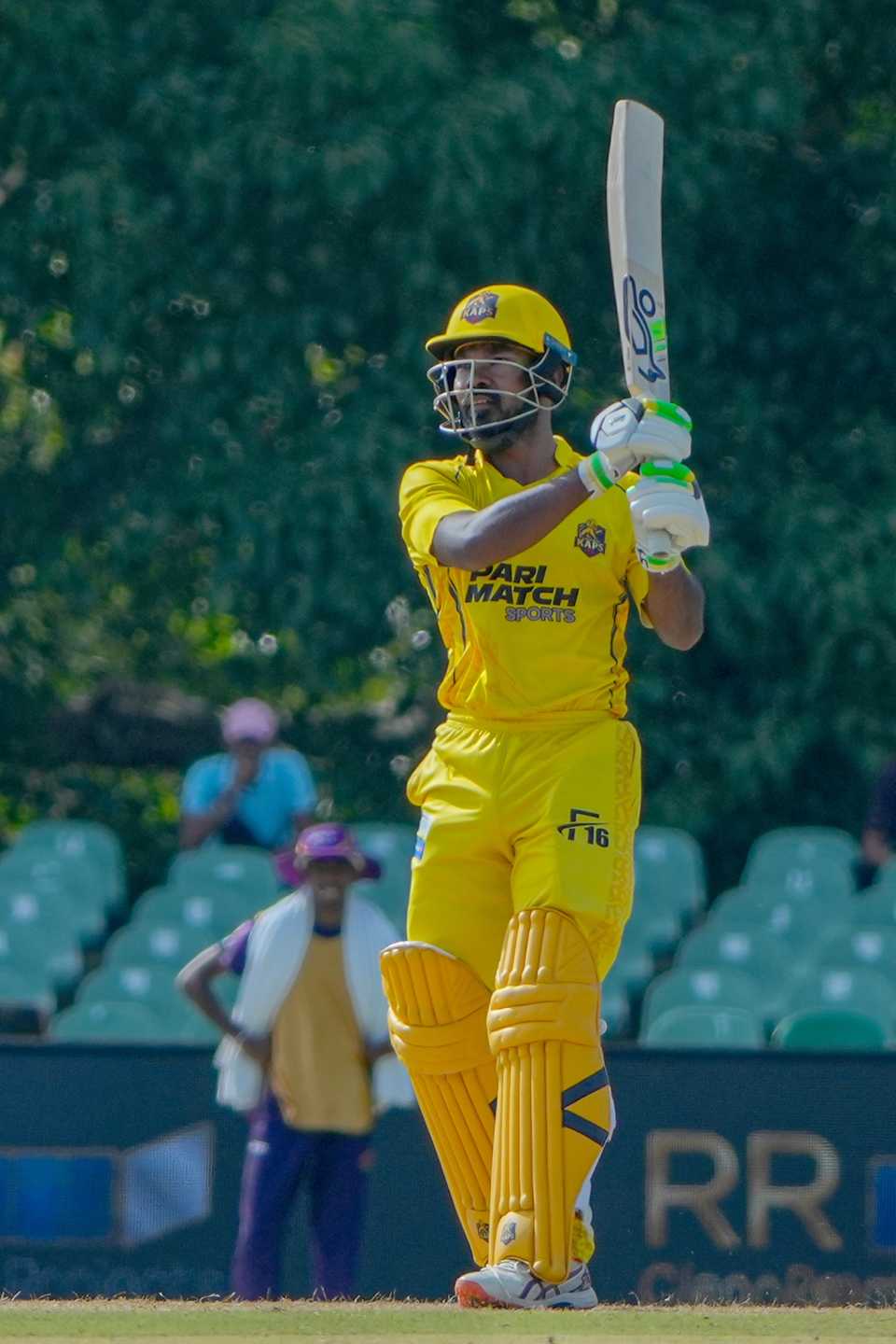
Prabhsimran Singh made 84 off 69 balls [SLC]

After a close-fought win against Sri Lanka A, India A continued their tri-series campaign with a defeat to Afghanistan A in a rain hit match in Dambulla. Prabhsimran Singh, Rutraj Gaikwad and Captain Tilak Varma all hit half-centuries to take India A to a big total, but Afghanistan A’s batters did enough to help them edge the game on DLS. Here are the key talking points from the game.

After showing glimpses of his talent in the tri-series opener against Sri Lanka A, Vaibhav Sooryavanshi put on a more impactful display against Afghanistan A. He lay down the marker early, cutting the first two balls he faced through cover point for fours.

He predominantly targeted the off side, driving or slashing anything offering width, finding the cover and point boundaries with ease, helping India A reach 50 in 4.5 overs.

He didn’t hit a six, but hit nine fours before a nick to the keeper off Abdollah Ahmadzai sent him back for 44 off 22 balls.

At the other end, Prabhsimran also started well, even if he wasn’t quite as explosive as his 15-year-old opening partner. He drove fuller balls through the covers and when the bowlers pulled their lengths back, he was happy to walk down the track and put away some punchy square drives.

He brought up a 39-ball half-century in the 14th over, driving left-arm wristspinner Zahir Khan straight of mid-off to get to the milestone. He finished that over with a deft touch to beat short third.

Prabhsimran picked up three more boundaries through and over the mid-off region across the next two overs, taking India A to 140 for 2 at the first drinks break, and also bringing up a half-century stand with Gaikwad off just 38 balls.

His first 12 boundaries all came through the off side, before he drove two Zahir full-tosses past mid-on to take India A to 150 in the 18th over. He eventually got out on 84 while trying to paddle-scoop Afghanistan A captain Imran Mir, and only managed a feather touch to the keeper.

Gaikwad, fresh off a century against Sri Lanka A, started off from where he left off, meeting his first ball with a glorious back-foot cover drive. That was his only boundary during his partnership with Prabhsimran, and he was happy to go at around a run a ball while Prabhsimran did the heavy lifting.

Once Prabhsimran fell, Gaikwad was joined by Tilak, and the two kept the scoreboard ticking mainly through singles and doubles, in the effort to ensure India A had the platform for a big finish. They shared a 78-run stand, during which Gaikwad brought up his half-century.

Gaikwad eventually got out trying to up the tempo, lobbing a top-edged slog off medium-pacer Farmanullah to midwicket.

Tilak also brought up a second consecutive half-century, before Suryansh Shedge and Anukul Roy applied the finish to take India A to 349 for 9 in their allotted 49 overs.

After a short delay during the first innings, more rain followed during the innings break, delaying the restart. Afghanistan A began their chase needing 294 from 38 overs. With the light likely to start fading, and with floodlights not in action, the match was most probably going to be decided by DLS.

Afghanistan A openers Hassan Eisakhil and Imran started off quickly, with Eisakhil the initial aggressor. India A’s new-ball bowlers Anshul Kamboj and Arshad Khan failed to threaten, until Arshad drew a top edge from Eisakhil with a bouncer in the eighth over, and later in the same over had the Afghanistan opener pulling another short ball to deep square leg.

Among the spinners, Roy looked the most dangerous, trapping Khalid Taniwal lbw with an arm ball, but Vipraj Nigam and Ayush Badoni were mostly ineffectual.

This allowed Imran and Bahir Shah to keep the scoring rate ahead of the DLS par score without losing wickets. Imran made 75 not out off 70 deliveries while Shah was on 51 off 52 after Eisakhil’s 29-ball 34.

Rain and bad light eventually stopped play at 5.28pm, with Afghanistan A four runs ahead on DLS.

SCORES:
Afghanistan A 177 for 2 in 25.5 overs  (Imran 75*, Bahir Shah 51*; Anbukul Roy 1-24) beat India A 349 for 9 in  49 overs (Prabhsimran Singh 84, Vaibhav Sooriyavanshi 44, Rutraj  Gaikwad 66, Tilak Varma 66, Suryansh Shedge 40; Abdollah Ahmadzai 5-68, Farmanullah 3-85)by 4 runs (DLS method)

[Cricinfo]

Continue Reading

Sports

India-born Nikhil Chaudhary called into Australia T20I squad

Published

on

By

Nikhil Chaudhary trained with Australia's squad in Brisbane before they departed for Pakistan but was not initially in the squad [Cricket Australia]

Tasmania and Hobart Hurricanes legspinning allrounder Nikhil Chaudhary, who was born in India, has been called into his maiden Australia T20I squad as a replacement for the rested Travis Head.

Chaudhary, 30, played 14 matches for Punjab between 2017-19, including 12 T20s across the Syed Mushtaq Ali Trophy (inter-state) as well as two List A games in the Vijay Hazare Trophy.

He travelled to Australia to visit his uncle in Queensland in 2020 when Australia shut its international borders due to the Covid pandemic. Chaudhary remained in the country and currently holds a temporary visa that is valid until 2027. He does not yet have permanent residency or citizenship but his five years living in Australia allows him to qualify to play for the national side under ICC rules despite not yet being a citizen. He has had three excellent seasons in the BBL for Hurricanes after being spotted by then Hurricanes bowling coach, now Sydney Sixers coach, James Hopes while playing grade cricket in Brisbane.

Chaudhary played a key role in Hurricanes’ BBL title in 2024-25 and has since made his List A and first-class debuts for Tasmania, including making a maiden Sheffield Shield century and taking a maiden five-wicket haul.

Chaudhary trained with Australia’s squad in Brisbane before they departed for Pakistan but was not initially in the squad with Joel Davies called in as a spinning allrounder. But the absence of Head has opened the door for Chaudhary to be called in.

“Nikhil has been a player of national interest for some time,” Australia selector Tony Dodemaide said. “He was a standby player for this tour, joining the squad at pre-season camps in Brisbane and comes in as a replacement for Travis Head.

“The panel has been impressed by his BBL form, particularly last season, leading to his addition to the squad. He has also been part of the Delhi Capitals setup in this year’s IPL.

“Nikhil will gain invaluable experience in Bangladesh and will be in contention to play his first game for Australia when we sit down to pick a team for the opening T20 fixture here next week.”

The last India-born male to represent Australia was legspinner Rex Sellers who played his sole Test in Kolkata in 1964. Former Australia women’s captain Lisa Sthalekar represented Australia 187 times across all forms after being born in Pune.

Australia are still hopeful T20I captain Mitchell Marsh will be fit for the series after being ruled out of the two preceding ODI series against Pakistan and Bangladesh due to an ankle injury. Marsh was seen having a net session in Dhaka during the second ODI.

Australia also welcome in fresh faces for the T20I series with Davies, Tim David, Spencer Johnson, Josh Philippe and Aaron Hardie joining the squad having not been part of the ODIs.

[Cricinfo]

Continue Reading

Trending