
Sports
With Sridhar on board, Sri Lanka eye fielding gold

When Sanath Jayasuriya walked into his first media briefing as Head Coach, he didn’t waste time playing it safe. He went straight to the point — fielding was going to be a game-changer. And true to his word, what the team has pulled off over the last 12 months is nothing short of a stunning comeback.
Here was a side that had just been bundled out of the ICC Cricket World Cup with a wooden spoon finish — ninth place — and failed to qualify for the Champions Trophy. But under Jayasuriya’s stewardship, Sri Lanka has punched above its weight, defeating the top two ranked teams in the world — Australia and India. And in this remarkable turnaround, fielding has been the unsung hero, the silent game-winner.
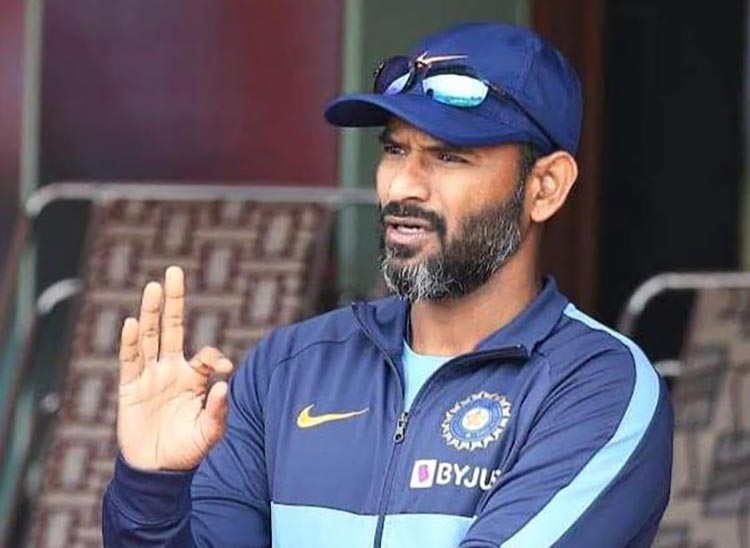
Doubling down on the importance of fielding, the team management roped in India’s former fielding guru R. Sridhar for a ten-day high-intensity camp. A coach who comes with a glowing reputation, Sridhar isn’t just focusing on the big boys — he’s spreading the gospel of fielding to the development squads and the under-19s too. It’s a move that signals intent — Sri Lanka wants to be sharp, not just with the bat and ball, but in the field as well.
These efforts to lift fielding standards deserve a standing ovation. One can only wonder how different things might’ve been if this sort of proactive thinking had been in place two years ago. The writing was on the wall even then — dropped catches, fumbled run-outs, and lazy throws were costing games. But instead of addressing the problem head-on, the management handed the reins to an overhyped foreign coach and, in cricketing terms, ended up hitting their own wickets.
Since Jayasuriya took over, he’s turned the tide. He brought in Upul Chandana — Sri Lanka’s very own livewire in the field — from within the SLC coaching system. Chandana, with his unconventional drills and energetic approach, has injected fresh blood and urgency into the unit. The players now seem to have caught the fielding bug.
That’s how it should be. While someone like Chandana remains as a permanent fixture, brief stints from specialists like Sridhar allow new ideas to bounce around the dressing room.
Earlier, even Jonty Rhodes, arguably the Michael Jordan of fielding, spent a few days in Colombo. He quickly identified the blind spots and sharpened Sri Lanka’s fielding toolkit.
That said, no matter how many big-ticket coaches you bring in, no fielding revolution can succeed unless the players themselves buy in. You can lead a horse to water, but you can’t make it dive full-length in the covers.
And for too long, that buy-in was missing. Thankfully, the tide seems to be turning — especially with the next-gen stars who appear hungrier, more agile, and aware that in modern cricket, fielding can win you matches.
Look no further than T.M. Dilshan. Initially groomed as a wicketkeeper, his path was blocked by a certain Kumar Sangakkara — who, let’s face it, wasn’t giving up the gloves anytime soon. So Dilshan pivoted. He transformed himself into a brilliant outfielder, arguably the best in the side. His work ethic was legendary.
After every net session, he’d drag Fielding Coach Trevor Penney to the boundary and aim for ten direct hits a day. In the early days, it took him hours to meet that mark. But with persistence and practice, he was hitting the target in just 15 minutes. That’s the stuff champions are made of — grit, grind, and getting your whites dirty.
What Sri Lanka needs now are more players with that Dilshan mindset — willing to do the hard yards, chase leather like it’s gold, and throw themselves around like they’re defending their mother’s dowry.
With Jayasuriya calling the shots, Chandana in the dugout, and experts like Sridhar chipping in, Sri Lanka’s fielding fortunes are finally turning a corner. It’s early days, but if this momentum continues, the Lions might just roar again — not just with the bat and ball, but in every blade of grass they defend.
by Rex Clementine




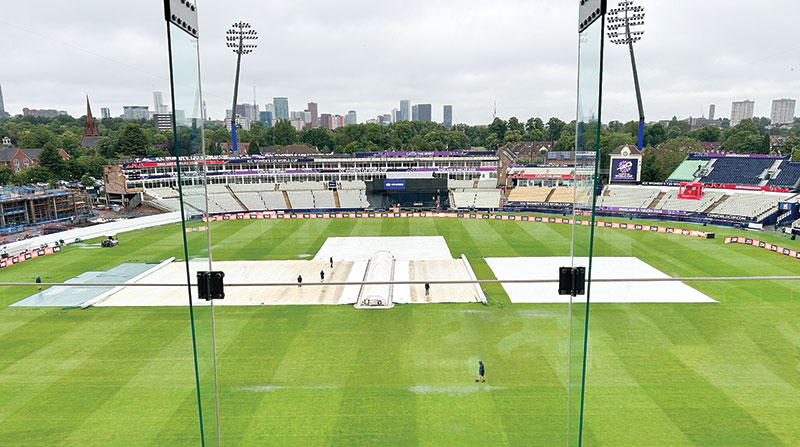
Sri Lanka’s women’s cricket team has been spending time in Birmingham, Britain’s second-largest city and will take on England in today’s opening encounter of the Women’s T20 World Cup. However, bad weather could spoil any chances of play. The whole of this week has been wet in Birmingham, often making you wonder whether this is really the English summer.
If there is a washout, Sri Lanka will not complain too much. They would gladly pinch a point off England, one of the pre-tournament favourites. Head-to-head, the teams have met on 12 occasions, with England winning ten and Sri Lanka just two.
England are ranked second in the world while Sri Lanka have made steady progress in recent years and are now sixth, ahead of both West Indies and Pakistan.
With the toughest opponent out of the way, Sri Lanka will fancy their chances of making the semi-finals. In global tournaments, teams have gone on to accomplish remarkable things thanks to a bit of luck. Wonder how? Ask Imran Khan. His famed ‘Cornered Tigers’ had no hope and were facing elimination in the 1992 World Cup when they were bowled out for 74 by Ian Botham in Adelaide. England were cruising in the chase when the heavens opened and the game was abandoned, with both sides sharing a point each. That single point eventually helped Pakistan edge out Australia for a place in the semi-finals and as they say, the rest is history.
Edgbaston is a leafy suburb of Birmingham, a short ten-minute bus ride from the city centre. It is also the youngest of England’s six leading Test venues, but it has witnessed some of the game’s most iconic moments.
It was here that Brian Lara was dropped on 18 by the Durham wicketkeeper, who famously told the slip cordon, “I hope he doesn’t make a hundred today.” Well, Lara went on to make a world-record 501 not out for Warwickshire in 1994, still the highest score in first-class cricket.
This was also the venue for the epic 1999 World Cup semi-final between South Africa and Australia, when the match ended in a tie and the Proteas, yet again, found a way to suffer heartbreak on the biggest stage.
Apart from Lara, many leading cricketers have represented Warwickshire over the years, including Alvin Kallicharran, Rohan Kanhai, Lance Gibbs, Allan Donald and our own Kumar Sangakkara.
The ground also houses the famous Thwaite Memorial Scoreboard, a masterpiece in this digital age where giant electronic screens have become the norm.
Warwickshire County Cricket Club, like Old Trafford and the Rose Bowl, has leased out a portion of the ground for a hotel project, ensuring that finances remain on the right side of the ledger. There is something special about watching cricket from your hotel balcony and fans are willing to pay handsome sums for the privilege.
Rex Clementine in Birmingham
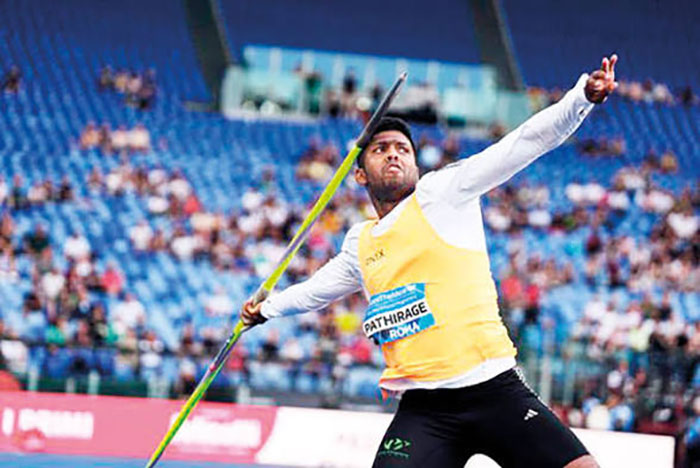
Rumesh Tharanga has overtaken former world and Olympic champion Neeraj Chopra to improve his world ranking to third, a position no Sri Lankan has ever held since the introduction of the ranking system by World Athletics, the sport’s governing body.
According to the latest rankings published by World Athletics late on Wednesday, Tharanga is ranked third with a ranking score of 1,324.
The 23-year-old’s massive throw of 92.62 metres at the Golden Gala Pietro Mennea in Rome last week not only secured victory against a world-class field but also propelled him from fifth place to third in the global rankings. Tharanga has firmly established himself among the elite athletes in the discipline and now sits behind only Germany’s Julian Weber and Grenada’s Anderson Peters, who has just two ranking points more than the Sri Lankan.
The remarkable throw helped him overtake international stars, including former world champion Chopra of India and Trinidad and Tobago’s Keshorn Walcott, underlining his rapid rise in the sport.
Tharanga’s ascent has been one of the most impressive stories in world athletics this season. Just a month ago, he was ranked seventh after a series of strong performances. He produced a huge national-record throw of 89.37m at Diyagama in March before winning the Kip Keino Classic at the Nyayo National Stadium in Nairobi with a throw of 89.28m in April. He then made a memorable Diamond League debut in Rabat in late May, where he finished second with a throw of 85.97m.
His Rome effort elevated him to eighth on the all-time world list and made him the second-best Asian javelin thrower in history, trailing only Pakistan’s Olympic champion Arshad Nadeem. The throw also surpassed the personal bests of both Chopra and Chinese Taipei’s Cheng Chao-tsun, further enhancing his standing on the global stage.
With the World Athletics Championships, Commonwealth Games, and Asian Games on the horizon, Tharanga has firmly established himself as a genuine medal contender. His rise from a national prospect to World No. 3 within a single season marks a watershed moment for Sri Lankan athletics and signals the arrival of a new force in international javelin throwing.
by Reemus Fernando
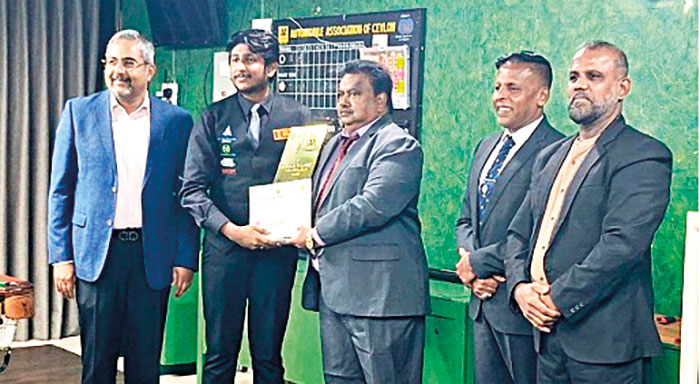
Irshad Thaha of the Moor Sports Club was crowned champion of the Automobile Association of Ceylon (AAC) sponsored 71 st National Billiards Championship Tournament, conducted by the Billiards & Snooker Association of Sri Lanka (B&SASL) at the AAC tables recently.
M M Mudeen of the Sri Lanka Army and M M Rikaz of Sri Lanka Air Force were the first and second runners up respectively.
S V Ganesh, Vice President – AAC was the Chief Guest at the Awards presentation held at the AAC Billiards Parlour.

Wife, counsel seek regular access to ex-Spy Chief Sallay held under President’s detention order

CIABOC summons Yoshitha over his participation in British Navy training programme

Communist Party condemns ill-treatment of Sallay, calls for review of PTA

Justice Minister responds to social media claims he represented Easter Sunday ringleader

Several SLTB Depots suffer losses due to their remote locations

Three Lankans among seven suspects arrested in Kuwait for alleged drug links

‘Dates have the highest sugar content to fight Coronavirus’

Sunday Island 27 December – Headlines

#SundayIsland 17th December – Headlines

Sunday Island – 28th March

Sunday Island Headlines – 21 March

Sunday Island – 21st February – Headlines
-
 News5 days ago
Women’s T20 World Cup 2026 warm-up: Chamari Athapaththu’s 94 helps Sri Lanka beat Pakistan
-

 News6 days ago
Asst. Manager, security officer arrested over Rs 30 mn snatch at Horana PB branch
-

 Editorial4 days ago
Probe Sallay’s complaint
-

 News5 days ago
Lankan-Canadian inducted to Toronto Sports Hall of Fame
-
 News2 days ago
Local firms move millions of dollars overseas for phantom imports: Govt.
-

 Editorial5 days ago
Prez in the dock
-

 Features5 days ago
Entering MIT for my Ph.D program, coping with harsh Boston winter and breasting the tape
-

 News6 days ago
No blanket ban on musical performances; only those promoting LTTE