
News
Wimal alleges Ranil, Sajith, AKD pursuing IMF, India agendas


Sri Lanka’s fate compared with that of Sikkim
By Shamindra Ferdinando
National Freedom Front (NFF) leader and Chairman of the Uththara Lanka Sabhagaya (ULS) Wimal Weerawansa, MP, said that President Ranil Wickremesinghe, SJB leader Sajith Premadasa, MP, and JVP/JJB leader Anura Kumara Dissanayake, MP, were pursuing the same strategy to address the economic crisis.
Therefore, an alternative political grouping was required for those who opposed the medicine prescribed by the IMF to overcome the current crisis, the former Commerce and Industries Minister said.
Addressing a gathering at the Maharagama Youth Centre Auditorium on Saturday (23), the Colombo District lawmaker declared that the ULS represented the interests of the patriotic and progressive electorate.
Alleging that the Wickremesinghe-Rajapaksa government, the main Opposition SJB and the JVP/JJB worshiped the IMF, and believed in the IMF remedies, MP Weerawansa called for public support for the only alternative for the people struggling to make ends meet.
Deputy Chairman of ULS and leader of Pivithuru Hela Urumaya Udaya Gammanpila, MP, its Secretary and General Secretary of the Communist Party Dr. G. Weerasinghe, the grouping’s main advisor Ven. Atureliye Rathana
Thero, MP, its Deputy Secretary Gevindu Cumaratunga and its Deputy General Secretary G. D. V. Thilakasiri of the Democratic Left Front (DLF) were present Rebel SLPP MPs, Dulas Alahapperuma, Dayasiri Jayasekera and Roshan Ranasinghe, too, addressed the gathering.
Alleging that at the behest of MP Anura Kumara Dissanayake, the JVP/JJB had meekly given in to the IMF dictates, MP Weerawansa said that the government was yet to rectify the main cause of the economic crisis. The former minister explained how enactment of Foreign Exchange Act No 12 of 2017 by the yahapalana administration allowed unscrupulous exporters to park export proceeds running into billions of USD overseas.
That law replaced the time-tested Exchange Control Act of 1953, MP Weerawansa said, pointing that those responsible continued with the yahapalana law at the expense of the national economy.
The former JVPer said that the incumbent government as well as the SJB and JVP/JJB had no alternative plans. Therefore, they entirely depend on the IMF’s bailout package and the current effort was to secure the third tranche of the USD 2.9 bn loan facility spread over a four-year period.
Sri Lanka has secured IMF assistance on 16 previous occasions.
Referring to Western sanctions imposed on Russia in the wake of the Ukrainian conflict, MP Weerawansa pointed out how that country faced the challenge and recorded the highest GDP among the European countries and was fifth in the world rankings.
MP Weerawansa said that ULS would soon reveal how the grouping intended to overcome the daunting economic challenges. Sri Lanka’s recovery plans wouldn’t depend on one individual but a leadership board that was to be entrusted with the overall strategy, the MP said.
The ex-minister said that both the SJB and JVP/JJB lacked appropriate strategy though they sought to deceive the public. MP Weerawansa said that SJB leader Sajith Premadasa didn’t realize the ongoing crisis couldn’t be addressed by distributing buses and making meaningless statements.
MP Weerawansa flayed the government over the ongoing privatization programme. Weerawansa said that privatization couldn’t be the panacea for all our ills. Commenting on the role played by former MP and President’s Chief of Staff Sagala Ratnayake in the Indo-Lanka dialogue, MP Weerawansa questioned the incumbent government’s strategy.
The former minister explained how the ongoing projects could make Sri Lanka a part of India. Unless the people united against the government and the ongoing Indo-Lanka projects, the day New Delhi took full control was not far away, MP Weerawansa claimed.
The NFF leader compared the current situation here with that of Sikkim that became the 22nd State of India in May 1975. Weerawansa explained the circumstances India intervened in Sikkim leading to the 1975 take over. According to the MP, the ongoing high-profile Indian projects would ultimately cause Sri Lanka to lose her independence. The former Minister alleged that the government, the main Opposition and JVP/JJB cooperated with the Indian strategy, therefore the only alternative would be ULS.
MP Weerawansa claimed that the JVP/JJB had totally abandoned their original ideals and was working closely with capitalists and other interested parties.



By PRIYAN DE SILVA
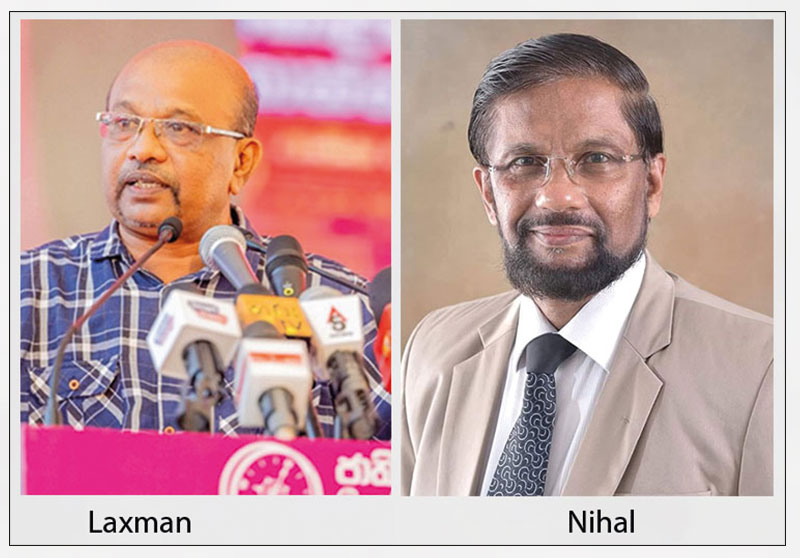
The government’s position on the abolition of the Executive Presidency and the future of the Provincial Council system will be set out in a new Constitution, NPP General Secretary Dr. Nihal Abeysinghe has said.
Abeysinghe made the remarks when a delegation from the Campaign for Free and Fair Elections (CaFFE) met him at the NPP headquarters in Pelawatte on Friday evening. Former NPP General Secretary and MP Laxman Nipunarachchi also participated in the discussion.
Dr. Abeysinghe said the JVP, the main constituent of the NPP, had consistently advocated the abolition of the Executive Presidency and that it was also a key pledge in the NPP election manifesto.
Responding to calls for the Provincial Council elections to be held under the existing electoral system, Nipunarachchi said the system was being changed to introduce the new electoral system.
He stressed that conducting the elections under the old system was therefore not acceptable.
CaFFE Executive Director Manas Makeen suggested that the Election Commission should be vested with adequate financial authority to ensure that elections are held on time.
Dr. Abeysinghe also requested CaFFE and other stakeholders to submit any proposals for constitutional amendments for consideration.
The NPP made the abolition of Sri Lanka’s executive presidency and the adoption of a new Constitution a central constitutional pledge in its 2024 presidential election manifesto, A Thriving Nation, A Beautiful Life. It promised to draft and enact a new Constitution after public discussion and a referendum, abolish the executive presidency and replace it with a president without executive powers elected by Parliament, while introducing a new parliamentary electoral system.
However, in June 2026, Public Administration Minister Chandana Abayaratne was quoted by the media as having said that although this remained an electoral promise, the Government did not regard it as a priority at that point, saying other constitutional and electoral reforms were being considered first.
The Opposition has accused the goverment of trying to retain the executive presidency by delaying the constitution making project.
By Chaminda Silva
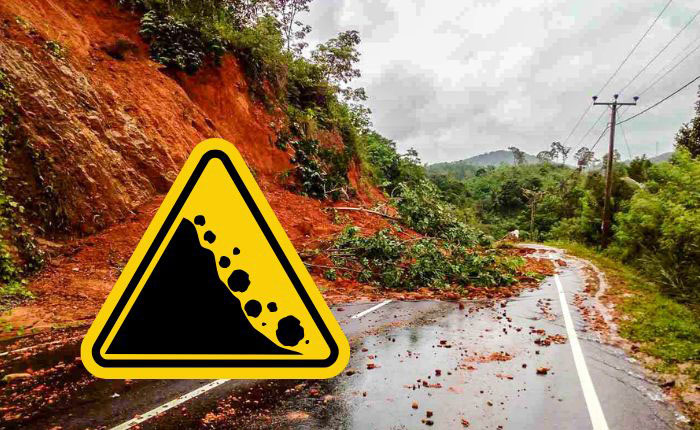
The National Building Research Institute (NBRI) has issued a Level 3 (Red) landslide early warning for several areas in the Kandy, Kegalle and Nuwara Eliya districts amidst continuing heavy rainfall.
The warning, issued at 2 p.m. yesterday (20), will remain in effect until 2 p.m. today (21).
In Kandy District, the red alert covers the Pasbage Korale Divisional Secretariat Division and surrounding areas.
In Kegalle District, red-level warnings have been issued for the Dehiowita, Aranayake, Deraniyagala, Mawanella and Yatiyanthota Divisional Secretariat divisions and surrounding areas.
In Nuwara Eliya District, the warning covers the Kothmale West, Kothmale East, Ambagamuwa and Norwood Divisional Secretariat divisions and surrounding areas.
Meanwhile, a Level 2 (Amber) landslide warning remains in effect for selected areas of Colombo, Galle, Kalutara, Kandy, Kegalle, Matara, Nuwara Eliya and Ratnapura districts.
The affected areas include Padukka; Nagoda, Thawalama and Neluwa; Bulathsinhala, Palindanuwara, Walallawita and Agalawatta; Ganga Ihala Korale; Bulathkohupitiya and Kegalle; Akuressa and Pitabeddara; Thalawakele; and several Divisional Secretariat divisions in Ratnapura District, including Pelmadulla, Ratnapura, Ayagama and Kuruwita.
Residents in the affected areas have been urged to remain vigilant for signs of landslides and follow instructions issued by local authorities, particularly during periods of heavy rainfall.
By SK Samaranayake
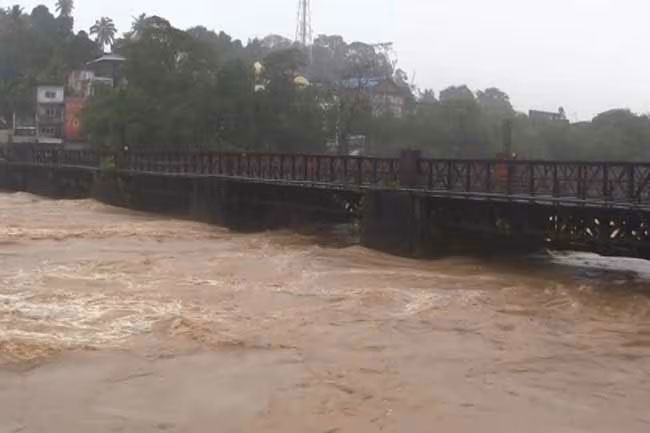
Heavy rainfall across the Central Highlands has triggered flood and landslide warnings, with the Mahaweli Ganga reaching spill level in Nawalapitiya and several roads and low-lying areas already affected.
The Kandy District Disaster Management Unit has urged residents living along the Mahaweli River in Nawalapitiya, Gampola, Gelioya and Peradeniya to remain on high alert as heavy rain continues on the western slopes of the Central Hills.
The Irrigation Department has warned that the Mahaweli Ganga, in the Nawalapitiya area, is nearing spill level. The river level at the Peradeniya Black Bridge, which is under repair, is also continuing to rise.
A senior official said the University of Peradeniya was taking precautionary measures in anticipation of a possible flood situation.
Meanwhile, five spill gates of the Polgolla Mahaweli Reservoir had also been opened yesterday (20) due to the heavy rainfall, Executive Engineer Thisara Bandara said.
Around 21,000 cubic feet of water per second is being released towards the Victoria Reservoir through the five gates.
Bandara warned that all spill gates may have to be opened if rainfall intensifies and urged communities downstream of the Polgolla Dam, on both sides of the river, to remain vigilant.
The threat has already translated into flooding and displacement in several areas.
Nearly 100 families have been displaced in the Pasbage Korale Divisional Secretariat area of Nawalapitiya after the Mahaweli River overflowed and inundated homes in low-lying areas, following heavy rainfall since yesterday (20), a Divisional Secretariat official said.
Kithulkote, Labuwelkotuwa and Jayasundara Ovita were among the areas affected.
The Irrigation Department has separately warned of a risk of major flooding in low-lying areas along the Mahaweli River in the Pasbage Korale area, urging residents and motorists to exercise extreme caution.
Meanwhile, roads have also been hit by the adverse weather.
The Road Development Authority (RDA) has closed the Poojapitiya–Medawela road until further notice after a section of the road at Madadeniya collapsed. The section had reportedly already been weakened during the Ditwah disaster and has now completely given way.
The RDA has closed the road from Poojapitiya town and advised motorists travelling towards Medawela to use alternative routes.
Traffic on the Hatton–Bogawantalawa–Maskeliya–Balangoda main road also came to a complete standstill yesterday after a landslide occurred near the Wanraraja Estate area in Dikoya at around 11 a.m.
Hatton Police officers and residents began clearing the earth from the road, while the local RDA office was informed to assist with the operation.
In another warning, the Disaster Management Centre (DMC) said a potentially dangerous situation had developed at Dabagolla Mountain in Yalagamuwa, Uvaparanagama.
Police said about 700 metres of the mountain had developed cracks measuring between 10 and 12 inches wide. In some locations, the ground had subsided to depths of seven to eight feet.
The DMC said the cracks had widened with the recent rainfall, while water flowing through them had begun loosening the soil and increasing the risk of a landslide.
Police said there were no houses or settlements around the affected mountain, which is located near a forest reserve. Several acres of pepper cultivation are, however, situated in the vicinity.
Meanwhile, heavy rain has also caused flooding in Bogawantalawa.
Several buildings in the low-lying section of Merys Estate National School have been inundated after the Keselgamu Oya, a major tributary feeding the Castlereigh Reservoir, overflowed.
A retaining wall above a house in the lower section of Kotiyagala Estate also collapsed amid the heavy rainfall, causing extensive damage to the house. Bogawantalawa Police said no one inside was injured.
Authorities have urged residents in flood-prone and landslide-prone areas to remain alert as further rainfall could worsen conditions, while motorists have been advised to avoid affected roads and use alternative routes where possible.

Kenya’s Ngetich breaks women-only half-marathon world record by a second

Showers about 100 mm are likely at times in the Western, Sabaragamuwa and North-western provinces and in Galle, Matara, Kandy and Nuwara-Eliya Districts

New Constitution to decide fate of executive presidency, PCs: NPP

NBRI issues landslide warning for three districts

Mahaweli rises as heavy rain triggers flood, landslide fears

SC determination on 22A to be conveyed to Speaker shortly

‘Dates have the highest sugar content to fight Coronavirus’

Sunday Island 27 December – Headlines

#SundayIsland 17th December – Headlines

Sunday Island – 28th March

Sunday Island Headlines – 21 March

Sunday Island – 21st February – Headlines
-

 News4 days ago
US embassy won’t comment on IGP’s probe into joint drug raid
-

 News3 days ago
Bid for Basil’s extradition nears final stage: Police
-

 Features6 days ago
The emptying university: why are academics leaving?
-

 Business4 days ago
All-new Bolero MaXX unveiled in Sri Lanka
-

 News2 days ago
Shanakiyan urges urgent action over reported death sentence for Lankan in Saudi Arabia
-
 Opinion6 days ago
Who committed genocide and created mass graves in Sri Lanka?
-

 Opinion4 days ago
A journalist who wrote across the divide
-

 Weather6 days ago
Showers above 100 mm expected at times in the Western, Sabaragamuwa, Central, Uva and Southern provinces, and in Ampara and Batticaloa districts