
Sports
Williamson powers New Zealand home, Breetzke’s record 150 in vain

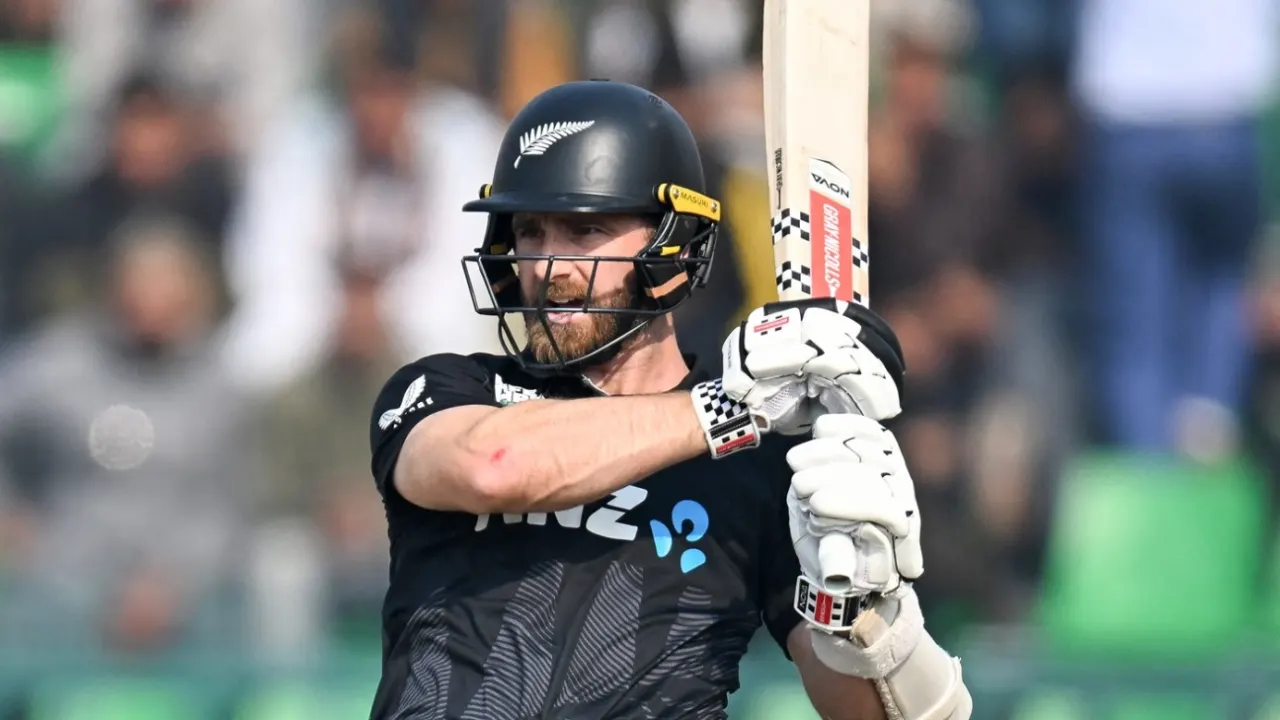
New Zealand have qualified for the Pakistan Tri-Nation Series final after completing the third-highest successful chase in Lahore to beat an under-strength South Africa by six wickets. The result means the next match, between Pakistan and South Africa in Karachi on Wednesday, is a knockout.
Kane Williamson and Devon Conway, both back in New Zealand’s ODI squad for the first time since the 2023 World Cup, scored 133 not out and 97 respectively and shared in a record partnership for New Zealand against South Africa (187). Conway’s score was the first time he crossed fifty since the opening match of the 2023 World Cup, 11 innings ago. Williamson’s century was his first in 22 innings, dating back to his 148 against West Indies in Manchester in the 2019 World Cup. It was also Williamson’s second fastest ODI hundred, off 72 balls. Between them, the pair eclipsed a remarkable achievement by Matthew Breetzke, who became the player with the highest individual score on ODI debut – 150 – and the fourth South African to score a century in his first match.
Breetzke accounted for just under a half of South Africa’s total, which is the first indication of where things went wrong for them. They scored too slowly in the middle of the innings, especially given the flat nature of the track. The second issue was a severely uninspired attack, albeit not a first-choice one. Three of the bowlers – Earthan Boxch, Senuran Muthusamy and Mihali Mpongwana were on ODI debut and could be forgiven but lack of punch from Lungi Ngidi and Tabraiz Shamsi, who conceded 116 in 16 overs between them will be a concern ahead of the Champions Trophy.
South Africa have now lost five ODIs in a row, their longest losing streak in 20 years, but have played all their matches without a full strength side. While they’re unlikely to have too many positives to take from this defeat, they may console themselves with the knowledge that, Rachin Ravindra aside, New Zealand were at full strength and played like it.
After choosing to bowl first in the only day game of the series, New Zealand struck early when Will O’Rourke bounced Temba Bavuma out as he edged a pull. Bavuma had looked confident for his 23-ball 20 but New Zealand’s O’Rourke’s consistent and aggressive approach with the short ball paid off.
Breetzke and Jason Smith combined for a second-wicket stand of 93 but their scoring rate of 5.31 runs to the over was testament to New Zealand’s squeeze. South Africa struck only two fours and three sixes in the 17 overs between Bavuma’s dismissal and Smith’s run-out, as they tried to take on Mitchell Santner but were largely kept quiet. In that time, Breetzke brought up fifty off 68 balls.
When Smith was run-out, New Zealand had an opportunity to get into an inexperienced middle order and they took it. Kyle Verreynne tried to reverse-sweep the fourth ball he faced, missed and was bowled by Michael Bracewell. Another quiet period followed, in which South Africa only hit one boundary in 11 overs, as the combination of Ben Sears, Bracewell and Matt Henry stuck to their disciplines.
South Africa were 196 for 3 entering the last 10 overs and 280 looked a distance away. Breetzke took it on himself to get them there. He dispatched O’Rourke through deep third to bring up his century off 128 balls in the 41st over, and then put foot down. His next fifty runs came off 19 balls as he brought out his full range. His 150 came in an over where he hit Sears for 20.
Just as it seemed Breetzke could be eyeing a double, he mis-read a Henry slower ball and was caught at mid-off. Wiaan Mulder, who had largely operated as a spectator to that point, had the responsibility to finish off the innings but was fortunate to have an inside-edge trickle away for four before he established some control. He reached his second ODI fifty with a crunching cover drive off Henry, off the 54th ball he faced, and took South Africa over 300 with a four through short fine in the penultimate over. South Africa got only four runs off their final eight balls.
It was not enough. New Zealand built slowly but got ahead of the required run rate just after the halfway stage of their innings and were in full control from there. They had only lost Will Young at that point, for 19, though he should have been out for 6 in the third over. Smith dropped Young at backward point off Ngidi but the miss did not prove too costly.
His dismissal brought Conway and Williamson together and there was one nervy moment, when Williamson inside-edged Junior Dala past Verreynne but he soon settled into a rhythm and put on a masterful display of run-scoring, all around the wicket. His wagon wheel was almost entirely symmetrical, with 67 runs on the off side and 66 on the leg side and the highlights included four strong cut shots and a creative ramp over Verreynne as he leaned back to an Ngidi delivery.
Equally, Williamson’s pacing of his innings was perfect. He gave himself time to get in, all while scoring at a run-a-ball, and then took over the more dominant role from Conway, who got to fifty first. Conway’s half-century came off 64 balls, before Williamson’s reached his, off 44 balls, with a massive six over mid-on off Shamsi. It was also Williamson’s fourth successive fifty-plus ODI score in Pakistan. He took a liking to Mpongwana and Ngidi’s short-balls while Conway took on Shamsi and South Africa had no answers.
Williamson got to his century in the 34th over with a single off Dala. Conway was not far behind and eager to get there but, when he was on 97, he tried to cut Dala past point and found Muthusamy, who moved to his left and took the catch.
Muthusamy was the pick of South Africa’s bowlers and dismissed Daryl Mitchell, thanks to a stunning catch from Mulder at long-on, and Tim Latham off successive balls but Glenn Philipps partnered Williamson to the end. Williamson hit the winning runs in the 49th over, to give New Zealand victory with eight balls to spare.
Brief scores:
New Zealand 308 for 4 in 4.4 overs (Kane Williamson 133*, Devon Conway 97, Glenn Phillips 28; Senuran Muthusamy 2-50) beat South Africa 304 for 6 in 50 overs (Matthew Breetzke 150, Temba Bavuma 20, Jason Smith 41, Wiaan Mulder 64, Matt Henry 2-59, Will O’Rourke 2-72) by six wickets
[Cricinfo]


World-leading javelin thrower Rumesh Tharanga underlined his status as the man to beat in world athletics with another sensational performance, winning the men’s javelin at the prestigious Weltklasse meeting in Zurich with a massive 92.07 metres.
Tharanga’s best effort came in the final round and left him just 21 centimetres short of the meeting record of 92.28m, which has stood for three decades.
The 23-year-old first overcome first round challenge from two-time world champion Anderson Peters of Grenada. Peters took the early lead with a first-round throw of 86.93m, but Tharanga responded in the second round with 88.23m to move ahead.
He then increased his advantage in the third round before producing his best effort of the night in the final round, sending the javelin soaring to 92.07m.
Peters had to settle for second with 86.93m, while Poland’s Dawid Wegner was third with 85.16m. Trinidad and Tobago’s Keshorn Walcott finished fourth with 83.02m, followed by Kenya’s Julius Yego (81.66m) and American Marc Anthony Minichello (80.38m).
The Zurich victory further strengthens Tharanga’s position at the top of the world javelin hierarchy at a crucial stage of the season. With the Wanda Diamond League Final in Brussels just a week away and the World Athletics Ultimate Championship looming, he has emerged as the athlete everyone will be watching.
Tharanga’s latest 92-metre-plus throw also provides a timely reminder of his extraordinary consistency at the highest level, as he continues his remarkable rise among the world’s elite javelin throwers. (RF)
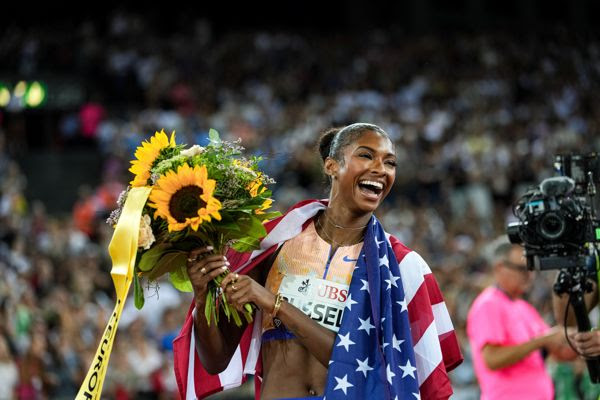
Less than 40 minutes after Alison dos Santos made history in the men’s 400m hurdles at the Weltklasse, another world record fell at the Wanda Diamond League meeting in Zurich as Masai Russell sped to a 12.09* clocking to win the women’s 100m hurdles.
The Olympic champion, who had come close to the world record twice already this year, produced a flawless run over the barriers and stopped the clock at 12.09 (0.0m/s), taking 0.03 off the previous world record.
Nigeria’s Tobi Amusan, the world record-holder heading into this race, was second in a season’s best of 12.23. European champion Nadine Visser was third in a season’s best of 12.34.
[World Athletics]

by Rex Clementine
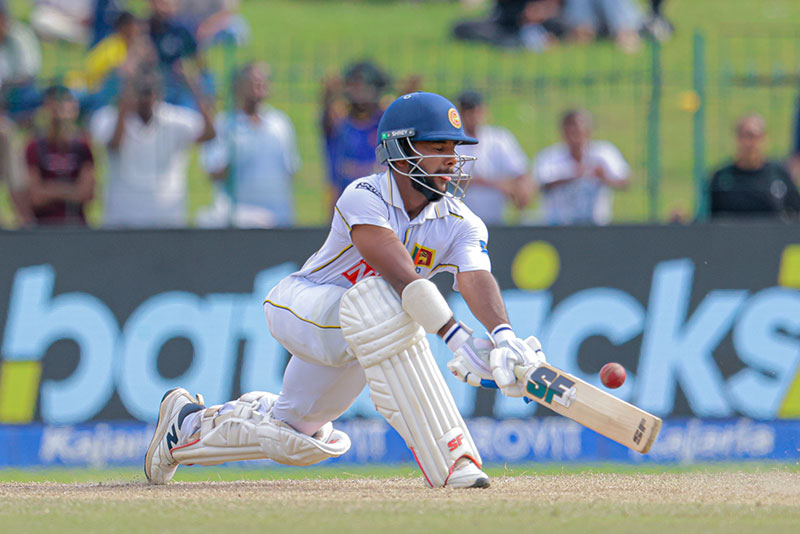
A match saving hundred by Sonal Dinusha helped Sri Lanka salvage a draw in the second Test against India at the SSC yesterday. India won the series 1-0, having claimed the opening Test in Galle by 165 runs.
Sri Lanka were 429 for nine in their second innings, with Dinusha unbeaten on 133, when the teams shook hands and called off the game with the 15 mandatory overs about to begin.
Sri Lanka, who were forced to follow on after conceding a first innings deficit of 213 runs, began the final day staring down the barrel at 229 for six, leading by just 16 runs with three sessions to survive.
In young Sonal Dinusha, however, the hosts seem to have unearthed a gem. He batted superbly under pressure to ensure Sri Lanka earned a draw and picked up some valuable points in the World Test Championship.
Dinusha had been Sri Lanka’s standout performer throughout the series, having made 100 and 84 in the first Test in Galle before following it up with 103 in the first innings at the SSC and an unbeaten 133 in the second essay to finish the series with 420 runs.
It was only the fifth Test for the 25-year-old, but he batted with authority and showed remarkable composure in a back to the wall effort.
India threw everything at him, including the second new ball, but Dinusha remained unmoved as he became only the eighth Sri Lankan to score hundreds in both innings of a Test, joining an exclusive list comprising Duleep Mendis, Asanka Gurusinha, Aravinda de Silva, T.M. Dilshan, Kumar Sangakkara, Kamindu Mendis and Dhananjaya de Silva.
The match saving hundred was Dinusha’s third in Test cricket and also his career-best score.
Dinusha could not have done it all by himself, however, as he received excellent support from Sri Lanka’s lower order.
He added 112 runs from 246 deliveries for the seventh wicket with Keshara Nuwantha as Sri Lanka batted through the entire morning session without losing a wicket.
India finally found the breakthrough in the first over after lunch when Nuwantha departed for a well compiled 46.
Dinusha then added 25 runs for the eighth wicket from 74 balls with Prabath Jayasuriya to keep Sri Lanka afloat. After Jayasuriya’s dismissal, Lahiru Kumara joined Dinusha and the pair added 47 runs for the ninth wicket from 170 deliveries, keeping India in the field for even longer and eating further into the time available for the tourists to force a victory.
Questions will be asked of India’s bowling attack after they were unable to run through Sri Lanka’s lower order on a fifth day pitch despite having the hosts six wickets down at the start of play.

Tharanga storms past 92m in Zurich

Iran, Qatar hold Hormuz talks amid int’l hopes dialogue with US will resume

Russell breaks world 100m hurdles record in Zurich

Sun directly overhead Kokkuvil, Nallur, Kodikamam and Nagar Kovil at about 12.11 noon today (28)

Showers above 75 mm are likely at some places in the Western and Sabaragamuwa provinces and in Kandy, Nuwara-Eliya, Galle and Matara districts

Eight politicians in drug kingpin probe

‘Dates have the highest sugar content to fight Coronavirus’

Sunday Island 27 December – Headlines

#SundayIsland 17th December – Headlines

Sunday Island – 28th March

Sunday Island Headlines – 21 March

Sunday Island – 21st February – Headlines
-

 Business6 days ago
SriLankan Airlines makes ShakthiSAT Mission possible for talented Sri Lankan student
-

 Latest News7 days ago
Imran Khan moved to private hospital amid deteriorating health
-
 Features5 days ago
My secondary schooling after Royal Primary
-

 Features5 days ago
From the First to the 22nd: A short history of Amendment Politics and Reform Frustrations
-

 Latest News6 days ago
Tharanga edges out Chopra in 88m javelin battle
-

 News3 days ago
Missing doctor’s body found in Mahiyanganaya
-
 Features5 days ago
How Shelton Kodikara became first Professor of International Relations
-

 Features5 days ago
How St. John’s College Shaped Panadura for 150 Years