
Features
Why the world is counting on a Biden victory

by Krishantha Prasad Cooray
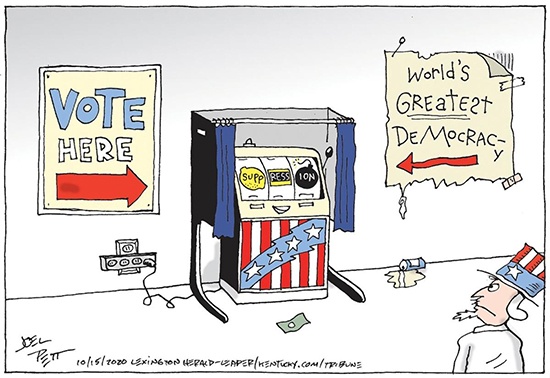
Next week’s presidential election in the United States of America has become a remarkable event on the world stage. It has exposed the dark underbelly of the American political system and left us all wondering whether America, the world’s oldest modern democracy, is indeed still a democracy at all?
Four years ago, America fell to a strongman. Donald Trump took the national stage with masterful control of the media, hijacking a democratic system, bypassing the traditional scrutiny of presidential candidates by hiding his tax returns, silencing people with non-disclosure agreements and controlling the narrative about his political opponent.
By the measure of an election in any normal democracy, he failed, garnering 2,868,686 fewer votes than Hillary Clinton, a margin of 2.23%. To put that margin in a context that Sri Lankans would understand, Ranil Wickremasinghe lost the 2005 presidential election in Sri Lanka by a narrower margin of only 1.86%. However, under the American system, it is the combination of states you win in the Electoral College that counts, not the number of votes, and Donald Trump became president as a result.
For decades, the battle for the right to vote has been a feature of American politics. Politicians and judges they have appointed frequently succeed in preventing minority groups, young voters or others from voting, and have found ways to have their ballots excluded from the final tally. On more than one occasion, the politicized American Supreme Court has sided with these efforts, further divorcing the American political system from what we in Sri Lanka understand as democracy.
Indeed, we can take pride in our own system. For all the political turmoil that our country has suffered in 72 years as an independent democracy, no one barring the LTTE has ever tried to deny the franchise to any Sri Lankan constituency or to prevent them from voting. More importantly, it would be unthinkable for Sri Lankan courts to even entertain a case seeking to deny the vote to any group of Sri Lankans.
But what is still unthinkable in little Sri Lanka is now the stated path to victory for Donald Trump’s re-election in America. A president who came to power on a technicality is now seeking to unleash a torrent of technicalities to cling on to power. His acolytes are sabotaging the postal service to scuttle the postal vote, rushing to courts across the country to seek rulings preventing votes from being counted, shutting down polling places in urban areas to make it more difficult for poor people to vote, and adopting a flurry of similar strategies not to increase their own vote count, but to reduce the number of votes counted for their opponent.
To those of us who treasure democracy and the institutions that defend it, there is solace to be found in the fact that Donald Trump is the first incumbent American President running for reelection who has not been endorsed by living former Presidents in his own party. Lifelong institutionalists in his Republican party, from former Speaker Paul Ryan to the late Senator John McCain, disavowed him. McCain went so far as to request that Trump not be allowed to attend his funeral.
Hundreds of retired senior military, intelligence and law enforcement officials in America have spoken out not just to oppose Donald Trump but to warn that his re-election would pose a grave threat to the national security and integrity of the United States of America.
What America has seen in the last four years is that when strongmen bluster their way into high office on a façade of glitzy propaganda and magical promises, the reality is that they will spend their time in office making excuses as to why they could not get anything done, and insisting that the only way they can deliver what they promised is if they are allowed more time in office. Meanwhile, they chafe at the democratic and institutional safeguards designed to ensure that our rulers are accountable to their people and serve at their mercy.
With Trump’s failure to deliver on his promises, and his catastrophic handling of the Covid-19 pandemic, there is reason to hope that his defeat will make way for healing America and making its institutions stronger than they were before Trump began his assault. There is a lot of healing to be done.
Ever since World War II, America has marketed itself as the poster-child for democracy on the world stage, even though the fairness of its electoral system has lagged objectively behind those of several other established democracies like Australia, the United Kingdom, Canada, New Zealand, Switzerland and the Scandinavian states.
Despite America’s wide inequalities, it is the country’s evolution that is most romantic. Before being elected President, as an opponent of slavery, Abraham Lincoln explained that America’s Declaration of Independence, which proclaimed that all men are equal, was not a statement of fact but an aspiration to strive for. The concept of equality, Lincoln said, is one that must be “constantly looked to, constantly laboured for, and even, though never perfectly attained, constantly approximated, and thereby constantly spreading and deepening its influence and augmenting the happiness and value of life to all people, of all colours, everywhere.”
Indeed, the American tradition has been to own up to its country’s dark history and aspire to do better. Whether slavery, the treatment of native Americans or other ethnic and religious minorities, the country has openly and gradually strived to evolve into a less racist and xenophobic, and more inclusive and equal nation, all under the glaring eye of one of the most searing and merciless news media environments in the world.
America’s claim to moral authority around the world has come from reconciling its roots in inequality, slavery and other heinous crimes, owning up to them, accepting its present shortcomings, and actively striving to grow with its founding values, while espousing those same values abroad. Democracies that have shared those values or even overtaken America in their implementation have found in the USA a strong and staunch ally who will stand up to autocratic bullying.
This is why Trump’s rejection, deriding and snubbing of democratically elected leaders, and his embracing and enabling of dictators and autocrats, and his encouragement of human rights abuses in his own country and overseas have struck such a serious blow to fragile democracies everywhere. The ideologies of countries like Russia and China depend on people losing faith in the idea of democracy and a free press. They could have no greater champion than an American president who insists American elections are rigged and boasts that he helped a foreign prince get away with murdering and disemboweling a journalist.
So when Mike Pompeo came to Sri Lanka, winked that democracies should stick together, and warned that the Chinese Communist Party is preying on Sri Lanka, his words would ring less hollow if his own party were not so feverishly dismantling and delegitimizing the concept of franchise in his own country. Indeed, he would sound more sincere if President Trump had not just months ago been impeached for “preying” on the democratically elected leaders of Ukraine.
Sri Lanka cannot be credibly lectured on human rights and democracy by a country whose government has for the last four years institutionalized the oppression of minorities, forcibly separated refugees from their children, and laboured to engineer the arrest of journalists and jailing of political opponents. When Trump speaks of autocrats like Vladimir Putin or Kim Jong Un, he betrays a frustrated envy of these strongmen and how simply they can silence and dispatch their political opponents.
These weaknesses in Trump and his lack of character are the primary reason he is on track to garner far fewer votes than his opponent, Joseph Robinette Biden Jr. Unlike Trump, whose manicured public image propelled him to fame on a campaign of fear, hate and race-baiting, Joe Biden is someone who has long been known to Americans and the world.
As a leader on the world stage, Biden has championed support for independent institutions in emerging democracies, especially in making judiciaries independent and distancing law enforcement activities from political pressures. All the while, he has made no secret of the fact that he believes his own country has a long way to go in making its own established institutions more inclusive, fair and just.
There is little doubt that Biden will garner more votes this Tuesday, but his opponent has made no secret of his plan to win through an assault on the franchise more akin to those adopted by leaders of failed states than the President of the world’s largest democracy. He has even tarred the independence of the courts, making no secret of his motives when stacking the Supreme Court with judges he believes will deliver him the presidency a second time.
Dictators, strongmen and autocrats around the world are also watching. In a world where such people cling to power not through overt fascism but by putting on the thinnest guise of democracy, it is mana from heaven for them to see an American President boast of rigging the US Supreme Court to stay in power. If Trump succeeds, they will only be inspired and emboldened to employ similar strategies to stifle the democratic will of their own people. If they see one candidate win millions more votes in America, only to have their victory overturned by a politically stacked court, they will see a blueprint for how they too can cling to power until the end of their days.
When George W. Bush was declared president in 2000 by the Supreme Court stopping the counting of votes in Florida, three key lawyers on his legal team were John Roberts, Brett Kavanaugh and Amy Coney Barrett. All three are now Justices on the US Supreme Court, who may soon be asked to choose whether the next President of their country will be their “party man” or the man who won the most votes.
Those Republicans in America who seek to use a politicized Supreme Court to prioritize keeping Trump in power over the founding principles of their nation would do well to examine the events that led to the founding and rise of their own political party. The Republican party in America came together after 1854 by bringing together a growing number of American politicians whose opposition to slavery left them without a party that reflected their political ideology.
As the party and its philosophy garnered traction and it became clearer that a clear majority of Americans were opposed to slavery, it was the opportunistic president James Buchanan and politically motivated Chief Justice Roger Taney who colluded to deliver a 7-2 judgment of the Supreme Court that declared that those of African descent were sub-human and thus must be treated as property all across the United States.
The barbarism of this move and its aftermath played no small role in the election of the first Republican President, Abraham Lincoln, in 1860. The question of freedom and who deserved to be free so charged American politics that his opponents tried to kill him before he took office, and soon drove the United States into a civil war. That war was won by those who stood on the principle that freedom and equality were the inalienable rights of all human beings. The world in the 1860s was not remotely as interconnected as it is today. The telephone had not yet been invented, and news traveled across the world no faster than a ship could sail the sea.
Today, the eyes of the world are on the American voters and American institutions. Dictators, strongmen and autocrats around the world have had an easy time of the last four years, finding their actions more legitimized by the United States than chastised, while journalists, rights advocates and those who stand for the rule of law have often found themselves isolated in every corner of the world.
If a Biden electoral victory is suppressed by discounting votes and overruling the will of the American people, the path will be cleared for every ruler who seeks to govern without the consent of those they govern to follow America’s example, and craft policies and institutions that cement their power. Such counties will then join America as politically apartheid states, democracies only in name.






by Dr Upul Wijayawardhana
We are living in an era of astonishingly rapid scientific advancement. From the time Apple launched the ‘iPhone’ in January 2007, the first targeting the mass market, smartphones have taken over the world, making them indispensable. According to the latest statistics, there are around 8.1 billion mobile phones with 7.4 billion active smartphones, for the world population of 8.25 billion. Except for a tiny minority of the very poor, most people have at least one smartphone.
We are now entering the era of Artificial Intelligence (AI) and smart robots. Recently, a ‘Chinese’ robot ran 100 metres faster than Usain Bolt! Though Alan Turing proposed the idea of ‘Thinking Machines’ way back in 1950, the real AI boom commenced with the release of the generative AI chatbot, ChatGPT, by OpenAI in November 2020. Number of technology firms in the US as well as in China have joined the race, China catching up very fast, quite unexpectedly. There is a frenzy at the moment, raising expectations, as the imminent floating of these companies is likely to value the two leaders, OpenAI and Anthropic, trillion dollars each!
However, trouble is brewing in the AI field. On top of the concerns raised by environmentalists regarding the huge power drain by AI centres, there are recent reports of some AI models hacking independently into other systems, without human input. Worse still, a senior researcher at Anthropic, who has previously worked for OpenAI as well, resigned in early September on ethical grounds stating that the way the two companies are fast-tracking AI poses an existential threat to humanity. Surprisingly, instead of a rebuttal the head of Anthropic supported his view, soon joined by three more heads of leading AI developers. Whilst they agreed on slowing progress, President Trump has claimed that slowing is totally unnecessary as long as a super intelligent President like himself is at the helm! There does not seem to be an end to Trump’s grandiosity! He was joined by Tony Blair. In contrast, King Charles held a summit with representatives of all AI developers to find a way AI could be developed without a threat to humanity. That is how wise leaders act!
Less sophisticated AI tools are already in widespread use and installed in computers, laptops and smartphones. Some of us are using these automatically. However, the more advanced AI tools like ChatGPT can change even reality. For instance, AI can generate videos hardly distinguishable from real ones. What you enjoy watching on YouTube may be just the creations of AI! Some people use AI to write articles; only a few of them admit that they do so. Very soon we may be reading stories AI creates and listening to music, courtesy of AI. Technology seems to be fast becoming the new religion? Or, will the existential threat move us more towards religion?
Religion, perhaps, is as old as humanity itself; various belief systems evolving and disappearing coupled with the fortunes of the associated civilizations. Just like AI, religion is also a creation of the human mind which our ancestors did to explain many phenomena which appeared, at that time, to be supernatural. Starting with Animism, perceiving the divine in the natural world around, humans went on to Polytheism, believing in many gods like in Hinduism, culminating in the concept of Monotheism.
World’s oldest religion, Hinduism, still in wide practice, is devoid of a founder or a single text. The earliest scriptures, Rigveda, is considered to be around 3,500 years old but archaeologists have discovered symbols of importance to Hinduism as far back as 7,000 BCE. Though it is considered to be Polytheistic, it can be argued that it was the precursor of Monotheism, the concept of a creator God, as Brahma was the creator in the triad, Trimurti, Vishnu being the preserver and Shiva being the destroyer. It seems to be a sensible balancing act; create, destroy and repair with improvements.
It is pretty obvious that as science expands, the importance of religion contracts but it is hardly likely religions would be totally redundant. We have no choice as to which family we are born to and that invariably determines what your religion would be, if any. Religion is the first brainwashing a child encounters and most remain in the same faith, often trying to defend even the indefensible, but some change through conviction or conversion due to one of many reasons. Further, religious rituals have social values and religious practices often come to one’s solace at times of distress. Therefore, many will continue with the religion they were born to but with declining enthusiasm, at times. However, some religions seem to be facing problems like falling attendances in places of worship. With education and tech savviness expanding, one would expect the youth to be less enthusiastic about religion but the converse is true in some religions, some youth becoming very militant unfortunately.
While most religions make you subservient to a supernatural power, the Buddha was wise and bold enough to remove those shackles. He proclaimed that one’s destiny is in one’s own hands. However, many Buddhists appear to attach greater significance to rituals than to practising the Dhamma.
Buddhism as a religion may become less relevant as the frontiers of science expands but the Buddha Dhamma, especially Abhidhamma and Vipassana, would receive increasing recognition, the Buddha remaining an authority on consciousness and the mind.
Scientific progress should be for the betterment of society but AI developers are taking huge risks, taking massive loans threatening the world economy, for one aim: profit! Some do not seem to care even if their actions pose an existential threat to humanity.
Perhaps, if the Four Sublime Attitudes (Sathara Brahma Vihara) expounded by the Buddha; loving kindness (Metta), compassion (Karuna), empathetic joy (Muditha) and equanimity (Upekkha) are adopted as universal values, the world would become a safer place to live in, with or without AI.
Tales of Mystery and Suspense 21
by Prof. Rajiva Wijesinha
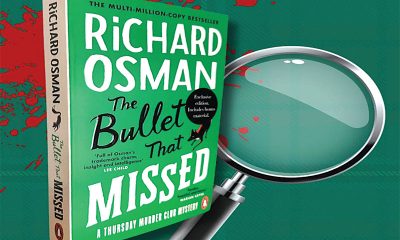
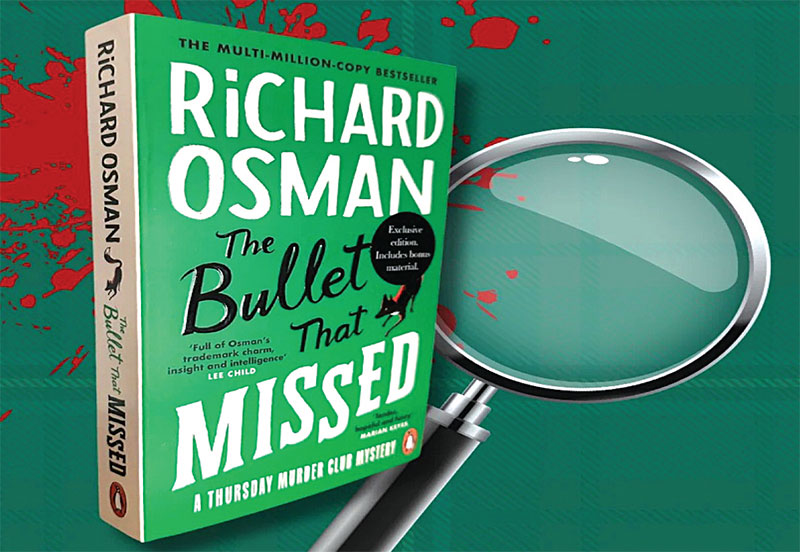
Another book that is part of a series, today—one that is fun without the brooding concentration on criminality in different forms that marks the Rebus novels. This one about the Thursday Murder Club, is a romp as its two predecessors were interspersed with deaths and what might be deaths.
The Bullet that Missed
begins with a meeting with the presenter of ‘South East Tonight’, a programme about the area, in which Coopers Chase is situated. The meeting is held because the club has decided to look into the murder of the producer’s assistant, Bethany Waites, whose car was found at the bottom of a cliff ten years ago. There was blood in it, but the body was never found.
Or, rather, the book begins with an account of Bethany Waites deciding, on the night she vanished, to meet someone in connection with a case of massive fraud that she had been investigating, after sending the producer, Mike Waghorn, a message that she had found new evidence though he had no idea what it was. The night she died, she sent him another message: “I don’t say this often enough, but thank you.”
CCTV cameras showed her leaving her place, but then the vehicle vanished, before being sighted near the cliff, with two people in it. Investigation of the fraud had led to the imprisonment of a woman, Heather Garbutt, though it proved impossible to pin anything on Jack Mason, the mastermind for whom she had worked.
The Club conducts investigations on several fronts, including through Connie Johnson, the drug dealer they had helped imprison in the earlier book. The psychiatrist Ibrahim, the most respectable member of the Club, interviews her in an attempt to get her to find out more from Heather, who is in the same prison as she. They also investigate the CCTV record of the night Bethany vanished, and deduce that she went to an apartment block and exited from its other side, and that is why she was not seen leaving the town. But some time had elapsed between her being seen in the town and then on the cliff.
Meanwhile, Elizabeth has been kidnapped, along with her husband, and taken to a house in Staffordshire, where she is told by a man called the Viking that she must kill a former KGB agent now in London, who has a profitable career in money laundering. The Viking tells her he will inform Viktor that she was responsible for stealing the diamonds, the story of which is told in the previous Murder Club Mystery, and Viktor will then kill her.
Elizabeth, who has an affair with Viktor, knows he will not kill her, but when the Viking says he will also send Viktor a picture of Joyce, she decides she must act, and goes to see Viktor, and fires when she gets him in the bathroom. But, of course, she fired into the ceiling, and Viktor is then taken to Coopers Chase, to stay with Joyce until they have dealt with the Viking. And Viktor then enjoys the camaraderie of the retirement home so much that he wonders whether he too should settle there.
Elizabeth does trace the Viking, or rather her husband does, for he has noticed rare books on the shelves in his library, and an antiquarian book dealer friend managed to find out who bought them. But before they could confront him, he comes to Coopers Chase, for he has seen the bullet hole in the bathroom of Viktor’s flat and realized he was fooled.
But he cannot bring himself to kill Joyce straight away, and she knocks him out with a drug in a cup of tea. When he meets Viktor, they both decide to fall in with the plans of the Club.
Before this, Heather has been found dead in her cell, with a note saying that ‘they’ were going to kill her, and only Connie could help. Before that she had admitted that she was frightened to name the man behind the fraud. Jack Mason said the same, after Ron had won his confidence. The Club had deduced by then that the body was buried in the garden of Heather’s house which Jack had bought, after she had been jailed, and digging reveals a gun and money, but no body. Jack tells them that the mastermind had said that Bethany was buried with a bullet with his DNA on it.
The Club is now working with the Chief Constable of Kent, Andrew Everton, who writes thrillers himself, but in the form of e-books. He is in search of a publisher, and delighted when Mike Waghorn puts him on his programme, as is Donna, who is substituted at the last minute for Chris.
The Club finds out whom Bethany visited in the apartment block—Mike’s assistant Pauline, who tells them later what she and Bethany had been doing. But this is after the man behind the fraud has been unmasked up in the house in Staffordshire, where he was trying to hire the Viking and Viktor to find the money that he had stashed away, using accounts that he could no longer trace. He has also confessed to murdering Bethany, hoping this will persuade the two money launderers to help him, but it turns out that he did not do this. Nor did he kill Heather, the incriminating note having been placed in her room by Connie, who decided that Heather’s suicide should be treated as murder so that the person who had been blackmailing her should be found out.
It was Jack Mason’s murder that was brought home to the crook. It turns out that Bethany, her appearance altered by Pauline, has vanished, to a new life in Dubai, where she has taken control of the missing millions. She has gone there because the threat, she received through the bullet she was looking at in the preamble, was to Mike and she wanted him out of danger.
Yet another whimsical conclusion to a whimsical book with enough loose ends left hanging for another sequel.
 At a time when Sri Lanka’s foreign policy is coming under intense scrutiny by some local sections it is only right that impartial and independent commentators shed some clarity on what fundamental foreign policy directions Sri Lanka ought to take. The extremely fluid and complex nature of current international politics renders such an understanding crucially important.
Given its vulnerabilities in a number of spheres Sri Lanka has no choice but to persist in broadly following the path of Non-alignment. That is, it should be ‘a friend of all and an enemy of none’, to the extent possible. However, it does not follow that in the process it could compromise what is seen as its national interest.
The latter point needs stressing against the backdrop of the criticisms the Sri Lankan government has been attracting from some quarters over what is made out to be some opaqueness in security and defence cooperation agreements it has entered into with India. It remains advisable for the Sri Lankan government to enter into pacts of this nature with India, but the government is obliged to disclose the contents of these agreements to the Sri Lankan people without undue delay in consideration of the uncompromisable sovereign rights of a people in a democracy.
However, there is no denying that the government should make it a central foreign policy premise to always work in cooperation with India. A consideration of what it cost Sri Lanka in the past to be in a disharmonious relationship with India and how such policy missteps worked against Sri Lanka’s best interests ought to dictate to Sri Lanka the advisability of maintaining uninterrupted cordial ties with India. Moreover, common sense ought to drive home to a country the costs of being at loggerheads with one’s closest neighbour who has also proved a ‘ready friend in deed.’
That said, it is the bounden duty of Sri Lanka’s diplomatic community or establishment to ensure that such cooperation does not degenerate into a policy of subservience towards India. That is, finesse and farsightedness in local diplomacy become prime requirements.
While India’s geographical location and physical size, besides her other strengths, contribute towards her centrality in regional and world affairs, her neighbours would be thinking and acting far-sightedly if they not only focus on India and her legitimate interests but also ensure continuous friction-free intra-South Asian relations. That is, for them collective South Asian well being should be of fundamental importance.
Much more than for India perhaps, such harmonious ties are of inestimable importance to India’s neigbours who are up against multiple vulnerabilities which are to a great extent regionally rooted. The latter could never, that is, afford to take their minds off the region’s collective development prospects.
The above are some of the reasons why it could prove highly counter-productive and self-defeating for the ‘South Asian Eight’ to render dormant and ineffective the historic SAARC organization. Rather than ‘dead’ SAARC has been allowed to drift into the ‘Limbo of Forgotten Things.’
The growing inter-dependence of the ‘SAARC Eight’ ought to impress on the collectivity the need to step-up regional cooperation in multiple areas which impinge on its members’ legitimate interests. For instance, the youth-led ‘Cockroach’ revolts, first in India and subsequently outside, should convince South Asia that it is continuing to be plagued in a major way by poverty and equity-linked issues. That is, West-inspired, largely market economics-dictated ways to see an end to poverty are simply not working completely.
Likewise climate-related questions are ravaging South Asia in unimaginable ways; Nepal being just one case in point. The rationale for regional cooperation remains valid and undefeated. It is time for revived and stepped-up SAARC cooperation. That is, the solutions to the region’s development dilemmas need to be found in mainly the region.
This amounts to making a case for a continued sense of ‘Southasianness’ among the SAARC countries. That is the conviction should be firm that they know their developmental challenges best and that answers to these issues must be primarily evolved by the grouping itself in cooperation with concerned sections.
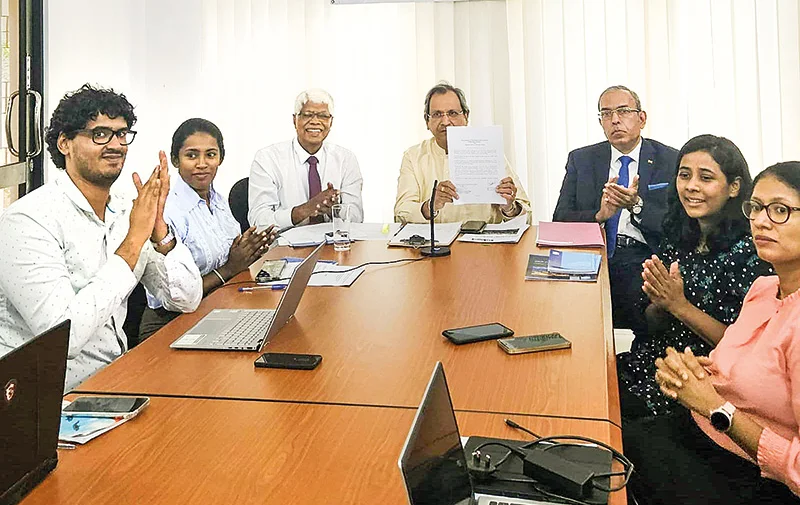
From the above viewpoints the Regional Centre for Strategic Studies (RCSS), Colombo did very well to tie-up with the South Asian University (SAU), India, to increase public awareness on the developmental problems affecting South Asia and for initiating a number collaborative measures that aim at ameliorating them. The relevant agreement was formalized in early September at the RCSS. The sealing of the pact took place under the aegis of SAU President Prof. K.K. Aggarwal and RCSS Executive Director Ambassador Ravinatha Aryasinha.
A press release issued by the organizations said the collaboration aims ‘to foster research networks, partnerships and collaborations for transformative change across South Asia.’ It also mentioned that the partnership marked the first agreement to be signed by SAU with an independent think tank in Sri Lanka.
Among other things, pacts such as the above are bold moves in the direction of fostering a spirit of intellectual independence in those areas of the South facing some of the stiffest developmental challenges. Rather than ‘import’ solutions to these challenges from outside the region, the SAU-RCSS initiative aims at fostering fresh approaches to evolving solutions to problems that are uniquely South Asian.
It is hoped that the SAU and RCSS initiative while leading a to a greater degree of Southern intellectual independence in the area of development thinking would also help in kick-starting the SAARC process all over again in a major way.
What ought to lend fresh urgency to the latter undertakings are fast-breaking current developments in international politics. It ought to be perceived by the most underdeveloped regions of the South that going forward their well being would matter least or not at all to the major powers of both East and West.
For example at the time of writing the foremost among US and Chinese political leaders are meeting in the US in what is made out to be a historic coming together of sorts to address issues of common concern. It is highly unlikely that the parties would be addressing the economic preoccupations of the least developed countries. The same goes for other states that matter from the East and West.
Essentially, the US and China would be looking at ways of strengthening business ties that matter majorly for them. The South and its issues would prove to be of peripheral interest, if at all they happen to matter to the protagonists. Such developments ought to be fresh reminders to the South and their collaborative organizations that there is no escaping self-help and joint solidarity.

PST: Old devil in new costume?

China backs Sri Lanka’s Non-aligned stance to counter regional pressures

Are religions getting redundant in the modern world?

‘The Bullet that Missed’

Four arrested with 62,100 narcotic pills in Kotahena

Police probe abduction and sexual abuse of 13-year-old girl at Galle Face

‘Dates have the highest sugar content to fight Coronavirus’

Sunday Island 27 December – Headlines

#SundayIsland 17th December – Headlines

Sunday Island – 28th March

Sunday Island Headlines – 21 March

Sunday Island – 21st February – Headlines
-

 News6 days ago
Shanakiyan urges urgent action over reported death sentence for Lankan in Saudi Arabia
-

 News7 days ago
Bid for Basil’s extradition nears final stage: Police
-

 News5 days ago
Namal Rajapaksa Buddhist gambit fails, bail denied
-

 Features5 days ago
Why the spelling Sri Lankan names in English vary
-

 Features5 days ago
Three bands, a new identity: Sri Lankan wolf snake recognised as distinct species
-

 Business5 days ago
SLIIT holds largest-ever convocation
-

 News5 days ago
Govt monitors reported Saudi death sentence – Foreign Ministry
-

 News5 days ago
Vehicle prices drop by up to Rs. 1 mn, says importers’ body