
Foreign News
What’s behind deaths at this year’s Hajj pilgrimage in Saudi Arabia?

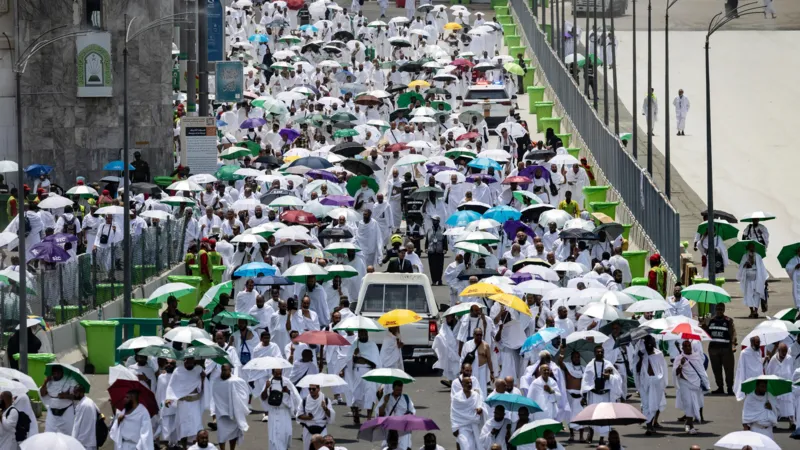
Hundreds of people are thought to have died during the Hajj pilgrimage in Saudi Arabia – most of them due to extreme heat as temperatures soared past 51C (123F).
AFP news agency quoted an Arab diplomat as saying 658 Egyptians had died. Indonesia said that more than 200 of its nationals had died. India said 98 people were known to have died.
Pakistan, Malaysia, Jordan, Iran, Senegal, Sudan and Iraq’s autonomous Kurdistan region have also confirmed deaths. The US believes a number of Americans died, the Wall Street Journal reported. Friends and relatives have been searching for those missing in hospitals and posting messages online.
The fallout from the number of deaths has been growing. On Saturday Egyptian Prime Minister Mostafa Madbouly stripped 16 tourism companies of their licences and referred their managers to prosecutors for enabling illegal pilgrimages to Mecca.
On Friday Jordan said it had detained several travel agents who facilitated the unofficial travel of Muslim pilgrims to Mecca. Meanwhile Tunisian President Kais Saied fired the minister of religious affairs after local media reported 49 Tunisians had died, many of whom were unregistered pilgrims.
Hajj is the annual pilgrimage made by Muslims to the holy city of Mecca. All Muslims who are financially and physically able must complete the pilgrimage at least once in their lifetime. About 1.8 million people have taken part this year, Saudi Arabia says.
More than half of those who died were unregistered pilgrims and joined the Hajj through irregular channels, leaving them unable to access cooling facilities such as air conditioned tents and buses, AFP reports.
Saudi Arabia has increased safety measures at the Hajj in recent years, but it still faces criticism for not doing enough, particularly for unregistered pilgrims. It has not yet commented publicly on the deaths.
However AFP quoted a senior Saudi official as saying 577 people had died on the two busiest days of Hajj alone – Saturday, when pilgrims prayed in the sun on Mount Arafat, and Sunday during the “stoning of the devil” ritual in Mina.
“This happened amid difficult weather conditions and a very harsh temperature,” the official said.
Here are some of the factors contributing to the deaths.
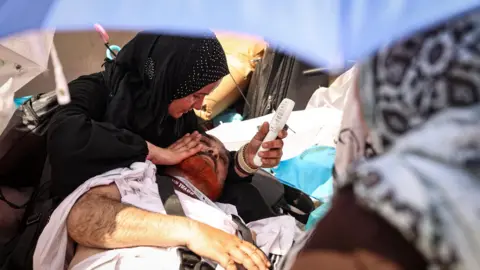
Unprecedented heatwaves in Saudi Arabia are believed to be a major factor behind the high death toll.
Despite warnings from the Saudi Health Ministry to avoid heat exposure and stay hydrated, many pilgrims fell victim to heat stress and heatstroke.
“It’s only by God’s mercy that I survived, because it was incredibly hot,” says Aisha Idris, a Nigerian pilgrim, speaking to BBC World Service’s Newsday.
“I had to use an umbrella and constantly douse myself with Zamzam water (holy water),” she said.
Another pilgrim, Naim, reportedly died from heatstroke, leaving her family searching for answers.
“Communication with my mother was suddenly cut off. We spent days searching, only to learn she had passed away during Hajj,” her son told BBC News Arabic, adding they would honour her wish to be buried in Mecca.
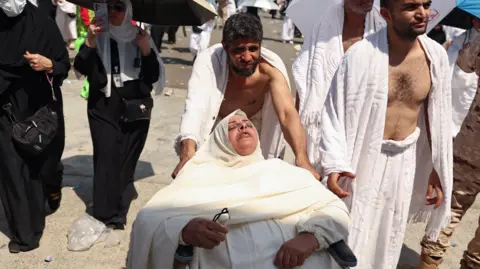
Pilgrims face risks due to the unfamiliar heat, strenuous physical activity, vast open spaces. Many are also elderly or unwell.
However, heat-related deaths during the Hajj are not new and have been recorded since the 1400s.
Scientists warn that global warming is due to make conditions worsen.
“The Hajj has operated in a hot climate for over a millennium, but the climate crisis is exacerbating these conditions,” said Carl-Friedrich Schleussner of Climate Analytics to the Reuters news agency.
His research suggests that with a 1.5C rise in global temperatures above pre-industrial levels, the risk of heatstroke during Hajj could increase up to five times.
According to several accounts, mismanagement by Saudi authorities exacerbated the extreme conditions, leading to a crisis in many areas designated for pilgrims.
They say accommodation and facilities were poorly managed, with overcrowded tents lacking adequate cooling and sanitation facilities.
Amina (not her real name), a 38-year-old from Islamabad, says: “There were no air conditioners in our tents in the heat of Mecca. The coolers that were installed did not have water most of the time.
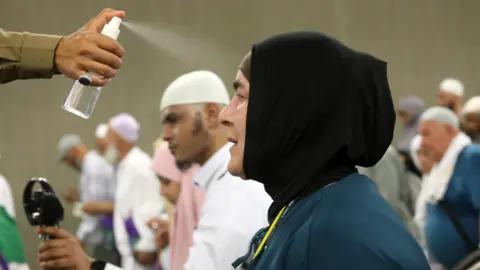
“There was so much suffocation in these tents that we were dripping with sweat and it was a dreadful experience,” she adds.
Fauziah, a pilgrim from Jakarta, agrees, saying, “Many fainted due to overcrowding and overheating in the tents.
She would welcome improvements but believes, “this is the best organization of the Hajj so far”.
However, the Saudi Health Minister has highlighted the resources allocated to ensure pilgrim well-being.
A government statement said they included 189 hospitals, health centres and mobile clinics with a combined capacity of more than 6,500 beds, and over 40,000 medical, technical, administrative staff and volunteers.
Pilgrims were often made to walk long distances in the intense heat, with some blaming roadblocks and poor management.
Muhammad Acha, a Hajj organizer for a private group said during the summer, a typical pilgrim may have to walk at least 15 kilometers per day. This exposes them to heatstroke, fatigue, and a lack of available water,
“This is my 18th Hajj, and in my experience, the Saudi controllers are not facilitators. They control, but they don’t help,” he said.
“In earlier years, the U-turns to access the tents were open, but now all those routes have been closed. As a result, an ordinary pilgrim, even if staying in a Category A tent in Zone I, has to walk 2.5 kilometers in the summer heat to reach their tent,” he explains.
“If there is an emergency on this route, no one will reach you for 30 minutes. There are no arrangements to save lives, nor are there water points along these paths,” Acha adds.

To perform Hajj, a pilgrim must apply for a special Hajj visa. But some individuals try to go on the five-day pilgrimage without the proper documentation, despite Saudi officials attempts to crack down.
Pilgrims without proper documentation often avoid authorities, even when they need help.
This issue of “unofficial Hajj” is believed to contribute to the excess deaths and authorities have blamed them for some of the overcrowding in tents.
“We suspect those using non-Hajj visas have infiltrated the Hajj areas”, says Mustolih Siradj, chairman of Indonesia’s National Hajj and Umrah Commission (Komnas Haji).
Saad Al-Qurashi, an adviser to the National Committee for Hajj and Umrah, tells the BBC: “Anyone who does not have a Hajj visa will not be tolerated and must return to their country.”
He notes that irregular pilgrims are identified using Nusuk cards, which are given to official pilgrims and contain a barcode for entry to holy sites.
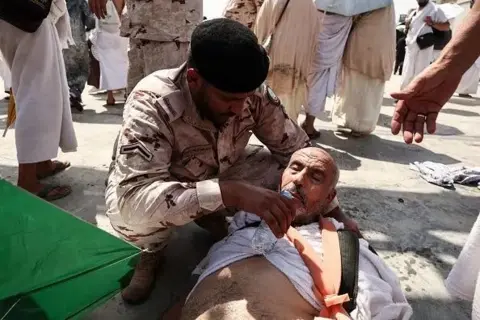
One reason there are may be many deaths every year at the Hajj is that many pilgrims go towards the end of their life, after saving for a lifetime.
Many Muslims also go in the hopes that if they die, it is during the Hajj – as it is considered to be a blessing to die and be buried in the holy city.
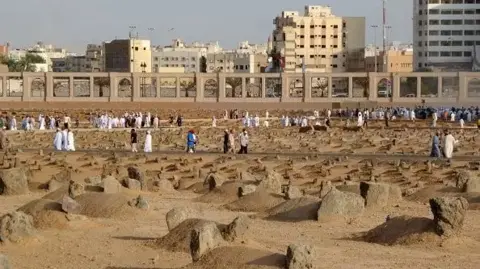
When a pilgrim dies while performing Hajj, the death is reported to the Hajj Mission. They use wristbands or neck IDs to confirm the identity. Afterwards, they get a doctor’s certificate, and Saudi Arabia issues a death certificate.
Funeral prayers happen at important mosques like Masjid al-Haram in Mecca or the Prophet’s Mosque in Medina, depending. The body is washed, wrapped, and moved in freezers provided by the Saudi government, who cover all costs.
Burials are simple, without markers, sometimes with many bodies in one place. The cemetery book lists who’s buried where, so families can visit graves if they want.
The Saudi government, with help from different groups and the Red Crescent, says it ensures “dignified and respectful burial processes”
[BBC]

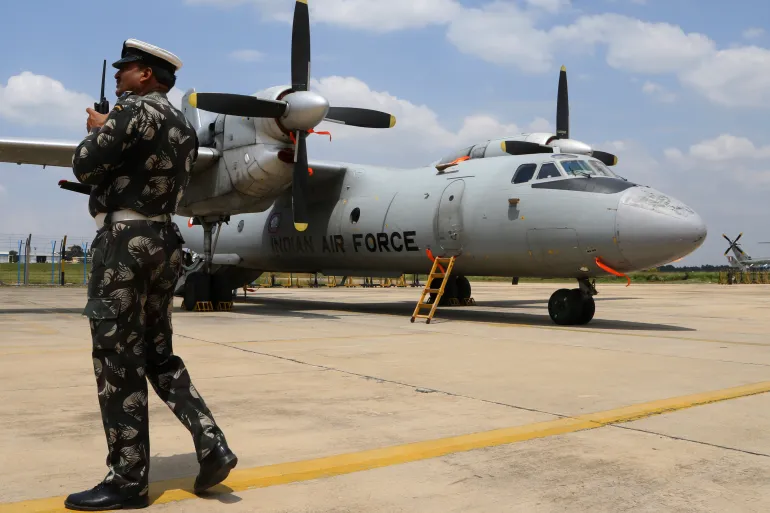
Five Indian air force personnel have been killed after the aircraft they were travelling in crashed in the northeastern Indian state of Assam, according to officials.
The Antonov An-32 transport plane “met with an accident” during a “routine sortie” in Assam’s Jorhat region, the Indian Air Force said in a statement on Saturday.
“Crash site management and initial enquiries are on at this time,” the Air Force wrote, adding that an investigation to determine the cause of the accident was under way.
News channel NDTV broadcast images of the crash site, showing a thick black plume of smoke and the aircraft apparently broken into pieces.
India’s air force operates a fleet of about 105 An-32 aircraft to transport people and cargo.
The last major crash involving a twin-engine turboprop took place in 2019 in Arunachal Pradesh state, near the border with China, when 13 people were killed
(Aljazeera)
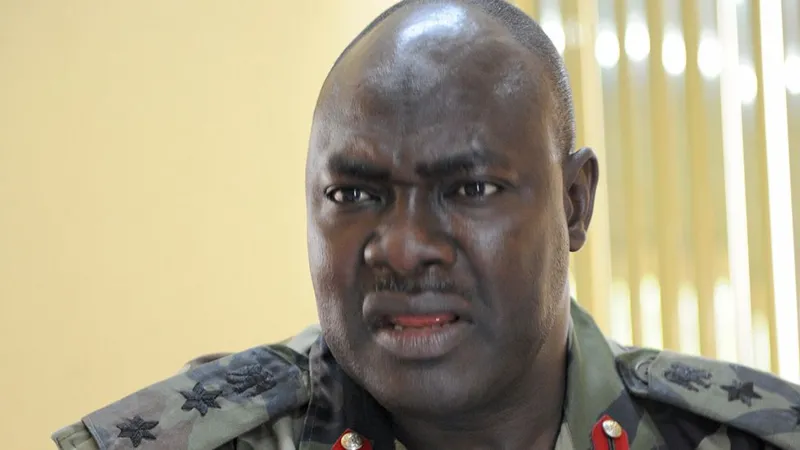
A retired Nigerian army general who had been kidnapped by gunmen in the country’s north-west has died while being held captive, the military has said.
Maj Gen Rabe Abubakar, who had a high-profile job as military spokesman between 2015 and 2017, was abducted with his wife while travelling in Katsina state last month.
No group has said it was behind the kidnappings.
The abduction and death of Abubakar highlights the continuing security challenges facing parts of north-west Nigeria, where criminal gangs known locally as “bandits” frequently carry out kidnappings for ransom, as well as cattle rustling and attacks on rural communities.
Some militant jihadists have also operated in the region. An alleged militant camp in Sokoto state was the target of a US airstrike on 25 December last year.
Katsina has been one of the states most affected by the violence.
Local media reported that the retired officer had been going to a wedding on 30 May when armed men attacked his vehicle and seized him, his wife and their driver.
Days before news of his death emerged, a video shared on social media appeared to show Abubakar in captivity. He was seen with an apparent injury to his left leg alongside his wife and other hostages.
The military said it chose not to comment publicly on the abduction while efforts to free those in captivity were being made.
“In deference to ongoing rescue efforts by security agencies, the Armed Forces withheld public comment while every operational resource was deployed in the hope of securing his safe return,” the statement said.
The whereabouts and condition of Abubakar’s wife remain unknown. But a military spokesman said that “ongoing operations have since been further intensified to bring perpetrators to justice and to dismantle all terrorist networks threatening our nation”.
The military paid tribute to the major general, who local media reported was 61 when he died, describing the loss as “tragic” and offered condolences to his family and former colleagues.
A statement said he made “immense contributions to counter-insurgency operations… His commitment to duty and to the unity of Nigeria remains a shining example for all personnel.”
[BBC]

A South Korean court has sentenced former President Yoon Suk Yeol to 30 years in jail for sending drones into North Korea.
Prosecutors argued that Yoon ordered the operation in October 2024 to provoke Pyongyang and create a pretext for his failed martial law bid later that year.
When Yoon declared martial law on 3 December, he had claimed he was protecting the country from “anti-state” forces that sympathised with North Korea. But it soon became clear he was driven by domestic troubles and he rolled back the order in the face of mass protests.
Yoon was impeached and is now serving time in prison after he was sentenced to life for insurrection over his botched martial law attempt.
On Friday, the Seoul District Court found Yoon, as well as his former defense minister Kim Yong-hyun, former head of the Defense Counterintelligence Command Yeo In-hyung and former head of Drone Operations Commands Kim Yong-dae guilty of treason and abuse of power.
Kim was sentenced to 30 years in jail, while Yeo received 15 years and Kim Yong-dae received three years in prison with a five-year suspended sentence.
“The defendants used the guise of a military operation to induce provocations from North Korea with the aim of creating a state of emergency,” the court said.
It added that all three officials had “provoked North Korea”, thus “increasing the risk of a military conflict”, but concluded that Yoon bore the “greatest responsibility” in this event.
Yoon’s lawyers had argued that his actions were a “legitimate” response to North Korea’s “provocations with rubbish balloons”.
This was a reference to North Korea dropping hundreds of balloons in 2024, which were later found to contain “filthy waste and trash”, across the border in the South.
The two countries have used such “propaganda balloons” in their campaigns since the Korean War, where messages are put inside the balloons.
But tensions shot up in 2024 when North Korea accused the South of flying drones into its capital. These drones allegedly scattered propaganda leaflets all over Pyongyang, in what the North described as a provocation that could lead to war.
It was Yoon who sent these drones into the North expecting it to strike back, said a judge in Friday’s ruling.
Apart from insurrection, Yoon has was also sentenced to five years in jail for abuse of power and obstructing his own arrest.
Yoon’s martial law attempt and the protests that followed created months of chaos in the country, ending in an election which saw the opposition Democratic Party’s Lee Jae-myung win a decisive mandate.
[BBC]

Showers will occur in the Western, Sabaragamuwa and North-western provinces and in Galle, Matara, Kandy and Nuwara-Eliya districts

Easter Sunday carnage: WR asks AG to question Dappula on ‘grand conspiracy’ claim

Beijing Capital Airlines to resume flights to Colombo signalling boost to tourism

Delegation of UN Subcommittee on Prevention of Torture here amidst protests against new anti-terrorism law

Jha underscores Indian package for upcountry region

New mediation law for smarter dispute resolution of civil and commercial disputes – I

‘Dates have the highest sugar content to fight Coronavirus’

Sunday Island 27 December – Headlines

#SundayIsland 17th December – Headlines

Sunday Island – 28th March

Sunday Island Headlines – 21 March

Sunday Island – 21st February – Headlines
-
 News4 days ago
CIABOC summons Yoshitha over his participation in British Navy training programme
-
 News6 days ago
Local firms move millions of dollars overseas for phantom imports: Govt.
-
 Midweek Review6 days ago
July 09: An inexcusable overall security failure and exceptional contingency plan
-

 News6 days ago
AI raises concerns over arrest of Sallay and rapper under PTA
-

 News3 days ago
Commonwealth lawyers urge Lanka to uphold rule of law
-

 Features2 days ago
Politics of protected species
-

 Sports1 day ago
Tharanga set for high-profile javelin clash in Ostrava
-

 News4 days ago
Justice Minister responds to social media claims he represented Easter Sunday ringleader