
Editorial
What an arrest!


Tuesday 20th October, 2020
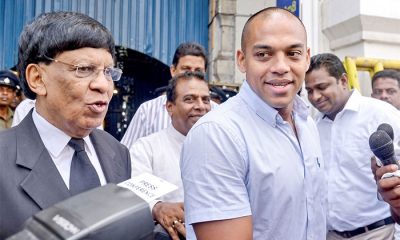
The police finally arrested All Ceylon Makkal Congress Leader and SJB MP Rishad Bathiudeen, wanted for allegedly misusing public funds. He was remanded. Having incurred much public opprobrium owing to the release of his young brother, Riyaj, who had been arrested, detained and interrogated on his alleged links to the Easter Sunday bombers, the government by allowing Bathiudeen to be arrested only made a virtue of necessity. It had the police refrain from making several arrests previously in defiance of the Attorney General’s orders. The police did not go all out to arrest Negombo Prison Chief Anuruddha Sampayo, Kurunegala Mayor Thushara Sanjeewa, former Finance Minister Ravi Karunanayake, Perpetual Treasuries owner Arjun Aloysius and several others. But for public resentment which caused some government MPs to call for action against the Bathiudeen brothers, the police would have thumbed their noses at the AG, again.
The manner in which the CID arrested Bathiudeen reminds us of the so-called ‘slow bicycle race’ at Avurudu sports festivals. In this contest, the slowest rider is adjudged the winner. The CID managed to make the slowest possible progress in its operation to arrest Bathiudeen until the eve of a crucial parliamentary debate on the 20th Amendment (20A). Bathiudeen can attend Parliament and vote while on remand.
The CID has also taken into custody several persons who harboured Bathiudeen, and legal action is to be instituted against them for that offence, we are told. There was no arrest warrant on Bathiudeen, but the police have rightly dealt with those who helped him go into hiding. In May, the Fort Magistrate’s Court issued an order for the immediate arrest of Karunanayake, Aloysius and others, but the CID did not make any serious effort to arrest them until they had their arrest warrants stayed by the Court of Appeal. Have the police identified those who harboured those suspects in spite of the Magistrate’s Court order? When they found it difficult to arrest the driver of former Minister Champika Ranawaka over a hit-and-run accident, they brought his wife and little daughter to Colombo, to pressure him to surrender, according to the suspect’s lawyers. When ordinary people happen to be on the wrong side of the law, the police act like Rambo, but when the wanted suspects are backed by powerful politicians they become mere ‘cardboard Sandows’.
What one gathers from the AG’s statements is that during the 2019 presidential election, the then Minister Bathiudeen and two of his officials—Project Director of the Ministry of Resettlement, Y. Samsudeen, and Project Accountant, A. Manoranjan—allegedly misappropriated public funds amounting to Rs. 9.5 million by misusing 222 state-owned buses to transport displaced voters from Puttalam to Mannar. Bathiudeen has allegedly committed offences under the Presidential Elections Act and the Offences against Public Property Act, the violation of which is a non-bailable offence.
Bathiudeen brought down the hurriedly formed Sirisena-Rajapaksa government, in 2018, by refusing to vote with it in Parliament. That administration crashed, unable to raise a simple majority in the House. This time around, Bathiudeen can give the present regime the kiss of death by voting for the 20A. If he and his four MPs vote for 20A, as expected, those who claim that he and the government have struck a secret deal will be vindicated. The only way the government can avert such a situation is to engineer the crossover of some other Opposition MPs so that it does not have to depend on Bathiudeen. It has reportedly succeeded in its endeavour, and how many MPs it has bought off can be seen when 20A is put to the vote on Thursday. It is only natural that the SJB is trying to prevent Parliament from convening today.
Meanwhile, it should be found out whether Bathiudeen helped the displaced voters exercise their franchise in a similar manner when he was a minister in the Mahinda Rajapaksa government. Did he use the state-owned buses to transport them from Puttalam to Mannar? If so, why was no action taken against him, then?


Wednesday 17th June, 2026
Some occupants of key positions in the public service unashamedly display their chameleon-like ability to adapt to changing political circumstances and please new leaders. They do not scruple to trade their professional dignity for expediency. So, it is not surprising that some police officers have chosen to be at the beck and call of powerful politicians, and the police go out of their way to further the interests of the powers that be. Their servility has stood in the way of efforts to depoliticise the police through constitutional safeguards.
Unsurprisingly, the police have resorted to legal action against some Opposition politicians who took up the cudgels for the rights of former State Intelligence Service Director Maj. Gen. (Retd.) Suresh Sallay in CID custody. If the CID had acted impartially and respected Sallay’s rights as a detainee, the need for protests would not have arisen. It was protests that prompted the CID to bite the bullet and rush Sallay to hospital. The Human Rights Commission of Sri Lanka (HRCSL) has reportedly expressed concern about the conditions of the detention cells at the CID headquarters.
Contrary to government claims, there have been no calls for Sallay’s release or an end to the ongoing police investigations into the Easter Sunday terror attacks. Everyone is of the view that the probe must go on and justice must be done to the carnage victims. Protests have been against the alleged ill-treatment of Sallay at the CID headquarters. Criticism of the suppression of the rights of detainees must not be misconstrued as efforts to undermine the judiciary.
Police action against the critics of the CID smacks of a sinister move to suppress democratic dissent. The incumbent government is apparently emulating the previous dispensations that resorted to draconian measures to silence dissent to consolidate their hold on power.
In a democracy, sovereignty resides in the people, who are the ultimate political authority, and they must not be denied their legitimate right to oppose the subjugation of the legal process to the political interests of the government in power. It is antithetical to democracy and amounts to an assault on the people’s freedom of expression for criticism of politically driven investigations and the abuse of suspects under the Prevention of Terrorism Act (PTA) to be framed as obstructions of the police or contempt of court.
The PTA allows the Defence Minister to order the detention of suspects arrested by police investigators to further the interests of his or her political party on some pretext or another. However, the abuse of the PTA is not of recent origin. There is hardly any law that has not been abused under successive governments, and the self-proclaimed campaigners for democracy and human rights, were abusers themselves, while in power.
The present-day UNP leaders who have condemned the alleged ill-treatment of Sallay fully endorsed numerous such violations, especially the arrest and prolonged detention of Vijaya Kumaratunga in a dark cell in the early 1980s. The JVP assassinated Kumaratunga a few years later.
The JVP vehemently opposed the PTA, politically driven investigations, etc., as it bore the brunt of repressive practices facilitated by the PTA. But the JVP-led NPP government has not only chosen to use the PTA to suppress dissent but also reached a new low; it has brought two of its active party members out of retirement and appointed them as the CID Director and Secretary to the Ministry of Public Security. Worse, it intimidates those who dare criticise the undemocratic actions of these officers and campaign for the rights of suspects in detention.
Now that the appalling conditions of the CID’s detention cells have come to light, pressure must be brought to bear on the government to take remedial action for the benefit of all suspects. Most of all, police officers loyal to the ruling party must not be allowed to subject detainees to cruel treatment in a bid to break their will and obtain confessions.
Tuesday 16th June, 2026
The world must have breathed a sigh of relief yesterday following the announcement that the US and Iran had agreed to sign a peace deal soon and begin negotiations in earnest to resolve contentious issues. The peace plan has renewed hope that no more lives will be lost due to military strikes in West Asia; precious assets, especially oil infrastructure, in that part of the world will be safe, and disruptions to global oil supplies will be over.
Interestingly, as US President Donald Trump turned 80, global oil prices which had shot up to extremely high levels, owing to his war on Iran, dropped to about USD 80 a barrel, the lowest since the eruption of the war in February. Upon the announcement of the US-Iran peace deal, WTI, the US oil benchmark, decreased to USD 80 a barrel, and the global oil benchmark, Brent crude, which was about USD 70 a barrel before the conflict and peaked at about USD 120 during the war, dropped to USD 83 a barrel. Share markets surged in Asia. These are very positive signs.
The US-Iran peace deal and the resultant oil price drops could not have come at a better time for developing nations, especially Sri Lanka, which is struggling to stabilise its rupee and shore up its forex reserves.
However, a return of global oil prices to the pre-conflict level of USD 70 a barrel may not be possible in the short term, given some factors, such as the lost production capacity in West Asia, strategic oil reserve replenishment and higher risk premium. The situation may improve sooner than expected if OPEC, the US, Canada, Brazil, etc., care to increase oil production and help stabilise the world energy market, thereby strengthening the global economy, which has shown signs of severe decline due the West Asian conflict.
US President Donald Trump pretends that he has done Iran a big favour by agreeing to a peace deal. However, Trump has apparently made a virtue of necessity. It was difficult for him to go on fighting, particularly in view of the passage of a crucial War Powers bill. Besides, US Vice President J. D. Vance, in an interview with Fox News, has said, inter alia, that Americans were facing economic hardships due to the Iran war; he has expressed hope that energy prices will start coming down shortly much to their relief. This shows that the Trump administration was also badly in need of a peace deal.
The US-Iran peace deal to be signed has been described in some quarters as a birthday gift for Trump. It must have gladdened his heart beyond measure, for his approval rating has plummeted due to his handling of the economy and the Iran war, and his Grand Old Party is expected to perform poorly at the midterm elections in November. One may recall that General Sherman, after completing his March to the Sea, famously “presented” the city of Savannah, the Confederacy’s most important port, as a Christmas gift to President Lincoln, in December 1864. Trump may have expected his military commanders to do likewise and present something like Iran’s Kharg Island to him as a birthday gift, but his plans went awry owing to Iran’s fierce resistance, with Tehran effectively shifting the war to the economic front by using the Hormuz Strait as a strategic lever. So, Trump apparently had to settle for a peace deal as a birthday gift, so to speak.
Israeli Prime Minister Benjamin Netanyahu is obviously not well-disposed towards the peace deal to be inked. He was dependent on the Iran war for political survival. His opponents are closing ranks, and he has court cases to contend with. So, if he carries out attacks on Hezbollah targets again, as speculated in international defence circles, Iran may be compelled to respond, maybe by closing the Hormuz Strait again. In the world of cloak-and-dagger geopolitics, anything is possible. It is up to Trump to ensure that his friend behaves.
World powers have welcomed the peace deal to be signed and praised the US, Iran and Pakistan, which made it possible. They themselves have been reeling from the knock-on economic effects of the West Asian conflict, and it will be in their best interest to do everything in their power to ensure that the peace deal will reach fruition and the Iran war will be a thing of the past.


Monday 15th June, 2026
Sri Lanka apparently has more than its fair share of extreme weather events, ranging from floods to droughts and now the disruptive effects of a mega climate anomaly. The World Meteorological Organization (WMO) has warned that due to unusually warm ocean waters in the tropical Pacific, El Niño conditions are developing fast, and they are expected to drive more extreme temperature and rainfall patterns in the coming months. Sri Lanka is among the countries that are expected to suffer the severest impact of this phenomenon.
Some climate experts have suggested that Sri Lanka may not experience a severe El Niño impact. However, it is prudent to prepare for the worst-case scenario.
The WMO has stressed that the time for informed decision-making, planning and preparedness is now. “The science is clear: El Niño is arriving on our doorstep in the coming months with 90% certainty. The world must treat it as the urgent climate warning it is,” UN Secretary-General António Guterres has said. The world has experienced El Niño events for many years and therefore knows what it is like to face them. However, the question is whether such warnings will jolt Sri Lanka into taking urgent action to mitigate the impact of El Niño, which will deal a double whammy, with floods and droughts affecting different parts of the country simultaneously.
Sri Lanka has earned notoriety for ignoring and failing to respond to crises and disasters swiftly. One may recall that in December 2004, nobody sensed danger on seeing the eerie drawback of the sea minutes before the landfall of the Boxing Day tsunami. Thousands of lives were lost as a result. There were quite a few warnings of the impending Easter Sunday terror attacks in 2019, but nobody cared to take preventive action. Many experts warned of a crippling economic crisis in 2022, but no action was taken to prevent it. So, fear being expressed in some quarters that nothing serious is likely to be done by way of disaster risk reduction in view of El Niño is not unfounded. Last year, Cyclone Ditwah caught the incumbent government unprepared and overwhelmed the state disaster response system initially. The impact of El Niño is expected to be far severer as it will last for months.
The first casualty of El Niño is agriculture dependent on monsoon rainfall. Most countries affected by El Niño-driven droughts and floods face crop losses in multiple seasons and the resultant prolonged food shortages have the potential to lead to political upheavals. A possible increase in food imports is bound to worsen Sri Lanka’s foreign currency woes. Perhaps, many countries will be compelled to restrict agricultural exports. There’s the rub. Hence, agricultural experts have called for a climate-smart home gardening initiative to meet such an eventuality.
The impact of El Niño usually spreads to other sectors, such as power and energy. The use of substandard coal has caused a sharp decline in power generation at Norochcholai. If reservoir levels recede steeply, decreasing the country’s hydro power capacity drastically, it will not be possible to meet the Norochcholai generation shortfall by burning diesel, etc., due to the cost factor and forex constraints. Shortages of power, energy and water take their toll on the industrial sector and impede economic growth. Beyond economic losses, El Niño entails broader social costs such as poverty, disease outbreaks and disruptions to education.
The JVP-NPP government would have the public believe that it has a well-thought-out plan to mitigate the severe impact of El Niño by focusing on water conservation, climate-resilient agriculture, food and energy security while strengthening disaster preparedness. The Food Policy and Security Committee, appointed by the government, has reportedly discussed ways and means of mitigating the impact of El Niño with particular focus on agriculture, water storage and drinking water supplies. The proof of the pudding is said to be in the eating. One can only hope that the government will succeed in this endeavour and all other stakeholders will put their shoulders to the wheel.

Hundreds of cats stolen for food in Vietnam rescued by police, welfare group says

Canada-Netherlands ODI abandoned due to dangerous pitch in Toronto

Da Silva and Jangoo earn recalls for West Indies’ Tests against Sri Lanka

Spinners make it two in two for England

Messi hat-trick fires holders Argentina to win over Algeria at World Cup

UNDP, Central Bank deepen financial literacy drive to build economic resilience

‘Dates have the highest sugar content to fight Coronavirus’

Sunday Island 27 December – Headlines

#SundayIsland 17th December – Headlines

Sunday Island – 28th March

Sunday Island Headlines – 21 March

Sunday Island – 21st February – Headlines
-
 News5 days ago
CIABOC summons Yoshitha over his participation in British Navy training programme
-

 Sports2 days ago
Tharanga set for high-profile javelin clash in Ostrava
-

 News5 days ago
Justice Minister responds to social media claims he represented Easter Sunday ringleader
-

 Features3 days ago
Politics of protected species
-

 News4 days ago
Commonwealth lawyers urge Lanka to uphold rule of law
-

 News2 days ago
Release of 2025 O/L results likely to be delayed
-

 News2 days ago
Theft of USD 2.5 mn from Treasury: CoPF accused of complicity in NPP cover-up
-

 News1 day ago
Beijing Capital Airlines to resume flights to Colombo signalling boost to tourism