
Latest News
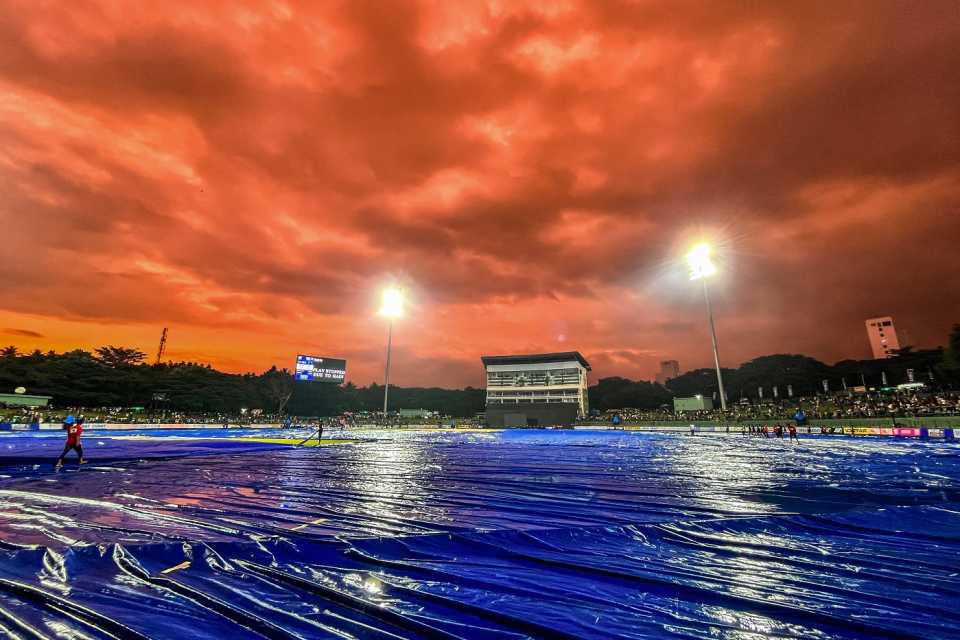
Wet balls contribute to West Indies’ defeat in Pallekele

West Indies have been unhappy with the state of the pitches in Sri Lanka. After their 2-1 defeat in the T20I series in Dambulla, coach Daren Sammy went as far as to claim a ‘moral victory ‘ for West Indies, for having supposedly pushed Sri Lanka into producing turning tracks for games two and three.
In the first ODI, West Indies didn’t just get another dry surface, the weather in Pallekele also conspired against them. Having won the toss and batted first, the rains coming through in the 39th over of the West Indies innings could barely have affected them worse.
Not only did the interruption last long enough to ensure that Sri Lanka’s bowlers – who had had dry conditions to operate in before the weather arrived – did not have to bowl with a wet ball. It also meant West Indies had to contend with a slippery ball right through the second innings – something Sri Lanka captain Charith Asalanka noted as a factor in his team’s victory in the post-match presentation.
After the game, Nishan Madushka, who hit 69 off 54 balls on ODI debut, and was part of a match-winning 137-run partnership with Asalanka, reiterated this.
“Their bowlers were really good, but because of the rain around, I think they had trouble gripping the ball,” he said. “There was less turn on the wicket too, to be honest. But they still bowled well. ”
In fact, when West Indies still had the new balls (they use one ball at either end in ODIs) and they had not yet become especially damp, their bowlers had dominated. Sri Lanka lost three wickets inside the first seven overs, before Madushka and Asalanka produced their big fourth-wicket stand.
During that partnership, the batters repeatedly hit the balls over the boundary and into areas of the ground and drainage areas that were waterlogged, thereby substantially changing the condition of the ball. In fact, West Indies’ bowlers brought this to the umpires’ attention at least twice, but were not successful in having the balls changed for drier ones.
Part of Sri Lanka’s strategy at 45 for 3 may have been to hang around until bowling became significantly more difficult. “What Charith aiya said was to take the game as deep as possible – to start with dragging the game to 20 or 25 overs, before we reassess,” Madushka said. “I think that positive mindset affected me positively as well, and helped me perform.”
With the two remaining ODIs also to be played in Pallekele, a notoriously wet venue, conditions may continue to play a significant role in the outcome. So far this tour, from West Indies’ perspective, they are the side that has been at a substantial disadvantage.
(Cricinfo)


Russia and China have criticised the US and Israeli attacks on Iran, with Moscow saying it had seen no evidence that Tehran was developing nuclear weapons, and Beijing demanding an immediate halt to the joint attacks.
Chinese Minister of Foreign Affairs Wang Yi told his Israeli counterpart, Gideon Saar, on Tuesday that the attack on Iran came as negotiations between Washington and Tehran had “made significant progress, including addressing Israel’s security concerns”, China’s Foreign Ministry said in a statement.
“Regrettably, this process has been interrupted by military action. China opposes any military strikes launched by Israel and the US against Iran,” Wang told the Israeli foreign minister during a phone call, according to the ministry.
“China calls for an immediate cessation of military operations to prevent the further escalation and loss of control of the conflict,” Wang said.
“Force cannot truly solve problems; instead, it will bring new problems and serious long-term consequences,” he added.
According to the Chinese Foreign Ministry, Saar agreed to a request from Wang to take “concrete measures to ensure the safety of Chinese personnel and institutions” in Iran.
The call on Tuesday with Israel and Beijing’s apparent efforts to stabilise the spiralling regional situation followed calls Wang made on Monday to discuss the conflict with the foreign ministers of Iran, Oman and France.
Russian Foreign Minister Sergey Lavrov also criticised the US and Israel on Tuesday, saying their war on Iran could lead to the very outcome they claimed they wanted to prevent: nuclear proliferation.
Lavrov told a news conference that the logical consequence of the US and Israel’s actions could be that “forces will emerge in Iran… in favour of doing exactly what the Americans want to avoid – acquiring a nuclear bomb”.
“Because the US doesn’t attack those who have nuclear bombs,” Lavrov said.
Lavrov also said that Arab countries could now join the race to acquire nuclear weapons, given the experience of recent days and “the nuclear proliferation problem will begin to spiral out of control”.
Israel is widely seen as the Middle East region’s only nuclear-armed state, which it neither confirms nor denies.
“The seemingly paradoxical declared noble goal of starting a war to prevent the proliferation of nuclear weapons could stimulate completely opposite trends,” he said.
Lavrov, who said that Moscow had still seen no evidence that Iran was developing nuclear weapons, spoke with his Iranian counterpart, Abbas Araghchi, on Tuesday, and said that Russia stood ready to help find a diplomatic solution to the conflict, while rejecting the US and Israel’s use of “unprovoked military aggression” in the region.
As the US and Israel launched their first strikes on Iran on Saturday, Russia’s Foreign Ministry accused the close allies of carrying out a “premeditated and unprovoked act of armed aggression against a sovereign and independent UN member state”.
The two countries had hidden their true intention of regime change in Tehran “under the cover” of negotiations to normalise relations with Iran, the ministry said.
The US and Israel were “swiftly pushing the region toward a humanitarian, economic, and potentially even radiological disaster”, the ministry warned.
“Responsibility for the negative consequences of this manmade crisis, including an unpredictable chain reaction and spiralling violence, lies entirely with them,” the statement added.
Russia has faced its own accusations of aggression against a sovereign state after it launched a full-scale invasion of Ukraine, a war now in its fifth year.
[Aljazeera]

The Department of Immigration and Emmigration has decided effective from 28th February 2026, to grant a free fourteen (14) day visa extension to all tourists who are unable to leave Sri Lanka due to flight cancellations. 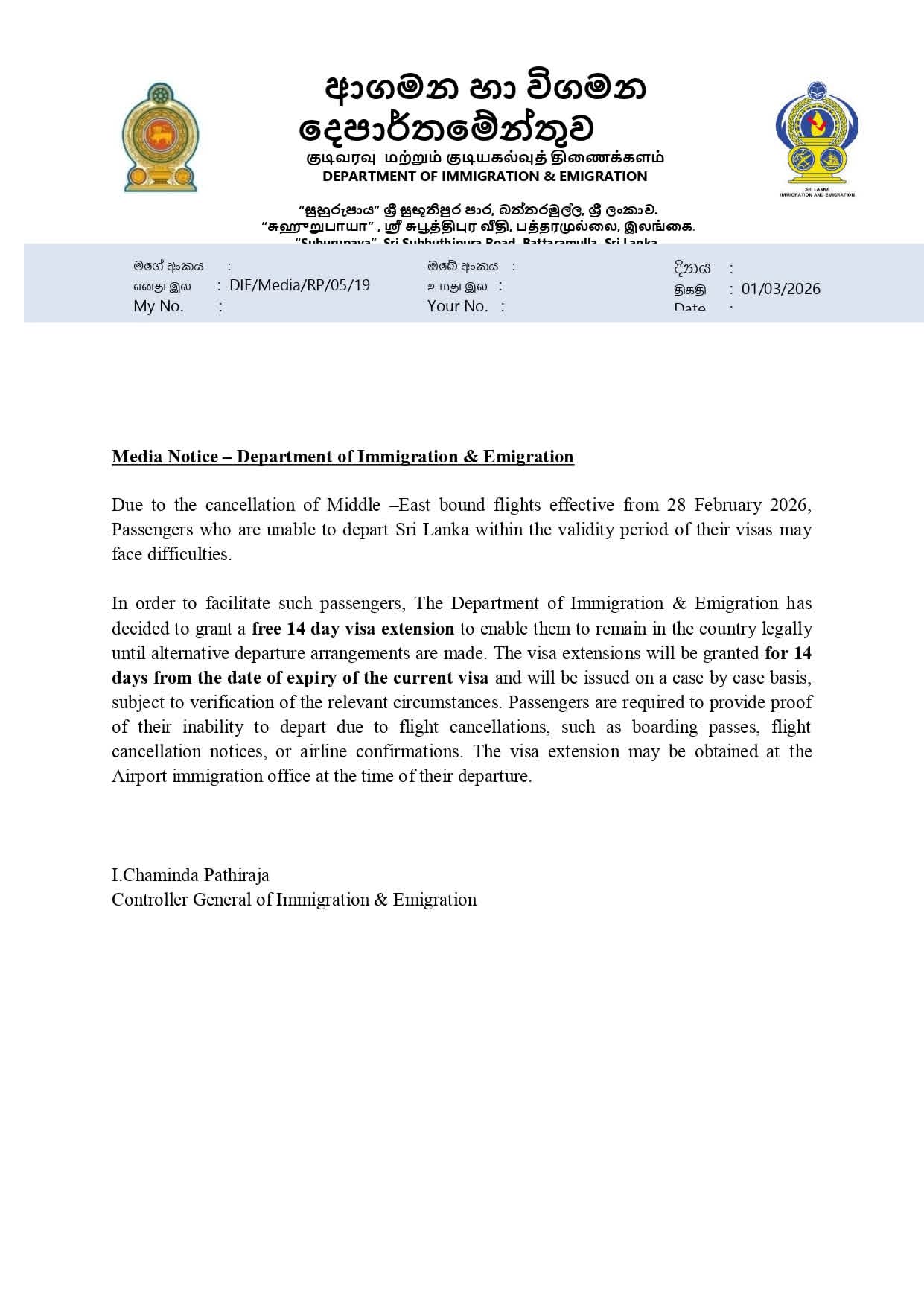

US and Israel’s bombardment of Iran and Lebanon continues, with a strike on a hotel near Beirut and the building of the Assembly of Experts in the Iranian city of Qom as the death toll surpasses 800 in both countries.
Tehran continues retaliatory attacks on Israel and US targets in the Middle East for a fourth night, with strikes reported on Washington’s embassy in Dubai and a port in the city of Fujairah in the United Arab Emirates.
US President Donald Trump says the US is prepared to deploy the navy to escort tankers through the Strait of Hormuz after Iran declared the vital waterway closed – a disruption already rippling through the region, with Iraq slowing or halting oil production at the Rumaila field and the West Qurna 2 project.
[Aljazeera]

Russia, China raise diplomatic voices against US-Israeli attacks on Iran

Financial allocations for the development of infrastructure in provincial schools have been provided to all provinces – PM

Free 14 day visa extension for visitors unable to depart Sri Lanka

US embassy in Dubai hit; Israel pounds Tehran, Beirut

Perera, Sugandika, Ranaweera take Sri Lanka to T20I series win over West Indies

Maldives Coast Guard Ship Huravee arrives in Colombo

‘Dates have the highest sugar content to fight Coronavirus’

Sunday Island 27 December – Headlines

#SundayIsland 17th December – Headlines

Sunday Island – 28th March

Sunday Island Headlines – 21 March

Sunday Island – 21st February – Headlines
-

 Opinion5 days ago
Jamming and re-setting the world: What is the role of Donald Trump?
-
 Features2 days ago
Brilliant Navy officer no more
-

 Features5 days ago
An innocent bystander or a passive onlooker?
-
 Features6 days ago
Ratmalana Airport: The Truth, The Whole Truth, And Nothing But The Truth
-

 Opinion2 days ago
Sri Lanka – world’s worst facilities for cricket fans
-

 Business6 days ago
IRCSL transforms Sri Lanka’s insurance industry with first-ever Centralized Insurance Data Repository
-

 Business5 days ago
An efficacious strategy to boost exports of Sri Lanka in medium term
-

 Features3 days ago
Overseas visits to drum up foreign assistance for Sri Lanka